

What Roland-Garros Inherited from Central Africa
Whenever I tell people I was born and raised in Cameroon, the first thing they bring up is the football. The Indomitable Lions. Roger Milla dancing at the corner flag in 1990. Samuel Eto’o at Barcelona, scoring goals against teams whose names we learned to pronounce just for him. The 1990 World Cup quarter-final against England, which we lost in extra time and never stopped talking about. Senegal reached the same round in 2002. Ghana followed in 2010. Morocco went one further in 2022 and made the semi-final, the deepest run any African team has ever managed at a men’s World Cup. I did not love football as a child. I learned to. There is no real way to live in Cameroon during a major tournament without being absorbed into the national mood.
We did not watch tennis. Roland-Garros, when I was growing up, was a thing that happened on television in May and June, between cooking and other lives. It was not for us. Nobody I knew watched tennis. Except, as it turned out, my aunt.
I moved to the United States as a teenager and ended up living with her. She is a nurse. The television in her house was permanently on whatever channel was showing Serena Williams. There was a kind of devotion in it. She caught the matches between shifts, late at night, before her early shift the next day. Serena was Serena, and my aunt was completely undone every time she walked on a court. The fearlessness mostly. Also the scream. Mostly, I think, the fact of her. A Black woman moving through the most genteel sport in the world with the kind of ease that suggested she had not been told the sport was supposed to be genteel.
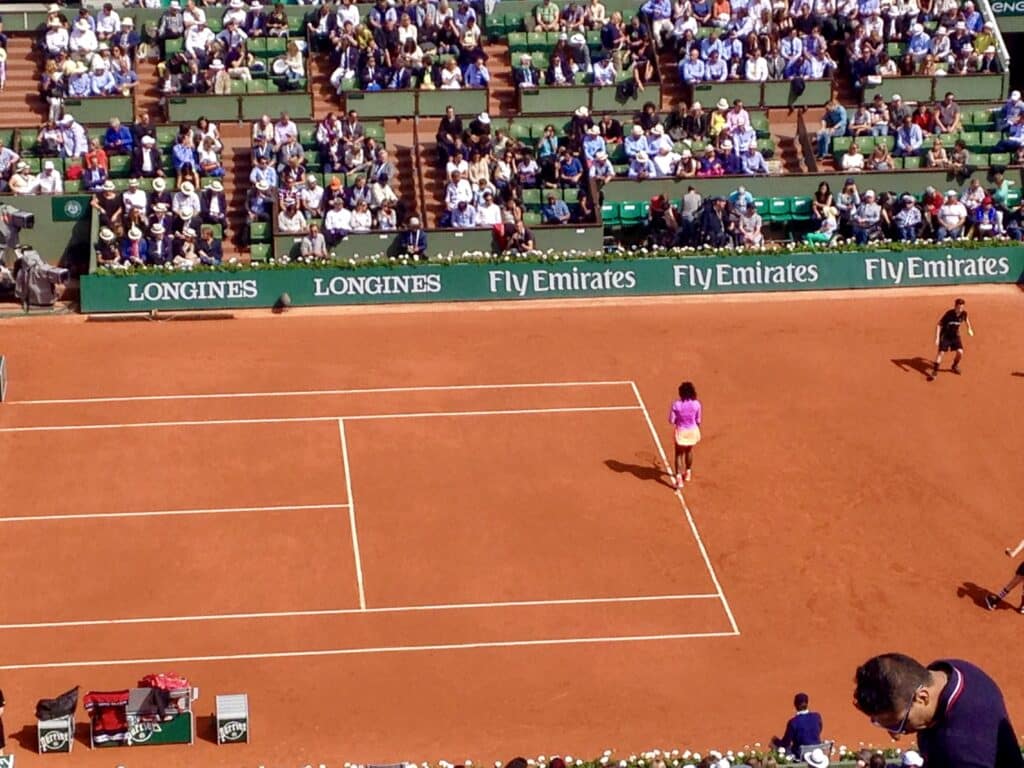
I started watching with her. In the summer of 2013 I had foot surgery for an injury I picked up playing football, the soccer kind, and was bedridden for most of June. Between watching grown men cry on red clay and listening to my aunt explain why Serena was about to do something terrifying to her next opponent, I went looking up Yannick Noah, who I knew was Cameroonian and a tennis player but not much else. He turned out to be one of the most consequential things Cameroon has ever exported, and nobody had told me. I felt the way you feel when a relative has done something significant and the world informed you before your own family did.
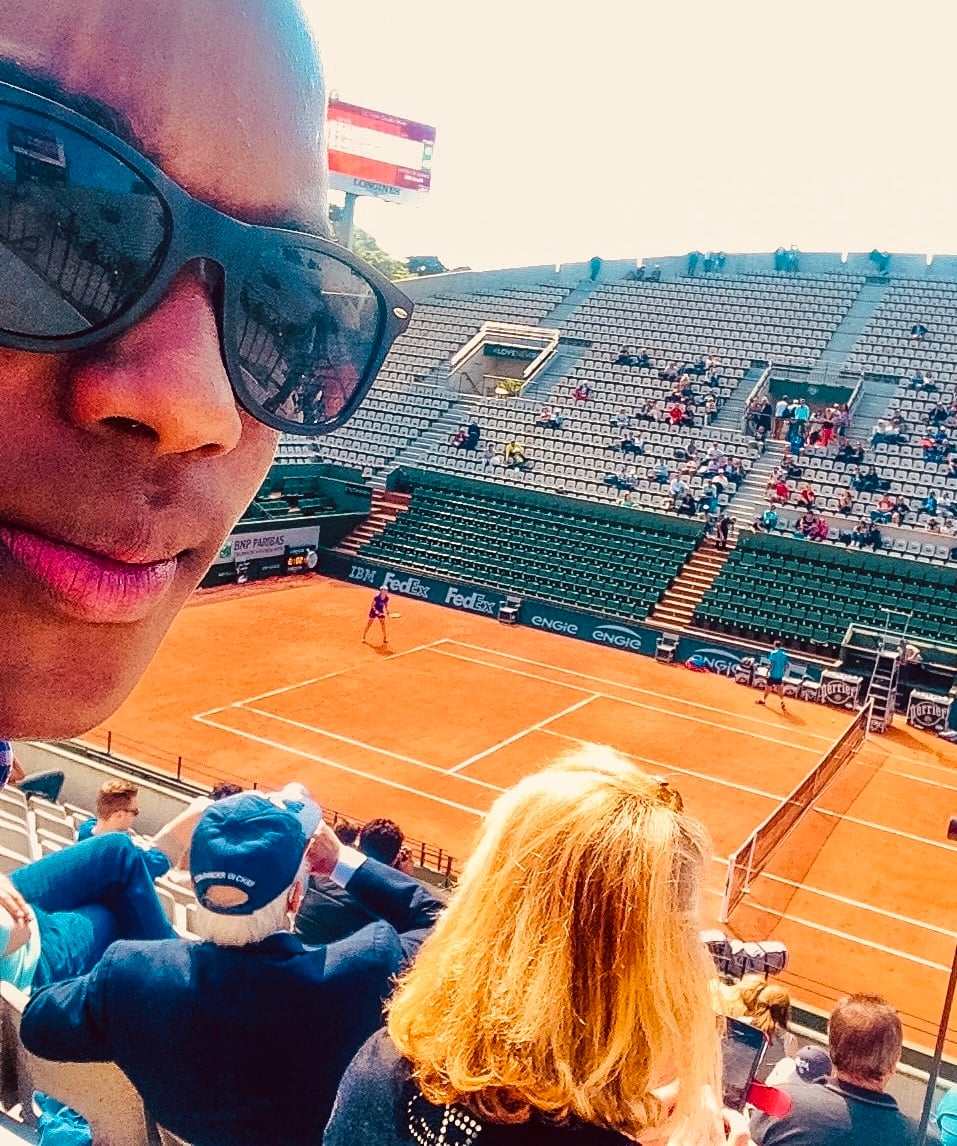
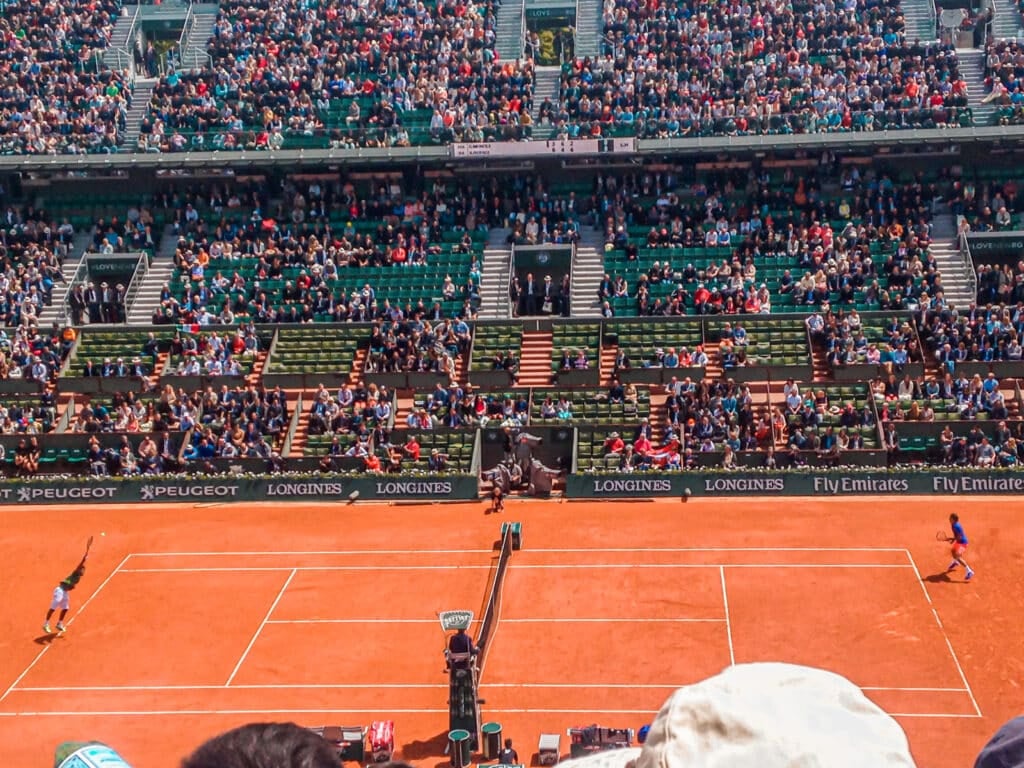
Two years later, partly to fix this, I went to Paris. I picked the study-abroad program at Stanford that would put me there during Roland-Garros. I got tickets to the show courts including Philippe-Chatrier and arranged my schedule so I was on the grounds nearly every day. I read every page about 1983. I came home convinced that the story of how a Cameroonian boy ended up holding up the Coupe des Mousquetaires in Paris was bigger and stranger than the story France had been telling about itself for forty years.
This is that story. It begins, like most things Cameroonians eventually export, with someone leaving home.
It is 5 June 1983, late afternoon, Court Philippe-Chatrier. Paris is loud, sunstruck, slightly beside itself. Yannick Noah has just beaten the defending champion, Mats Wilander, in straight sets, 6-2, 7-5, 7-6, to become the first French man in thirty-seven years to win the home Slam. Wilander was eighteen and the betting favorite. The year before, at seventeen, he had become the youngest men’s champion in the tournament’s history. Noah, six years older and seeded sixth, was the underdog. He drops his racket, drops to his knees, lifts himself again, and then his father Zacharie comes onto the court. Not politely. Not ceremonially. He comes on like a man who has been waiting years for permission to walk into his own story.
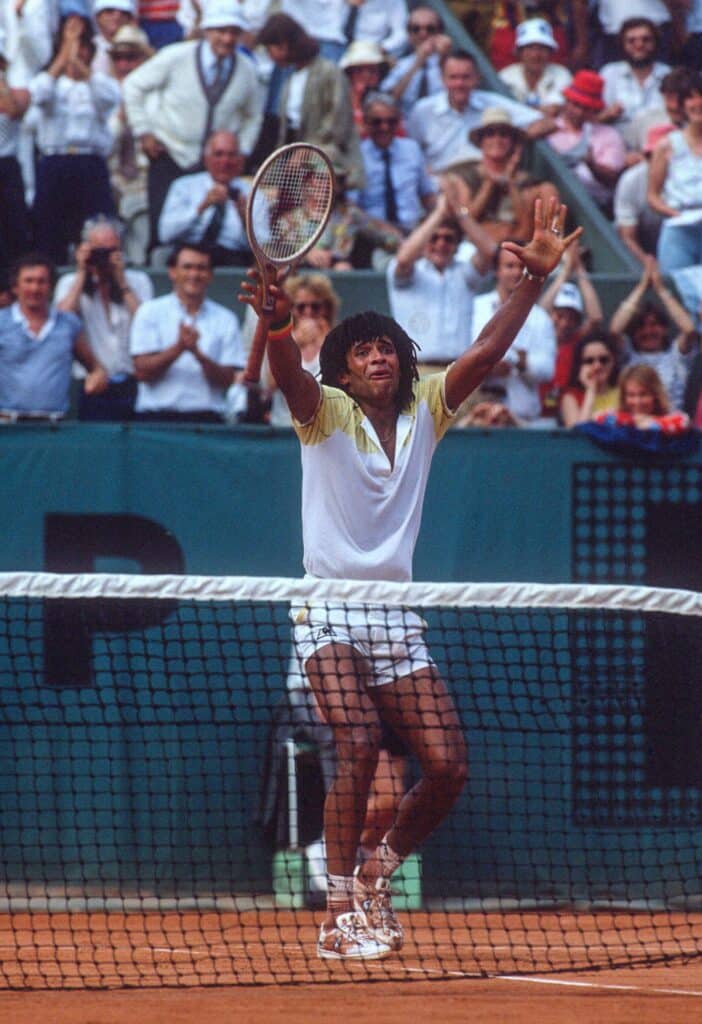
There are sports photographs that survive because of the score. There are others that survive because the people in them seem to forget the camera. Noah falling into his father’s arms belongs to the second kind.
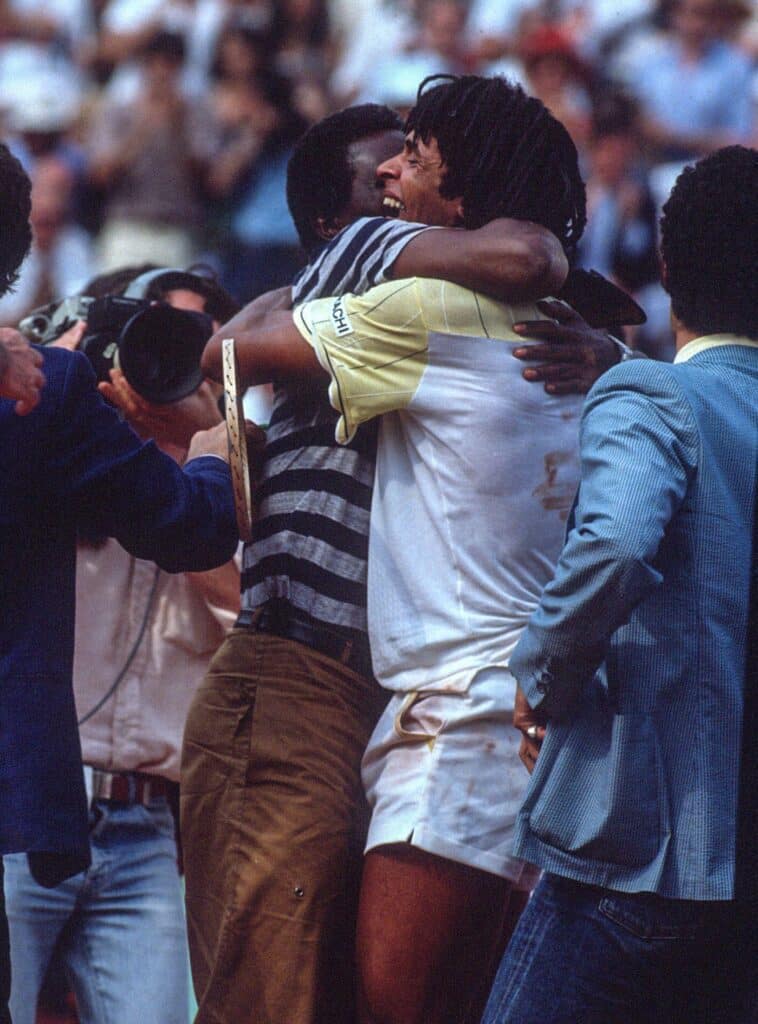
The federation handed Noah a microphone, which it had never done before for a men’s champion. He thanks, in this order: the people he played with, the gardeners, the people who maintained the courts, the federation, his coach Patrice Hagelauer, his family, and a country he calls his second one. The second country is Cameroon. Forty-three years later, the embrace photograph is still in heavy rotation every May. The thank-you list is mostly forgotten. The thank-you list is the more interesting document.
This essay publishes on a Sunday in May. Tomorrow is Yannick Noah’s sixty-sixth birthday, and the opening day of qualifying for Roland-Garros 2026. The federation has scheduled a tribute exhibition to Gaël Monfils on Court Philippe-Chatrier for Thursday, four days from now. Somewhere on a back court between tomorrow and Thursday, a sixteen-year-old French boy whose grandparents were born somewhere between Yaoundé, Brazzaville, Pointe-à-Pitre and Port-au-Prince is hitting balls with the kind of seriousness reserved for people who have not yet been seen.
This essay is about that boy. It is also about why, four decades after the embrace, French tennis is still telling the same story about the same afternoon, while the institution that benefits from the story has not, in the meantime, built the machinery that produced it.
The boy Ashe saw
The story of Arthur Ashe meeting Yannick Noah in Yaoundé is usually told as a fairytale, and like most fairytales it tidies up the working machinery underneath.
Ashe and Charlie Pasarell were on a private tennis tour through Africa in February 1971, traveling with Tom Okker and Marty Riessen. Ashe later clarified, in a 1978 Washington Post interview, that this was his second African trip and was not, in fact, a State Department tour as it is often described. The tour stopped in Yaoundé to put on a tennis clinic and exhibition match with local players. Cameroon at the time had eight tennis courts in the entire country. Noah was eleven, the smallest boy invited to hit on court that day. The others were fifteen and sixteen. He had taught himself to play with a wooden board his father had cut into the rough shape of a racket, since rackets in 1971 cost about two months of his parents’ income. Ashe asked the organisers to let the youngest one play. Noah hit clean returns. Ashe walked off court and gave him his own Head racket.
That part is the photograph. The infrastructure is the next part.
After the exhibition, Ashe placed a call to Philippe Chatrier, then president of the French Tennis Federation. The result of that call was that Noah was offered a place at the FFT training centre in Nice the following autumn. He was eleven. He arrived alone. His mother Marie-Claire Échalier-Perrier had been captain of the French national women’s basketball team; she would eventually move to Nice with his sisters. His father Zacharie, who had won the Coupe de France with Sedan in 1961 before injury sent him home to Cameroon in 1963, stayed in Yaoundé.
What Ashe gave Noah in 1971 was not inspiration. Inspiration is everywhere. The world is full of children who are good at things nobody knows how to carry. What Ashe gave Noah was conversion. He turned being seen into a route. He picked up the phone.
An American Black tennis player on a private exhibition tour identified a small mixed-race child in a former French colony and routed him into the metropolitan French training system through one relationship with one federation president. Forty-five years later, no comparable pipeline exists. There is no institutional version of that February afternoon. There is no FFT scouting programme in the West African capitals where Cameroon’s eight tennis courts have multiplied, modestly, into perhaps a few dozen courts spread across the region.
Tennis prefers to remember Ashe seeing Noah as an act of vision. It was that. It was also a phone call. The phone call has not been institutionalised.
Two years before he won, William Klein caught Noah inside the Roland-Garros machine before the machine knew what he would become. The French, Klein’s 1981 documentary, has the locker rooms and the massage tables and the television booths and the wood rackets and the cigarette smoke, all the old glamour and absurdity of elite tennis. Noah is twenty-one in it, on the trainer’s table, talking about his own foot injuries with the kind of candour no modern athlete’s media training would permit. Ashe is there too, in the commentary corridors, ten years after Yaoundé and two years before Noah’s win. Klein never makes the connection explicit. The title now reads like a dare. The French. Who gets to belong inside that phrase. The film does not answer. Two years later, Noah did.
Africa as backdrop
Tennis has been to Africa many times since 1971. It usually arrives in evening dress.
In February 2020, Roger Federer and Rafael Nadal played the Match in Africa at Cape Town Stadium, the first edition of Federer’s exhibition series ever staged on African soil. The five preceding editions, dating back to 2010, had been held in Switzerland, Spain and the United States, with proceeds directed to African schools through the Roger Federer Foundation. The foundation’s focus is early childhood education across six southern African countries, more than three million children reached through over 13,000 schools. Its work is about schools, not about tennis. The “Africa” in Match for Africa was the destination of the money, not the location of the event.
None of this is bad. Children’s education matters. The Federer Foundation is a serious, multi-decade project. The Match in Africa was a lovely night. It is just not infrastructure.
A sold-out stadium in Cape Town does not, by itself, build a pipeline from Yaoundé, Dakar, Accra, Nairobi, Abidjan, Lagos or Douala into the professional game. It does not produce a network of elite coaches, competitive tournaments, sports medicine, sponsors, visas, ranking opportunities and federations willing to treat African talent as central rather than decorative.
What Ashe did in Yaoundé in 1971 fits none of these categories. He was not raising money. He was not promoting a foundation. He was watching the youngest boy on the court and deciding he was worth the call.
What was asked of a child
The triumphant version moves quickly. Yaoundé to Nice, training to glory, the highlight reel. Real life has more luggage.
Noah’s first months in Nice were lonely. He was the smallest in the pension and the only Black boy in it. The older boys took his chocolates. He has talked, over the years, about the strangeness of suddenly being elsewhere, of being eleven and having his life reorganised around forehands. He came home to Yaoundé for Christmas in tears and did not want to return. His father told him to be patient and to grow, and he grew. By his fourteenth year he was taller than the boys who had bullied him. He taught himself English from records in the pension. He kept playing.
His mother and sisters eventually moved from Cameroon to Nice, which closed part of the distance. His father stayed. Zacharie was building a life back in Yaoundé, and there is no version of the Noah story in which the family fully reunites on one continent. For forty-six years, from Yannick’s arrival in Nice in 1971 to Zacharie’s death in January 2017, the Noahs lived split across two countries.
The most consequential French sporting family of the past half-century has always also been a Cameroonian family that has done part of its living somewhere else.
Noah told Sports Illustrated in 1980 that the Cameroonian federation had not really helped him as a child because his mother was white, and that he felt no obligation to a race or a country. He was twenty when he said it. The trophy was still three years away, and he was already declining to be claimed by anyone.
The embrace in 1983 is real. So is what came before it.
The second microphone
Noah retired from singles in 1991, captained France to the Davis Cup that same year, and immediately began a second career in music. His debut album, Black & What!, was released in May 1991 with Manu Dibango on the record. Dibango, the Cameroonian saxophonist behind 1972’s Soul Makossa, is not a casual collaborator. His presence anchored Noah’s debut in a Cameroonian musical lineage that French audiences had largely consumed as exotica. The album is mostly in English, but the lead single Saga Africa is mostly in Cameroonian French, the variant of French spoken in Cameroon, with its own vocabulary and references. Noah wrote the lyrics himself. They name the players who carried the Indomitable Lions to the 1990 World Cup quarter-final (Thomas N’Kono, François Omam-Biyik, Roger Milla) alongside Cameroonian music genres (soukous, makossa, bikutsi, assiko). After the French Davis Cup victory that December, the team broke into the song’s dance on the trophy stage, and the song became the chant-along soundtrack of the celebration.
The Noah you meet across the music is the same one Klein found at twenty-one on the trainer’s table, willing to describe his own construction in front of the camera. He has never been a tidy national symbol, and he has never tried to be one. He is the most consequential French tennis player of the last half-century, and the country has spent four decades trying to figure out what kind of Frenchman he is, while he has gone on being Cameroonian in public.
Access received, then redistributed
In 1996, Noah and his mother founded Fête le Mur, an organisation that places tennis rackets in the hands of underprivileged children across France. It is now a thirty-year-old institution. Its mailing address is inside Roland-Garros itself, at 8 Boulevard d’Auteuil.
There is a clean line from Arthur Ashe seeing Noah in Cameroon in 1971 to Noah, twenty-five years later, building structures for children in France who might otherwise not be seen. That line might be the most important thing in his legacy, more than the trophy or the music. The transmission. Access received in Yaoundé and redistributed in France.
What Fête le Mur has not done, because no single foundation could, is produce a male successor to Yannick Noah at Grand Slam level. Forty-three years after his title, he remains the last French man to win one. Three French women have won majors in that span. On the men’s side, the gap has hardened into a structural feature.
That is not a critique of Fête le Mur. It is a question about the federation that handed Noah a microphone in 1983 and has not, since, used its institutional weight to systematise what produced him.
Forty years of contenders
Here is what the anniversary footage tends to obscure. The four decades since Noah’s victory have not been an absence of French male tennis players. They have not been an absence of Black French male tennis players. They have been an absence of Black French male tennis players who won.
Tsonga had the final. Monfils had the electricity. Fils has the promise. Mpetshi Perricard has a serve that arrives like bad news. Kouamé has the eerie early timing of someone tennis people start whispering about before he is old enough to rent a car.
Jo-Wilfried Tsonga, born in Le Mans in 1985 to a Congolese handball player from Brazzaville and a French teacher, reached the Australian Open final in 2008 against Novak Djokovic. He spent twelve weeks at world number five, won eighteen ATP titles, helped France win the Davis Cup in 2017, and has said throughout his career that Yannick Noah was the player he watched as a boy. He retired on 24 May 2022 with a first-round loss on Court Philippe-Chatrier, on the same court where Noah had won the Coupe des Mousquetaires thirty-nine years earlier. His foundation, Attrap’ La Balle, supports children’s access to sport in Congo.
Gaël Monfils, born in Paris in 1986 to parents from Guadeloupe and Martinique, reached two Grand Slam semi-finals and a career-high ranking of six. He gave tennis one of its great athletic imaginations, elastic and theatrical and occasionally maddening, and never won a Slam. He and Tsonga were childhood friends, practising together as boys and imitating the great players from the television.
Arthur Fils, son of a Haitian father, was twenty when he cracked the world top fifteen last April and reached the semi-finals at the Madrid Open earlier this month before losing to Jannik Sinner. Giovanni Mpetshi Perricard, son of a Congolese semi-professional footballer who emigrated to France in the 1990s, stands 2.03 metres and holds the Wimbledon serve-speed record at 153 miles per hour. He and Fils won the Roland-Garros boys’ doubles title together in 2021 and now share a coach. Moïse Kouamé, son of an Ivorian father and a Cameroonian mother, in March 2026 became the youngest player to win an ATP Masters 1000 match since Rafael Nadal in 2003. He was seventeen.
Five players over four decades. One Grand Slam final between them, which was lost.
It is a line of Black French men in the upper reaches of professional tennis, generationally connected by mentorship and friendship rather than by federation infrastructure. Tsonga retired on the court Noah had won on. Monfils takes his bow on the same court this Thursday. Kouamé is the son of a Cameroonian woman, while the man whose 1983 victory still anchors the whole conversation is the son of a Cameroonian man. That is not a poetic coincidence. It is what the bloodline has always been doing on its own.
What football built that tennis did not
If you want to see what an institutional response to that bloodline looks like, you do not have to leave France. You walk across the road to football.
This is the part of the story I grew up inside, even though I did not know I was inside it. The football pipeline between Africa and Europe is the most successful talent migration in modern professional sport, and it was not built by accident. It was built deliberately, over more than half a century, through clubs, federations, agents, scouts and continental academies. Zacharie Noah’s own career was an early instance of that migration. A Cameroonian defender in Sedan won the Coupe de France in 1961 and went home to Cameroon two years later when his knees gave out. He was not an outlier. He was an early entry on a list that, in the decades to follow, would include George Weah of Liberia, the only African player to win the Ballon d’Or, in 1995. Samuel Eto’o, his successor as Cameroon’s most famous footballing son, won three Champions Leagues at the peak of the club game.
The diaspora-already-in-Europe pipeline, the closer equivalent of what French tennis has on its hands, is the more striking one. The French national team that won the 1998 World Cup was built on Zinedine Zidane (Algerian Kabyle heritage), Patrick Vieira (born in Dakar), Marcel Desailly (born in Accra), Lilian Thuram (Guadeloupean) and Claude Makélélé (born in Kinshasa). The 2018 winning team carried the migration forward. Kylian Mbappé is the son of a Cameroonian father and an Algerian mother. N’Golo Kanté is the son of Malian immigrants. Aurélien Tchouaméni, son of Cameroonian parents, anchors the current French midfield. Eduardo Camavinga, born in a refugee camp in Cabinda, Angola, was starting for Real Madrid before he turned twenty.
The diaspora that has produced two French World Cup victories in two decades is the same diaspora that produces French tennis players. The institutional difference is what football’s federations and clubs have built around it.
Noah’s father played football. Tsonga’s father played football. Mpetshi Perricard’s father played football. The most powerful serve currently on the men’s tour comes from a household built by the same African-footballer-to-Europe migration that produced Yannick Noah in the first place.
The pattern is not new. The institutional response that converts the pattern into Grand Slam champions is what tennis has not yet built.
Football’s institutions scout. Tennis’s institutions hope.
Etoudi asks him to belong
When Zacharie Noah died in January 2017, his son returned to Cameroon to bury him and stayed.
Etoudi, where Yannick had spent his early childhood, is a neighborhood in the northern hills of Yaoundé, also home to the Cameroonian presidential palace. It was once a village of the Etoudi people, of the Ewondo Beti, and retains village governance structures even now that the capital has grown around it. The chiefship, which had been Simon Noah Bikié’s before his death in 1984 and Zacharie’s after, became Yannick’s. The role is not symbolic. A chief, in the Cameroonian context Yannick has inherited, is the recourse of last resort for a community of several thousand people. He is asked to mediate disputes and to be present when presence is what the community needs.
Paris asked him to win. Etoudi asks him to belong. That is a harder assignment.
The reading that gets the chiefship wrong is the one that frames it as a sentimental return. The role is work, not symbol. The reading that gets it right is closer to this. A French national hero has publicly accepted an inheritance that places his daily centre of gravity outside Europe. Joakim Noah, his son, played thirteen years in the NBA. Marie-Claire, Yannick’s mother, captained France in basketball. Zacharie won the Coupe de France with Sedan in 1961. Yannick won Roland-Garros in 1983. Joakim played for the Chicago Bulls. Four sports across three countries, one bloodline. The Noahs are arguably the most consequential transnational sporting family of the past century, and the chiefship at Etoudi is the explicit naming of where that family understands itself to be from.
Noah did not let the trophy be the period at the end of his story. He turned it into a comma.
What clay remembers
Every year, Roland-Garros asks the same narrow question. Who will master the clay.
Noah’s life asks a better one. What is the clay supposed to grow.
Clay is not just a surface. It is evidence. It holds the mark of every slide, every fall, every recovery, every body that passes through it.
Hard courts erase faster. Grass hides its bruises in beauty. Clay remembers.
The clay at Roland-Garros remembers a lot. It remembers Cameroon and France in the same body. It remembers Arthur Ashe in Yaoundé in February 1971, and Zacharie running onto the court twelve years later. A winner’s microphone was handed over for the first time and used to thank the gardeners. Tsonga waved off it for the last time in 2022. In four days it will register the studs of Gaël Monfils. By the time the men’s final is played on Sunday, 7 June, it will have been hit on by Fils, by Mpetshi Perricard, by Monfils for one last fortnight, and by Kouamé. It is going to be a busy clay.
Tomorrow is Yannick Noah’s sixty-sixth birthday and the opening day of qualifying for Roland-Garros 2026. Somewhere on a back court between tomorrow and Monfils’s tribute on Thursday, a sixteen- or seventeen-year-old French boy whose grandparents were born somewhere between Yaoundé, Brazzaville, Pointe-à-Pitre and Port-au-Prince is hitting balls. That player exists. The pipeline that would convert him into a champion does not.
This summer, Roland-Garros, the FIFA World Cup and Wimbledon will place African and African-diaspora athletic talent on three of the world’s largest stages, almost without interruption from now through 12 July. Football will arrive with its long answer. The French team is going to North America with Mbappé, Tchouaméni, Camavinga, Dembélé and Kanté, whose parents and grandparents came from Cameroon, Algeria, Mali, Senegal, Angola and Mauritania. Tennis will offer Fils, Mpetshi Perricard, Monfils for one last fortnight, and Kouamé in his first Grand Slam. The talent on the field and the talent on the court share, in significant part, the same family album. Football has its long answer. Tennis is still being asked.
Yannick Noah, on the trophy stage in 1983, thanked the gardeners.
The federation has not yet caught up to him.
Valdes Tita is Head of Editorial and Partnerships at Guzangs. Before Guzangs he led product and partnerships across travel, education, and consumer technology, and he brings a systems lens to questions of cultural value and visibility. He writes about movement, identity, and what gets built behind the images we already know.
Guzangs publishes one essay like this each week. Subscribe to read the next one.