


Africa’s Creative Work Is Training AI. Who Makes the Terms Count?
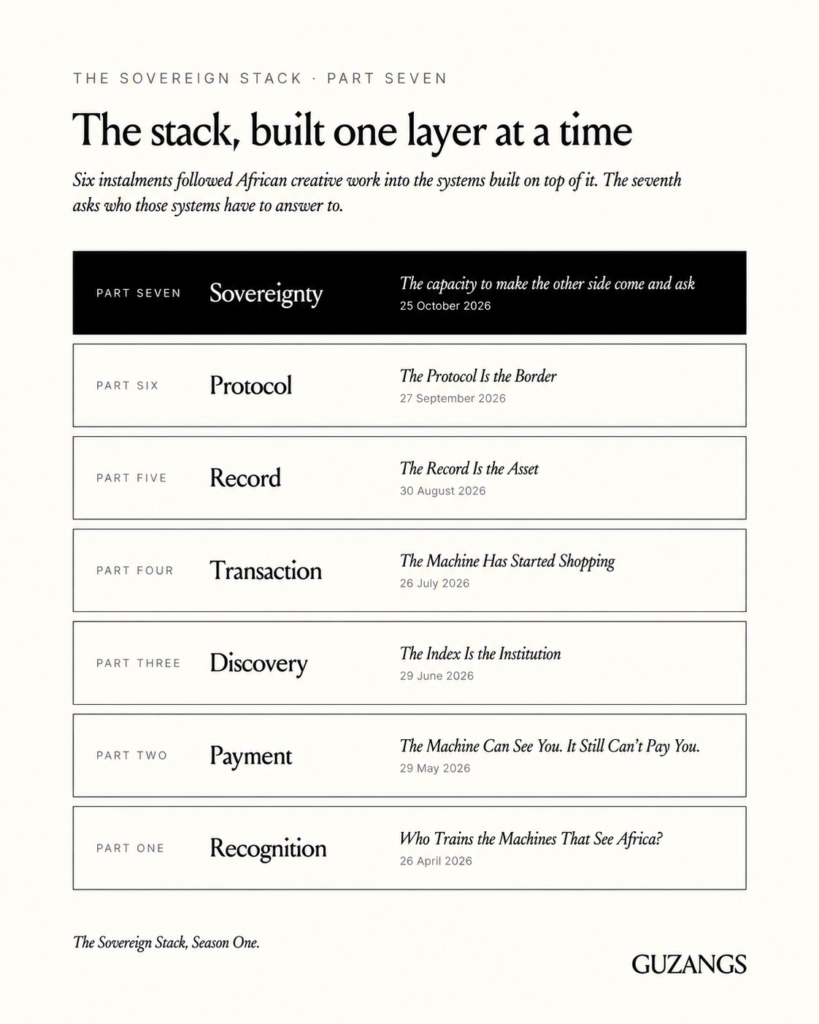
Over six instalments, The Sovereign Stack followed African creative work into the AI systems now being built on top of it: how it is seen, paid for, found, bought, recorded and governed. The season closes on the question beneath every one of them: who can make those systems come and ask, and who will still be there to answer?
In April, a generative model was asked for Aso-Oke, the hand-loomed Yoruba cloth, and returned an image that was “polished, cinematic, and wrong”. That is where The Sovereign Stack began, and across its first six instalments the same figure kept returning in different clothes: a Nigerian grant recipient who waited more than three weeks for money already awarded; hotel phone bookings “scribbled on Post-it notes and sometimes lost or forgotten”, as HotelOnline’s Håvar Bauck put it; Adaobi Orajiaku’s reminder that “we cannot manufacture a provenance that was never written down.” In every case the African maker was there, and working. What was missing was any way to make the systems built on that work answer to the people who made it.
Last month the series stopped at a download button. DhoNam, a Dholuo speech dataset from Kenya’s Maseno Centre for Applied Artificial Intelligence, carries a condition its speakers set: no one may clone or imitate their voices. Part Six could show the condition being printed. It could not show anyone honouring it.
So this month Guzangs asked Lilian Wanzare, who founded and directs the centre, whether anyone who had downloaded DhoNam had come back to ask permission for a particular use.
“So far it has been downloaded but no one has come back to us for permission for a specific use,” she wrote.
There is no accusation in that. A download is not a breach, and nothing suggests a voice has been cloned. Her answer points to the stretch after the download, the problem this series has kept running into since April: the terms are printed and clear, but no one has yet come to ask, and her account leaves open how the centre would know whether those terms are being honoured.
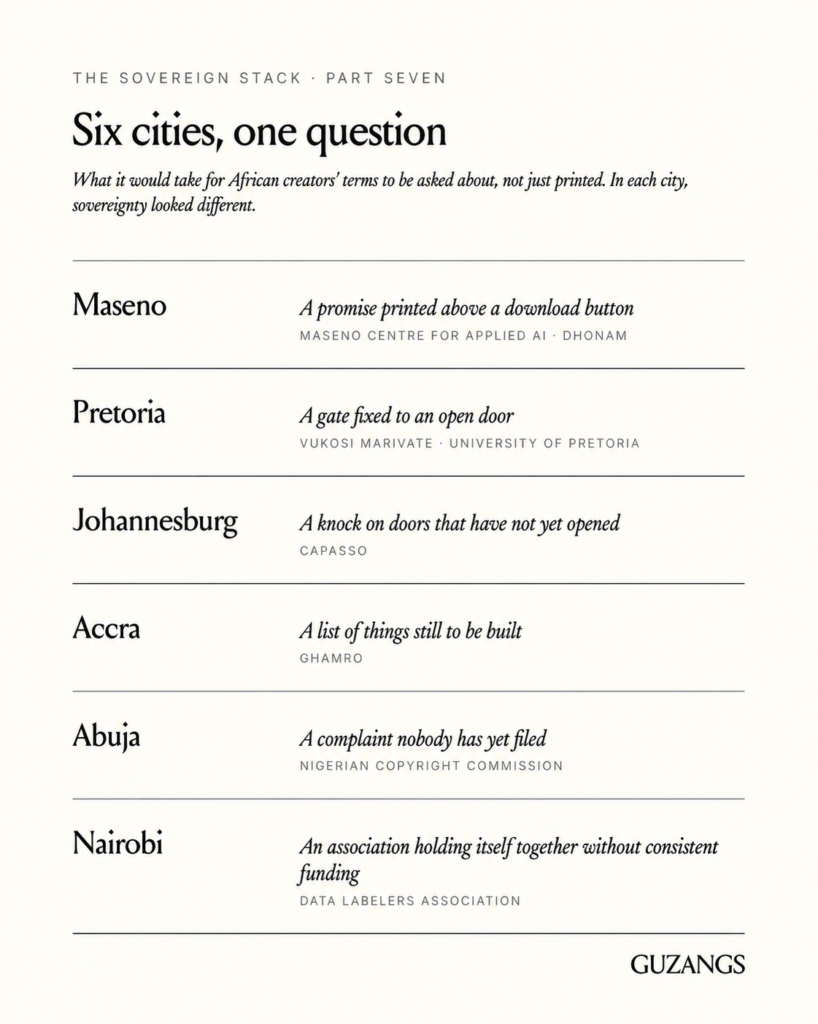
The Sovereign Stack has carried a word in its title for seven instalments without pinning it down. To close the season, Guzangs took a narrower question to the people trying to make African creators’ terms count in practice, from a language lab in Kenya to a copyright regulator in Nigeria: what would it take for those terms to be asked about, not just printed? The answers came from six African cities, and each one moved the question somewhere new.
The work differs from city to city, but the imbalance is familiar: the contribution travels, and the power to question its use does not always travel with it.
Maseno: the promise
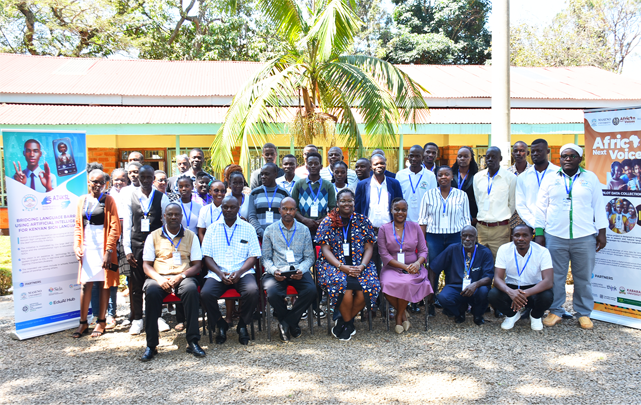
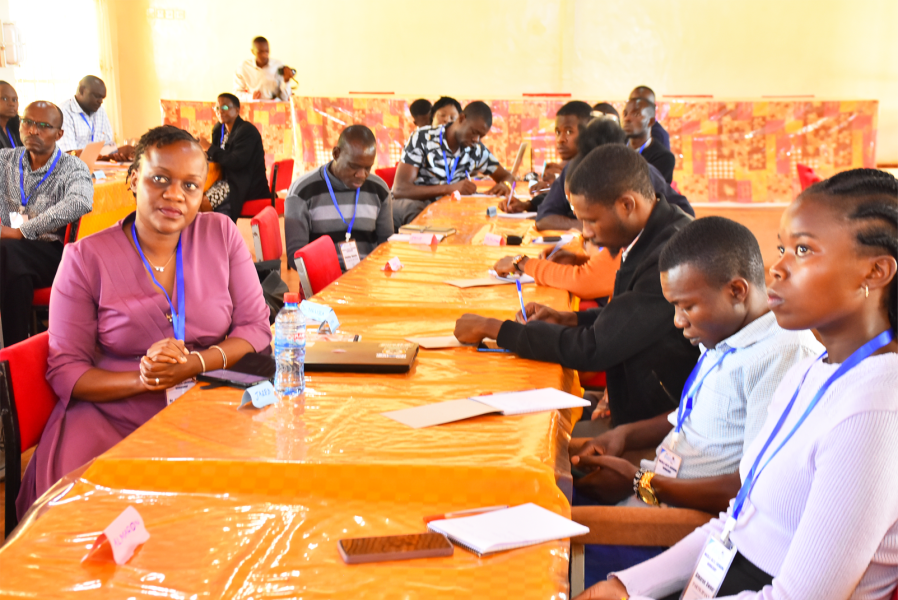
DhoNam is the cleanest test the series has found, because the people behind it tried to build an answer in from the start. The speakers set the condition themselves, Wanzare says, and the centre coordinates the dataset; if the condition is ever broken, they “are to find out from us, as we are the coordinator for the dataset itself”. The terms came out of a series of workshops and capacity-building discussions involving the centre and CIPIT at Strathmore University, she says. A March 2025 report on Maseno University’s website, which Wanzare supplied, describes a workshop of this kind, at which participants from the Dholuo language community sat with linguists, lawyers and AI researchers to “co-create and pilot a novel, community-centered license”. The community was asked what kind of licence it wanted and what conditions it would set, and it settled on the Nwulite Obodo Open Data Licence, known as NOODL. The centre now looks after the dataset.
The line the speakers drew is narrower than it might sound. The listing names text-to-speech training among the dataset’s intended uses, and Wanzare puts the distinction plainly: “TTS is OK, but voice cloning is Not.”
What the steward can see is another matter. Mozilla Data Collective, which hosts the files, keeps count of downloads; what each user means to do with them is, as Wanzare puts it, self-declared. Asked what Maseno could do if a voice were cloned, she did not reach for a statute. There is “not a clear answer to this apart from calling them out,” she wrote, and the question is “still part of discussions”.
Nor is the keeping paid for. Answering for DhoNam, she wrote, “takes a lot of commitment as its volunteer work”, and it belongs with “an entity that is able to sustain itself beyond the funding period”. The first question this story raises, then, is one of stamina: who keeps a promise once the grant that paid for it has been spent?
Pretoria: the open door
The obvious way to make a promise unbreakable is to lock the data away. Vukosi Marivate, a professor at the University of Pretoria who builds African language datasets, explains why that would be a mistake.
Marivate’s team releases its recordings under what he calls a “funder-mandated CC BY license”, one that allows broad reuse.
The team strips personal identifiers from its recordings while keeping markers such as age and gender, puts the data behind a gate on Hugging Face, a major platform for sharing AI data, and requires anyone who comes through to agree not to clone a voice. “We intentionally layer this ethical friction on top of our funder-mandated CC BY license,” he wrote. The reason: “we believe building a sovereign stack means protecting our communities without starving African innovators of the open data they need.”
It is the strongest argument in this story against shutting the door. If every clip of African speech needed a contract, the first people locked out would be African students and start-ups building tools in their own languages, with no lawyers on retainer.
It also leaves something exposed. Marivate calls his team’s primary protection “complete anonymization”, but a name comes off a recording far more easily than a voice does, and the voice is itself the identifying thing. That may be why two quite different arrangements, one licence chosen by a community and the other set by a funder, arrive at the same promise: an undertaking, given by the user at the gate, not to clone anyone’s voice. On the accounts given so far, neither steward can see far beyond that gate. “This is a continued place of tension and we should continue discussing and figuring out responsible and sustainable ways to build our way forward,” Marivate wrote.
If the door is to stay open, the protection has to come from somewhere other than a lock: from someone with the standing to negotiate on the speakers’ behalf.
Johannesburg: the knock
Music has an old answer to scattered creators facing large buyers: the collecting society. So Guzangs asked the societies.
CAPASSO, which licenses the rights of songwriters and music publishers in South Africa, said no AI company had approached it to license African music for training, and that it had issued no such licence. The traffic runs the other way. “Rather, it is CAPASSO that is continuously reaching out to Generative AI companies to try and find a solution for the use of African music in AI-generated content,” it said in a written statement. Its policy holds that in any AI-generated song “there is an element of previously human-created music, and such creators need to be compensated”. For that to happen, it says, “policymakers need to come up with clear legislation”.
South African musicians have reason to want the knock answered. When SAMRO, the country’s performing-rights society, surveyed 502 of its members in April, 34.3 per cent said they had used Suno and 89.2 per cent backed SAMRO’s advocacy for protective AI legislation. They are trying the tools and asking for rules in the same breath.
A knock, though, says nothing about what a society would need in order to sign, or to pay anyone afterwards. In Accra, that answer came back in detail.
Accra: the list
GHAMRO, Ghana’s music rights organisation, has a policy. Its ten-page statement on AI, built on principles set out by CISAC, the international confederation of authors’ societies, affirms “authorization, remuneration and transparency” and says plainly that GHAMRO is not opposed to AI. One line in it could serve as a diagnosis of everything that follows: “Authorization without transparency may be difficult to enforce.”

Asked what stands between that policy and a deal, its management gave the most detailed answer anyone offered this story: a list of things still to be built.
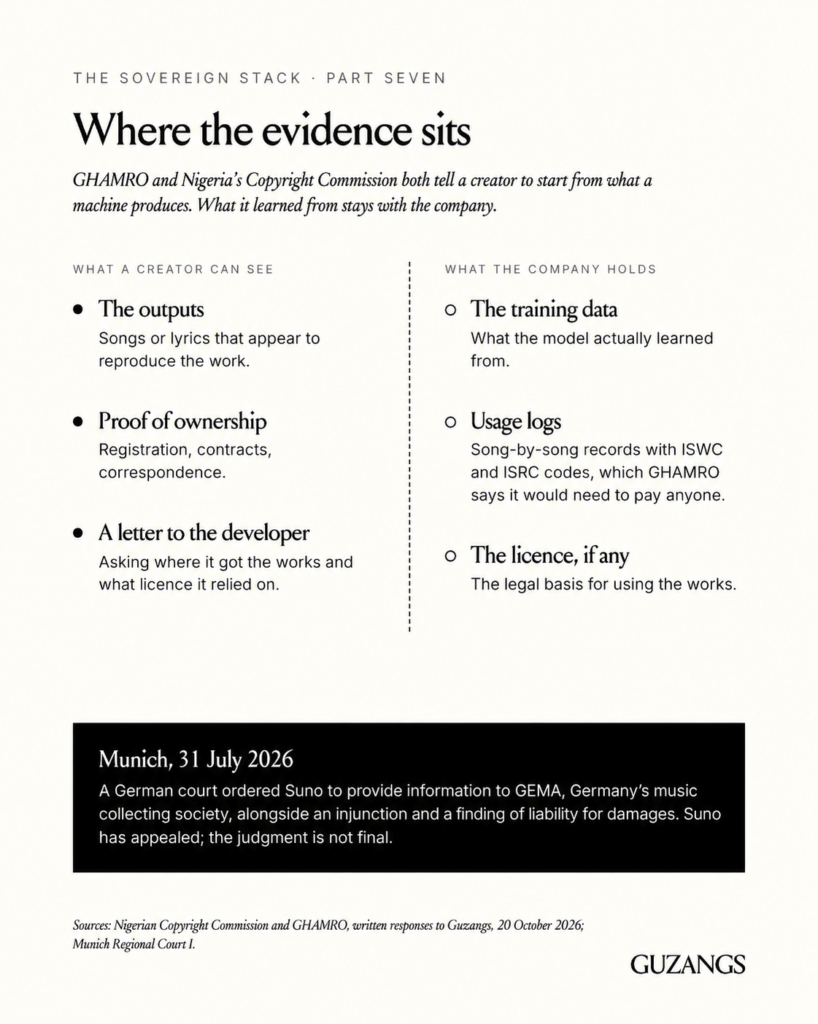
GHAMRO has finalised no licensing agreement with an AI training company. Its mandate covers public performance, broadcasting and mechanical rights, and a comprehensive AI licence “may require explicit new mandates from our members”. To pay anyone fairly it would need AI companies to provide “comprehensive, verifiable usage logs and metadata”, down to the codes that identify each song and recording, and it would have to upgrade its own monitoring to read them.
On the law, GHAMRO wants Ghana’s Copyright Act of 2005 clarified so that text and data mining for commercial AI training is not treated as fair use or an educational exception “without fair compensation”, and it is consulting the Copyright Office and the Ministry of Justice. There is “no fixed parliamentary timetable”.
One item on the list faces inward, towards members rather than companies. In any AI framework it negotiates, GHAMRO says, it intends to champion a system in which creators can opt in or out of AI training “without losing their standard collective management benefits”.
Members who suspect misuse can already complain to GHAMRO, which can send a cease-and-desist notice or escalate to Ghana’s Copyright Office. It has had general inquiries about digital copyright, it says, but no formal legal complaint about AI training.
Abuja: the evidence
Nor has Nigeria’s copyright regulator. Asked whether creators had complained about AI training on their work, the Nigerian Copyright Commission replied: “No. The Commission has not received any complaints.”
Its first answer to Guzangs, in mid-October, was that it did not “at the moment” have a position on AI training using Nigerian sound recordings without a licence. Its fuller reply pointed to the Copyright Act of 2022 and set out how a complaint would run. Every step starts with the creator, who is to gather evidence, including “the Outputs that appear to reproduce the music, lyrics or distinctive elements of the work”, and write to the developer asking where it got the works and what licence it relied on. The Commission can then investigate. It noted that “there has been no judicial pronouncement in Nigeria on whether the use of copyright works to train AI per se would constitute infringement”, and that Nigeria’s approved collecting societies “are free to negotiate permissions or pursue complaints about AI training”.
GHAMRO, too, tells a member who suspects misuse to begin by documenting outputs. Both institutions send creators to what comes out of a machine, because what went in cannot be seen from outside, and GHAMRO’s own statement concedes that imitating a musical style, “standing alone, does not necessarily constitute copyright infringement”. The record that would settle the matter, what a model was actually trained on, sits with the company the creator is questioning. The Commission’s advice to ask the developer is sensible. It also makes plain who holds the answer.
An empty inbox proves nothing either way, but it is easy to see why a songwriter might hesitate to go first. Chris Emezue, the founder of the African language data platform Lanfrica, described the general problem in Part Five. “If you don’t have the bargaining chip, you’re basically just begging,” he said. “It’s very hard to see the power when everything is scattered.”
Munich: the order to disclose
This summer a German court showed what it looks like when the power is not scattered.
On 31 July, Munich Regional Court I largely upheld claims by GEMA, Germany’s music collecting society, against Suno, the American company whose software turns a line of text into a song. The case concerned six songs, among them “Forever Young”, which the court found Suno had copied while training its models in the United States. It ordered Suno to stop the infringing uses, held it liable for damages and, the detail that matters most here, ordered it to provide information about the extent of the specified infringements and the revenue they generated. GEMA had taken the dispute beyond asking the developer and obtained a ruling that required an answer. The judgment is under appeal at the Munich Higher Regional Court and is not final.
The court held that Section 131 of Germany’s Collecting Societies Act allowed it to hear the connected claims concerning training in the United States, which it then judged under US copyright law, rejecting Suno’s fair-use defence. GEMA came to that court as an institution, with a statute behind it and a documented repertoire.
Read GHAMRO’s list again with Munich in mind. Mandates, records and a clear law are what turned GEMA’s terms into something an American AI company had to answer, and an order to disclose is the step that the advice from Accra and Abuja, which starts from the outputs, does not describe. German law does not travel to Ghana or Nigeria. What Munich shows is what such an institution is made of.
Nairobi: the price of no
There is a harder condition still. An institution can win the right to be asked; the people it speaks for must still be able to afford to say no.
The Data Labelers Association represents people who sort and tag the data that AI systems learn from. Its president, Joan Kinyua, says it grew out of workers’ experiences of “arbitrary account deactivations, poor working conditions, and having little or no say in decisions that directly affect their livelihoods”. Building it, she wrote, “has taken a lot of collective effort, trust, and personal sacrifice, especially as we operate without consistent funding.” To refuse unfair terms, workers need collective bargaining, legal support and recognition “as a workforce with rights, not just a pool of labour that companies can replace at will.”
Adio-Adet Dinika, who researches the labour behind AI, wrote: “Data workers, whose labour makes these systems possible, have far less power to refuse exploitative conditions when doing so threatens their livelihoods.” The real test of African AI sovereignty, he argues, should move beyond whether African countries can negotiate with technology companies “to whether the workers and communities sustaining these systems have the power to determine the terms of their participation”.

Kinyua’s words about funding echo Wanzare’s about volunteers. On one side of most of these tables sit capital and lawyers; on the other, commitment and borrowed time. For a speaker, a songwriter or a labeller, a right to refuse is worth what it costs to use, and it tends to cost less when it is used together.
Who has to ask
Set the cities beside one another and the word this series has carried since April finally holds still.
Sovereignty, as these seven pieces have found it, has less to do with where the servers sit, who owns the dataset or whether a licence carries the right words than with a capacity: to make the other side come and ask, to answer on behalf of the people who made the work, and to still be there, accountable to them, when the next request arrives.
That definition leaves room for Pretoria’s open door, since a community can decide which uses must knock and leave the rest free, as DhoNam’s speakers did. It also cuts both ways. A Kenyan steward or a Ghanaian society can fail its members as surely as a foreign platform can ignore them, and the people an institution speaks for should be able to see what it agreed in their name and decline it. That is why GHAMRO’s opt-out commitment matters as much as any licence it may sign.
Part One asked who trains the machines that see Africa. At the end of the season the sharper question is whom those machines have to ask. In Maseno that would mean a company unsure whether its plans fall within the speakers’ terms writing to the centre before it builds, and the speakers hearing who asked; in Nairobi, a no that does not cost the next contract.
None of that exists yet in finished form, and much of what would decide it is still moving. Ghana’s legislative review has no timetable, CAPASSO is still knocking, and the Munich judgment remains under appeal. The people who could build the rest are already at work, in six cities, on the same problem from different ends and mostly apart. A steward in Maseno and a society in Accra are each deciding who may say yes on other people’s behalf. A labeller in Nairobi and a songwriter in Johannesburg want the same thing from the answer, and a regulator in Abuja says it would welcome a deeper conversation. Keeping them together long enough to settle who speaks for whom, and who pays for it, is slow work. It is also the next layer of the stack.
The speakers behind DhoNam lent their voices to a machine on terms of their own. If those terms are ever broken, Wanzare says, they will hear it from Maseno; the centre’s responsibility does not end when the files leave its hands. Nobody has come to ask yet. When someone does, the request should reach the people whose voices it concerns, and someone should still be there to answer it.
The first season ends there, with work released into the world and people who still have a claim on what happens to it. Making that claim count is not a job for any single person in this story. It starts when they are in the same room.