


The Machine Can See You. It Still Can’t Pay You.
Twelve months wrote the rules of AI compensation. African creators were named in none of them.
Somewhere in a court-approved spreadsheet, nearly half a million books have become line items. Whatever a book once was in the making of it, the years of revision and abandonment and recovery before it ever reached a reader, it now exists in that file as an eligible work with a claim status, a payout estimate, and a share of administrative and attorney costs deducted against it. The going rate is roughly three thousand dollars a title, assuming the settlement holds and the arithmetic survives the lawyers. A line item is a strange afterlife for culture, and it is also the first accounting the AI economy has been compelled to perform: a tally of what it used.
In San Francisco, the Bartz v. Anthropic settlement has become one of the clearest early attempts to decide what happens when copyrighted work enters a model through the wrong door. By the May 14 fairness hearing this year, class counsel reported that 447,576 of the 482,460 eligible works had been claimed, a rate of 92.77 percent, and the court took the matter under submission. A parallel fight is underway in Los Angeles, where Disney and NBCUniversal are suing Midjourney over characters the company allegedly learned too well, arguing that the image generator reproduced protected worlds on demand rather than merely admiring them. The question took a different shape in London, where Getty Images spent two years pursuing Stability AI over what happens when a visual archive becomes part of machine memory; in November 2025 the UK High Court rejected most of the case while finding limited trademark infringement tied to earlier outputs that carried Getty-style watermarks, a judgment that settled little but made the larger question harder to avoid, and which Getty has signalled it will carry into its ongoing US case. Adobe has moved more quietly, sending Firefly contributor bonuses to the photographers, illustrators, and stock creators whose work trained its commercially positioned image model. The payments are modest, but they amount to the same admission the courts are circling toward, that a model has authors and that authors need a way to be paid.
None of this settles the future so much as it shows where the future is being priced. The economy has reached the stage at which an image becomes a claim and an archive becomes evidence, and a creator becomes payable only once the system can prove what was taken, from whom, and on what terms. African creativity is already deep inside that machine. Its cloth and its music, its ceremony and its city light, its studio reels and its editorial shoots have circulated online for years, living in feeds and archives and travel listings and image libraries, in the vast visual soup from which generative systems learn how the world is supposed to look. What African creators are largely outside of is the settlement. They are barely present in the precedent-setting copyright cases, in the compensation experiments the largest creative-software companies are running, or in the standards bodies deciding how provenance should travel with a piece of digital media. Of the eleven institutions on C2PA’s public steering committee, the body effectively writing the rules for content authenticity, every one is headquartered in the United States, Europe, or Japan, and none is African.
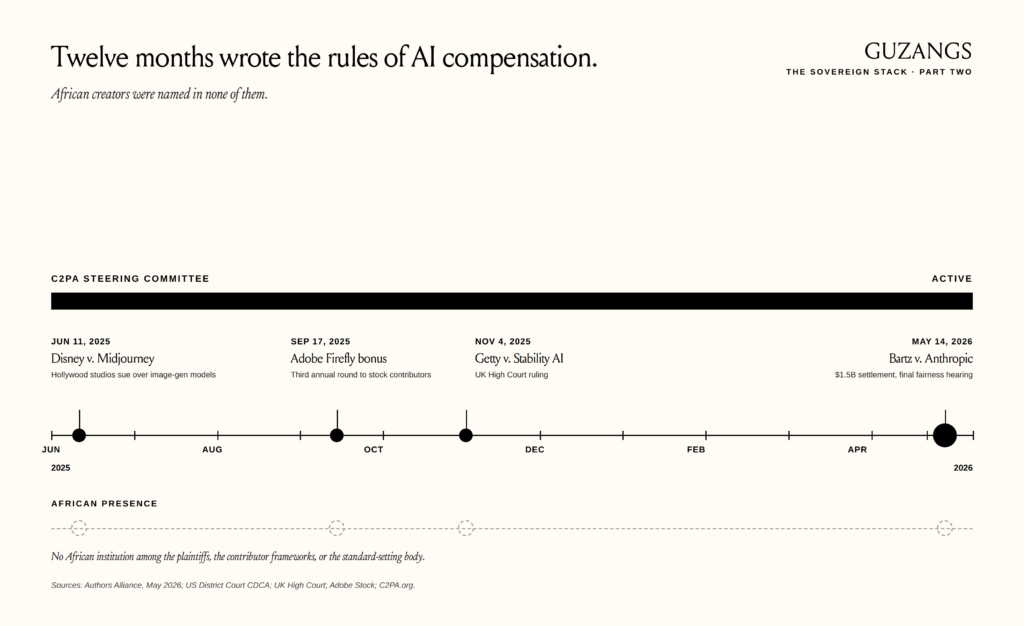
That absence carries a price. Brookings projects that Africa’s creative economy could reach two hundred billion dollars by 2030, a figure against which the Bartz settlement alone runs to 1.5 billion, and the infrastructure being assembled this year will set the defaults for how a generation of African work is priced, indexed, attributed, and routed. The continent is being left out of a one-time architectural decision about who pays whom, and for what. The first essay in this series asked whether the systems learning to read the world held enough African life inside them to see the continent clearly. This one begins after the machine has seen enough to sell, and turns to the harder question of who teaches it what the work is worth.
After Visibility
For years, African creativity has been discussed in the language of exposure, and the more visible the work became, the more often the world arrived late and called its arrival a discovery. Exposure has always mattered and still does. A feature can change a career, a campaign can introduce a designer to the right room, and a city can become real to a traveller because a photographer saw it honestly before any tourism board learned how to describe it. None of that is the same as value. The global market has become very good at consuming African aesthetics and has built almost nothing for compensating African authorship, and in a creative economy an unpaid invoice is rarely only a delay; it is often the difference between influencing a market and owning a position inside it.
The Front Door Moved
This reckoning over value is arriving at the same moment the front door of the internet is being rebuilt. Search has begun to behave less like an index and more like a concierge with opinions. Google’s own documentation describes its AI Overviews and AI Mode issuing a fan-out of related queries across subtopics to assemble a single answer, which reads as a technical footnote until you notice that it decides who gets found. A buyer no longer works through ten designers, ten websites, and a fortnight of unanswered email. She asks an agent for three West African textile studios that can produce handwoven cloth for a limited interiors collection, with export capacity and clear provenance, and the system goes looking. What it tends to find on one side are beautiful Instagram pages carrying no structured information, museum archives written in colonial-era language, and small businesses whose sites are broken and whose rights and payment terms are stated nowhere. On the other side it finds a single studio with clean metadata, English-language documentation, verified collaborators, shipping terms, and a few recognisable international references. The system will surface not the best studio but the one it can read, because legibility is close to the only quality it can actually assess.
The traffic data already reflects the shift. Pew found that when an AI summary appears, users click through to a traditional search result in only 8 percent of visits, against 15 percent when no summary is present, and they follow a link inside the summary itself just 1 percent of the time. The first internet sent people out to websites; this one increasingly answers them in place and keeps the visit. For an African creative business, that summary box has become the front door to global demand.
Metadata Is Money
Metadata reads as housekeeping until you notice it is deciding who gets paid. A caption beneath a runway image, the material description on a product page, a byline on a film still, the licensing terms travelling with a photograph, the verified profile of a studio in Accra, the festival record proving a designer showed in 2018 rather than last week: each is part of the connective layer that lets cultural work travel without losing its name or its price. The economy is also far larger than it is legible. In its 2025 mapping of the sector, Brookings found that roughly 84 percent of Kenya’s 275,375 creative enterprises are unregistered, and that African film industries lose somewhere between half and three-quarters of their revenue to piracy. A continent producing at scale is capturing only a fraction of what it makes, and much of the leakage is a valuation problem before it is anything else, since an unregistered business is harder to finance and an unattributed work is easier to steal.
This is the terrain the Guzangs Material Literacy series has spent the past few months mapping, documenting bògolànfini, Guinean lépi, and the weave architecture of african cloth as precisely the cultural metadata that lets a cloth survive translation into a global market. Without it, a handwoven piece lands on a Western buyer’s desk as “African print,” and the price follows the description. Markets reward legibility at least as much as they reward talent, and the flattening runs in both directions. The Nigerian designers Tia Adeola and Tolu Oye, whom Guzangs profiled a few weeks ago still circulate through global feeds under the word “emerging” long after they built the production capacity that should have retired the term, while Dakar Fashion Week, twenty-five years into a sustained programme of pan-African design, is still introduced to the international press as a discovery rather than an institution. The same lazy vocabulary turns a cuisine into “fusion” and a neighbourhood into something “vibrant” and a continent into a mood board, and the laziness has commercial consequences, because a buyer who cannot separate technique from material from origin from production capacity cannot price the work, and a model that cannot tell a living tradition from atmosphere will treat it as atmosphere.
Natalie Narh, co-founder of NewComma, the African and diaspora creator platform built between London and Accra, describes the same gap from the field.

“The aesthetic travels. The strategic depth doesn’t always follow. And that gap is where campaigns get made that look right but feel wrong.”
African work has long travelled without its context. Ankara wax prints became a global shorthand with their Dutch colonial-trade history left unspoken, Fela Kuti’s horn arrangements were folded into a hundred uncredited samples, and the visual language of Black hair entered Western fashion as a trend well before the women who built the technique were credited. Generative AI did not invent this habit; it industrialised it, learning the look at scale while remaining oblivious to the debt.
The Platform Can Find You. Can It Settle?
The African creator stack is not standing still. Selar, the creator-commerce platform, paid out more than ₦18 billion to nearly 400,000 creators in 2025, close to double its 2024 figure of ₦9.8 billion, while LemFi has crossed a billion dollars in monthly processed volume serving more than two million customers who move money across borders. These are the numbers of a continent already transacting at scale, where a photographer in Accra can invoice a client in Berlin and watch the money clear within a day. The trouble is that pipelines move value without setting its price. Angolan crude leaves the ground priced against a Brent benchmark fixed in London, and Congolese cobalt leaves the mine valued against an exchange in London or Shanghai; the commodity is local and the pricing is decided elsewhere. The same architecture is now forming around creative work. A platform can carry a Lagos designer’s collection to a buyer in Milan without telling that buyer what the cloth is, what the technique is called, what the studio’s last collection sold for, or whether the designer has shown in three exhibitions or thirty. That valuation layer, the metadata and the comparables and the verification and the taxonomy that together let a market price a thing, is being built somewhere other than the continent.
Narh’s work sits inside that gap. NewComma began with discovery, giving African and diaspora creatives a place to be found and to reach opportunity, and what it has learned since is that being found does not produce a market on its own. The talent pool diversified far faster than the buyer listings did, so demand for opportunity ran well ahead of the supply of serious buyers, and a designer in Accra, a stylist in Lagos, and a photographer in Dakar could all be visible to one another while still lacking the shared structure needed to price, verify, contract, and settle the work.
“If the system can’t see you accurately, it can’t pay you fairly.”
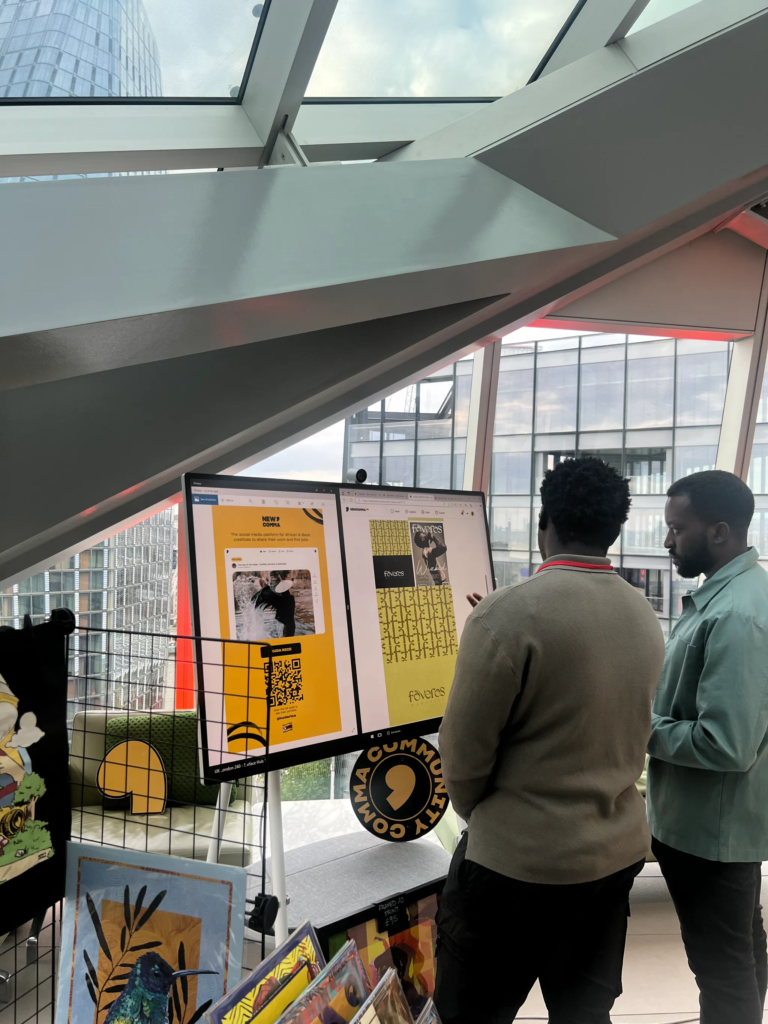
The platform’s NewComma Creative Fund has run forty microgrant cycles since 2022, reaching recipients across Ghana, Nigeria, Kenya, Uganda, Malawi, South Africa, Botswana, Zimbabwe, Angola, and the UK, financing Adobe subscriptions and podcast equipment and photography series and live studio sessions. The hardest part, Narh has said, was never finding the talent or choosing the work but sending the money, and she points to one Nigerian recipient who waited more than three weeks to receive a grant that had already been awarded.
“The rails that exist were not built with these transactions in mind.”
Everything required is in place, the person and the work and the award and the funds, and somewhere between the account and the recipient the system still coughs. That is the operator’s version of the sovereign stack.
What Has to Be Built
The systems that will decide what counts as authentic, traceable, and compensable in the AI age are being assembled now. The Coalition for Content Provenance and Authenticity, or C2PA, maintains Content Credentials, a technical standard that records how and when a piece of digital content was made or altered, and its steering committee runs through Adobe, Amazon, the BBC, Google, Intel, Microsoft, Meta, OpenAI, Publicis Groupe, Sony, and Truepic. Provenance standards genuinely could help creators prove authorship, contest manipulation, and follow how their media moves, but a standard is never only technical. It encodes the assumptions of whoever built it about which creators were imagined, which archives are already digitised, which rights are easy to describe, and what becomes of traditions held collectively or orally or across borders. These standards already exist, which means arriving late is not a fresh start but a decade of retrofitting, of translating yourself into someone else’s architecture after the default has been set.
The next layer will not be glamorous. It will look less like a runway or a cover or a festival stage than like administration, which is generally where power keeps itself. The first thing missing is identification, not in the internet’s sense, where a photographer becomes “image via Pinterest” and a textile becomes “African print,” but in the market’s sense, where a name attaches to a place, a capacity, a set of rights, and verifiable proof, so that an international production house can confirm that the studio it wants in Accra exists, has delivered at the scale it claims, owns the work it is showing, and can produce inside the timeline on the table. Language is the layer above that. The words have to get specific, because aso-oke is a weave architecture rather than a vibe, bògolànfini and Guinean lépi are named techniques with makers and markets behind them rather than a generic “African indigo,” and kente is a particular cloth rather than a synonym for the continent. Where the vocabulary stays lazy the payments stay low, since taxonomy is what lets a market tell a commodity from a cultural work that has a maker, a place, a technique, and a claim to its own name. Rate transparency is the third piece. The information gap that lets one market underpay another is seldom a verdict on talent; it is the absence of comparable data, so that a photographer in Dakar negotiates blind against a client in New York who already knows the number, and a filmmaker in Lagos discovers only after delivery that the same brief paid differently in London. Building the data closes the gap.
Parts of this already exist. Selar and Mainstack sit at the commerce layer, LemFi and Paystack and Flutterwave move the money, NewComma works the discovery problem, and Lelapa AI, Masakhane, and Intron occupy the data-and-model layer the first essay covered, alongside the publishers, museums, archives, festivals, and studios holding contextual knowledge that has never been fully structured. The components are in place; the stack that would connect them is not.
The New Gatekeepers Wear Interfaces
African creators know the old gatekeepers intimately: the buyer who waits for Western validation before taking the original source seriously, the magazine that discovers a scene local editors named years earlier, the museum that acquires the object and loses the maker, the luxury house that borrows the language of craft while keeping ownership elsewhere. The new gatekeepers are harder to recognise because they arrive as software, as dashboards and rankings and recommendation engines and provenance standards and payment rails, and they feel neutral precisely because they look procedural. None of them needs ill intent to do damage. A ranking system underprices African work on incomplete data, a generative model reproduces a visual code it was fed without context or attribution, an AI travel agent routes a culturally important hotel out of its recommendations because cleaner information sits elsewhere, and a procurement tool devalues a photographer in Accra by drawing on a vendor database his peer set never entered. This is the quiet violence of bad infrastructure, which never announces itself and simply sends the opportunity somewhere else.
The Model Eats the Moodboard
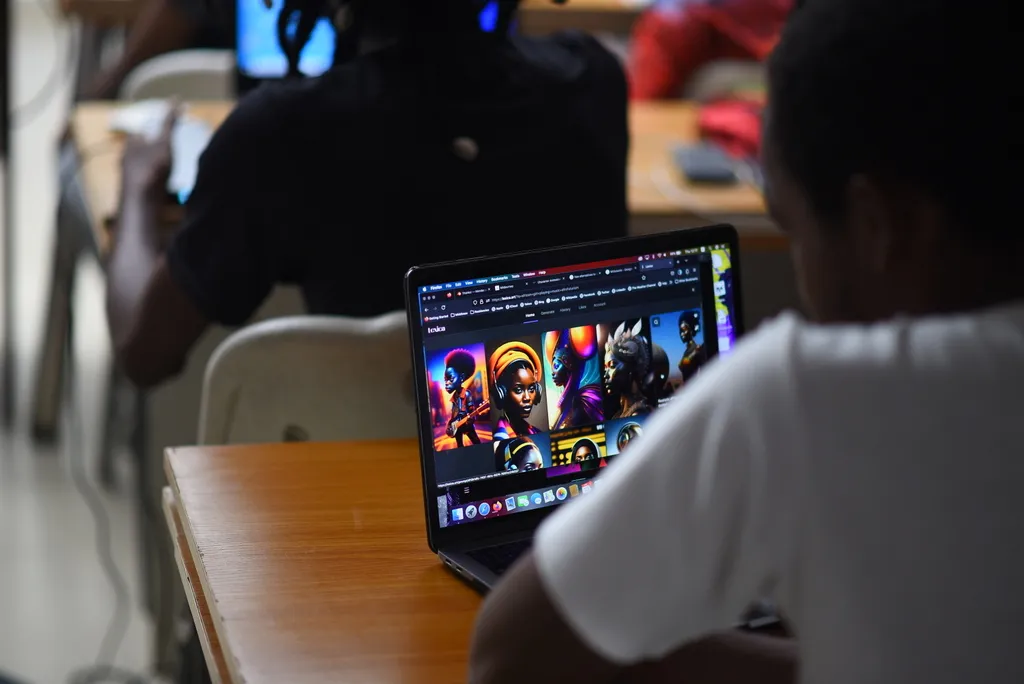
For years the mood board was a private object, an assembly of screenshots and textures and rooms and garments and faces and street scenes and archive images pulled together to suggest a direction. Now it answers back and generates. A brand can prompt a “modern African luxury interior” and receive a room that appears to understand raffia and earth tones and carved wood and Sahelian shadow and a dozen references it cannot name, and a production team can prompt “West African editorial fashion, cinematic, high-end” and receive an atmosphere assembled from years of human image-making, most of it unpaid and uncredited and untraceable. The point is not that African creators should refuse these tools, many of them already use them, but who owns the value underneath. A Nigerian designer reaching for Midjourney to sketch a collection is using a tool; a Western production team prompting the same model for “West African editorial fashion” is drawing, without payment, on the labour of every photographer and stylist and designer whose work taught the model what the phrase means. The more dangerous future is the one in which the machine gets Africa right enough to sell while still not knowing who ought to be paid.
The Rules Are Being Written
African creativity is already inside the machine; the open question is who controls the indexing. The window is concrete rather than theoretical, because the Anthropic settlement is moving through final approval, the Midjourney case is live, Getty’s findings will keep pressure on the unresolved questions about training data, and C2PA is being adopted across the software the global creative class opens every day, and each of those decisions sets a default that then travels. For a long time the counsel to African creators was exposure: get seen, get featured, get into the room. That advice has become dangerously incomplete, because the room is no longer a magazine cover or a runway but a model, a recommendation engine, a provenance standard, a buyer’s agent deciding who looks credible enough to email. The machine can already see African creativity well enough to reference it, generate alongside it, and sell against it; whether African creators and institutions and businesses will be present in the systems that price it is the part still being decided.
Somewhere between London and Lagos, meanwhile, a transfer is still sitting in a queue. The grant was awarded weeks ago, the recipient was chosen, the money is in an account, and the rail has not moved it. The valuation layer is being built regardless, and whoever builds it first will set the terms for the decade of continental trade that follows. The choice ahead is architectural rather than creative, and it is being made now.
The valuation layer will outlast every headline in this story. Subscribe.
The Sovereign Stack is a continuing Guzangs research series on the data engines, machine-learning pipelines, and transactional architectures shaping the future of the African and diaspora creative economy. Part One: Who Trains the Machines That See Africa?
Continue reading