


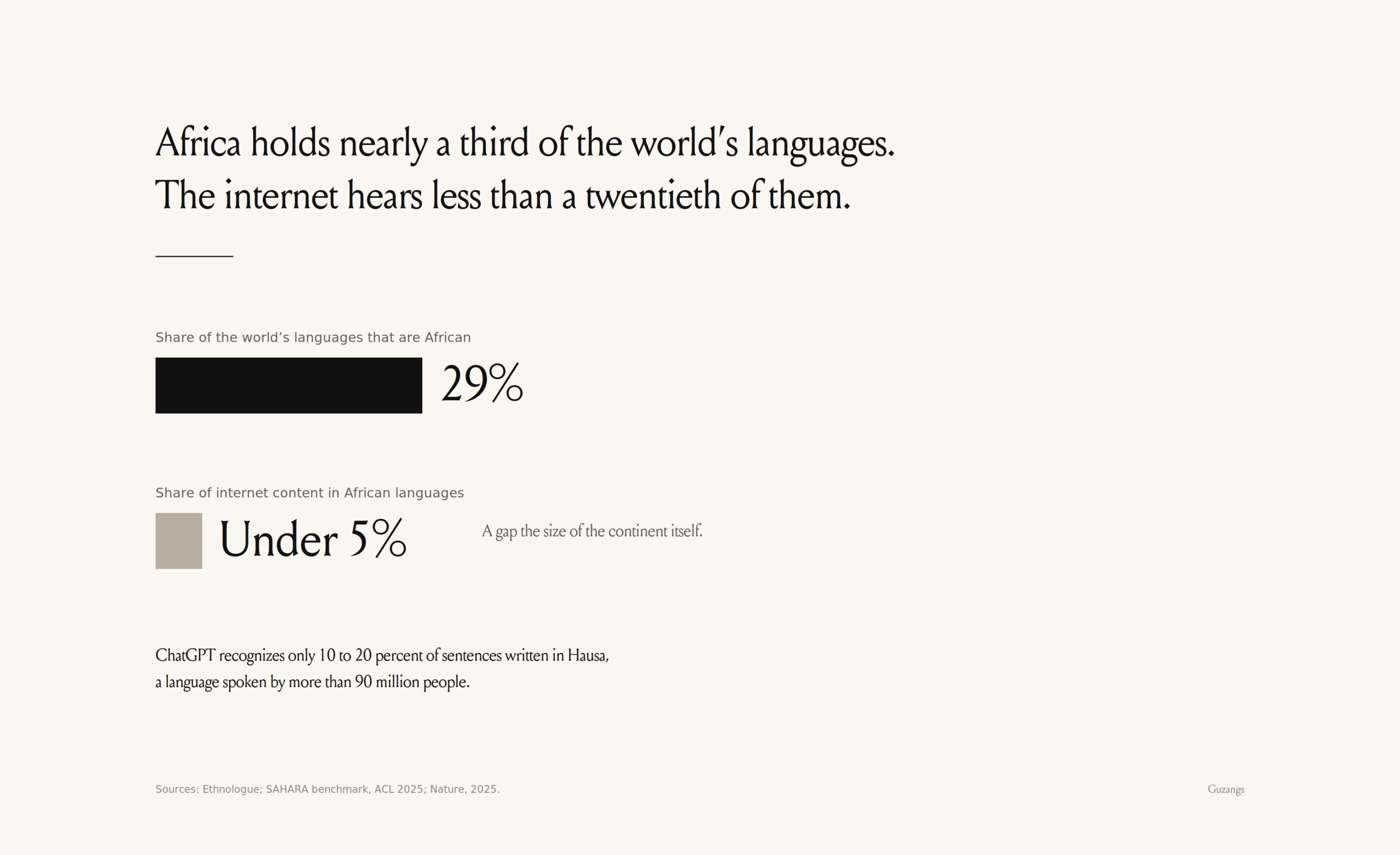
Africa accounts for roughly 2,000 of the world’s 7,000 languages. No single African-origin language accounts for even 0.1 percent of global internet content, according to w3techs data cited by the Barcelona Centre for Contemporary Culture. The datasets that train generative AI were built on that internet, which means they were built on an internet that barely hears the continent.
The SAHARA benchmark, published at ACL 2025 by researchers at the University of British Columbia and MBZUAI, evaluated 517 African languages across 16 natural-language-processing tasks. The performance gap between English and most African languages is wide and persistent. Its authors traced those disparities not to linguistic complexity but to policy-driven data inequities and decades of underinvestment in digital infrastructure.
The recognition gap is just as revealing. According to Sarah Wild’s July 2025 Nature feature, ChatGPT recognizes only 10 to 20 percent of sentences written in Hausa, a language spoken by an estimated 94 million people across West Africa, primarily in Nigeria and Niger. Imagine sending a CV to a recruiter who can only read every fifth word. That is roughly what it means for one of the continent’s most spoken languages to live inside the world’s most-used AI tools.
There is a harder truth underneath the deficit. Global models are not ignoring African content. They are ingesting it. African music, visual culture, fashion, and design have all been absorbed into training datasets without consent or payment. The sovereign stack is about both: building what is missing, and reclaiming leverage over what has already been taken.
If you do not help build the training set, your style becomes a prompt that someone else owns.
The Rise of Sovereign Infrastructure
African builders are no longer waiting to be interpreted.
They are doing it against a concentrated capital landscape. 83 percent of AI startup funding on the continent goes to four countries: Nigeria, Kenya, South Africa, and Egypt. Much of it comes from international investors.
In 2023, in a co-working space in the Rosebank neighborhood of Johannesburg, Jade Abbott opened a tab on her laptop and asked ChatGPT to count from one to ten in isiZulu, a language spoken by more than ten million people in her native South Africa. The answers came back, in her words, mixed and hilarious. She tried translation. The results were not close. She did not close the tab. She and the biomedical engineer Pelonomi Moiloa had co-founded Lelapa AI the previous December, a Johannesburg-based research and product lab committed to building language infrastructure for the continent from the continent.
By 2024, Lelapa had released InkubaLM, a compact multilingual model trained on five African languages spoken by roughly 364 million people: Swahili, Yoruba, isiXhosa, Hausa, and isiZulu. Its Vulavula platform offered transcription, translation, and sentiment analysis tuned to local accents and code-switched speech. Moiloa was named to TIME’s 100 Most Influential People in AI. Microsoft President Brad Smith publicly cited Lelapa as a partner.
Lelapa sits inside a broader architecture. Masakhane, the grassroots NLP collective Abbott co-founded at the Deep Learning Indaba in 2019 with Laura Martinus and Vukosi Marivate, has grown into a community of more than 2,000 African researchers working across over 40 languages, supported in part by a $3 million Google.org grant. Masakhane’s name means “we build together” in isiZulu, and the collective produces benchmark datasets like MasakhaNER and MasakhaNEWS that the field now relies on to measure whether any African-language model actually works.
In Nigeria, Awarri’s N-ATLAS project, launched on the sidelines of UNGA80 in September 2025 in partnership with the Federal Ministry of Communications, Innovation and Digital Economy, is an open-source multilingual and multimodal model covering Yoruba, Hausa, Igbo, and Nigerian-accented English. The government partnership has come with its own debates, including reporting by Rest of World on data ownership and procurement. Those debates are exactly the terrain sovereignty asks a sector to occupy.
Intron Health, founded by Dr. Tobi Olatunji, started in clinical speech-to-text and has grown into voice AI now spanning 24 African languages and over 500 accents, trained on more than 50,000 hours of audio from 40,000 speakers across 30+ African countries. The team has published benchmarks like AfriSpeech-200 with Masakhane and Zindi, and released Sahara-v2, which includes the world’s first bilingual Swahili-English ASR built for the rapid code-switching that mainstream speech-to-text still mangles.
These are infrastructure projects, and they point to something larger: African digital infrastructure that begins to hear African life accurately, and creators working in local languages who no longer have to flatten themselves to fit someone else’s machine.
When an AI can hear the difference between Twi and Ga, or between Nigerian Pidgin and formal English, it is registering forms of meaning that have long been dismissed as noise.
What Culture Loses
For creative industries, the stakes look like this.
A music recommendation engine that does not understand Afrobeats subgenres will quietly bury a Lagos producer behind better-indexed competitors who happened to be built into the system from the start. A transcription model that cannot handle code-switching between Pidgin and English will deliver garbled subtitles on a Nigerian film and lose half the dialogue to any search engine that comes looking later. An image model that decides “African design” means kente cloth and mud cloth motifs will train the next round of brand teams and creative directors to expect exactly that, and call it research.
Once errors like these harden into infrastructure, they become much harder to challenge.
The AI conversation in Africa cannot be reduced to hype cycles or funding announcements. The question is who gets to define the systems now sorting and pricing cultural work, and whether African creators are in the room when those systems are built or only learning about them after the fact.
A sovereign stack means more revenue, not just better-looking images. The Ghanaian producer reaches the right ears instead of getting buried in the algorithm. A multilingual podcast keeps its meaning through transcription instead of losing half of it. And the royalty payment for a Lagos hit actually finds its way back to the artist whose name the system finally learned to read.
The Next Site of Authorship
The politics are catching up to the technology. The Deep Learning Indaba has made sovereign intelligence a central frame for its 2026 convening. UNESCO has been building toward global commitments on multilingualism and community participation in the governance of linguistic data. In March 2026, the GSMA and Zindi launched the African Trust & Safety LLM Challenge at MWC Barcelona, inviting data scientists worldwide to stress-test large language models across the languages and code-switching patterns most existing safety frameworks ignore. Sovereignty has crossed over from rhetoric into infrastructure.
The creative industries belong in that conversation from the start. No sector understands more clearly what it costs when a system learns your surface and misses your substance.
For years, African creativity has been globally visible but unevenly valued. The image has traveled. The sound has crossed over. But the systems that catalog, surface, monetize, and protect that work have usually sat somewhere else. Stronger local infrastructure can keep more of that value with the people making the culture. AI is the next vector for it to leak away, this time through models and datasets rather than just platforms and publishers.
The intelligence layer is the next site of authorship, and it asks for a different cast at the center of the story: not only the artist but the founder building the model behind her work, the engineer training it, and the cultural worker making sure the model knows what the work actually is.
To endure, culture needs architecture.
The first chapter of African creative-tech was about proving creators needed rails. The next chapter is about whether African builders will help define the intelligence those rails carry. Audiences still see the image first. The model lives behind it. And behind the model is the question that may matter more than any launch event or product demo.
Who trains the machines that see Africa?
The answer will decide whether the next decade of African creativity becomes a gold rush for global platforms or a renaissance for the continent’s builders.
The architecture behind the image is what decides the next decade. Subscribe.
The Sovereign Stack is an original Guzangs series on the data, models, and systems shaping the African and diaspora creative economy, and the builders working to own them.
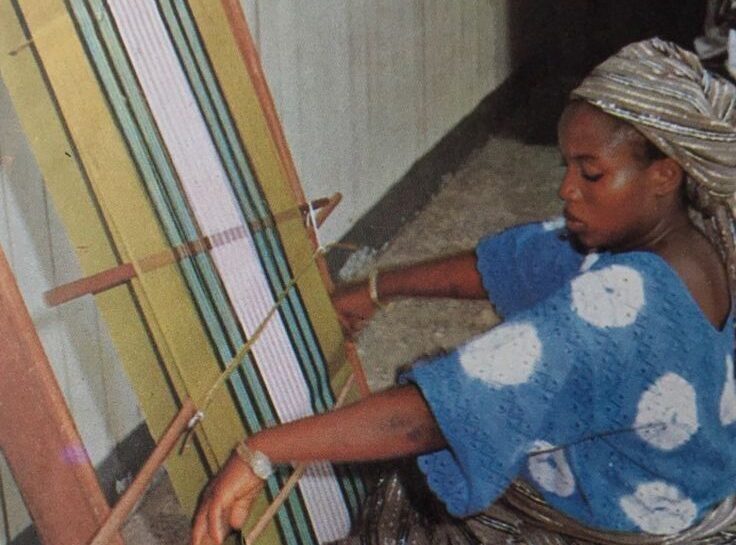
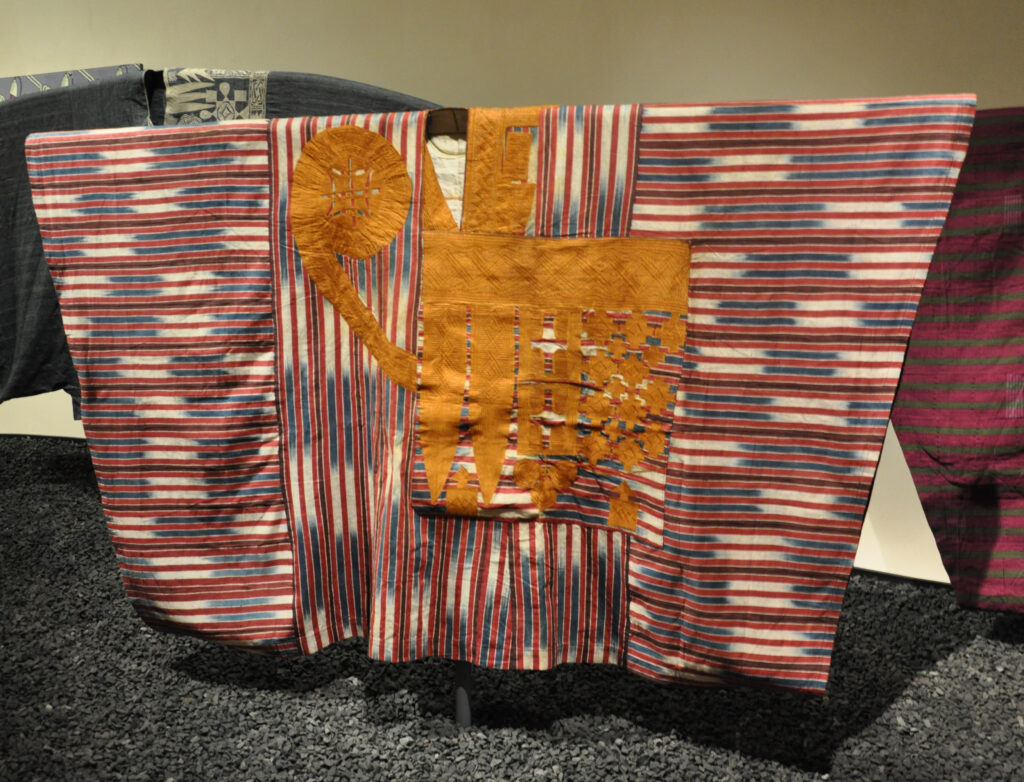
A designer in Lagos opens a generative AI tool and types in a prompt. She wants an editorial image rooted in Aso-Oke, the Yoruba strip-weave she has worn since she was a girl, the cloth her mother pulled out for every wedding, the cloth on every chief at every ceremony she remembers. What comes back is polished, cinematic, and wrong.
The silhouette has no relationship to how hand-loomed cloth actually moves in her city. Fabric falls like a studio render instead of something woven on a narrow loom and pieced together by hand. The pattern is Aso-Oke adjacent but generic, one of four or five motifs the internet has decided count as African because they show up most often in stock libraries. The headwrap is styled for an algorithm that has never been to Balogun Market. The image is “African” the way the internet has learned to see the continent: flattened, detached from lineage.
She closes the tab and does the work herself.
The system keeps learning anyway, and what it is learning from is not her. It is the internet’s idea of her, scraped without consent and sold back to the market as a cheaper version of what she knows.
The mistake is not small, and the question it opens is structural. Who owns the systems now learning to interpret African creative life, and what happens when those systems get it wrong at scale?
This is a product problem with economic stakes, not an aesthetic complaint. If a model cannot understand the drape of a specific Guinean lépi, or the difference between an Aso-Oke worn for everyday tailoring and one whose pattern signals a particular family or ceremony, the failure isn’t representational. It is technical. Bad data produces bad products. African creative traditions are some of the most layered source material in the world, and models that read them poorly end up producing weaker intelligence in every market, not just this one.
What follows is about both halves of that story: a global AI industry building on incomplete foundations, and the African builders putting better foundations down.
Beyond the App: The Intelligence Layer
For most of the past decade, African creative-tech was defined by what got built on top of borrowed rails. Creators worked around global social platforms, mobile storefronts, and improvised payment systems that were never quite designed for the continent. A smartphone in Lagos or Accra had to function as studio, bank, and audience pipeline at once, and the workarounds were often the product. The results were real and measurable: Selar paid out over ₦18 billion in 2025 to nearly 400,000 creators across Africa, and NewComma now hosts more than 17,000 creatives, with a wider network of over 60,000 African and diaspora talent finding work outside the structures that used to gatekeep it.
What comes next is harder. The frontier has moved beneath the upload, into the systems that decide what an upload means in the first place. Speech models have to make sense of local accents they were never trained on. Recommendation engines decide, opaquely, what gets surfaced to whom. Datasets quietly define what passes as “African design” to a global audience. Machine learning systems determine whether African creative labor is legible at all to the market on the other side of the screen.
That, in shorthand, is the Sovereign Stack: the fight for ownership over how African culture is recognized, translated, and paid for at the level of model and infrastructure rather than feed and post.
Visibility is not the same thing as recognition, and the gap between them is economic. A recommendation engine surfaces what it can hear; everything else gets buried. Transcription systems do similar work in reverse, preserving what they can parse and quietly losing whatever they cannot. For creative industries, that gap shows up most painfully in royalty payments that never reach the artist whose name the system never learned to read.
The internet does not have a language problem. It has an ear problem.
The Scale of the Gap
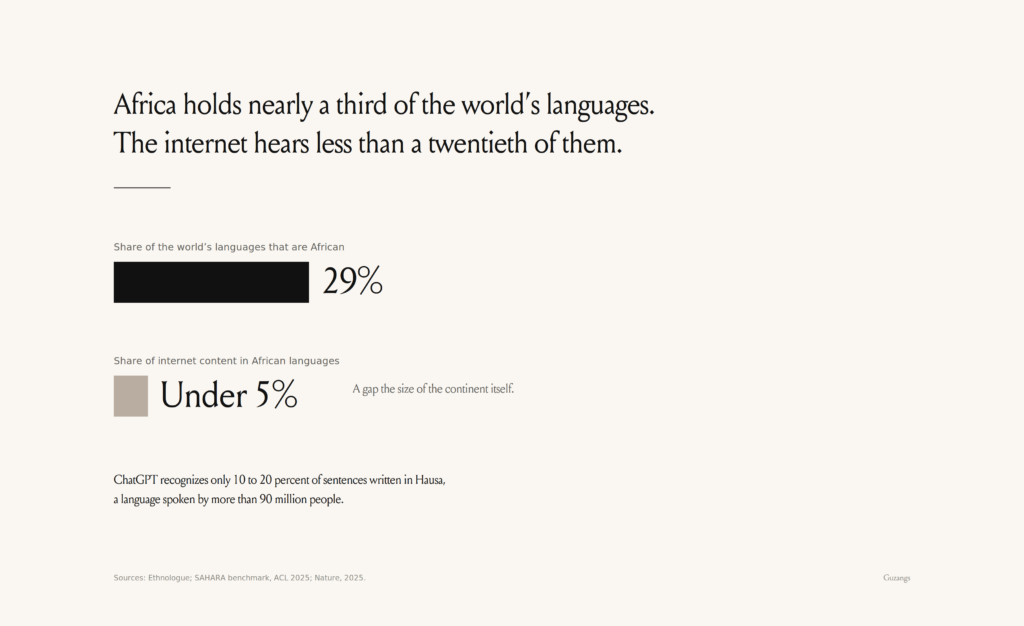
Africa accounts for roughly 2,000 of the world’s 7,000 languages. No single African-origin language accounts for even 0.1 percent of global internet content, according to w3techs data cited by the Barcelona Centre for Contemporary Culture. The datasets that train generative AI were built on that internet, which means they were built on an internet that barely hears the continent.
The SAHARA benchmark, published at ACL 2025 by researchers at the University of British Columbia and MBZUAI, evaluated 517 African languages across 16 natural-language-processing tasks. The performance gap between English and most African languages is wide and persistent. Its authors traced those disparities not to linguistic complexity but to policy-driven data inequities and decades of underinvestment in digital infrastructure.
The recognition gap is just as revealing. According to Sarah Wild’s July 2025 Nature feature, ChatGPT recognizes only 10 to 20 percent of sentences written in Hausa, a language spoken by an estimated 94 million people across West Africa, primarily in Nigeria and Niger. Imagine sending a CV to a recruiter who can only read every fifth word. That is roughly what it means for one of the continent’s most spoken languages to live inside the world’s most-used AI tools.
There is a harder truth underneath the deficit. Global models are not ignoring African content. They are ingesting it. African music, visual culture, fashion, and design have all been absorbed into training datasets without consent or payment. The sovereign stack is about both: building what is missing, and reclaiming leverage over what has already been taken.
If you do not help build the training set, your style becomes a prompt that someone else owns.
The Rise of Sovereign Infrastructure
African builders are no longer waiting to be interpreted.
They are doing it against a concentrated capital landscape. 83 percent of AI startup funding on the continent goes to four countries: Nigeria, Kenya, South Africa, and Egypt. Much of it comes from international investors.
In 2023, in a co-working space in the Rosebank neighborhood of Johannesburg, Jade Abbott opened a tab on her laptop and asked ChatGPT to count from one to ten in isiZulu, a language spoken by more than ten million people in her native South Africa. The answers came back, in her words, mixed and hilarious. She tried translation. The results were not close. She did not close the tab. She and the biomedical engineer Pelonomi Moiloa had co-founded Lelapa AI the previous December, a Johannesburg-based research and product lab committed to building language infrastructure for the continent from the continent.
By 2024, Lelapa had released InkubaLM, a compact multilingual model trained on five African languages spoken by roughly 364 million people: Swahili, Yoruba, isiXhosa, Hausa, and isiZulu. Its Vulavula platform offered transcription, translation, and sentiment analysis tuned to local accents and code-switched speech. Moiloa was named to TIME’s 100 Most Influential People in AI. Microsoft President Brad Smith publicly cited Lelapa as a partner.
Lelapa sits inside a broader architecture. Masakhane, the grassroots NLP collective Abbott co-founded at the Deep Learning Indaba in 2019 with Laura Martinus and Vukosi Marivate, has grown into a community of more than 2,000 African researchers working across over 40 languages, supported in part by a $3 million Google.org grant. Masakhane’s name means “we build together” in isiZulu, and the collective produces benchmark datasets like MasakhaNER and MasakhaNEWS that the field now relies on to measure whether any African-language model actually works.
In Nigeria, Awarri’s N-ATLAS project, launched on the sidelines of UNGA80 in September 2025 in partnership with the Federal Ministry of Communications, Innovation and Digital Economy, is an open-source multilingual and multimodal model covering Yoruba, Hausa, Igbo, and Nigerian-accented English. The government partnership has come with its own debates, including reporting by Rest of World on data ownership and procurement. Those debates are exactly the terrain sovereignty asks a sector to occupy.
Intron Health, founded by Dr. Tobi Olatunji, started in clinical speech-to-text and has grown into voice AI now spanning 24 African languages and over 500 accents, trained on more than 50,000 hours of audio from 40,000 speakers across 30+ African countries. The team has published benchmarks like AfriSpeech-200 with Masakhane and Zindi, and released Sahara-v2, which includes the world’s first bilingual Swahili-English ASR built for the rapid code-switching that mainstream speech-to-text still mangles.
These are infrastructure projects, and they point to something larger: African digital infrastructure that begins to hear African life accurately, and creators working in local languages who no longer have to flatten themselves to fit someone else’s machine.
When an AI can hear the difference between Twi and Ga, or between Nigerian Pidgin and formal English, it is registering forms of meaning that have long been dismissed as noise.
What Culture Loses
For creative industries, the stakes look like this.
A music recommendation engine that does not understand Afrobeats subgenres will quietly bury a Lagos producer behind better-indexed competitors who happened to be built into the system from the start. A transcription model that cannot handle code-switching between Pidgin and English will deliver garbled subtitles on a Nigerian film and lose half the dialogue to any search engine that comes looking later. An image model that decides “African design” means kente cloth and mud cloth motifs will train the next round of brand teams and creative directors to expect exactly that, and call it research.
Once errors like these harden into infrastructure, they become much harder to challenge.
The AI conversation in Africa cannot be reduced to hype cycles or funding announcements. The question is who gets to define the systems now sorting and pricing cultural work, and whether African creators are in the room when those systems are built or only learning about them after the fact.
A sovereign stack means more revenue, not just better-looking images. The Ghanaian producer reaches the right ears instead of getting buried in the algorithm. A multilingual podcast keeps its meaning through transcription instead of losing half of it. And the royalty payment for a Lagos hit actually finds its way back to the artist whose name the system finally learned to read.
The Next Site of Authorship
The politics are catching up to the technology. The Deep Learning Indaba has made sovereign intelligence a central frame for its 2026 convening. UNESCO has been building toward global commitments on multilingualism and community participation in the governance of linguistic data. In March 2026, the GSMA and Zindi launched the African Trust & Safety LLM Challenge at MWC Barcelona, inviting data scientists worldwide to stress-test large language models across the languages and code-switching patterns most existing safety frameworks ignore. Sovereignty has crossed over from rhetoric into infrastructure.
The creative industries belong in that conversation from the start. No sector understands more clearly what it costs when a system learns your surface and misses your substance.
For years, African creativity has been globally visible but unevenly valued. The image has traveled. The sound has crossed over. But the systems that catalog, surface, monetize, and protect that work have usually sat somewhere else. Stronger local infrastructure can keep more of that value with the people making the culture. AI is the next vector for it to leak away, this time through models and datasets rather than just platforms and publishers.
The intelligence layer is the next site of authorship, and it asks for a different cast at the center of the story: not only the artist but the founder building the model behind her work, the engineer training it, and the cultural worker making sure the model knows what the work actually is.
To endure, culture needs architecture.
The first chapter of African creative-tech was about proving creators needed rails. The next chapter is about whether African builders will help define the intelligence those rails carry. Audiences still see the image first. The model lives behind it. And behind the model is the question that may matter more than any launch event or product demo.
Who trains the machines that see Africa?
The answer will decide whether the next decade of African creativity becomes a gold rush for global platforms or a renaissance for the continent’s builders.
The architecture behind the image is what decides the next decade. Subscribe.
The Sovereign Stack is an original Guzangs series on the data, models, and systems shaping the African and diaspora creative economy, and the builders working to own them.