The Guzangs Report

The African creative economy, tracked

The Guzangs Report gif;base64,R0lGODlhAQABAAAAACH5BAEKAAEALAAAAAABAAEAAAICTAEAOw==

The Guzangs Report · Quarterly Editions

Period covered · 1 April – 30 June 2026

The Guzangs Report

Q2 2026

The African creative economy, tracked.

The Infrastructure Beneath the Visibility

The continent's creative work has rarely been more visible than it was this quarter. A nation of half a million people held the world's attention through a goalkeeper at the World Cup, and a Nairobi house reached the LVMH final for the first time. What the quarter exposed underneath the attention was how much of the machinery that turns visibility into income is missing or owned somewhere else. In the same three months, Africa's leading fashion e-commerce platform closed, one of its most important art galleries shut its London doors, and its biggest homegrown streamer was switched off. The visibility and the corrections arrived together.

This briefing reads Q2 through that gap, between how far African creative work now travels and how slowly the businesses behind it can scale. It works through Guzangs' editorial lens: fashion, textiles, art, sport style, creator infrastructure, cultural IP, and the platforms that move value around them. It is built first from Guzangs' own reporting across the quarter, with outside data used to test and extend it.

Period covered: 1 April to 30 June 2026.  Prepared by the Guzangs editorial desk.

00

The Quarter in Brief

Q1 mapped the infrastructure of African fashion, the competing models through which the work gets built and funded. Q2 put that infrastructure on trial in public. The defining story was the distance between attention and income, and what happens to the businesses caught in it.

Three movements ran through the quarter. The corrections came first, as platforms built to commercialize African culture for global audiences shut down across commerce, art, and screen. The builds ran alongside them, in a cotton-to-garment factory outside Dakar, a European fashion week paying African designers to show, and creator-payment rails reaching real scale. Underneath both, the policy floor shifted, with AGOA renewed for a single year and a hard expiry in December, while new tariff regimes reshaped who can sell what, and where.

The throughline

Visibility is no longer the hard part. The unresolved question is whether the value it creates can be kept, and by whom.

Fashion

Recognition rose, the production base began to move

African fashion's global validation hit new highs while the continent started building the manufacturing it has long lacked. A Kenyan house reached the LVMH Paris final, the first to do so, and Dakar opened a cotton-to-garment factory aimed at keeping value closer to the cloth. Recognition is increasingly solved; value capture is the unfinished work.

Proof point: First Kenyan house in the LVMH final · AVCI's ~$10.45M plant opens in Diamniadio.

Art

The correction reached the galleries

The African art market is contracting from its 2022 peak, and the mid-tier gallery is the first casualty. Tiwani Contemporary closed after fifteen years, the layer that backs artists before the wider market does, and the one most exposed when collector confidence cools.

Proof point: 2022 auction peak ~$116.5M · Tiwani closes after 15 years.

Business

Platforms built on visibility ran out of runway

In a single quarter, the businesses built to monetize African culture for global audiences closed across commerce and screen. Industrie Africa and Showmax showed that an audience is not the same as a fundable model, and that the capital to build the layer underneath is still missing.

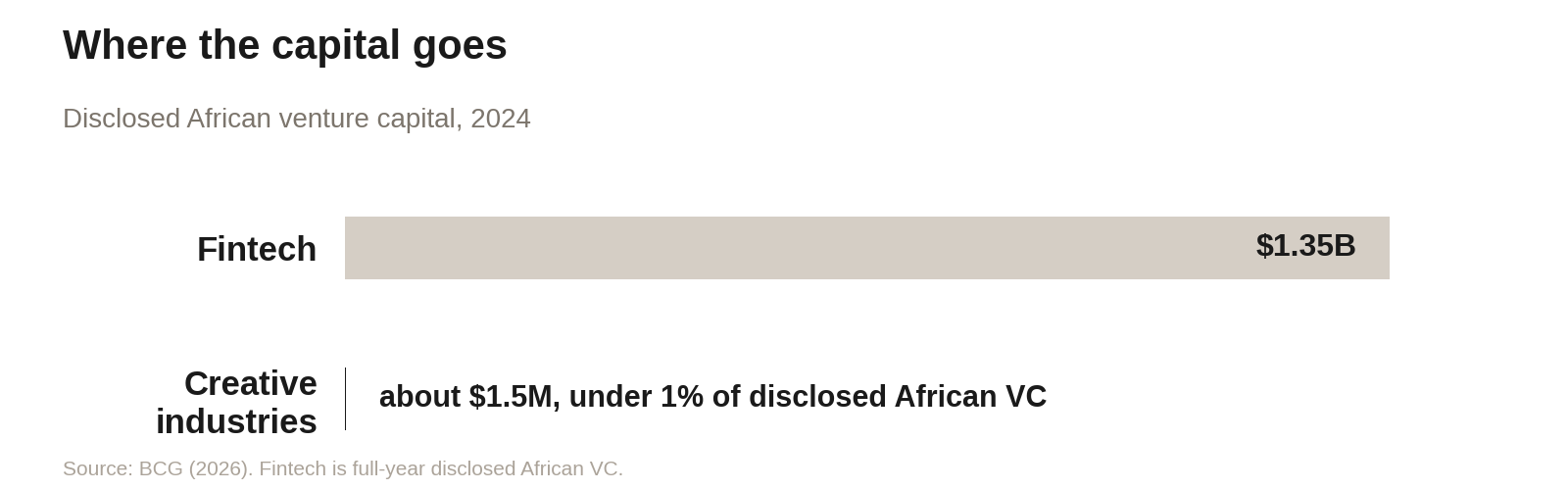
Proof point: The creative sector drew under 1% of African VC, about $1.5M against fintech's $1.35B.

AI

Discoverability is becoming the institution

The contest is shifting from being seen to being legible to the machines that now broker attention, search, and payment. African languages and creative work sit largely outside that layer, and Q2 was when the frontier started getting funded. Whoever owns the index, the metadata, and the payment page decides who gets found and paid.

Proof point: Of 2,000+ African languages, ~42 appear meaningfully in major models · Selar paid creators $12.8M in 2025.

Free · Not a paywall

Read the full report

The Guzangs Report is free. Enter your email to unlock every section, and we'll send the next quarter to your inbox. No payment, no catch, sign up once and it stays open.

Already subscribed on this device? The report opens automatically.

✓ You're in. The full report is unlocked.

01The Lead Question: Who Keeps the Value

The African industry named the problem itself this quarter. At London Climate Action Week on 22 June, the African Fashion Coalition convened by Lagos Fashion Week, the 2025 Earthshot Prize winner, launched a ten-pillar regenerative-fashion manifesto, The Blueprint for a Regenerative Fashion Future. Its framing could serve as the title of this report. African creators, it said, are celebrated as inspiration and “shut out of the industry we inspire.” The pillars run straight through the quarter's signals: cultural intellectual property, local production, economic sovereignty, and waste justice. This is the thesis stated from the inside. The test, as ever, is whether ten pillars become procurement rules, supplier standards, maker income, and enforceable IP protection, rather than language.

Football made the case in public. Cape Verde, one of the smallest nations ever to reach the World Cup knockout rounds, drew nil-nil with Spain on 15 June, and its goalkeeper Vozinha became the face of the tournament. His following rose from roughly fifty thousand to about fifteen million inside a week. Travel interest in the islands spiked, and reaching the Round of 32 earned the federation a multimillion-dollar FIFA payout. Guzangs followed the same moment to its edges and found the gap: the goalkeeper drew a global audience while his own mother nearly missed the tournament over the cost and timing of a visa. The follower equity sits with an individual, the prize money with a federation, the merchandise margin with a kit supplier, and the family could barely reach the stadium.

The brands read the visibility better than the systems did. Puma dressed five African nations at the tournament, the largest block of any kit maker, with design teams that spent close to two years in those countries before finalizing the jerseys. That is sportswear treated as cultural infrastructure, and a reminder of where the licensing value lands: with a German sportswear group, not the federations whose identity it sells. A Kenyan house reaching the Paris LVMH final the same quarter made the point from the other direction. The work was seen everywhere; the structures that decide where its value rests still sat largely outside the continent.

The clearest evidence was not a win but a closure. Industrie Africa, the platform built to sell African fashion to the world, shut its store at the end of April. Discovery and storytelling had worked. What closed the store was the cost structure beneath them: US tariffs, the end of the de minimis exemption, and a craft-led, made-to-order production model that a global e-commerce system built for instant replenishment could not carry.

Why this is the quarter's frame

African creativity now travels faster than African creative businesses can scale. Every signal below is a test of whether the gap is closing or widening.

02Market Signals

The material developments of the quarter, grouped as corrections, builds, moments of visibility, and the policy and digital shifts around them.

What counts as a signal

Guzangs counted a Q2 development as material when it changed one of five things: value capture, production capacity, distribution, policy exposure, or cultural discoverability. Viral moments are included only where they shifted commercial leverage, tourism demand, licensing potential, or institutional attention.

Corrections

SignalWhat happenedWhy it matters
Industrie Africa closes its storeThe continent's leading multi-brand fashion e-tailer shut e-commerce on 30 April after five years, pivoting to an advisory model, IA+.About 80 percent of sales were US-based. Tariffs, the end of de minimis, and small-batch production broke the model.
Tiwani Contemporary closesThe London and Lagos gallery for African and diaspora art ceased operations on 28 May after 15 years.The African art market has contracted from its 2022 peak. The mid-sized gallery, the layer that backs artists early, is the first to disappear.
Showmax switched offCanal+, now owner of MultiChoice, announced the streamer's end in March and switched it off on 30 April, calling it an expensive failure.Even the leading homegrown streamer could not carry the cost of competing across 40-plus markets.

Builds

AVCI textile plant opens in DakarSenegal's president inaugurated a Turkish-backed cotton-to-garment unit at Diamniadio on 20 June. About $10.45M, near 200 jobs.A physical bet on owning the value chain. The test is local skills and procurement versus another enclave inside a special economic zone.
African Fashion Coalition manifestoLagos Fashion Week launched a 10-pillar regenerative-fashion manifesto at London Climate Action Week on 22 June, with the Earthshot Prize.The industry's own declaration of the value problem: celebrated as inspiration, shut out of the industry it inspires.

Visibility and validation

Cape Verde at the World CupDrew with Spain, reached the Round of 32; goalkeeper Vozinha gained roughly 15 million followers in a week.Follower equity, prize money, and merchandise margin all settled in different hands.
Yoshita 1967 in the LVMH finalAnil Padia's Nairobi house was named among nine finalists on 24 April, the first Kenyan house to reach the final. Final on 4 September.Paris validation at the highest level. The open question is whether a strong showing builds capacity in Nairobi or in Europe.

Policy and digital

AGOA renewed for one year onlySigned 3 February, effective to 31 December 2026. The House had passed a three-year version 340 to 54.An uncertainty tax on apparel exporters. The cliff lands at year-end, and Industrie Africa is the early warning.
AI meets African languagesCommonLingua, covering 61 languages, launched 28 April; the Masakhane LINGUA Africa fund closed its call on 15 June.Discoverability is becoming a funded frontier. Being legible to the machine is the precondition for being indexed and paid by it.
03Market Corrections: Visibility Without Infrastructure

Three closures in one quarter, across commerce, art, and screen, told a single story. The platforms built to turn African cultural appetite into revenue ran into the same wall.

Commerce: Industrie Africa

Founded in 2018 by the Tanzanian entrepreneur Nisha Kanabar, Industrie Africa spent five years as the continent's leading multi-brand fashion store, carrying more than seventy designers from over twenty countries to shoppers in roughly sixty markets. It closed its e-commerce arm on 30 April. The United States accounted for close to 80 percent of sales, the vulnerability Vogue Business identified when US tariffs of 15 to 30 percent and the end of the de minimis exemption hit overnight, with AGOA uncertainty making long-term pricing impossible. Underneath the policy shock sat a structural mismatch. African fashion is small-batch, made-to-order, and craft-led, and global e-commerce is built for instant replenishment and predictable logistics. The company is pivoting to Industrie Africa Plus, an advisory placing African brands inside luxury hotels and concept stores, with a first site on Bawe Island in Zanzibar. The direction of that pivot, into hospitality, is itself a signal worth holding.

Art: Tiwani Contemporary

Tiwani Contemporary closed on 28 May after fifteen years between London and Lagos, shutting its Mayfair space and pausing Lagos for restructuring. Founded in 2011 by Maria Varnava and named by the late curator Bisi Silva with a Yoruba phrase that translates loosely as it belongs to us, Tiwani showed Njideka Akunyili Crosby, Simone Leigh, and Kapwani Kiwanga before the wider art world decided they mattered. Its closure, reported by the Art Newspaper and Artnet, arrives as the African art market contracts from a 2022 peak, when auction sales reached about 116.5 million dollars, with Art X Lagos exhibitor numbers falling sharply the following year and Sotheby's folding its dedicated African art department into broader sales. The reading in Guzangs' own coverage was direct: galleries are the weakest layer of the infrastructure, and when collector confidence slows they are the first to go. Visibility alone does not sustain a market.

Screen: Showmax

Showmax went dark on 30 April, eleven years after launch. Canal+, which acquired MultiChoice in a roughly two billion dollar deal last September, announced the discontinuation in March and switched the service off at the end of April, after losses that had worsened by close to 90 percent, with its chief executive calling it an expensive failure. The failure was financial rather than creative. Subscribers had grown 44 percent year on year, and the platform backed bold local storytelling from Lagos to Nairobi to Johannesburg that rival services would not. Building a streaming platform across more than forty African markets, in the same era as Netflix and Disney, demanded capital the business could not generate fast enough, in markets where data is costly and incomes irregular.

The pattern

Commerce, art, and screen hit the same wall in a single quarter. The appetite for African work is real; the architecture built to monetize it for global audiences is thin, and exposed to tariffs, rising costs, and a cooling market.

04The Infrastructure Being Built

Against the closures, the quarter also produced the quieter work of building. Most of it sat below the runway, in factories, funding mechanisms, and the everyday clothing economy.

Production: Dakar tries to own the value chain

On 20 June, as Senegal's state daily Le Soleil reported, President Bassirou Diomaye Faye inaugurated a textile plant by the Turkish group AVCI Global Industrie at the Diamniadio special economic zone outside Dakar. The unit represents a 6 billion CFA franc investment, about 10.45 million dollars, with capacity near 1,200 garments a day and close to 200 jobs in a first phase weighted toward young and women workers. The stated aim is to process Senegalese cotton locally and supply state uniforms through guaranteed public procurement, the spine of a cotton-to-garment strategy under the Senegal 2050 plan. The gap it targets is real. By US Department of Agriculture estimates, local processors transform only about 3.6 percent of Senegal's cotton. The skeptical question, the one Guzangs raised in its reporting on the ASFW Dakar sourcing fair, is whether this becomes durable local capacity and skills transfer or another foreign-backed enclave inside a zone. ASFW Dakar framed the same shift months earlier: African fashion moving from image to industrial policy, where sourcing, leather, and cotton matter more than the runway.

The cloth underneath

The factory is the industrial layer. The cultural layer is just as economic, and Guzangs' Material Literacy series has been documenting it. The work on Guinea described a textile civilization now dependent on imported yarn, with thin local spinning and younger weavers drifting away. The work on kente set out Ghana's 2025 geographical-indication protection as a real legal step that still needs buyer education to bite, because printed imitations carry no maker, no name, and no labour, yet undercut the woven cloth on price. If buyers cannot read woven from printed, or authorship from pattern, the market rewards imitation. Owning the value chain means owning the meaning of the cloth as much as its manufacture.

Funded access: who pays for the show

For Africa-based designers, the cost of presenting in Europe has long been the barrier, and one European fashion week pays it down directly. Berlin Contemporary, the Berlin Fashion Week competition funded by the Berlin Senate, awards 25,000 euros per selected label to stage a runway show or presentation, with around five international slots and one reserved for a label based in an African country. It has continued to function as one of the few European fashion-week mechanisms that directly subsidise the cost of showing, with SS27 winners including Buzigahill, Fruche, and Orange Culture. The signal is not Berlin itself but the economics underneath it: for many Africa-based designers, international visibility still depends on production funding from outside. It is a genuine lifeline, and a dependency, since the access it opens is paid for elsewhere.

The economy that already works

Underneath the export ambition sits a clothing economy that already functions, and Guzangs spent the quarter reporting it. How Dakar Moves described a creative economy that runs on relationships, tailors, the fabric stalls of Marche HLM, and the recurring demand of weddings, baptisms, and Tabaski, rather than on export. The Cloth That Carries the Church traced chitenge inside Zambian Catholic women's groups as a recurring, women-led textile economy that is more stable than most fashion-week moments. And in Accra, Kantamanto continues to rebuild after the January 2025 fire as one of the largest circular-fashion labour systems anywhere, absorbing millions of used garments a week from the Global North. These systems rarely appear in runway coverage and rarely attract funding, yet they are where most clothing value on the continent actually changes hands.

05Designers

A map of where value is moving this quarter, told through the designers Guzangs covered and read by the model each one represents. This is not a watchlist. Every name here earns its place by revealing how value gets made and kept, rather than by a single collection.

The systems designer

Diarra Bousso, Diarrablu (Dakar). Bousso designs with equations, datasets, and digital tools, lets community voting help decide which prints go into production, and keeps hand-painting and artisan work at the centre. Guzangs profiled the model this quarter, including a Dakar atelier community that has grown from fewer than five people before the pandemic to more than thirty. It points to where the next layer of African fashion infrastructure sits, in the systems around the cloth: on-demand production, data-informed design, and capacity held locally.

Cotton as origin

BAKUSORAYA (Manane Bakary, Cotonou). Benin is West Africa's largest cotton producer, and BAKUSORAYA builds from that fact rather than around it. The house's Coton brut collection, which Guzangs published this quarter in a piece reported by Oury Sene and photographed by Christ M'po in a Porto-Novo courtyard atelier, works in raw, unbleached cotton and argues that luxury is measured by how close the garment stands to the field, not by how far it travels from it. It is the designer-scale version of the bet the AVCI plant makes at industrial scale: that the value in African cloth begins in the cotton, and should be kept there.

Diaspora research, done properly

Huguette Tchiapi, Numero 01 (London and Yaounde). Tchiapi's debut is the rare diaspora project that returns to material systems instead of flattening them into reference. Developed between London and Cameroon, and reported by Guzangs, it grew out of research into Ndop cloth, work with weavers on traditional looms in Douala, museum archives in Yaounde, and a collaboration with a bamboo furniture maker named Paul. The value is in the method: building from Central African craft knowledge with the makers kept in the frame.

The economics of handwork

Hertunba, Florentina Agu (Lagos). The Akaoru collection makes the cost of craft visible, which is the point. Across 23 looks spanning weaving, woodwork, and pottery, Agu commissioned surviving wood carvers from her father's old network to make bags from reclaimed mahogany and ebony, paying above the usual furniture-commission rates. It is what heritage looks like as paid production rather than mood-board borrowing, the distinction Guzangs drew in its reporting on the economics of the runway moment.

Lagos leather as proof of concept

Kkerele, Tina Akerele (Lagos). Kkerele turns African manufacturing from policy language into a shoe with a price. The leather footwear is made to order by a network of Lagos makers, and Akerele's stated ambition, as Guzangs reported, is to build a standardized manufacturing facility in Nigeria that could serve Kkerele and other brands. The bet is the one Industrie Africa's closure underlined: that the missing layer is repeatable production capacity.

National image as product

Ibrahim Fernandez (Cote d'Ivoire) and Alvin Junior Mak, JMAKxPARIS (DR Congo). The World Cup turned the team arrival into a runway, and two designers showed what it means when national image is authored from inside the country rather than outsourced to a European maison. For Cote d'Ivoire, Fernandez built a ceremonial look commissioned by the national federation around Ivorian dye traditions, regional craft, and the elephant totem. For DR Congo, Mak dressed the Leopards for their first World Cup since 1974 in black silk crepe with leopard accents and star-shaped bags, drawing on La Sape and the 1974 squad. The image went global within hours, and the project moved from image to business quickly. By Vogue's account Mak has fielded more than a hundred orders and interest from clubs and national federations, with an ambition to keep much of the artisanal production in Congo as he prepares for a Paris Fashion Week debut in early 2027. The open question is whether the viral arrival becomes a durable business, through commissions, licensing, and that local production, or fades into another African image absorbed by the tournament's attention economy.

Validation, capture unresolved

Yoshita 1967, Anil Padia (Nairobi). The first Kenyan house to reach the LVMH Prize final, named on 24 April among nine finalists drawn from more than 2,400 applicants, with the final set for 4 September. Every piece is made in Nairobi by a team of 21 women artisans, so the production base already sits on the continent. That is what makes it the test case. A strong showing in Paris is validation. Whether the capital, mentorship, and orders that follow build capacity in Nairobi or mostly feed a European pipeline is the open question, and the one to watch into Q3.

The benchmark: owned infrastructure

Thebe Magugu (Johannesburg). The benchmark rather than an emerging name. Magugu offers one of the clearest cases of value capture on the continent, built on owned space, hospitality, exhibitions, and brand collaboration with houses including Dior, Valentino, and Adidas, rather than on scaled wholesale. Magugu House, his Johannesburg campus, pairs a shop, a gallery, and a working atelier under one roof. In Cape Town, his residence at Mount Nelson, A Belmond Hotel, became Belmond's first ever Designer Residence and the hotel's first designer collaboration in its 125-year history, set alongside a Magugu House concept store whose opening exhibition was staged with Southern Guild. When Industrie Africa closed, it pivoted toward exactly this terrain. Luxury hospitality is emerging as African fashion's next retail layer, and Magugu is already there.

The caution. His unit economics are not public, and the press around the brand runs ahead of any disclosed numbers. A model leaning on collaboration and licensing captures value, and it concentrates the risk in a small number of partners.

06The Sovereign Stack: AI, Payment, and Discoverability

If the corrections and the factory are about physical infrastructure, the most forward part of the quarter's story is digital, and it is where Guzangs has been reporting ahead of the field. The Sovereign Stack series ran its argument across three installments. The argument is simple. Before African creative work can be paid for, it has to be seen by the machines that now mediate culture, and being seen is itself a contest over who builds the index.

Part One: who trains the machines that see Africa

The series opened on training data. Africa holds more than two thousand living languages, and across the major large language models only around 42 appear meaningfully, with four handled consistently. A language absent from the training data is, in effect, absent from the systems that increasingly broker attention, search, and translation. Two Q2 moves began to close the gap. CommonLingua, an open language-identification model covering 61 African languages, launched on 28 April from Pleias and the GSMA. The Masakhane LINGUA Africa fund closed its open call on 15 June, with up to 250,000 dollars in cash and 400,000 in compute per project. The frontier is now funded, which is the precondition for being indexed at all.

Part Two: the machine can see you, it still cannot pay you

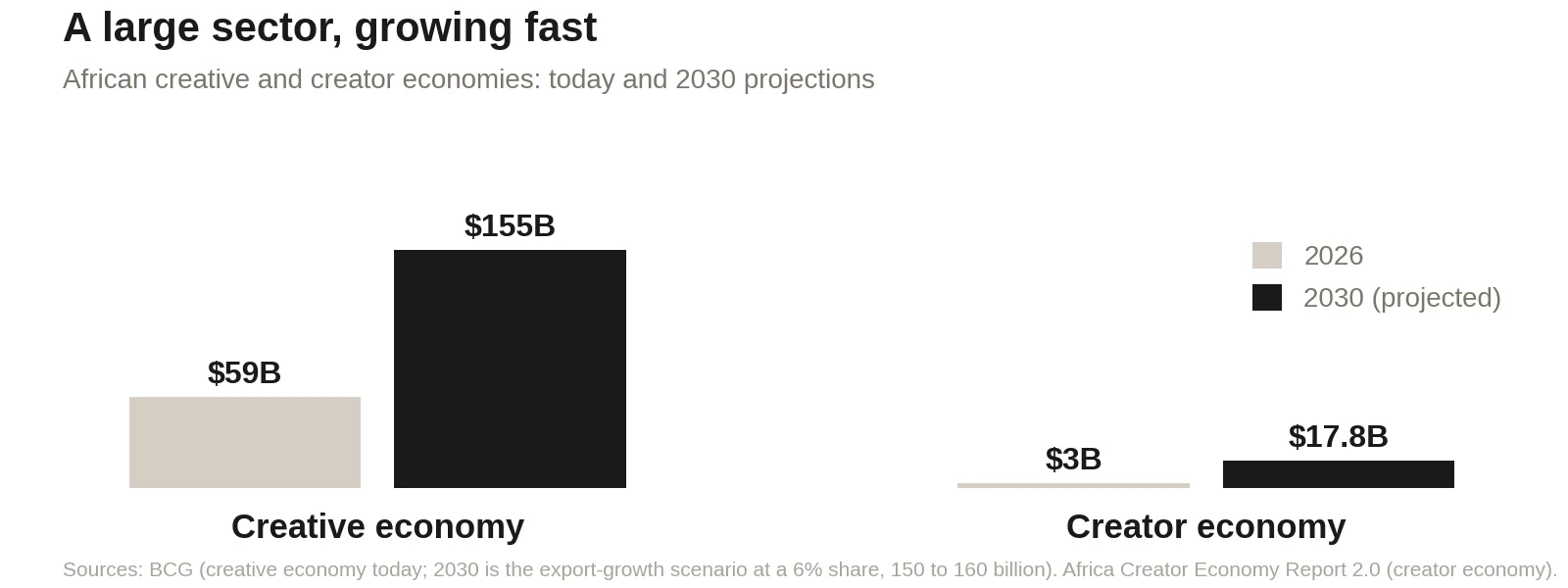
The second installment turned to compensation. African creativity is already inside the machine, through images, music, cloth, ceremony, and archives pulled into training sets, while the creators sit outside the systems that would pay them for it. Payment depends on provenance, on systems that can prove what was used, from whom, and on what terms, and that layer is only now being built. The rails that exist are maturing fast. Selar, the Nigerian creator-commerce platform profiled in the series, paid out over 12.8 million dollars to African creators in 2025, close to double the year before. The African creator economy sits near 3 billion dollars today and is projected toward 17.8 billion by 2030, even as roughly 60 percent of creators still earn under 100 dollars a month.

Part Three: the index is the institution

The third installment made the sharpest point. Before work is recognized or paid, it has to be found, and finding now depends on descriptions, tags, provenance records, and the categories built into archives, marketplaces, and retrieval systems. Whoever controls the index shapes what can be found, a power that used to belong to institutions. The piece profiled Chao Tayiana Maina, whose work with African Digital Heritage and Open Restitution Africa builds African-governed records of cultural objects and their histories, and Douglas Kendyson of Selar, whose payment pages turn an audience into revenue. The tension it named is that the same legibility which makes African work payable also makes it extractable. The next layer of African creative infrastructure runs through metadata, provenance, payment pages, and indexes that Africans own, alongside the factories and stores.

Why this is the spine

Fashion weeks and prizes still decide who gets celebrated. What gets found, and eventually paid for, increasingly depends on the index and the payment page beneath it. The open question for the continent is whether Africans build that layer or get catalogued by it.

07Data and Policy

Market sizing

African creative economy, estimated value (BCG, 2026)~$59 billion
Share of the ~$2 trillion global creative marketUnder 3%
BCG 2030 scenario, exports at a doubled 6% share$150 to $160 billion
Creative industries' share of African venture capitalUnder 1%
Disclosed creative-sector VC, 2024, vs fintech ($1.35B)~$1.5 million
African fashion market (UNESCO, 2023)~$31 billion
Annual African textile and apparel exports~$15.5 billion

The pattern is consistent. A large and fast-growing sector that institutional capital has not yet learned to fund. For Guzangs, the under-funding is the opportunity, the white space for an authoritative record of an economy the market still misreads.

African creative and creator economies, today and 2030 projections
Figure 1. The creative and creator economies are projected to grow several times over by 2030.
Disclosed African venture capital, 2024: fintech versus creative industries
Figure 2. Yet the creative industries draw under one percent of disclosed African venture capital.

Trade and policy

The policy floor moved in three directions at once. AGOA was renewed for a single year and now expires on 31 December 2026, after a four-month lapse, leaving apparel exporters planning against an eleven-month horizon; Industrie Africa is the lived consequence of that uncertainty. From 1 May, China expanded zero-tariff treatment across African countries with diplomatic ties, extending coverage beyond the least-developed countries already covered, a real opening that still does not equal industrial power without local production, standards, and buyer relationships. And the low-value parcel rules tightened on the other side, with the EU introducing a roughly 3-euro charge on small parcels and South Africa closing the loophole that let Shein and Temu undercut local sellers.

The policy clock

Apparel exporters face a hard AGOA stop in December, the same window as the Road to DFW calendar. New tariff lines are redrawing who can sell what. The sector's constraint now is uncertainty more than the loss of any single trade preference.

08Looking Ahead: Three Questions for Q3

One. Does the build hold? The AVCI plant and the ASFW Dakar agenda are a bet on cotton-to-garment production. Q3 will show whether procurement contracts, skills transfer, and a credible second phase materialize, or whether the factory stays a ribbon-cutting inside a special economic zone.

Two. Does the AGOA cliff get a bridge? With the program expiring on 31 December, the autumn is the window for a durable extension. If Congress does not act, expect exporters to price in the uncertainty and pull back before the deadline, with the effect landing across the same months as the Road to DFW activations. Industrie Africa is the early warning.

Three. Does Paris validation build capacity at home? The LVMH Prize final on 4 September will decide whether Yoshita 1967's run converts into capital, mentorship, and orders that strengthen the Nairobi base, or into a credential that mostly serves a European pipeline. Watch where the investment lands, not only who wins.

Q2 was the quarter the visibility met its plumbing. The closures and the builds were the same story seen from two sides. The next quarter decides which side holds. Subscribe to The Guzangs Report and read it before the market does.

Read The Guzangs Report

The African creative economy, tracked, every quarter.

Subscribe

The Guzangs Report

Q1 2026

The African creative economy, tracked.

Executive Summary

The African fashion and creative economy entered 2026 with structural momentum and structural friction in equal measure.

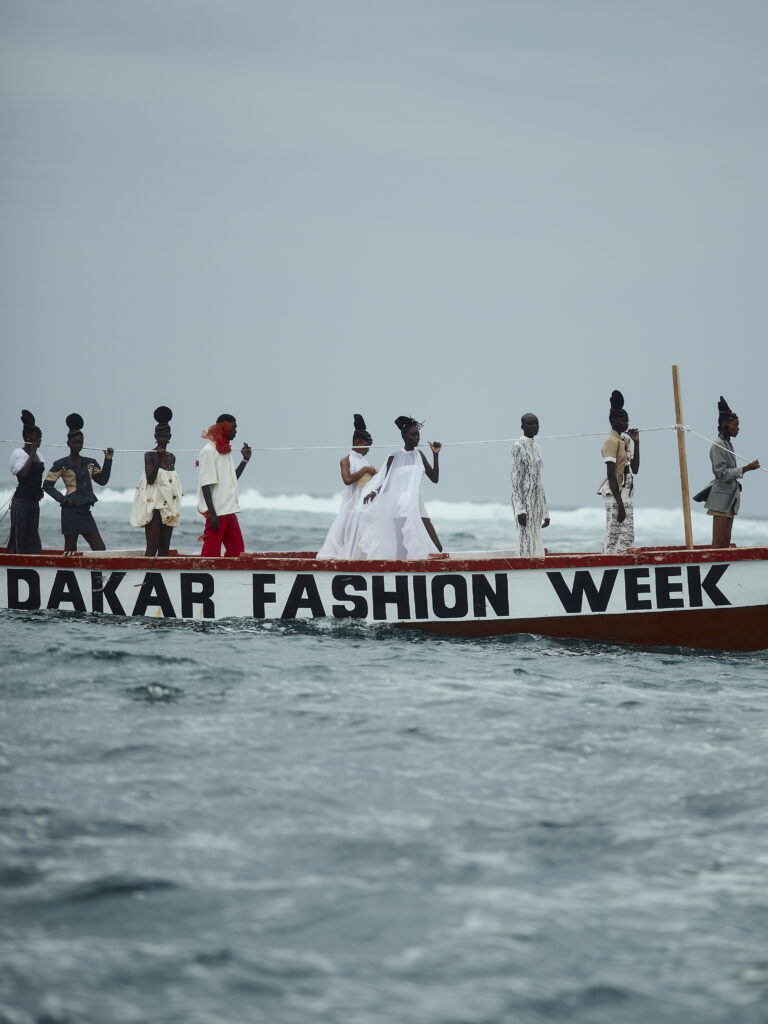
On the continent, Ghana announced three garment factories targeting 27,000 jobs. Hub of Africa Fashion Week centered Ethiopian manufacturing with its first cross-border sourcing roundtable. Dakar Fashion Week closed its 2025 season on pirogues in the Atlantic. Lagos Fashion Week won the £1M Earthshot Prize.

In the global system, recognition accelerated. Iamisigo and Yoshita 1967 reached the LVMH Prize semi-finals, both producing on the continent, with Kenya represented for the first time. Three African designers each won €25,000 at Berlin Fashion Week's Contemporary Competition, including Kenneth Ize, returning after a two-and-a-half year hiatus. Free The Youth became the first African brand to collaborate with Jordan Brand, with two releases confirmed for 2026. And Topshop launched an 18-piece capsule with Tolu Coker, placing African-diaspora design in scaled mainstream retail.

The friction points are just as real. African startup funding fell to $174M in January 2026, down sharply from the prior year and weighted toward debt, not equity. AfCFTA rules of origin for textiles remain incomplete. AGOA reauthorization extends only through December 2026, too short a horizon for multi-season factory investment. And Hanifa's pause after a fulfillment crisis exposed the gap between cultural capital and operational capacity that defines the sector.

This briefing tracks both sides: the creative and commercial momentum, and the infrastructure still missing underneath it.

Period covered: 1 January to 31 March 2026.  Prepared by the Guzangs editorial desk.

Fashion

Lagos Fashion Week wins the £1M Earthshot Prize

The first fashion platform to win an Earthshot Prize. Full analysis inside the report.

Proof point: First fashion platform to win an Earthshot Prize.

Business

Africa's apparel market: $73.6B in 2025 revenue

19 market signals tracked this quarter. From AGOA caps to Jordan Brand in Accra.

Proof point: 19 market signals tracked this quarter.

Art

African art auction sales: $70.5M in 2025, up 43%

The fastest-growing segment in the global art market. Source: Artnet Price Database.

Proof point: Fastest-growing segment in the global art market.

Free · Not a paywall

Read the full report

The Guzangs Report is free. Enter your email to unlock every section, and we'll send the next quarter to your inbox. No payment, no catch — sign up once and it stays open.

Already subscribed on this device? The report opens automatically.

✓ You're in. The full report is unlocked.

01The Infrastructure Question: Which Model Builds Careers?

The competing models through which African fashion careers get built and funded — the through-line of the Q1 edition. Read the full section in the complete Q1 report.

02Market Signals: Q1 2026 Developments Tracker

19 market signals tracked across the quarter, from AGOA caps to Jordan Brand in Accra. Read the full tracker in the complete Q1 report.

03On the Continent: Reporting

On-the-ground reporting from across the region. Read the full section in the complete Q1 report.

04Designers to Know

The trajectories that defined the quarter. Read the full section in the complete Q1 report.

05Data and Policy: The Numbers

The numbers behind the narrative. Read the full section in the complete Q1 report.

06Looking Ahead: Three Questions for Q2

The questions Q1 left open for Q2. Read the full section in the complete Q1 report.

Read The Guzangs Report

The African creative economy, tracked, every quarter.

Subscribe
The Guzangs Report 87I1579

Inside The Continent

The full view of the continent and diaspora

FASHION

Lagos Fashion Week: £1M Earthshot Prize winner, 2025
The first fashion platform to win an Earthshot Prize. Full analysis inside the report.

BUSINESS

Africa’s apparel market: $73.6B in 2025 revenue
19 market signals tracked this quarter. From AGOA caps to Jordan Brand in Accra.

ART

African art auction sales: $70.5M in 2025, up 43%
The fastest-growing segment in the global art market. Source: Artnet Price Database.

EXECUTIVE SUMMARY

The African fashion and creative economy entered 2026 with structural momentum and structural friction in equal measure.

On the continent, Ghana announced three garment factories targeting 27,000 jobs. Hub of Africa Fashion Week centered Ethiopian manufacturing with its first cross-border sourcing roundtable. Dakar Fashion Week closed its 2025 season on pirogues in the Atlantic. Lagos Fashion Week won the £1M Earthshot Prize.

In the global system, recognition accelerated. Iamisigo and Yoshita 1967 reached the LVMH Prize semi-finals, both producing on the continent, with Kenya represented for the first time. Three African designers each won €25,000 at Berlin Fashion Week’s Contemporary Competition, including Kenneth Ize, returning after a two-and-a-half year hiatus. Free The Youth became the first African brand to collaborate with Jordan Brand, with two releases confirmed for 2026. And Topshop launched an 18-piece capsule with Tolu Coker, placing African-diaspora design in scaled mainstream retail.

The friction points are just as real. African startup funding fell to $174M in January 2026, down sharply from the prior year and weighted toward debt, not equity. AfCFTA rules of origin for textiles remain incomplete. AGOA reauthorization extends only through December 2026, too short a horizon for multi-season factory investment. And Hanifa’s pause after a fulfillment crisis exposed the gap between cultural capital and operational capacity that defines the sector.

This briefing tracks both sides: the creative and commercial momentum, and the infrastructure still missing underneath it.

The most important development in Q1 is not any single event but the emergence of competing models for integrating African designers into the global fashion system. Each model makes a different bet on what African fashion needs most.

Berlin: Funded Competition

Provides €25,000 plus production infrastructure through a government-backed competition. Application-driven. Open to international designers. Three African winners in AW26. This model subsidizes the cost of European market access and enabled Kenneth Ize’s comeback after a collapse that prestige-based systems could not prevent.

Paris: Prize Prestige

The LVMH Prize offers €400,000 and mentorship but no production infrastructure. Two African semi-finalists in 2026. The prize has produced extraordinary visibility for African designers since Thebe Magugu’s 2019 win, but has not solved the structural challenges of building businesses from the continent. Kenneth Ize, a 2019 finalist, generated nearly €500K in sales and still collapsed.

London: Curated Retail Pipeline

Brand63Africa places designers directly at Harrods through an institutionally backed social enterprise. High-touch, low-volume: five designers per cohort, one retail partner, exclusive placement. Backed by the British establishment. This model prioritizes commercial outcome over creative development.

Accra: Streetwear Commerce

Free The Youth’s Jordan Brand collaboration bypasses the fashion week system entirely. An Accra-based collective built enough commercial gravity through social media and cultural credibility to earn two Jordan collaborations and heel branding privileges — all conceived, produced, and launched from Ghana. No fashion week, no prize — just market demand meeting cultural authenticity on the ground.

The Continent: Self-Built

Thebe Magugu paused wholesale and built Magugu House, a cultural campus in Johannesburg. Adama Paris is planning a manufacturing plant in Dakar. Mozambique Fashion Week built a 20-year institution without a textile industry. The designers and organizers surviving long-term are those building home-market infrastructure rather than chasing European validation cycles.

The Policy Layer

The U.S. reauthorized AGOA through end of 2026, maintaining duty-free access for qualifying African apparel exports — but the short horizon discourages multi-season factory investment. The published cap of 1.04 billion SME (February through September) means compliance is now a competitive advantage, not an administrative detail. AfCFTA rules of origin for textiles and apparel remain incomplete, limiting intra-African trade. Ghana’s announcement of three garment factories targeting 27,000 jobs signals that at least one government is moving from trade-policy rhetoric to industrial infrastructure.

The Capital Conditions

Africa’s startup funding fell to $174 million in January 2026 — below January 2025 ($276 million) and the trailing 12-month average ($263 million). Capital is scarcer and more selective. The designers and platforms succeeding in this environment are those that treat visibility as an input to conversion, not a product in itself.

HAFW 15th Edition

Addis Ababa, January. Core Fashion Kenya’s first Ethiopian sourcing tour. British Council CDNA 3.0 with 10 start-up brands. Cross-continental runway.

Significance: East Africa positioning as production hub

IShowSpeed Africa Tour

28 days, 19 countries. 7.1M views Kenya, 280K concurrent Ethiopia. 50M YouTube subscribers hit in Lagos. Visited Gorée Island.

Significance: Largest Q1 cultural moment on the continent. Fashion absent.

Two LVMH Semi-Finalists

Iamisigo (Bubu Ogisi, Nigeria) and Yoshita 1967 (Anil Padia, Kenya) among 20 from 2,400+ applicants. First Kenya-based designer at this stage. Presented at La Samaritaine March 4–5.

Significance: Two simultaneous African semi-finalists, both producing on the continent

Berlin Contemporary x3

Orange Culture, Kenneth Ize, Buzigahill each won €25K + production support. Ize’s first show since 2.5-year hiatus. Funded competition model.

Significance: European fashion week that actually funds African designer participation

FTY x Jordan Brand

Accra-based Free The Youth: first African Jordan Brand collaborator. Made and launched in Ghana. AJ1 F&F (175 pairs, gifted to Ghana’s President Mahama). AJ16 (July, $250). AJ3 (December). FTY replaces Nike Air on heel.

Significance: Jordan Brand went to Ghana. Most significant African fashion collaboration of 2026

Brand63Africa Launch

Feb 19, London Fashion Week. Harrods retail partner. King Charles. Creative Committee: Harrods MD, LVMH D&I chief, CFDA past president. 5 designers.

Significance: Highest-level institutional validation for African retail pipeline

SAFW Hybrid Return

April 20–26. First reinvention in 28 years. Digital-physical model. No government funding. No fashion council.

Significance: Test case for African fashion week sustainability

Hanifa Pauses

Anifa Mvuemba announces pause after fulfillment crisis and backlash. Second pause in brand history. Went from postpartum leave into crisis management.

Significance: Cultural capital outpacing operational capacity

Loewe Craft Prize

Three African-linked finalists from 30 total across 19 countries.

Significance: African craft traditions in global luxury design discourse

Byredo in Accra

Bal d’Afrique Absolu de Parfum. Photographed by Philip-Daniel Ducasse in Accra.

Significance: Global fragrance house returns to continent that inspired its most iconic scent

MFW at 20+

Mozambique Fashion Week launched Fashion Forum with National Cotton Institute. Operating without domestic textile industry for 20+ years.

Significance: Alternative model — culture-first in absence of commercial industry

AGOA Reauthorized

U.S. reauthorized AGOA through end of 2026 with retroactive effect. Published duty-free apparel cap: 1.04 billion SME (Feb–Sep). Short runway for multi-season investment.

Significance: Trade policy shaping African fashion’s export economics in real time

Ghana: 3 Garment Factories

President Mahama announced three garment factories across three regions targeting ~27,000 jobs in State of the Nation address (Feb 27).

Significance: Industrial policy moving from rhetoric to factory-count targets

Topshop x Tolu Coker

18-piece capsule launched March 2 on Topshop via ASOS. British-Nigerian designer in scaled retail distribution. King Charles attended her FW26 show at 180 Strand the same week.

Significance: African-diaspora design in mainstream commercial retail

Dye Lab x Pichulik

Nigeria x South Africa cross-regional capsule (Feb 10). Small-batch, craft-forward. Disclosed price points ~$38–85. Global DTC availability.

Significance: Cross-continental collaboration with commercial transparency

Levi’s x Afro Fashion Association

“Voices in Denim”: year-long initiative with 30 BIPOC creatives. Public culmination timed to September 2026.

Significance: Global denim brand investing in African creative talent as sustained program

SA Menswear Week Rebrands

Evolved into “The Week of Fashion South Africa” — ecosystem model built around collections, conversations, commerce, and cultural leadership. Seasonal dates published for Apr and Oct 2026.

Significance: Second SA platform restructuring in parallel with SAFW’s hybrid return

Addis Ababa: Hub of Africa Fashion Week (January 2026)

Hub of Africa Fashion Week held its 15th edition at the Hyatt Regency with four days of programming that deliberately prioritized infrastructure over spectacle. The standout moment was not a runway show but a closed-door roundtable: Core Fashion Kenya’s first sourcing tour outside Kenya, bringing designers Ugo Monye, Ejiro Amos Tafiri, and Tumi Buys together with Ethiopian manufacturers, sourcing agents, and UK-based PR professionals to discuss continental production systems.

Day Two featured the third iteration of Creative DNA, a British Council partnership supporting ten Ethiopian start-up brands including ASHARO, SAIO, RE.COLORED LAB, and METII through mentorship and micro-grants. The cross-continental runway featured designers from Ethiopia (Dagmawit, DANN, MAFI MAFI), Nigeria (Ejiro Amos Tafiri), South Africa (Naked Ape, Mantsho), Kenya (Studio Fit), and Cameroon (NGWISA).

Johannesburg: SAFW Returns as Hybrid (April 2026)

South African Fashion Week, after its first pause in 28 years, returns April 20–26 with a restructured hybrid model. Director Lucilla Booyzen was direct about the reasons: “The traditional model of fashion week no longer works.” SAFW receives no government support and no fashion council infrastructure. The new model blends digital storytelling with curated in-person shows.

Maputo: Building the Cake

Mozambique Fashion Week, now in its third decade, operates without a domestic textile industry. Shows have been staged on trains at Maputo’s historic station and on airport runways. The 20th edition launched the Mozambique Fashion Forum with the National Cotton Institute to reconnect the value chain from cotton production to textile processing to design.

Director Vasco Rocha: “Fashion Week is normally the cherry on top of the cake. What we have is only the cherry. We still need to bake the cake.”

Across the Continent: IShowSpeed and the Attention Economy

IShowSpeed’s 28-day “Speed Does Africa” tour (December 29 – January 26) across 19 countries generated 7.1 million views in Kenya, 4.9 million in South Africa, and 280,000 concurrent viewers in Ethiopia. He hit 50 million YouTube subscribers in Lagos, visited Gorée Island in Senegal, and received Free The Youth’s exclusive Jordan 1s in Accra. It was the largest cultural moment on the continent in Q1. The fashion industry was entirely absent from it.

Organized by what each designer signals about the direction of the market, not by cultural significance alone.

Infrastructure Builders

Thebe Magugu | South Africa

Magugu House in Johannesburg’s Dunkeld neighborhood operates as a cultural campus combining showroom, gallery, atelier, and headquarters. Designed a signature suite at the Mount Nelson Hotel for LVMH’s Belmond. Paused wholesale, prioritized DTC. Collaborations with Dior, Valentino, Adidas, and Canada Goose. Orlando Pirates kit. TIME World’s Greatest Places.

Adama Paris | Senegal

Founder of Dakar Fashion Week, which marks 25 years in 2026. One of the longest-running fashion weeks on the continent. Staged the Pirogue Runway on the Atlantic, one of the most shared fashion images of Q4 2025.

Kwasi Paul — Samuel Boakye | Ghana/USA

Diasporic designer working between New York and Accra, building with Ghanaian artisans using hand-loomed fugu cloth and cowrie references in fluid tailoring. Work featured in Superfine: Tailoring Black Style at The Met.

Prize Pipeline

Iamisigo — Bubu Ogisi | Nigeria/Kenya/Ghana

LVMH Prize 2026 semi-finalist. Zalando Visionary Award 2025. Two Copenhagen Fashion Week appearances. Based across Lagos, Nairobi, and Accra. 100% artisanal.

Yoshita 1967 — Anil Padia | Kenya

LVMH Prize 2026 semi-finalist. First Kenya-based designer to reach this stage. Paris/Nairobi. 21 women crochet artisans in Nairobi. Indo-Kenyan heritage. Every piece handmade.

Comeback

Kenneth Ize | Nigeria

Returned at Berlin Fashion Week AW26 after two-and-a-half year hiatus. Won €25K Berlin Contemporary competition. Aso-oke textile integration in contemporary suiting. Nigerian production infrastructure remains intact. Previously generated nearly €500K in sales before investor withdrawal and supply chain failures collapsed the brand.

Commercial Crossover

Free The Youth | Ghana

Founded in Accra, 2013. First African Jordan Brand collaborator. Two releases confirmed for 2026. FTY branding replaces Nike Air on the heel. Jordan Brand came to Accra. The collaboration was conceived, produced, and celebrated in Ghana.

Christie Brown | Ghana

Operating since 2008. Founded by Aisha Ayensu. Brand63Africa Harrods cohort. One of the longest commercial track records in the current wave of African design.

Tolu Coker | UK/Nigeria

18-piece Topshop capsule via ASOS. King Charles at her FW26 show. London-based, Nigerian heritage.

Kente Gentlemen — Aristide Loua | Côte d’Ivoire

Digital debut at Milan Fashion Week. In-house tailoring, handwoven textiles, ethical production. Deliberate link to Ivorian textile continuity.

Dye Lab x Pichulik | Nigeria x South Africa

Cross-regional capsule. Disclosed price points (~$38–85). Global DTC. A model for intra-African collaboration that is commercially legible.

Next Generation from the Continent

Boyedoe — David Kusi Boye-Doe | Ghana

First Ghanaian LVMH Prize semi-finalist (2025). Showed at Tranoi/Paris and Galeries Lafayette via Afreximbank.

Buzigahill — Bobby Kolade | Uganda

Berlin Contemporary winner, SS26 and AW26. Upcycled garments from Kampala’s secondhand markets. Structural critique of global waste embedded in every garment.

Chibaia — Claudio Lobo | Mozambique

Reclaimed ancestral family name forsaken during colonial rule. Physical store in Maputo. Capulana-meets-streetwear.

Romzy Studio — Roméo Moukagny | Gabon/Senegal

The Skin Dress went viral. Vogue Italia coverage. Ciara on Rolling Stone Africa cover. Newly opened Dakar boutique.

Africa Fashion Economy

Total Africa apparel market (2025): $73.59B (Statista)

Africa luxury goods market (2025): $7.84B (Statista)

E-commerce fashion Africa (2025): $6.53B, 7.96% CAGR

Annual textile/clothing/footwear exports: $15.5B (UNESCO)

Africa textile/clothing trade deficit: $7.6B

South Africa luxury growth (2025): 15% (Euromonitor)

Africa GDP growth projection (2025): 4.1% (AfDB)

E-commerce participation growth: 13% (2017) to 28% (2021, UNESCO)

Africa startup funding, Jan 2026: $174M (vs $276M Jan 2025)

AGOA duty-free apparel cap (Feb–Sep 2026): 1.04 billion SME

Ghana garment factory target: 3 factories, ~27,000 jobs announced

Lagos FW Earthshot Prize: £1 million (November 2025)

ME&A luxury market projection (2030): $32.97B (Mordor Intelligence)

Global Context

Global fashion market (2025): $1.84 trillion

Global luxury market: $1.5 trillion

Executives expecting conditions to worsen: 46% (+8pp YoY)

Top risk for 2026: Tariffs (76% of executives)

Top opportunity for 2026: AI

Secondhand growth vs first-hand: 2–3x faster through 2027

Source: BoF-McKinsey State of Fashion 2026

Institutional Landscape

IFC Creative Industries: Led by Germán Cufre ($3.5B annual portfolio). Fashion is a named priority.

Afreximbank CANEX: Khanyi Mashimbye managing fashion. CANEX Creations Incorporated launched as IP holding subsidiary. George Elombi succeeded Oramah as president (June 2025).

Brand63Africa: Harrods partnership. Five designers. Royal/institutional backing.

Industrie Africa: E-commerce marketplace. Seasonless model.

Brookings AGI: Landry Signé published “The Outsized Potential of the Cultural and Creative Industries in Africa” (May 2025).

UNESCO: Inaugural African Fashion Sector report (October 2023). Estimated exports $15.5B.

  1. Which European fashion week model actually builds African designer careers?

Berlin provides €25K funded competitions and production infrastructure. Paris provides LVMH Prize prestige but no production support. London provides Brand63Africa’s curated Harrods pipeline. Berlin’s model just produced Kenneth Ize’s comeback from a collapse that the prestige system contributed to. Q2 will add more: the LVMH finalists are announced in April. If Iamisigo or Yoshita 1967 makes the final eight, the prize system earns another data point. If neither does, the infrastructure question gets sharper.

  1. Can SAFW’s hybrid model work?

The April 20–26 return is the most important structural experiment in African fashion right now. No fashion council. No government money. Twenty-eight years of history and a single season’s pause to reinvent. If the digital-physical hybrid generates commercial outcomes for designers — orders, revenue, sustainable relationships — it becomes a template for the continent. If it generates visibility without viability, the question of what happens when fashion week infrastructure fails will define the next cycle.

  1. What does the IShowSpeed effect mean for how Africa reaches the world?

One 21-year-old creator generated 280,000 concurrent viewers watching Africa in real time, hit 50 million subscribers in Lagos, and did more to reshape global perception of the continent in 28 days than decades of institutional programming. The fashion industry was entirely absent from that conversation. Free The Youth gifted him Jordans in Ghana and got global press. Nobody else from fashion showed up. Q2 should force a reckoning: is the industry building for the audiences that actually exist, or performing for the audiences it wishes it had?

[mailpoet_form id="1"]

The Guzangs Report is a quarterly analysis of the African creative economy. It tracks market developments, institutional activity, designer trajectories, infrastructure models, and policy dynamics across the continent and diaspora.

For institutional subscriptions, licensing, or to contribute to future editions: [email protected]

guzangs.com

© 2026 Guzangs. All rights reserved.

Share This:

Facebook
X
Pinterest
Email

You Might Also Like

This is what we publish. Every week.

Original reporting on the designers, institutions, and economies defining African creativity, delivered to your inbox.

A weekly letter on African fashion, art, and design, and the people making the work. Reported properly, and worth your time.

By signing up, I agree to the Terms of Use (including the dispute resolution procedures) and have reviewed the Privacy Notice.