


The Index Is the Institution
A heritage archivist who builds African archives by her own categories, and a marketplace founder who says nobody gets paid for work a system can't read.
Ask a machine where to find African design and it will answer without hesitation. It returns names, a few studios, an archive or two, a marketplace. The answer arrives as though it were a window onto everything that exists. It is closer to a door that someone else hung, opening onto the rooms they chose to build.
Chao Tayiana Maina has spent a decade thinking about that door. She founded African Digital Heritage and built Open Restitution Africa, which means she has structured the kind of archive a search system reads, and she has watched what those structures decide. She describes the work as a question of where to put the entrance. “Think of it like deciding where to place the front door of a house,” she told us. “What do you want people to see when they walk in, how do they navigate it once inside?” Some rooms are kept private, reachable by only a few. Others are made for hosting. None of that shows up in a search result. What you choose as the entry point, she says, decides “whose questions the whole system is built around.”
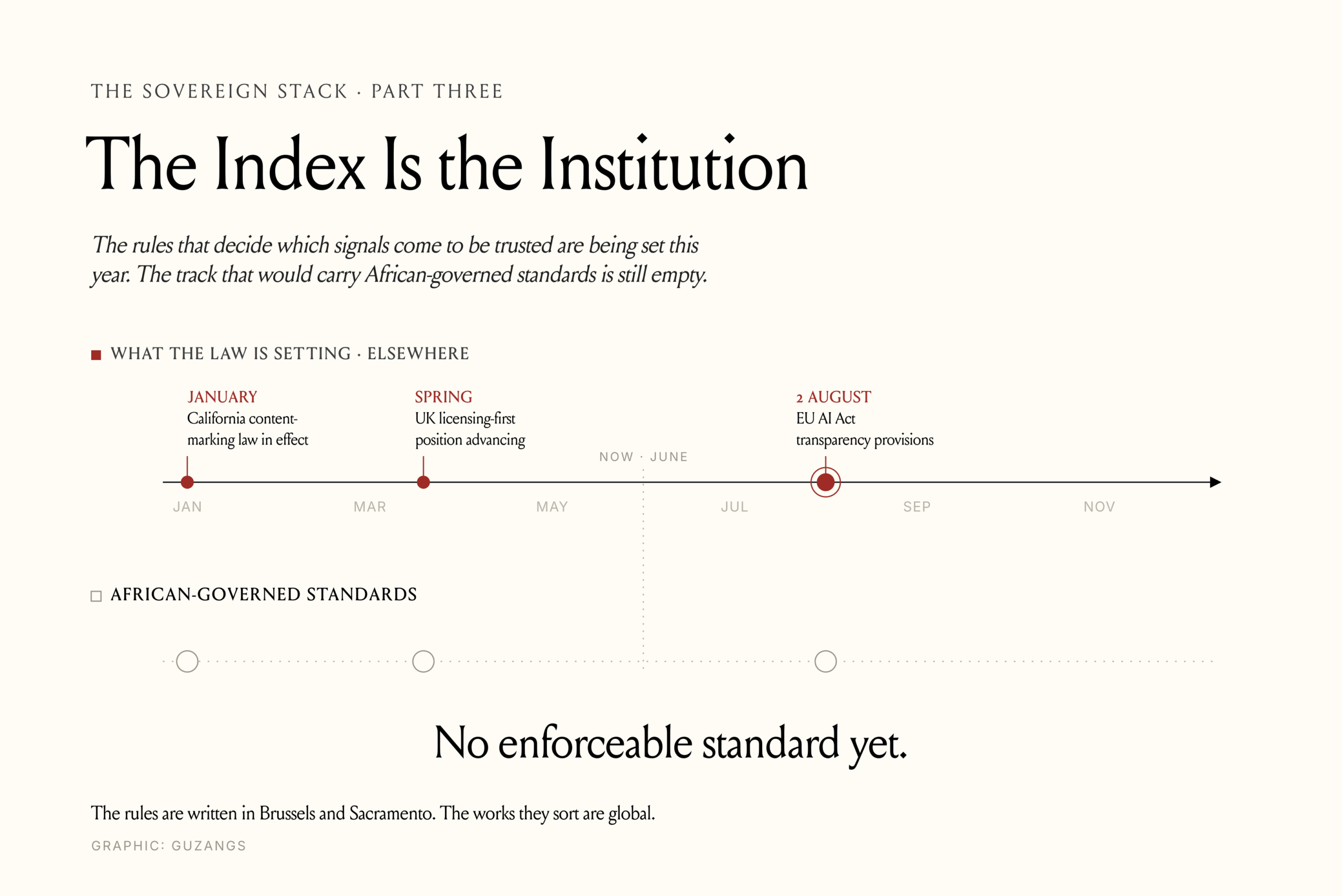
The first two parts of this series followed African creativity into machine systems that could see it and then could not pay for it. This part is about the layer that sits above both. Before a work is recognised, before anyone is paid, it has to be found, and finding now runs through systems that surface only what they are able to read. The index has become the institution. It does what institutions have always done. It decides what gets in, and it sets the conditions under which a culture becomes reachable by the people looking for it.
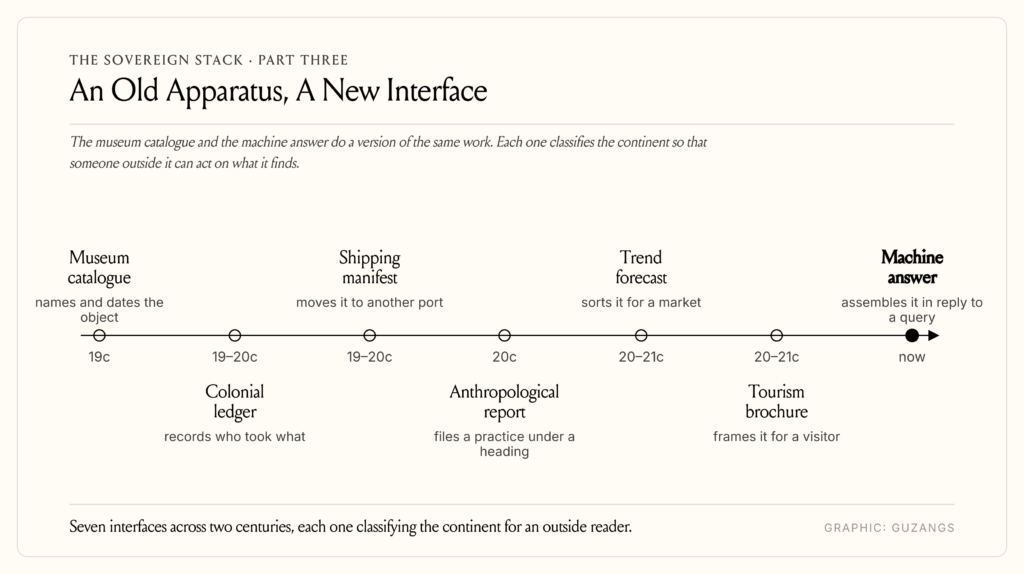
This is an old asymmetry meeting a new interface. The museum catalogue, the colonial ledger, the shipping manifest that moved a carved figure to a European port, the anthropological report that filed a practice under someone else’s heading, the trend forecast, the tourism brochure, and now the answer a machine assembles in response to a query have all done a version of the same work. Each one classified the continent so that someone outside it could understand and act on what it found. What has changed is the speed at which a description now travels and the weight it carries once it does. A thin or borrowed record no longer sits in one archive. It moves through recommendation systems and foundation models and becomes the version other systems learn from, because it is the one easiest to read.
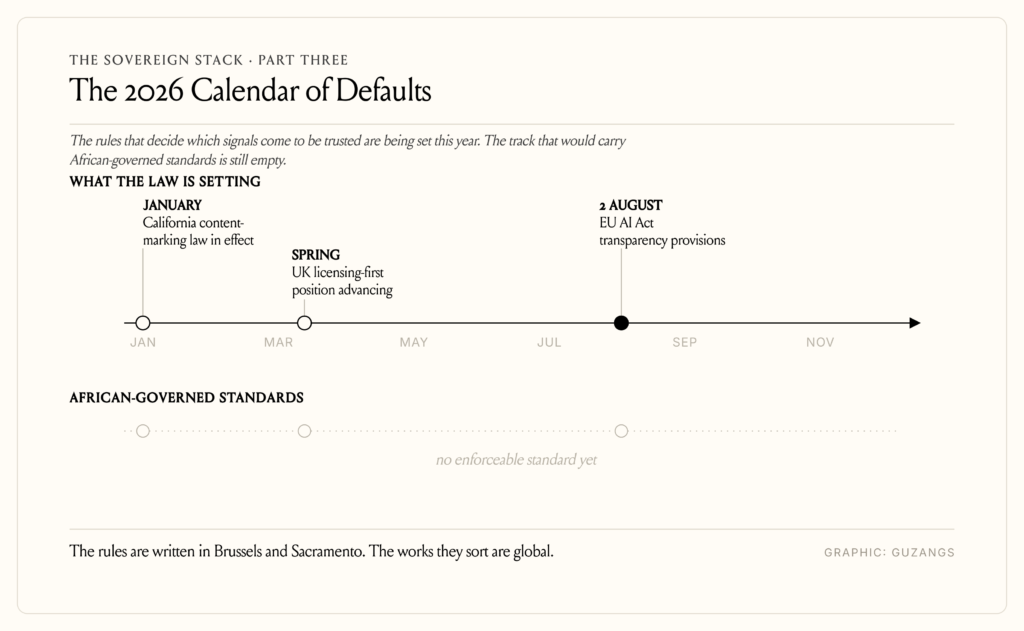
The terms of that reading are being set this year, in rooms a long way from the continent. The European Union’s transparency rules and California’s content-marking law both take effect on the same day in August, and a licensing-first position is gaining force in the UK. The standard that decides how a work carries its author and history across the web, C2PA, is steered by a small group of Western technology firms and broadcasters. None of this settles discoverability on its own. What it settles is quieter and more lasting. It decides which signals come to be trusted, and it puts whoever is in the room early in a position to set the defaults the rest will inherit. The works being sorted are global. The rooms where the sorting is designed are not.
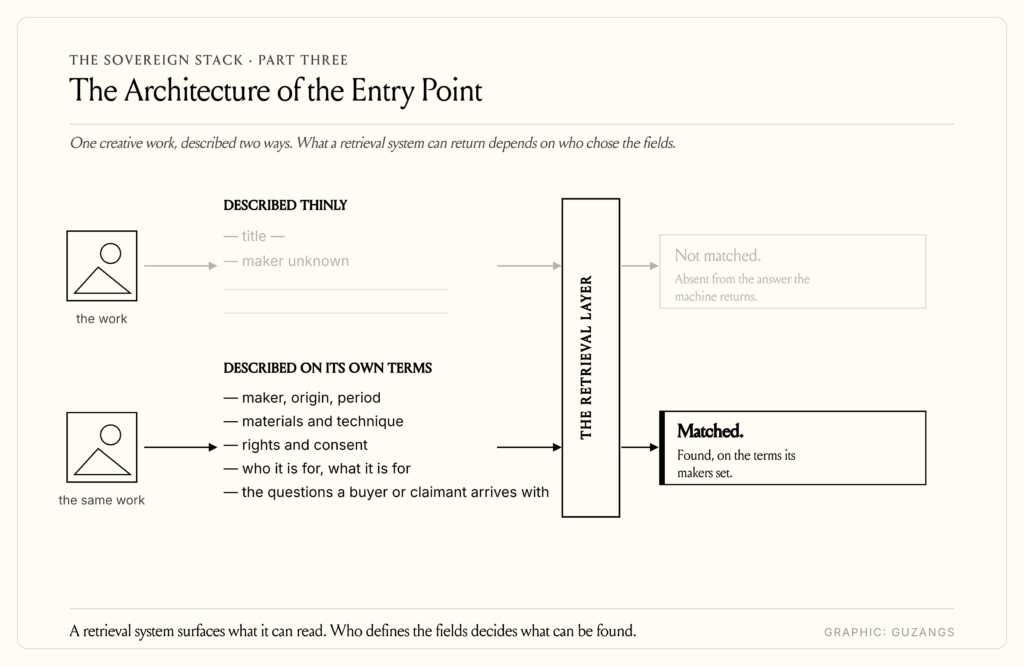
The mechanism underneath is plain. A retrieval system does not read a work the way a person does. It reads the description, the tags, the provenance record wrapped around the file, and surfaces what that wrapping lets it match against a query. A textile with no documented maker is close to absent as far as the system is concerned. When Google published guidance in May for site owners on its AI-driven search, it described those features as running on the same index as ordinary search, reaching for what it can already read and trust. The traffic has tipped at the same time: Cloudflare reported in June that automated requests passed human ones across HTML web traffic for the first time, more of the web now read by systems that answer somewhere else and send fewer people back to the source. A work these systems struggle to read is not only ranked lower. It is left out of the answer.
THE RECORD
Maina’s warning begins before anything is scanned. Digitisation, she says, is “largely an unending system of constant decision making,” and the decisions that matter most are made early, in what gets selected and what gets left out. Centuries of imperial extraction did more than move objects and people. They installed a hierarchy of knowledge that treated the written Western archive as more legitimate than oral history and indigenous record-keeping. Build a database of African culture on those foundations and the old order is carried forward. The frameworks are not neutral, she says: “their biases, their absences, their violence is encoded and entrenched further across mediums and more specifically across generations,” at the moment when indigenous knowledge is passing out of living memory.

A database is a theory of the world organised into columns. The columns decide whether a belonging is encountered first through the people it came from or the institution that now holds it, and whether an oral account is filed as evidence or left in the margin as atmosphere. When the categories are inherited from elsewhere, that encounter is settled before anyone runs a search.
The control people assume they hold over a digitised record is mostly an illusion. A few platforms hold the world’s social activity. Most of the cloud that stores the world’s data is domiciled in the West and run by a small number of companies. Inside that arrangement, Maina argues, the question of control has to move off its usual axis. She would stop treating technical infrastructure as the main lever and look instead to human infrastructure, the practitioners trained to decide what is kept and how it is managed, and to governance infrastructure, the policies that determine how digitisation is funded and maintained once the first grant runs out.
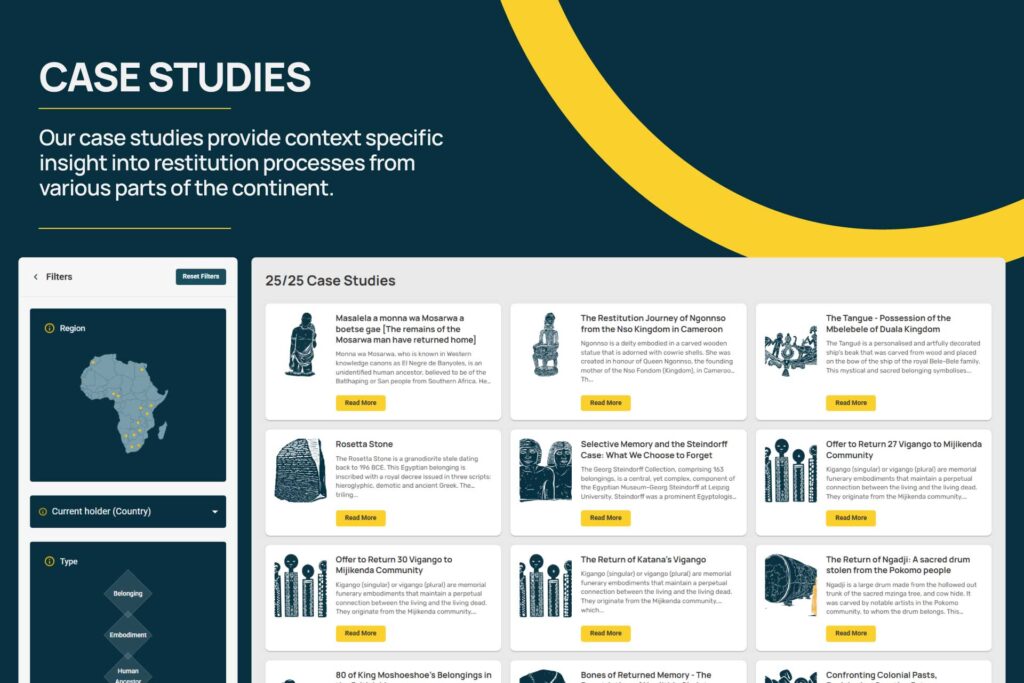
What that looks like in practice is visible in her own work. When her team built a case-study tool for Open Restitution Africa, they began from the questions an African stakeholder pursuing a restitution claim would actually arrive with. The tool lets someone search by region, by the period in which a belonging was taken, by whether a claim was pursued at the level of a state, a community, or an individual, by whether the diaspora was involved. Each filter is a decision about what matters, reached through conversations with practitioners and activists rather than imported from a standard schema.
THE STOREFRONT
Douglas Kendyson works the other end of that economy. He runs Selar, a platform where hundreds of thousands of African creators turn an audience into income, which gives him a clear view of the moment attention is supposed to become money and often does not. “Attention and income are not the same thing,” he said. Creators spend years learning to gather an audience and almost no time learning to package what they know into something a person can buy. He has watched creators with five thousand engaged followers out-earn creators with five hundred thousand, because the smaller account understood what it was actually selling and to whom.

The path from discovery to payment is longer than it looks. A buyer might first meet a creator through an answer engine, a short video, a marketplace listing, or a friend’s recommendation, then spend weeks or months inside that creator’s work before buying anything. The sale comes from trust accumulated across many encounters rather than from a single moment of being seen. Kendyson tells his creators to stop trying to go viral and start building the relationship that survives the algorithm’s next change.
Then he describes the same constraint from the seller’s side of the economy. “A storefront, a payment page, or even an AI tool can only work with the information you give it.” Strong work goes unsold when its value is buried in a vague description, because the systems that now broker discovery cannot read what the maker never made legible. A storefront and a payment page are now read as claims about who a creator is and what they can do. The storefront is itself a schema, the structured information a system reads before any buyer does, and what it contains decides whether the work is found at all.
WHETHER TO BE READ
This is where the two builders part, and the disagreement is worth holding open rather than smoothing. Maina is wary of legibility. Her entire argument is that making African culture readable inside frameworks built elsewhere is how the same violence gets re-encoded, cleaner and harder to see. Kendyson treats legibility as leverage. The creator who is precise about what they offer and who it serves gets surfaced “whether they have 5,000 followers or 500,000,” and the shift toward AI answer engines, in his reading, can level a field that popularity used to tilt.
For a moment the two of them seem simply to disagree. One has spent her career warning that readability is the trap; the other tells creators that readability is the way out. Side by side the positions look irreconcilable, and the easy move would be to pick one.
They resolve only when you look at what each of them governs. Kendyson’s creators write their own storefronts and decide what their work says about itself. Maina’s filters were built from her practitioners’ own questions. When you set the terms yourself, legibility is a form of authority. Handed up to a system designed somewhere else and sorted by categories you never saw, the same readability is the older extraction running on better hardware. Maina cares about what a culture chooses to keep and how it shows that choice to the world. For Kendyson, the creators who last are the ones who know precisely who they are serving, however many people happen to be watching.
The familiar telling puts Africa a step behind the discoverability question, still arriving at a problem the West has already mapped. The interviews invert it. Maina has worked the structure of the archive for ten years, in a field where the cost of a badly placed entrance is measured in knowledge lost from a generation. Kendyson watches attention and income come apart every day in live data. The illustrator in London and the musician in Jakarta, now worried about whether the answer engine will surface them, are arriving where these two practitioners already stand. The discoverability anxiety moving through the global creative economy is the same structural question, reached late and from a more comfortable starting point.
The question is rarely whether the machine will find you. The harder one is who built the door, and whose questions it was built to answer.
THE LONG HORIZON
Both of them describe discovery as something that takes time, which is easy to miss when the language around AI search promises an instant answer. Kendyson’s customers rarely find a creator and buy in the same moment. They meet the work, then return to it across weeks or months, and the purchase arrives only after trust has gathered through many small encounters.
Maina’s timeline runs longer. The case-study tool her team built at Open Restitution Africa is organised around questions that Africans pursuing the return of their heritage have been asking for two hundred years, work that has mostly happened out of view, negotiated case by case behind closed doors. Structuring those questions into an index moves the work from private negotiation into shared evidence, so a strategy won in one claim becomes available to the next person who arrives with the same need. The archive lets what was learned compound across generations instead of starting over each time.
Whether the asset is a digital product made this year or a bronze taken in the nineteenth century, value settles slowly, through a structure that holds what was learned and keeps it findable later. A spike of attention passes and leaves little a system can use afterward. What endures is the entry point that someone built to be returned to.
That reframing changes what is worth building now. The advantage will go to whoever has already done the slower work. That means the records are built and the fields are named on terms the maker or the community chose, permissions and provenance are set before anything is exposed to a crawler, and there are people trained to decide what a machine should be allowed to know. The work is less about training a better model than about who holds the authority to certify a record as trustworthy in the first place. Maina’s distinction between technical, human, and governance infrastructure is the map. The technical layer is the part already being handled elsewhere. The other two are where the terms can still be set, and where African-governed indexing has already begun rather than being something to wait for.
Maina was asked what she would protect first if she were starting over. Her answer was not a technology. “Build a trusted community of practice from the very start,” she said. Heritage work on the continent is under-resourced enough that a single person ends up carrying roles a better-funded sector would spread across a team, and the isolation is most dangerous when the histories being handled are violent and still close. A community of practice, in her account, “isn’t a luxury you get to once the real work is done, it is the thing that makes the work sustainable, and the thing that keeps you grounded while you do it.” The systems that will decide what the world can find of African culture are still being structured. The index is becoming the institution. Who builds it, and on whose terms, is still being decided.

The Sovereign Stack is a continuing Guzangs research series on the data engines, machine-learning pipelines, and transactional architectures shaping the future of the African and diaspora creative economy. Part One: Who Trains the Machines That See Africa? Part Two: The Machine Can See You. It Still Can’t Pay You.