


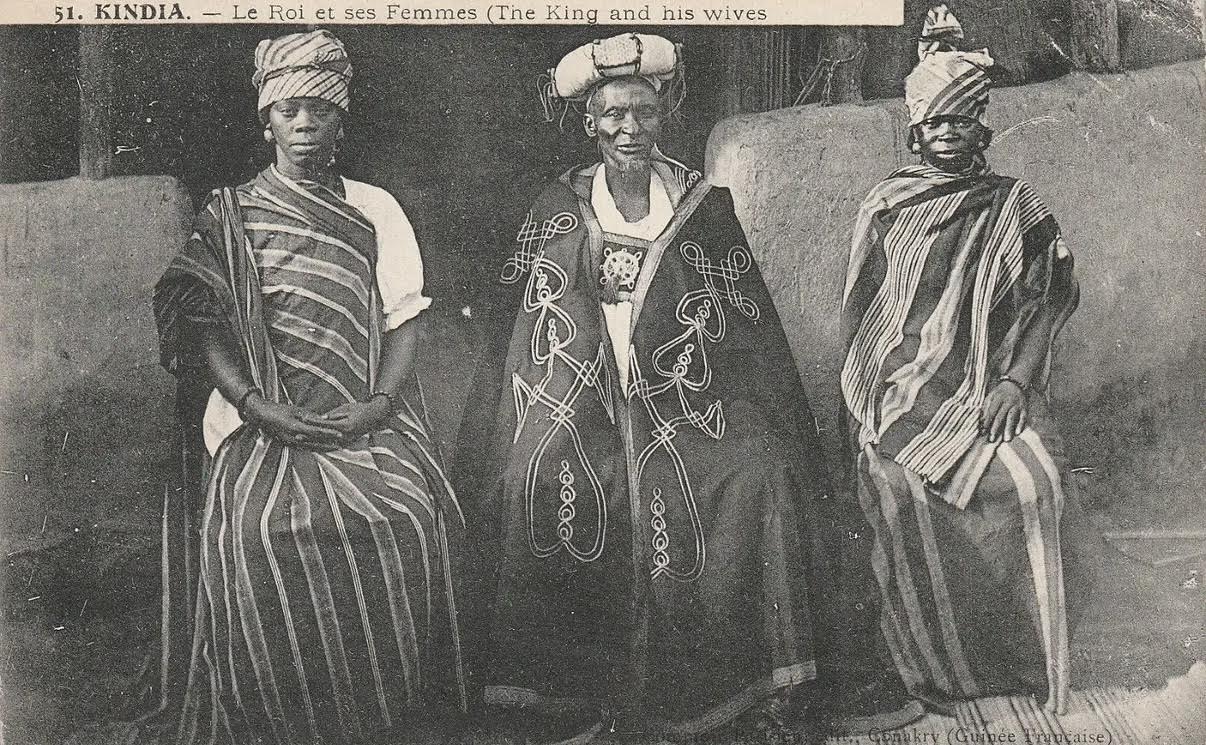
Guinea, officially the Republic of Guinea, is rarely understood through its material systems. It is more often described through borders, politics, or natural resources.
Yet beneath these frameworks lies a foundational reality: Guinea is a textile civilization.
Across its four regions, Basse-Guinée (Coastal Guinea), Moyenne-Guinée (Middle Guinea), Haute-Guinée (Upper Guinea), and Guinée Forestière (Forest Guinea), textile does not function as decoration. It operates as structure: shaping identity, organizing economies, encoding belief systems, and carrying memory across generations.
This feature is documented from inside that structure. My family’s textile practice spans five generations in Guinea, from the women dyers of Kindia through my mother and her mother before her. That lineage, and two decades of work between artisan communities and the global fashion industry, inform what follows.
Historically, these systems were complete. Cotton was cultivated, spun, woven, dyed, and circulated within interconnected regional networks. Today, that continuity is under pressure.
This feature examines four textile systems, léppi, pouto, Danfanin weaving, and Forêt Sacrée, not as isolated traditions, but as components of a larger material intelligence now at risk of erosion.
Léppi: The Textile of Continuity (Moyenne-Guinée)
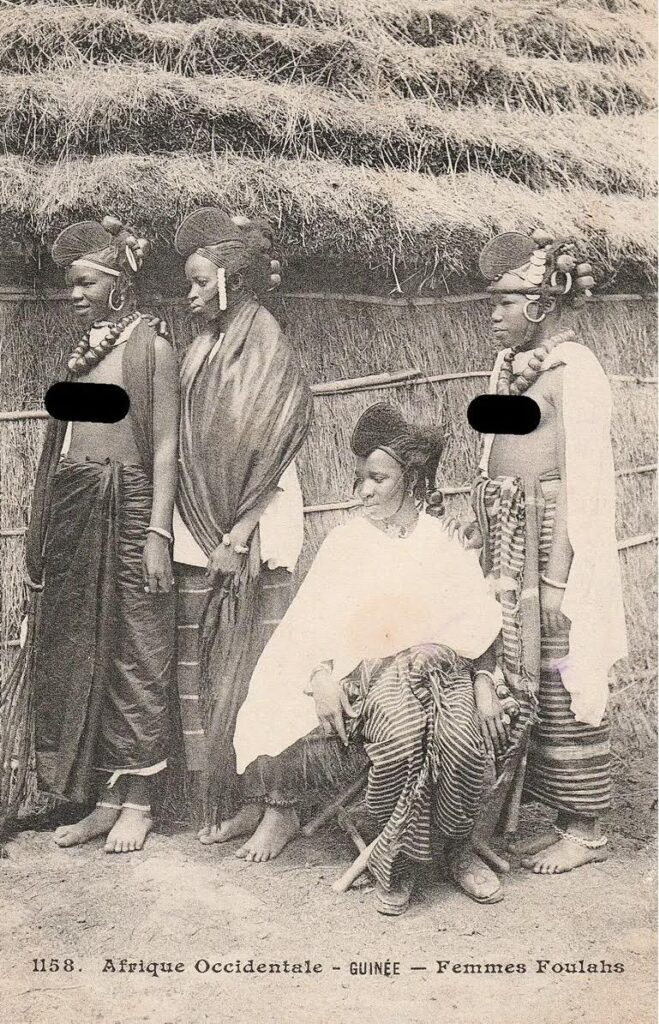
In the Fouta-Djalon highlands of Moyenne-Guinée, the léppi remains the central textile of Fulani life.
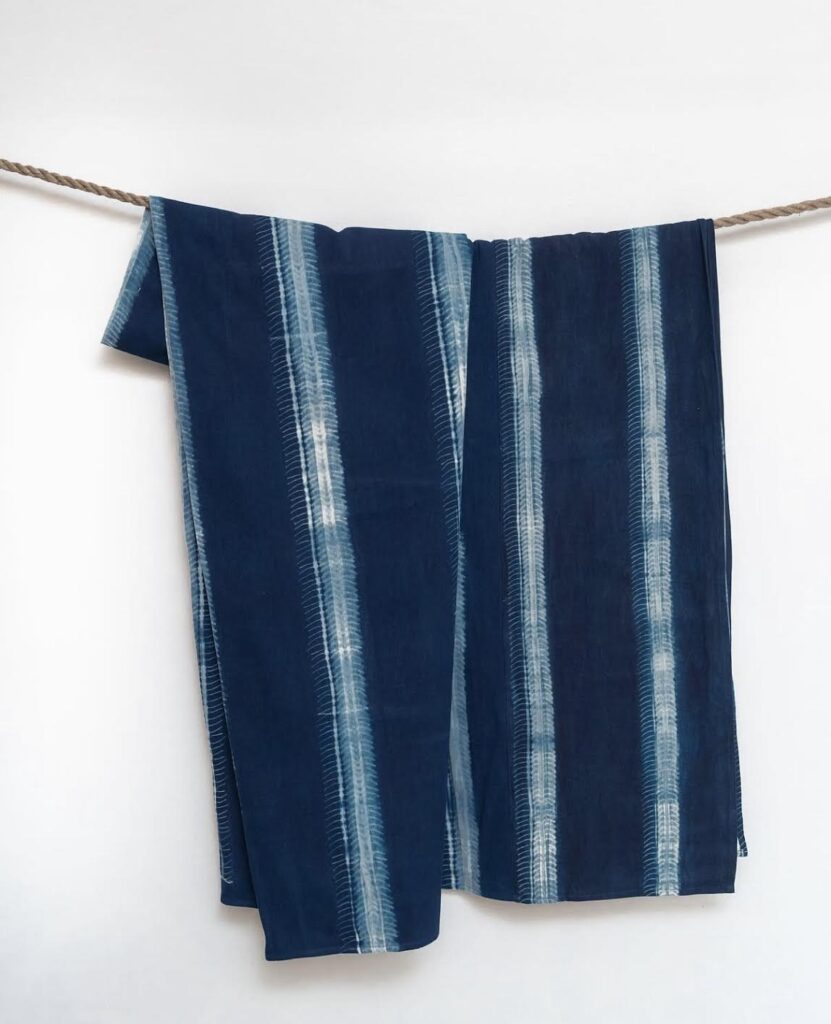
Handwoven on narrow-strip looms and assembled into larger cloths, it is defined by deep indigo tones and a structured visual rhythm. Its production relies on established botanical processes in which indigo leaves are fermented, oxidized, and layered through repeated dyeing cycles to achieve depth and durability.
The léppi operates across both social and ceremonial contexts. It is worn at baptisms and marriages, exchanged between families, and used to carry infants. Its presence extends into oral culture: “Si taawi ko a bambiradho woudere leppi ar etein…” meaning, “If your mother carried you in woven cloth, come and face me.” To have been carried in léppi was to have been given strength from the beginning.
Historically, its production formed part of an interdependent system. Cotton was sourced through trade with Haute-Guinée or cultivated locally. Weaving was primarily practiced by men, while women prepared fibers and supported dye processes.
That system is now fragmented.
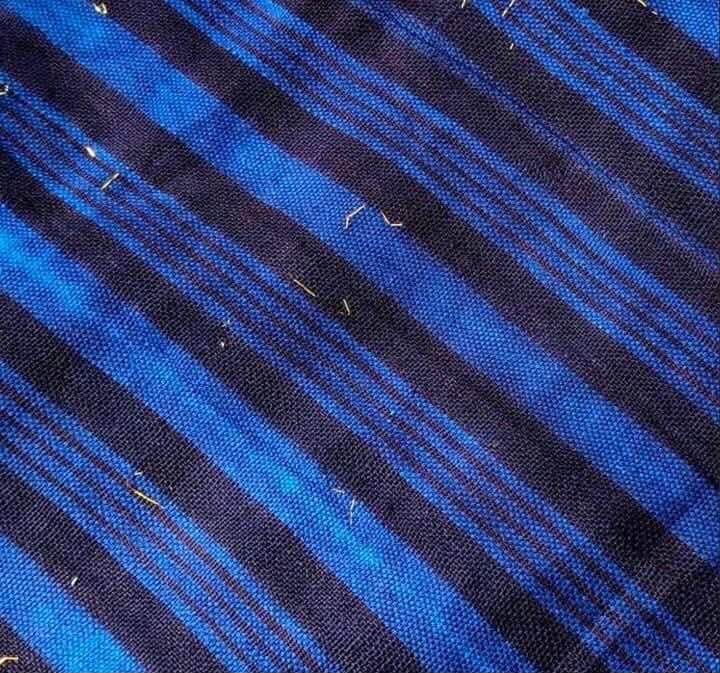
Weavers depend on imported yarn. Local spinning infrastructure is limited. Economic returns remain low relative to labor, and younger generations are increasingly disengaging from the craft.
In 2024, the léppi was recognized by the Organisation Africaine de la Propriété Intellectuelle as a Protected Geographical Indication, formally anchoring it to the Fouta-Djalon and establishing a framework for its protection. A UNESCO inscription is currently in progress.
Its continued existence is not incidental. It is the result of transmission.
Pouto: Structure, Status, and Social Order
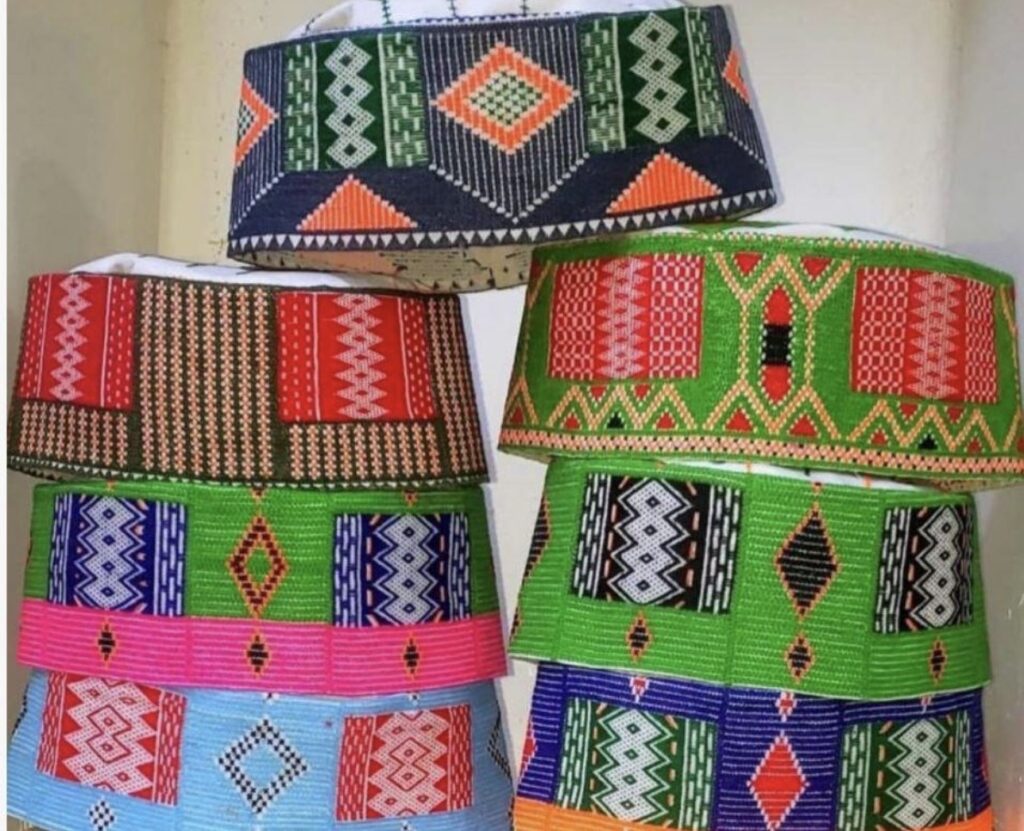
From the same weaving ecology of the Fouta-Djalon emerges the Pouto (or Poutoorou), an embroidered Fulani cap constructed by hand on cotton.
Its geometric divisions historically correspond to systems of hierarchy, territorial organization, and religious authority. It functioned as a visible marker of status, traditionally restricted to leaders, clerics, and figures of recognized authority.
The Pouto does not operate as ornament. It encodes structure.
Today, it circulates more widely across Guinea and within the diaspora, reflecting adaptation rather than rupture. Its expanded use has not erased its underlying system of meaning.
It remains a material record of how authority and identity were historically organized.
Haute-Guinée: Danfanin and the Decline of a Weaving System
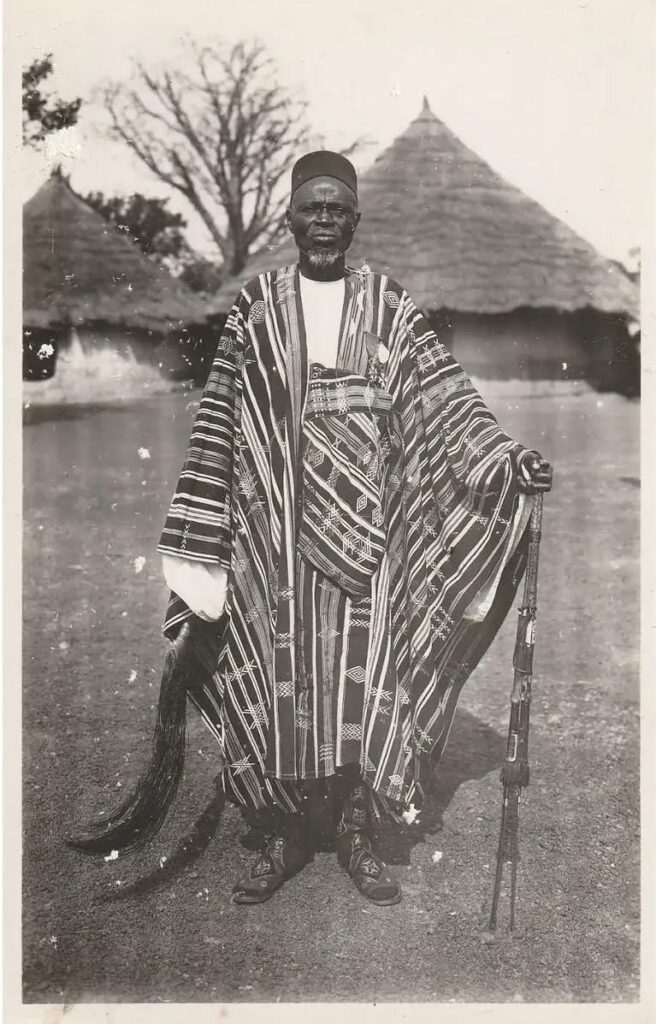
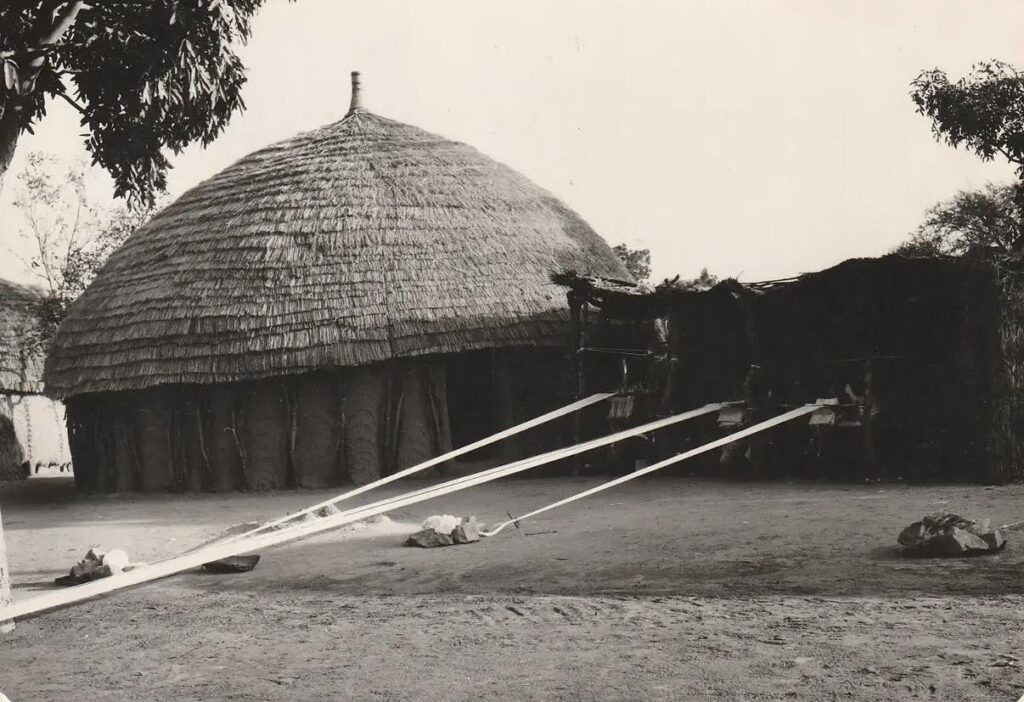
Haute-Guinée formed part of the broader Mande textile region, where cotton production, weaving, and dyeing operated as an integrated system.
Across Kankan, Siguiri, Faranah, and Mandiana, narrow-strip weaving traditions, commonly associated with forms such as Danfanin, structured both everyday and ceremonial life.
Cotton was woven into strips and assembled into garments. Women controlled dyeing systems, while men operated looms. Together, they sustained a complete textile ecology.
That system has significantly weakened.
Across oral accounts and direct conversations with individuals from Haute-Guinée, names of textile forms continue to surface, though many are no longer widely recognized outside the communities that carry them. Their persistence in language marks what has contracted in practice. What was once worn openly has, over time, been pushed inward, from public garment to private layer worn beneath clothing, from daily wear to ritual use, from lived practice to symbolic fragment.
Weaving is no longer economically viable at scale. Access to materials and tools is limited, and transmission has declined. In many communities, knowledge persists only in partial forms, through ritual use, inherited terminology, or memory.
Industrial textiles, including bazin and imported fabrics, have replaced locally woven cotton in daily wear.
The result is not simple substitution, but system contraction.
A textile practice that once operated at scale is now reduced in visibility, function, and transmission.
Basse-Guinée: Kendéli and the Coastal Indigo Economy
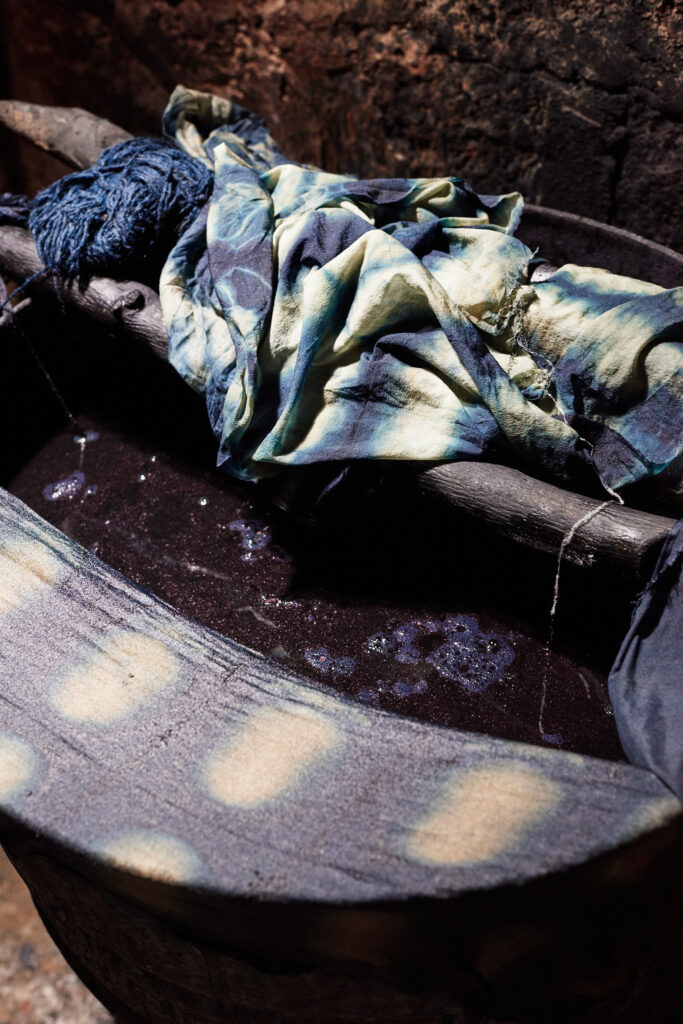
In coastal Basse-Guinée, textile production is structured around Kendéli, a resist-dye system locally associated with guairai and its indigo cloth, guairai diugui.
Unlike weaving-based systems, Kendéli is defined by transformation. Cloth is shaped through binding, repeated immersion, and oxidation in indigo baths that gradually build depth and variation in blue.
At the center of this practice are Susu women, custodians of indigo knowledge and its transmission. Their work is rooted in botanical processes where indigo leaves are fermented, oxidized, and reactivated across multiple dye cycles. Each stage is both technical and temporal. Color emerges through repetition and time.
Kendéli functions as both cultural practice and economic system. Cloth circulates through household production spaces, local markets, and trade routes extending toward Dakar, Côte d’Ivoire, and wider West African coastal networks.
Transmission occurs through observation and repetition rather than formal instruction, knowledge carried within women’s working spaces and passed through practice. It was this method that produced my own education. My mother traveled by boat with her grandmother to Dakar during school holidays, watching, assisting, absorbing. Decades later, she realized those journeys were not a vacation. They were an apprenticeship in motion. The most beautiful entrepreneurial education she ever received.
That same model of transmission is how knowledge has moved through Basse-Guinée for generations. At a time without magazines, without fashion weeks, without platforms or algorithms, a textile designer’s influence spread the only way that truly matters: through reputation, through wear, through the bodies of women who chose to put it on. That is market. That is cultural authority, exercised without any of the institutional structures we now associate with those words.
Among the women sustaining that model today is Fatoumata Bangoura. When the There Is No Limit Foundation made its first loan to her in 2008, she was running her tie-dye practice entirely alone, no credit, no institutional support, no formal recognition of what she did as a business. What that loan represented was larger than its amount: it was someone finally saying that her knowledge had value worth investing in. Fatou built. She grew. When the Tory Burch collaboration came, she was among the women whose hands made it happen, cloth from Kindia, worn internationally. She was present in Modiya in 2019 when artisans were trained in natural dye processes. She has taught her own daughter the techniques she spent a lifetime mastering. She now leads the women tie-dyers community of Kindia, a position granted by the formal city administration. In an economy of knowledge, that continuity is everything.
Today, the system is under pressure. Synthetic dyes and imported textiles have reshaped production rhythms and consumer expectations, prioritizing speed, uniformity, and cost over process-based value.
Forêt Sacrée: A Forest-Based Textile System (Guinée Forestière)
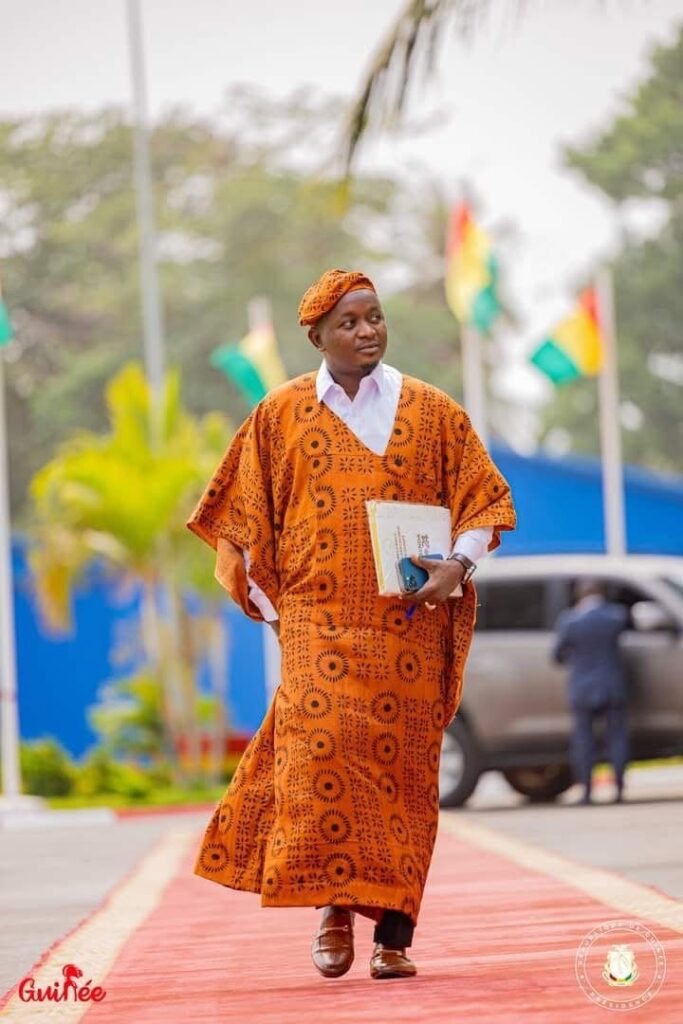
In Guinée Forestière, Forêt Sacrée represents a distinct textile system rooted in forest ecology and ritual practice.
Its base is handwoven cotton, dyed using plant-based materials including bark and kola nut, producing characteristic earthy tones. The surface is marked by symbolic motifs applied using natural pigments.
These motifs form a structured visual language and are traditionally drawn by hand.
According to practitioners at the Centre d’Exposition Artisanale de Nzérékoré, including Jacqueline Loua, stamping is a contemporary adaptation. The original method involves direct drawing onto the cloth, making the act of creation inseparable from transmission. “We take the dye and draw the design directly on the cloth. It is done by hand.”
Forêt Sacrée is often compared to Bogolan due to visual similarities and shared natural dye processes. However, these textiles are not the same, and one does not originate from the other. They belong to a shared material family, defined by plant-derived tannins, earth-based pigments, and the transformation of handwoven cotton, but they are fundamentally distinct in technique, structure, and meaning. The resemblance reflects shared intelligence, not shared origin.
Forêt Sacrée remains active in ceremonial contexts, including masked performances and ritual practices.
However, it faces increasing pressure from limited documentation, low economic visibility, and the expansion of industrial imitations.
What is at risk is not only the textile itself, but the broader system of ecological knowledge, symbolic meaning, and controlled transmission that defines it.
Across all four textile systems, consistent structural challenges emerge: weakening transmission mechanisms, limited access to raw materials and production infrastructure, economic instability for artisans, insufficient institutional support, and the expansion of industrial textile imitations.
Traditional designs and symbolic systems are increasingly reproduced without attribution, detached from their originating communities. This raises critical questions of authorship, intellectual property, and cultural ownership. Without formal systems of protection, documentation alone cannot ensure continuity.
But the pressure is not only external.
Through interviews conducted with artisans and local communities, another reality becomes visible. Many consumers are increasingly turning toward industrial imitations, not out of rejection of tradition, but out of accessibility and perception. The industrial fabrics are more affordable. The colors appear more stable. The products are easier to obtain. As some have stated: “When we buy the imported version, the color does not run. It stays the same longer.”
This introduces a shift more consequential than any single imitation. The value of textile begins to move away from process, material knowledge, and cultural meaning, toward durability, price, and convenience. If the measure of a textile becomes only how long its color lasts, how affordable it is, how easily it can be replaced, then the systems that require time, transmission, and human skill will inevitably weaken.
A textile disappears not only when it is no longer made, but when it is no longer recognized.
And yet, within that same landscape, continuity persists. The léppi continues to be produced and transmitted. The Pouto remains in circulation and adaptation. Elements of Haute-Guinée weaving endure in reduced forms. Forêt Sacrée continues to be practiced within ritual contexts.
These systems remain active, but under constraint.
The recognition of the léppi as a Protected Geographical Indication represents a significant step. It cannot remain an exception.
Guinea does not lack textile knowledge. It lacks the structural systems required to sustain it.
A textile system survives through practice.
Practice requires structure.
The continuity of these systems will depend on whether that structure is built, and sustained.
Material Literacy is produced in partnership with the Institute of African Textile.
In This Series
Material Literacy: The Knowledge in Cloth
Mariama Camara on authorship, ownership, and the distance between admiration and accountability. The series launch.
Guinea: A Textile Civilization in Four Systems
You are here.
Next: Bogolanfini, the mud cloth of Ségou, Mali.