


The Money Is the Wrong Shape
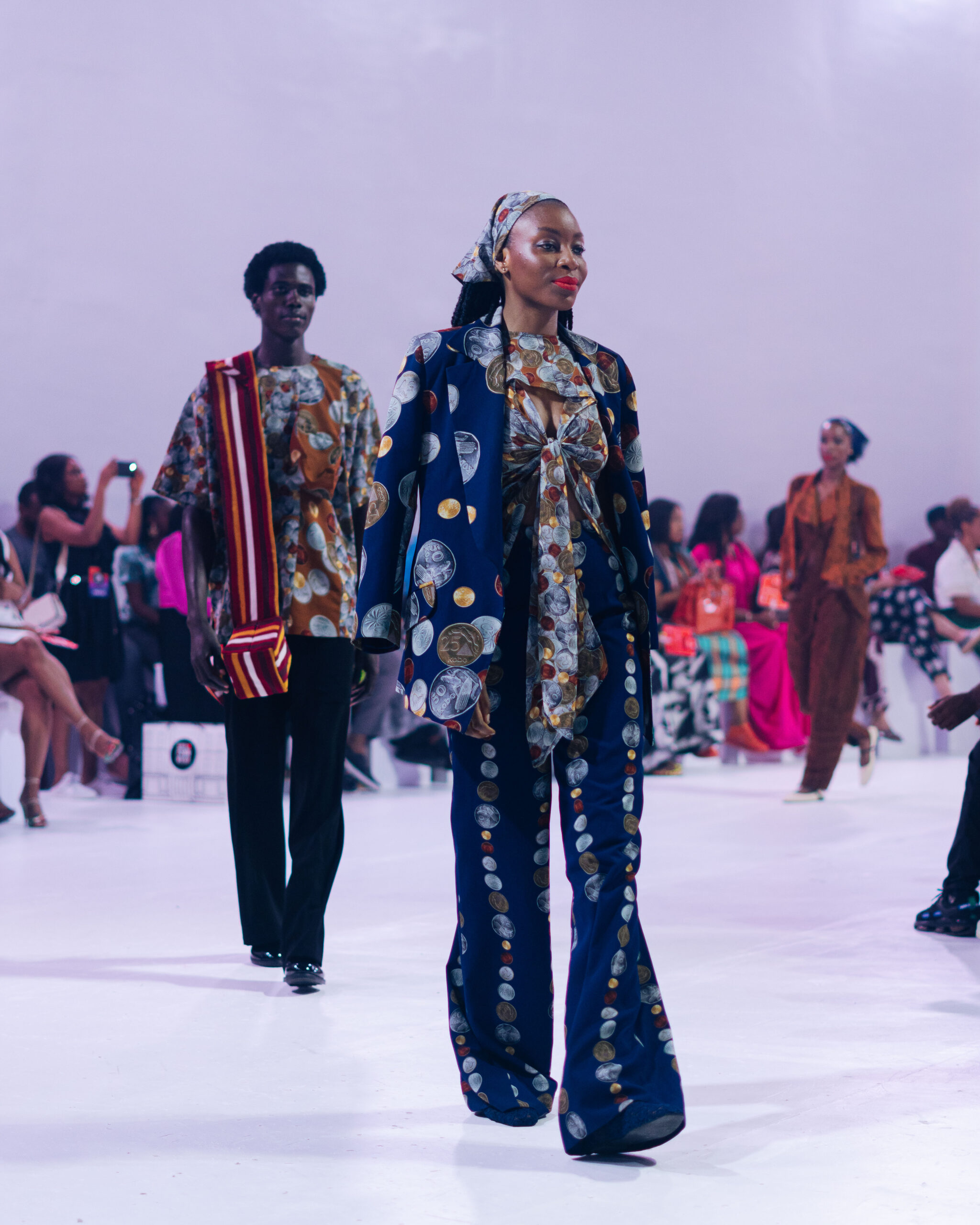
The year Beyoncé wore her clothes, Sarah Diouf was still, in effect, her own bank. Building the label meant buying fabric before the money came back and paying tailors before the invoices settled, then finding cash for the samples, the shoots, the customs paperwork and the long quiet months between one burst of global attention and the next. Tongoro, which she launched in Dakar in 2016, is made entirely in Africa, cut by local tailors she trained as she went, an attempt to prove a fashion company could be built from the continent and not only inspired by it. When Beyoncé wore it in 2018, and Naomi Campbell and Alicia Keys after her, and when Diouf entered the Business of Fashion 500, the world took it as proof that African fashion had crossed from promise into power. What the world did not see was the arithmetic underneath, the question of whether the next roll of cloth could be afforded at all.
That is the part of African fashion the camera rarely holds on. The finished garment travels beautifully. The capital behind it does not. Celebrity does not solve working capital, and it can make the problem sharper, because demand becomes operational before it becomes financial. A dress goes viral in a day, but the fabric still has to be bought and the cutters paid, and the order still moves through a logistics system that does not bend around the tempo of attention. Diouf has named the reality behind her own milestones plainly: African fashion, she has said, is an ecosystem, not yet an industry.
Before the bank arrives, in other words, the founder becomes the bank. And across the continent, the strongest brands are being built this way, on the endurance of the person at the center, because the financial system around them does not yet know how to read what they are building.
That gap is usually called a money problem, and the description is only half right. The trouble is not only that there is too little capital. It is that too much of the capital within reach is the wrong shape, arrives at the wrong time or carries assumptions borrowed from businesses that do not run like fashion. A brand does not need money in the abstract. It needs money timed to the order and priced to the margin, money that understands a purchase order is not revenue yet and that a wholesale account can create a cash crisis that looks, from the outside, exactly like success.
Self-financing has become proof of discipline in African fashion. It should not be mistaken for a system.
View this post on Instagram
The instinct, in policy rooms and pitch decks alike, is to say the sector needs more money, as if liquid funds were missing from the continent entirely. The macro backdrop makes the instinct understandable, since the International Finance Corporation puts the unmet demand for small-business finance in Sub-Saharan Africa at roughly $331 billion, a gap it still cited in a 2025 banking handbook. Fashion sits squarely inside that number without being named by it, formal enough to generate real orders, yet still awkward for most banks, which want scale and regularity, and worse for venture capital, which wants software.
Development economists call this the missing middle, and the phrase usually stays abstract. For African fashion it is an address. The brands live there, sophisticated past the hobby stage and short of anything a loan committee would call a corporation, with real customers and repeat orders on one side of the ledger and, on the other, none of the collateral or audited history a bank would need to say yes.
A commercial banker in Lagos or Abidjan looks at a designer and sees an unacceptable risk. The bank wants land or property, collateral a young founder rarely holds, and it has no way to price what the business is actually made of. A name, an archive, a technique, a confirmed order from a European store: these are real assets in the market and illegible on a loan application, because banks like assets they can seize, and the things this business runs on, the trust of its suppliers and the meaning stitched into the garment, cannot be repossessed. So the designer is left choosing between rigid, high-interest loans that would crush the margins of even an established Western house and episodic grants that fund a single show and leave nothing for the production cycle that follows.
The mismatch becomes most obvious the moment a brand enters wholesale. A retailer places an order and everyone outside the business sees progress. Inside, the order becomes a problem of timing.
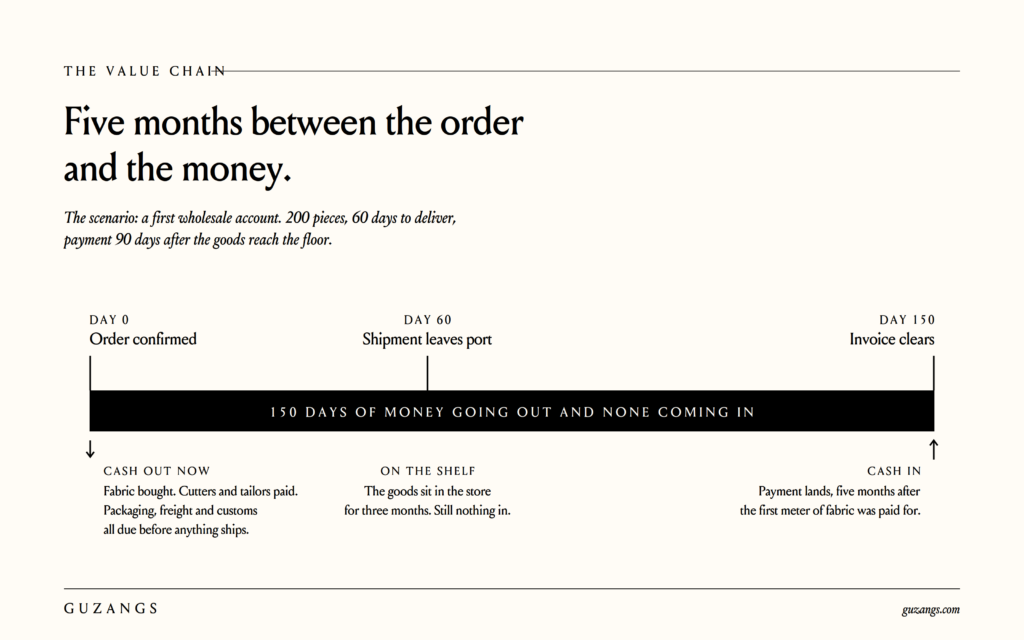
Picture a young label that wins its first serious account, two hundred pieces for a global department store, sixty days to deliver and payment ninety days after the goods reach the floor. The fabric has to be bought now and the cutters and tailors paid now, with freight and customs still to settle before anything ships. By the time the shipment leaves port the founder has spent thousands in cash, and the goods then sit on a shelf for three months before the invoice clears: a five-month stretch with money going out and none coming in. If the collection goes viral in those months, the crisis only deepens, because the cash that would buy fabric to meet the demand is trapped inside an unpaid foreign invoice.
This is why the unglamorous instruments matter, and why their absence is so costly. Purchase-order financing advances cash against a confirmed order, so a brand can produce before it is paid, while factoring runs the other way, turning an unpaid invoice into cash today rather than in ninety days. Between them sit facilities that lend against stock already in hand. None of these are headline instruments. They are the ordinary plumbing of the garment trade in markets that have one, and in much of Africa they exist only barely, where they exist at all. A handful of platforms have begun trying to broker them, among them The Folklore, a marketplace that matches brands to third-party lenders against a confirmed order, though a broker is only as useful as the capital standing behind it. A designer with a full order book can still fail for want of the financing that order book should unlock.
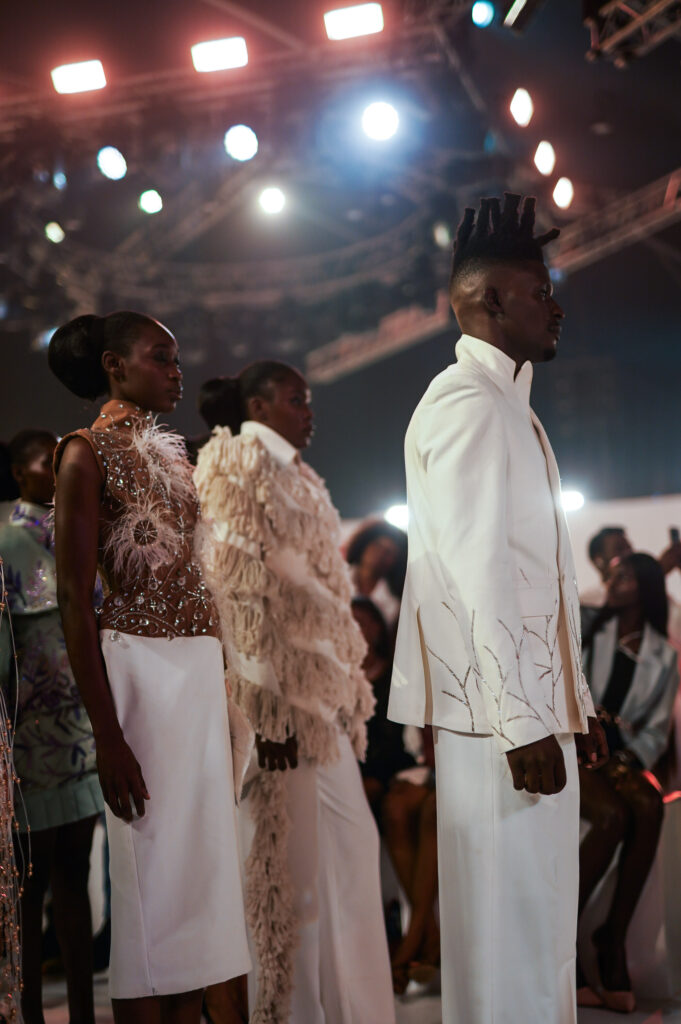
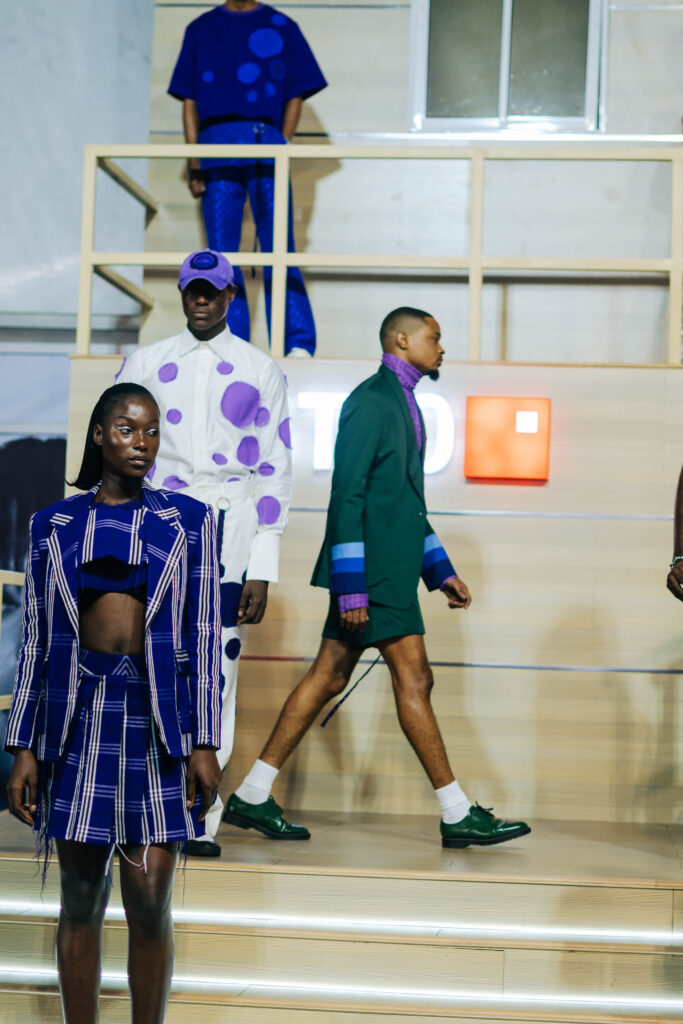
Sevon Dejana (left) and a Fashion presentation at GTCO Fashion Weekend 2024. Photo: Olaniyan Pelumi for Guzangs.
The aspiration that organised the last decade of talk was the continent’s own luxury conglomerate, an African house with the reach of LVMH. The appeal is easy to understand, since that group is the most visible proof that clothing can turn into durable corporate power. Read closely, though, LVMH argues against the model it is invoked to justify.
The popular story treats it as a monument to founder patience. The record is closer to financial engineering. In 1984 Bernard Arnault took control of Boussac, the bankrupt textile group that happened to own Christian Dior, putting in about fifteen million dollars of his own money alongside roughly forty-five million arranged by Lazard, and paying a ceremonial single franc for the whole. He sold off most of what he had bought and kept Dior, then three years later engineered the merger of Louis Vuitton and Moët Hennessy into the group that now carries their initials. What reads from a distance as the patient compounding of a heritage house was a sequence of leveraged acquisitions, run through deep capital markets by a financier who had studied the buyout in America and applied it to couture.
That is why it travels badly as a template. Arnault’s method runs on leveraged debt and on capital markets deep enough to absorb the eventual sale, and neither exists at any depth for a designer in Dakar. Equity is priced for that ending. An investor accepts years without return on the expectation of a sale or a listing, which only a narrow kind of company can deliver, one with very high margins and a decade to spare. A few African houses may fit that description. Most do not, and gain little by pretending to.
Their return builds through steady output and regional reach rather than the slow construction of a rarefied name, and it compounds only while the business can keep producing. What keeps it producing is capital that turns over quickly, repaid by the order it funds rather than by a distant exit, working capital for the next production run or invoice finance against the account just won. The return the continent is likeliest to see is not one house the size of a European group. It is a wide base of durable mid-sized businesses that never need an exit to justify the money that built them.
The announcement is not the deployment
Because the right instruments are scarce, the sector has grown a parallel industry of its own. Call it the announcement. Large windows of capital are launched in expansive language, creative economy, infrastructure, access to finance, scale. Some of it matters and some of it eventually deploys. The founder’s question is simpler. When does the money reach the account, and on what terms? Much of what the sector counts as finance turns out to be capacity-building or an application portal, and an application is not a disbursement.
Afreximbank’s Creative Africa Nexus program is the case in point. In October 2024 the bank announced it would raise CANEX funding from $1 billion to $2 billion over three years, money for infrastructure and financing across the creative sectors, including fashion-manufacturing facilities and training centers. That matters, because it names the right category of problem rather than only visibility. It is also a commitment made in a fragile environment. Across 2025 and into 2026 the bank was downgraded repeatedly, by Fitch ultimately to junk, over a dispute about whether Afreximbank should be repaid ahead of commercial creditors in the debt restructurings of Ghana, Zambia and South Sudan, and a development bank entangled in sovereign defaults has less room to move liquid capital to independent brands.
The distinction the sector has learned to make, the hard way, is between pledged capacity and deployed capacity, and Afreximbank has drawn it in its own words. Asked about designers who went through its programs and left without investment, a bank spokesman told the Business of Fashion that Afreximbank is not a party to the resulting investment agreements, and that its role was to convene the ecosystem and create the conditions for engagement. The bank brokers the room. Whether money follows is a separate question, and for many designers it does not. One who did secure funding, Pam Samasuwo-Nyawiri of Zimbabwe’s Vanhu Vamwe, took a six-figure investment from a third party rather than from the bank.
The private side has the same distance between narrative and delivery, and its most credible specialist is candid about it. Birimian Ventures launched in Abidjan in 2021 to real acclaim. Its founder, Laureen Kouassi-Olsson, promised patient equity and hands-on support for African heritage-luxury brands, and later brought in Paris-based Trail Capital to target five million euros a year across a portfolio of brands. Several years in, the equity ambition has moved slowly. The financing that actually reached brands came through a quieter channel, a working-capital facility run with Orange Bank Africa that Birimian says has financed roughly 25 brands and later drew a portfolio guarantee from the IFC. By the firm’s own account close to sixty brands have been supported in some form and fewer than thirty financed, which is the more honest measure of a specialist vehicle built with the right intentions in a market where the manufacturing and the supply-chain records are not yet there to close equity deals at speed.
Kouassi-Olsson does not dress this up. She has told the Business of Fashion that investing in companies at this early stage is genuinely difficult everywhere, not only in Africa, and she has described much of Afreximbank’s creative-sector activity as marketing activation rather than pure investment. The most useful reading is a diagnosis of the system rather than of any single institution. Even the best-intentioned vehicle moves slowly when the ecosystem beneath it is thin. Founders have learned to hold the applause until the money clears.
The Guzangs Report · Q2 2026
The capital gap mapped here runs through the wider creative economy. Our quarterly briefing tracks the infrastructure beneath the visibility.
The money that fits the clothes
The strongest evidence is not coming from the most visible fashion-finance names. It is coming from institutions built around production rather than prestige, the local enterprise fund or the industrial-policy desk that learned to underwrite a factory’s working capital long before anyone asked it to read a lookbook.
Kenya has the clearest working version. Since 2013 the Nairobi-based HEVA Fund has designed credit for the creative economy rather than adapting credit built for something else, and its figures now describe an actual portfolio rather than an intention, with HEVA reporting roughly $42 million raised and more than 120 creative enterprises financed across East Africa. Its most recent facility runs through the Mastercard Foundation-backed Sanara programme, which by July 2026 had deployed about KSh1.2 billion, close to $9.3 million, in loans and grants to more than 330 creative enterprises, close to two-thirds of them led by women. The loans, branded Ota Kopa, are sized for creative businesses and priced at 9 percent, and they reach borrowers through licensed local lenders rather than a single fund. The demand tells its own story, since Sanara reports applications worth nearly KSh4 billion against the KSh1.2 billion it has been able to place, a gap of roughly three to one.
West Africa offers a different model, one that finances fashion almost in passing. WIC Capital, launched in Dakar in 2019 by the Women’s Investment Club Senegal, invests in women-led companies across Senegal and Côte d’Ivoire without regard to sector, in a country where only 3.5 percent of women entrepreneurs reach formal credit at all. Its portfolio runs to a pastry chain and a natural-beauty group, and among them sits Sarayaa, a Senegalese ready-to-wear label. The structure matters more than the single fashion name. WIC invests through equity and zero-interest instruments in tickets of around $200,000. It drew a $1 million facility from FSD Africa in 2023 and is now raising a second fund of roughly €30 million to reach up to twenty companies. A designer inside that fund is financed as a business rather than as a designer, which is closer to what the sector actually requires.
The Francophone network built by Investisseurs & Partenaires reaches further into the unglamorous middle. Through local funds in Burkina Faso, Côte d’Ivoire, Senegal, Mali and Madagascar, I&P has put seed and working capital into textile companies no fashion editor has canonised. La Maison Fenel, in Ouagadougou, turns handwoven Faso Dan Fani into fashion accessories and has raised around $326,000. Ultramaille, a knitwear factory in Madagascar, produces some 400,000 sweaters a year for European labels including Sandro and Armor Lux. In Mali, the group’s Zira Capital seeded IKALOOK. Tropic 105, in Abidjan, is three decades into building a domestic clothing business under the Ciss St Moïse name. The language around these deals is production capacity and formalised jobs, which is the register in which manufacturing capital actually speaks.
South Africa shows what the same logic looks like when the state runs it. The Clothing, Textiles, Footwear and Leather Growth Programme, administered by the Industrial Development Corporation on behalf of the Department of Trade, Industry and Competition, offers grants capped at 5 million rand and interest-free or concessional loans capped at 10 million rand for equipment and working capital, with import substitution as its stated aim. By the department’s own account, the redesigned programme had approved about 1.87 billion rand for 154 businesses and disbursed 1.41 billion rand by the middle of 2024. The instrument is blunt and industrial, and it moves money into the exact place a garment business tends to break, the purchase of a machine and the first production run.
None of these institutions set out to fund fashion, which is close to the reason they can. Each was built to underwrite the ordinary machinery of a small manufacturing business, and each reads a creative enterprise as a company with a cash cycle rather than a cultural cause in need of patronage.
The talent argument ended years ago. The money argument has barely begun, and meanwhile the current arrangement, global standing financed by the slow exhaustion of a founder’s own account, has reached its limit. A designer can be on a billboard in one city and unable to make payroll in another.
Burnout is the visible cost. The quieter one is distortion. When founders finance everything themselves, they design around scarcity, avoiding the larger order and choosing fabric by cash timing rather than by intention. Over time a sector can mistake that caution for a lack of ambition. The truer reading is that ambition here takes physical form, cloth to buy and machines to run, and almost none of the money on offer was built for that. It was built for software, for revenue that arrives the moment the sale does. The money has to fit the clothes.
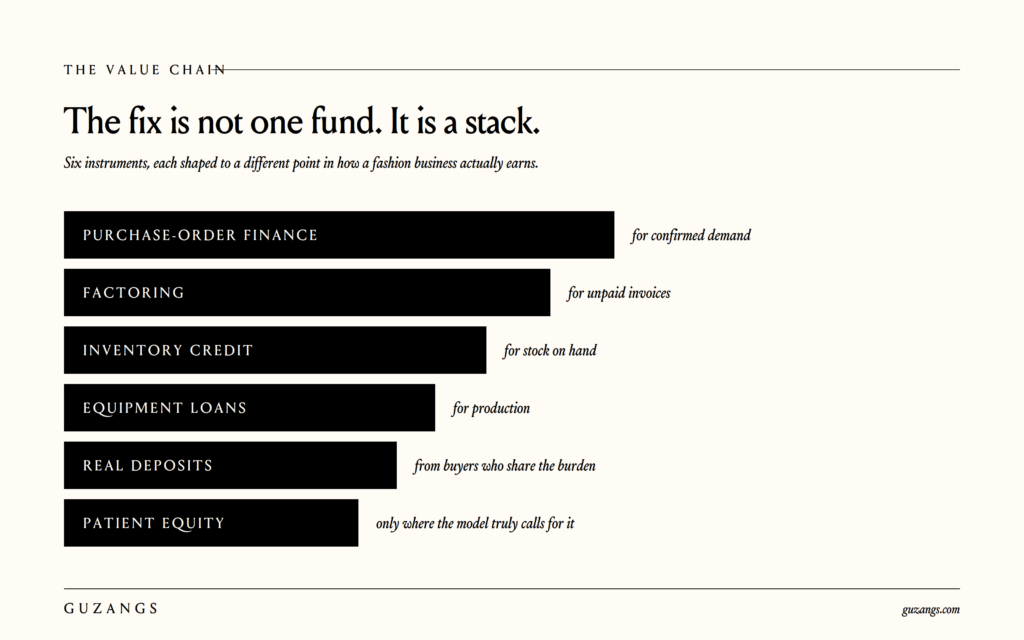
There is no single instrument, because there is no single African fashion business. Some brands need purchase-order finance against confirmed demand. Others need factoring for an unpaid invoice, or credit against the inventory already in hand. A few, and only a few, need patient equity. A serious financial system would underwrite those differences instead of flattening them into one category called creative. Until one exists, the founder remains the bank, on a model too fragile for a sector now asked to carry culture, employment, export ambition and a continent’s global image at once.
Sarah Diouf built her frame out of little more than stamina, and it is extraordinary. A frame cannot hold a house forever without a foundation under it. What remains is the wire transfer, the patient and unglamorous work of building capital shaped to the business, so that the next founder does not have to build the whole thing alone.
Visibility brought the world to the door. The right kind of money decides whether anyone can afford to answer it.
Subscribe to keep reading the part no one photographs.