

Adirẹ and the Wrapper-Wearers
My relationship to adirẹ is perhaps an unusual one; it begins not with indigo, but with cassava.
In 2024, I returned to Nigeria for a two-month residency with the G.A.S. Foundation to study cassava’s role and cultural significance in the country. It was the longest I had spent in the country since leaving at five years old. At the farmhouse in Ijebu-Ode where I was lodged, I became obsessed with garri, fermented and granulated cassava. For four days straight, I poured it into a small bowl and covered it with just enough cold water for the dirt particles to float to the surface, where I could scoop them away. I would finish it with a dollop of honey and a handful of groundnuts.
Its sourness returned me to my childhood in Nigeria, memories I can now access primarily through my senses: through flavours; through the feeling of the sun striking my skin until I feel faint; and through the sight of buildings that somehow remained fixed in the memory of my five-year-old self.
I first learned about the use of cassava in adirẹ in 2023, but I had encountered adirẹ textiles before then: blue cloth patterned in lighter shades, its designs ranging from abstract and geometric forms to extraordinarily detailed figures and scenes. From adirẹ among the Yoruba to ùkárá among the Igbo, indigo runs through the textile histories of West Africa. But it is among the Yoruba that cassava, a crop I have been studying since 2022, becomes integrated as a resist, emerging in the early twentieth century as a specialist craft unique to south-western Nigeria.
Adirẹ has a history that stretches back several centuries, growing from the Yoruba tradition of cultivating cotton, weaving narrow strips of cloth, and dyeing textiles with indigo extracted from locally grown plants such as Lonchocarpus cyanescens. Indigo held practical and symbolic value: its deep blue colour was associated with prestige and skilled craftsmanship.
Although many Yoruba towns practised indigo dyeing, Abeokuta became the centre most closely associated with adirẹ during the nineteenth century. Founded in the 1830s by the Egba people after periods of warfare and migration, Abeokuta developed into a thriving commercial hub where women dominated the production and sale of textiles. Adirẹ entered its most prolific period between the 1900s and 1930s, as British-manufactured cotton cloth flooded colonial markets. Smoother and more receptive to indigo than locally handwoven fabric, the imported textiles were quickly embraced by artisans, transforming both the scale of production and the reach of adirẹ across West Africa.
What distinguishes one adirẹ textile from another is not simply its pattern, but the technique behind it. Each method of resist dyeing produces its own visual language, giving every cloth a unique rhythm and character. In adirẹ oníkò, sections of cloth are tightly bound with raffia before being submerged in indigo, producing geometric patterns as the dye seeps around the bindings. Adirẹ alábẹ̀rẹ́ relies on carefully stitched resist designs, while adirẹ ẹlẹ́kọ becomes the most intricate of the three, with artisans painting elaborate motifs onto the fabric using cassava starch before dyeing.
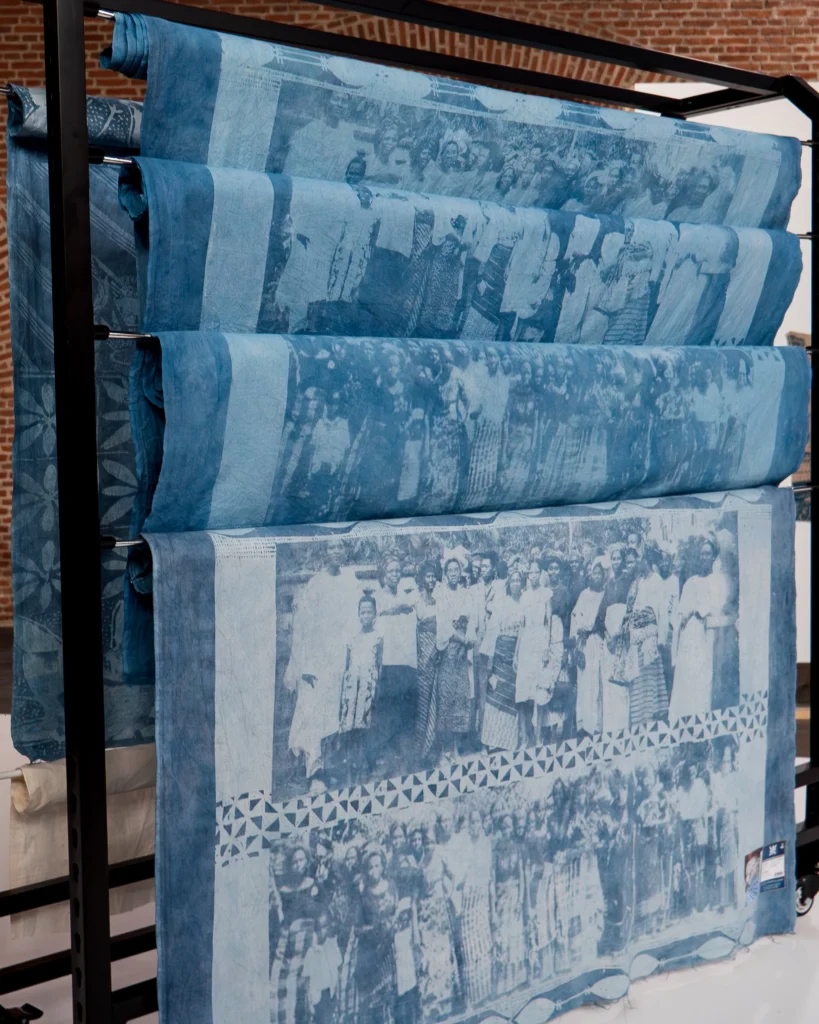
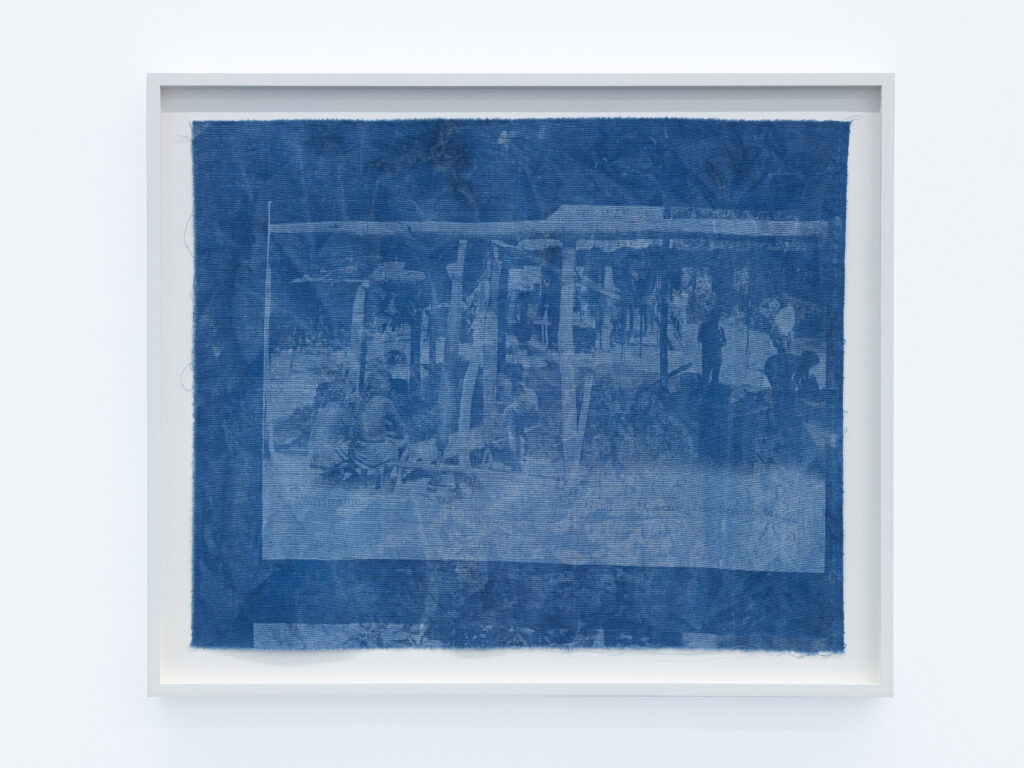
In 2025, I began adapting the process of adirẹ ẹlẹ́kọ to reproduce photographs using only indigo, cotton, and cassava. I had witnessed the traditional process for adirẹ ẹlẹ́kọ during visits to Abeokuta in 2024 and 2025, and learned it firsthand through Peju Layiwola’s workshop in Lagos. Alongside this practical learning, I spoke with established practitioners such as Nike Davies-Okundaye and local designers, including This Is Us, who are taking the tradition in new directions. In modifying the established method and transforming adirẹ ẹlẹ́kọ into a photographic development process, I was adding my own labour and knowledge to this evolving practice, joining a lineage shaped by generations of Yoruba women.
“Guaranteed Nigerian Adire – Available By the Yard!” was born out of my experience in Nigeria. It was first created for and displayed during an exhibition put on by Unfair Amsterdam and curated by Serana Angelita in 2025. At the opening of the exhibition, I engaged in a performance in which I took a seemingly empty or blank sheet of cloth and dyed it before the audience, revealing an image that had always been there, merely latent. Through the body of work, I foreground the labour of adirẹ, which I had witnessed in Nigeria, but also transform it into a methodology of revealing the sediments of colonial history that we have been taught to forget.
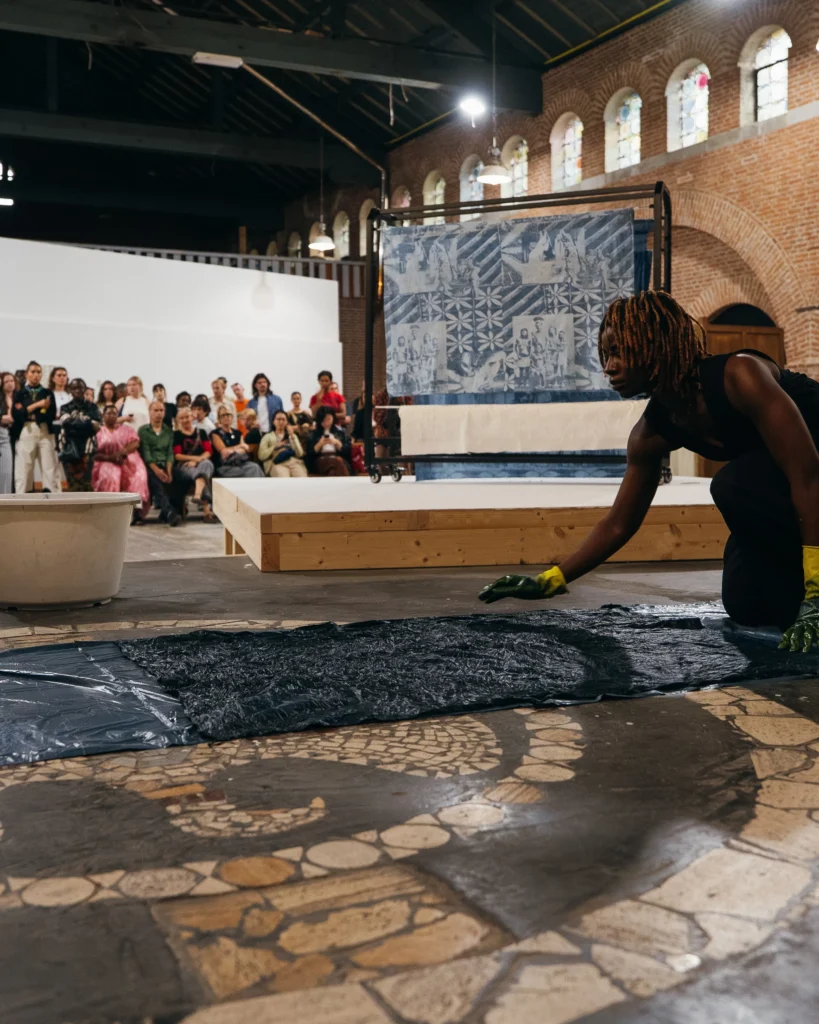
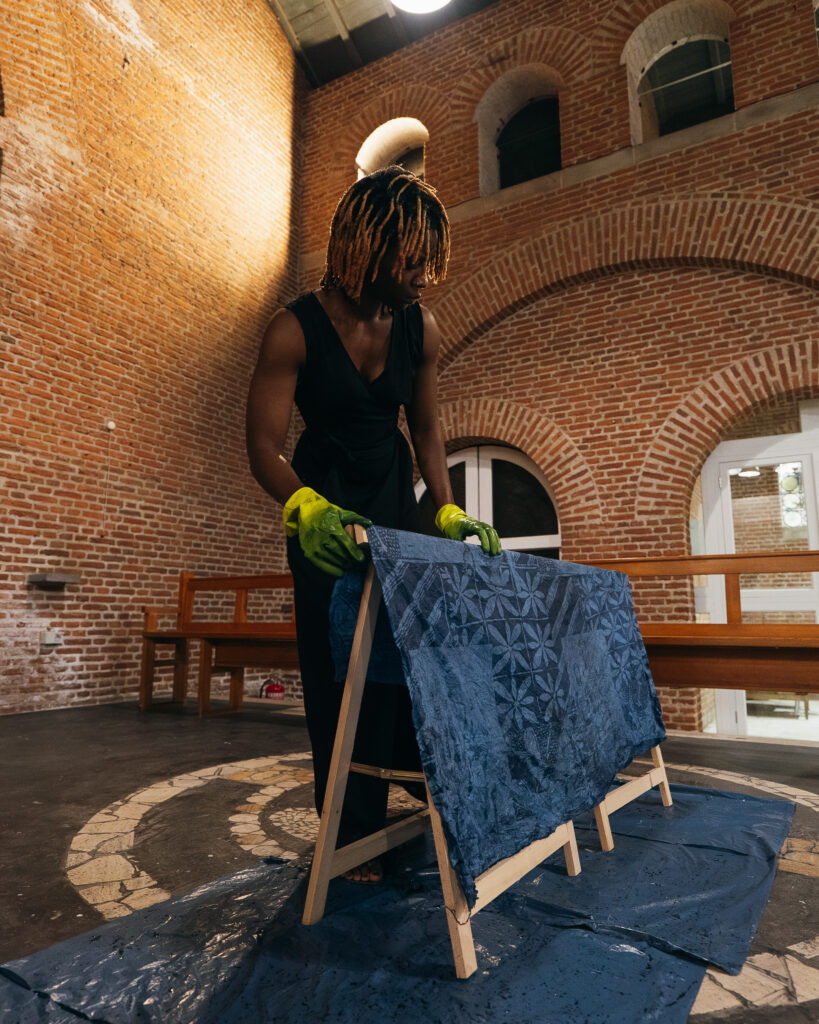
The first images I developed depicted the Taíno, the Indigenous people of the Caribbean whose knowledge enters the cloth through cassava, a crop whose life-sustaining, poisonous, and spiritual properties they had long understood and harnessed. Their image is recreated through the hold of the root that had kept them alive, that they had seen as a gift from Yúcahu, the giver of cassava. And I wanted to blur the line between materiality and representation, even while I rendered cassava as a significant element that has breathed new life into the archival representations of the Taíno.
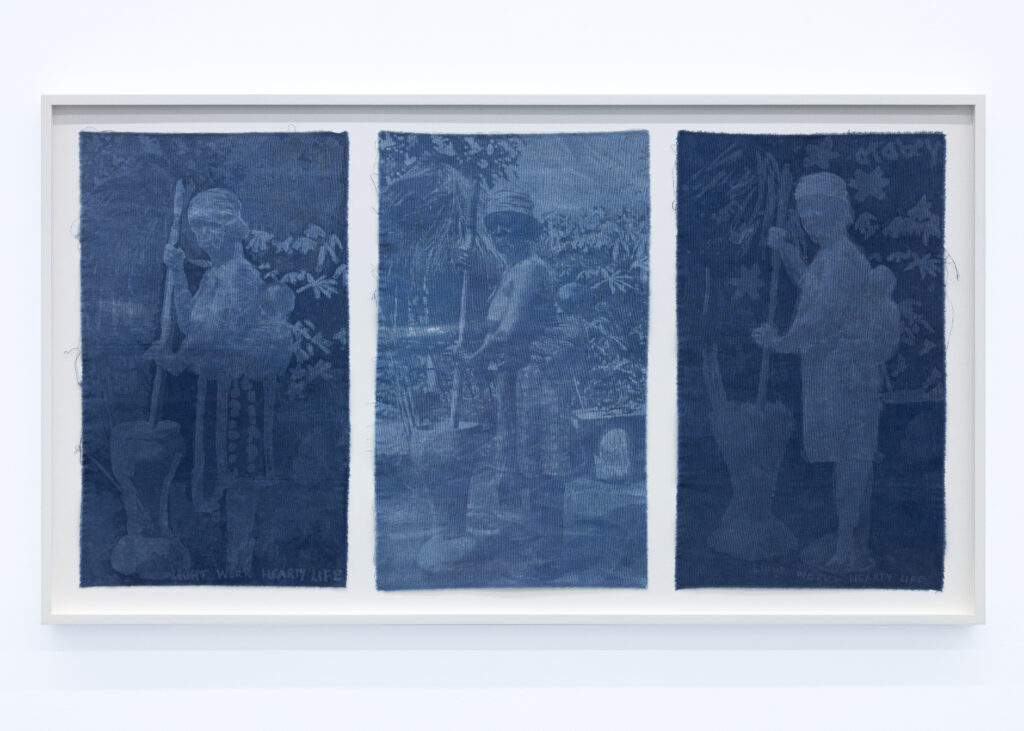
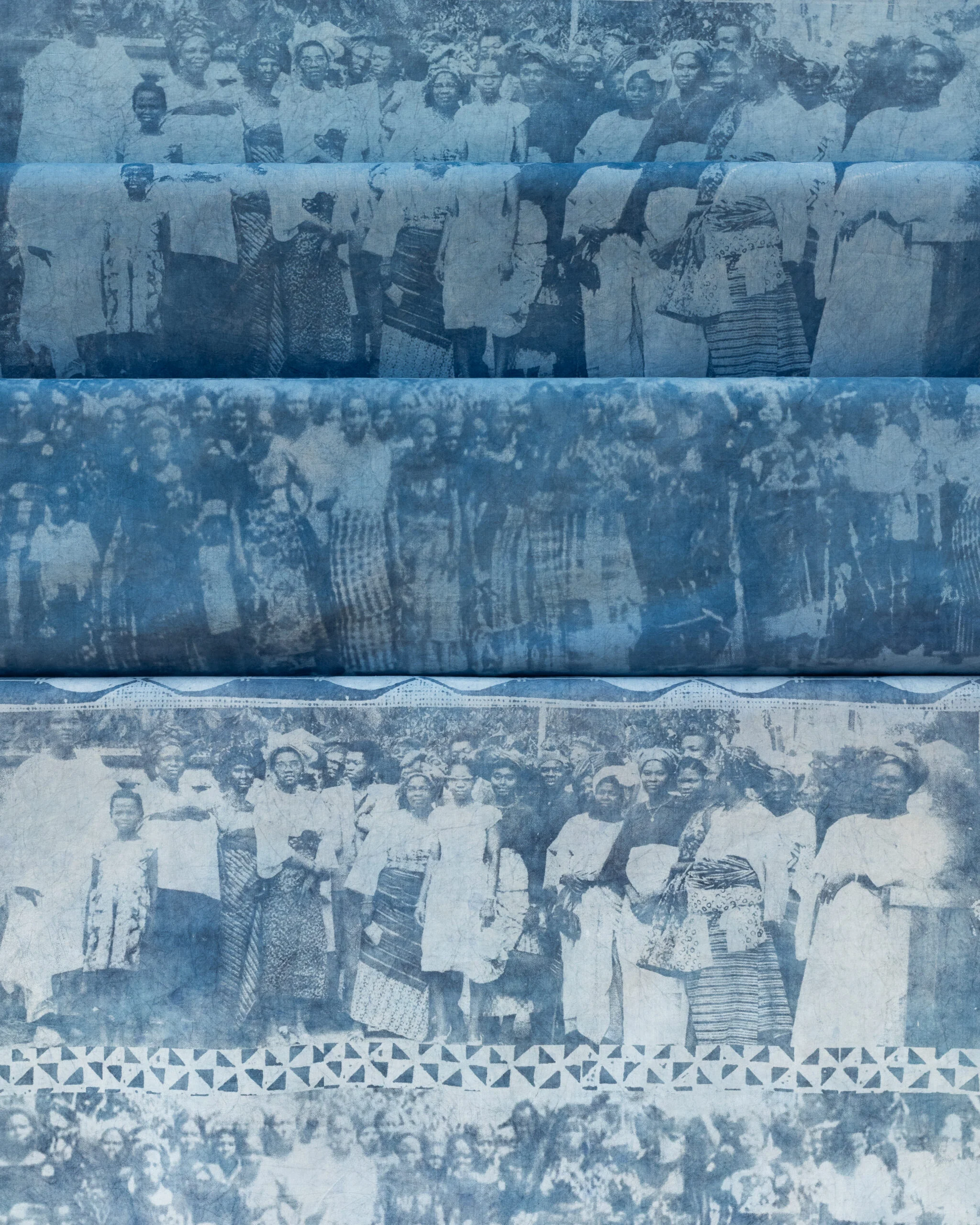
I had also installed, on opposite sides of a clothing rack, a second textile bearing photographs of women from Abeokuta, for whom adirẹ ẹlẹ́kọ offered a measure of financial autonomy and became intertwined with collective resistance against colonial policies during the 1947 Abeokuta Women’s Revolt. It was a mass protest led by the Abeokuta Women’s Union, under Funmilayo Ransome-Kuti, against the taxation of women and their exclusion from political decision-making in colonial-era Abeokuta. What struck me the most was how thousands of market women and traders came together to challenge both British colonial authorities and the traditional ruler, the Alake of Egbaland. They sat around his palace for days, arguing that women should not be taxed without representation. And through sustained demonstrations, petitions and acts of civil disobedience, the women secured the suspension of the tax, prompted the temporary abdication of the Alake in 1949, and helped advance women’s political rights in Nigeria. It remains one of Nigeria’s most significant anti-colonial and feminist movements.
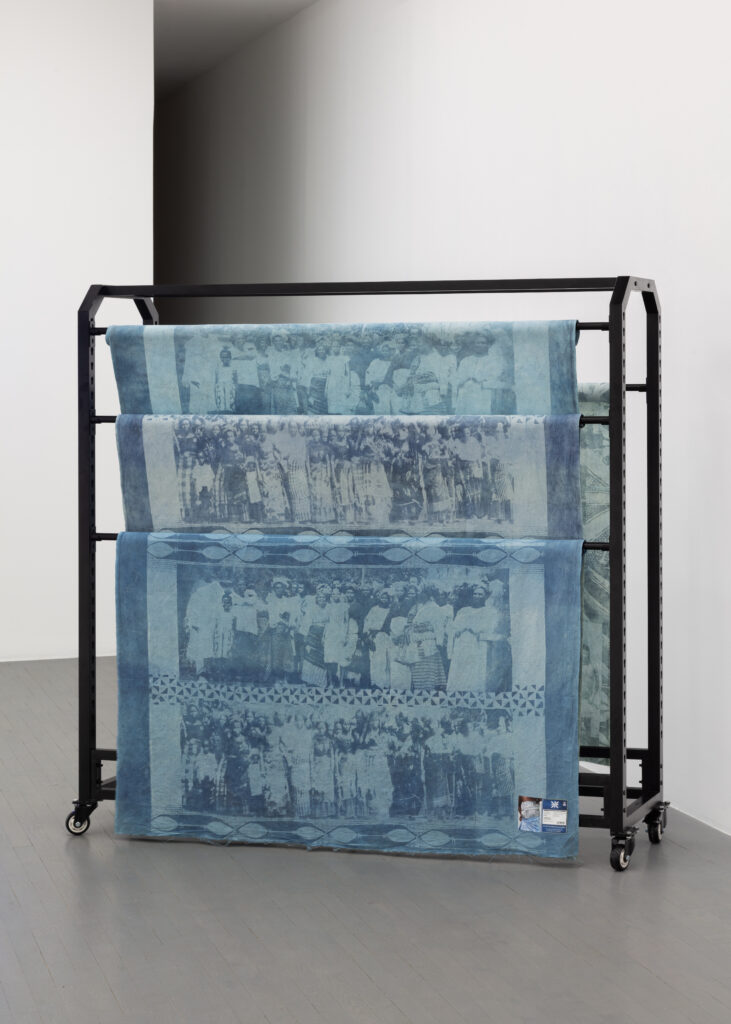
In his memoir Aké: The Years of Childhood, published in 1981, Wole Soyinka refers to the protesters as aróṣọ, or “wrapper-wearers,” a term denoting those who wore a piece of fabric traditionally tied around the waist, and whose significance hinges on its counterpart: oníkaba, or “gown-wearers.” It was this garment that betrayed the class difference. The wearing of the wrapper was mandated by the leader of the Abeokuta Ladies’ Club, Funmilayo Ransome-Kuti, as she expanded it from a gathering of upper-class women, or gown-wearers, into the Abeokuta Women’s Union, a mass movement incorporating working-class market women. The wrapper, or iro, became the unifying medium.
The photographs included in this body of work, reproduced in the dimensions and style of a typical wrapper, are largely archival, including the aforementioned photograph of the Abeokuta Women’s Union. In it, Funmilayo Ransome-Kuti stands off centre, not in the limelight but still quickly recognizable.
Beneath it is a photograph of a reenactment of the 1929 Aba Women’s War, a group of largely Igbo women from southeastern Nigeria also donning the wrapper. In historical records about the war, the women are described as having their waists covered with short wrappers and fern, and this simple dress was part of a broader tradition of undressing as a form of protest in what is called “sitting on a man.” For me, both images are just two instances in a long history of women-led protest movements in Nigeria, cutting across both class and ethnic identity, where traditional shaming tactics and (un)dress have been used to signal opposition to societal changes triggered by colonization.
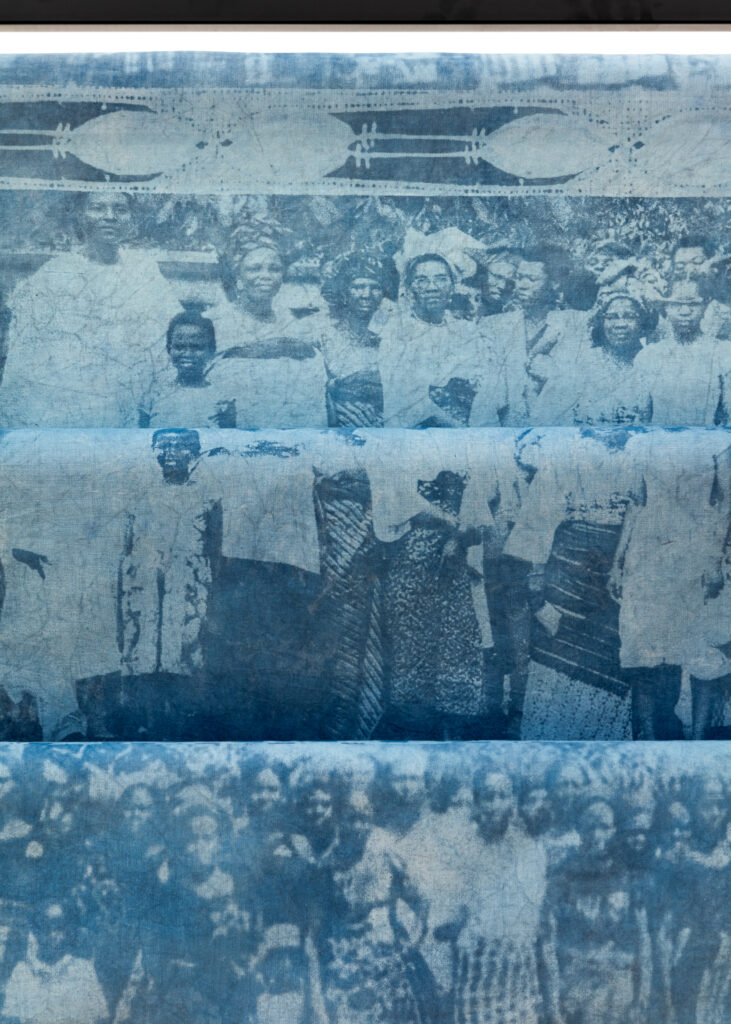
To learn about Abeokuta as the site of an anti-colonial protest movement led by women was to further nuance both my understanding of the city and of adirẹ through its sociopolitical dimensions. Adirẹ‘s relevance to the financial lives, and specifically the autonomy, of Yoruba women is part of what attracted the attention of the colonial government, and part of what drove the imposition and further hikes of taxes directly on women that precipitated the 1947 revolt. Adirẹ is part of the history of this revolt, but is seldom discussed as such. In a way, finding a black-and-white photograph of the Abeokuta Women’s Union reinforced this role through the repetition of the wrapper, without the trademark blues of indigo to confirm.
“Guaranteed Nigerian Adire – Available By the Yard!” might have been my approach to commemorating this eight-decade history through a textile that has come to shape their practice, but I’m consciously looking for additional lenses beyond the surface. I’m thinking deeply about how these works can be activated beyond just the exhibition. One possibility lies in public wear, allowing the textiles to return to the body and the rhythms of everyday life. Another is through performance, drawing on the inherently collective nature of adirẹ dyeing as it has long been practised in Nigeria. I am interested in creating spaces where they can be inhabited, performed and shaped by the shared labour, exchange and communal gestures that have always defined the making of the cloth.
Kosisochukwu Nnebe is a Nigerian-Canadian conceptual artist and writer working across installation, lens-based media, and sculpture, with a practice that treats foodways and language as counter-archives of colonial histories. She is a recipient of the G.A.S. Foundation Fellowship and has held a residency at the Jan van Eyck Academie in the Netherlands. “Guaranteed Nigerian Adire – Available By the Yard!” was first shown at Post-Tropical Imagination, Unfair Amsterdam, in 2025, and has since appeared in Rootwork at Zalucky Contemporary and We Have The Cure at the Visual Arts Centre of Clarington, both in 2026.
In This Series
Material Literacy: The Knowledge in Cloth. Mariama Camara on authorship, ownership, and the distance between admiration and accountability. The series launch.
Guinea: A Textile Civilization in Four Systems. The four ecological zones of Guinea, and the textile systems each one produced.
Understanding Bògòlanfini: The Malian Textile Written in Mud and Cotton. Iron-rich mud, boiled leaves, and a written language fixed onto handwoven cotton.
Kente and the Politics of Being Read. From royal courts and politics in Ghana to its significance at the United States Capitol and graduation stages.
Aṣọ-Òkè: The Cloth We Inherit. How a centuries-old Yoruba textile became an heirloom of memory and identity.
Adirẹ and the Wrapper-Wearers. You are here.
Next in the series: Shemma and the Shamanes: Inside Ethiopia’s Cotton Community