


Kente and the Politics of Being Read
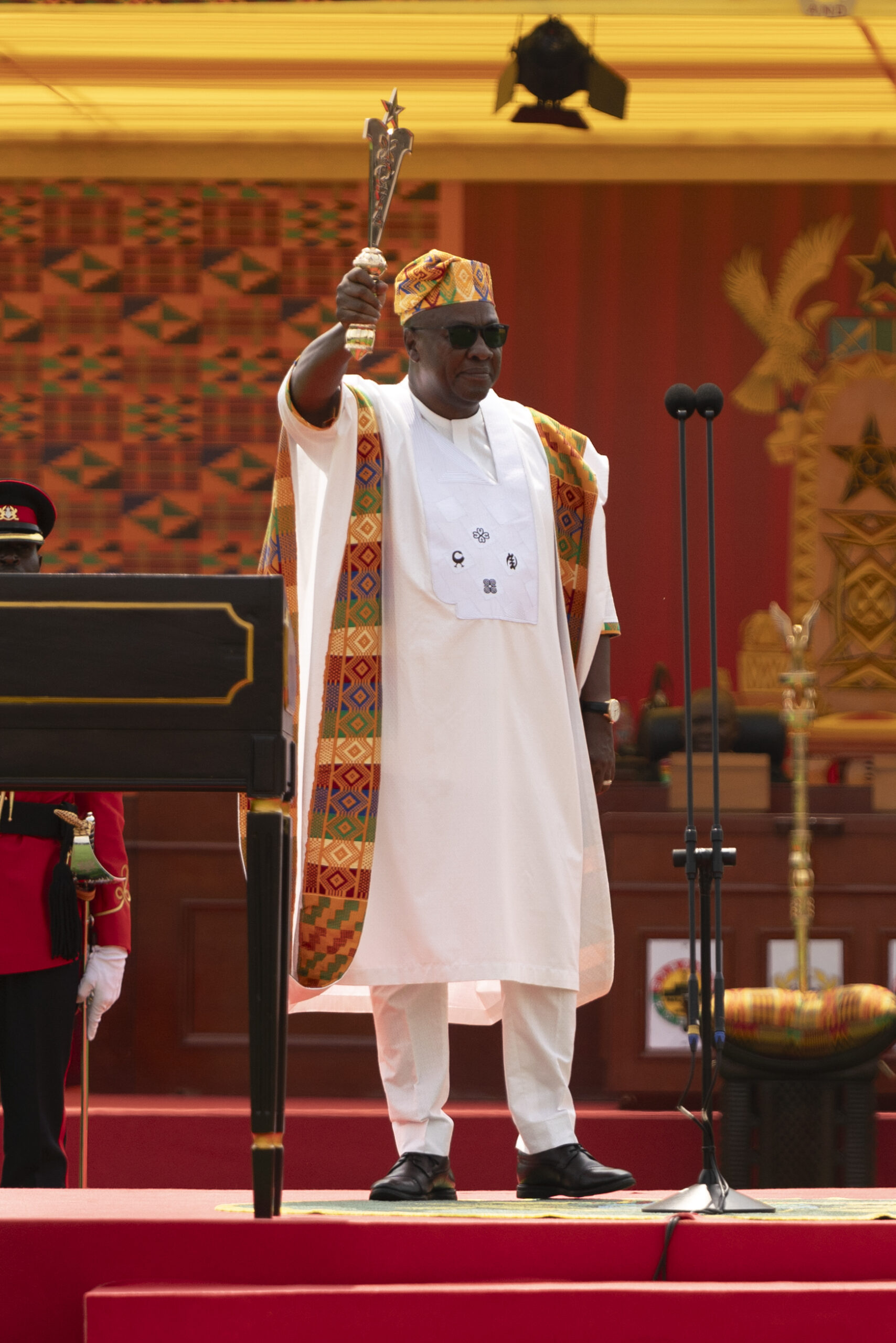
On June 8, 2020, a group of Democratic lawmakers knelt on the floor of the United States Capitol for eight minutes and forty-six seconds, the duration then believed to mark how long a Minneapolis officer had knelt on George Floyd’s neck, later revised at trial to nine minutes and twenty-nine seconds. Several of them wore kente stoles over their suits, draped there by members of the Congressional Black Caucus, as they introduced police reform legislation in the weeks after Floyd was killed. The photographs moved within minutes, and so did the response. Robin Givhan, writing in The Washington Post, argued that the staging muddied the conversation it meant to clarify. Doreen St. Félix, in The New Yorker, read it as closer to performance than to mourning.
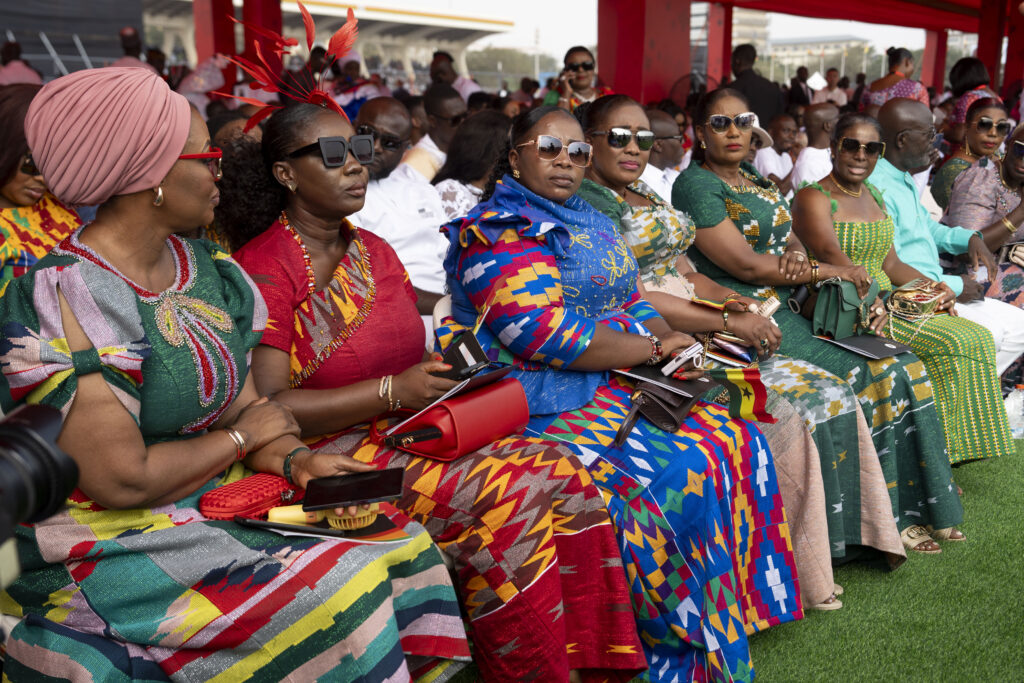
The cloth in those photographs is among the most recognized textiles in the world. It is also among the least read. Most people who recognize kente recognize a palette and a posture: bright interlocking color, worn across the body, standing in for African identity in the broad sense. That recognition is real, and it is shallow. It treats the cloth as an emblem when it works more like a script. The distance between those two things is where this story sits.
The System on the Loom
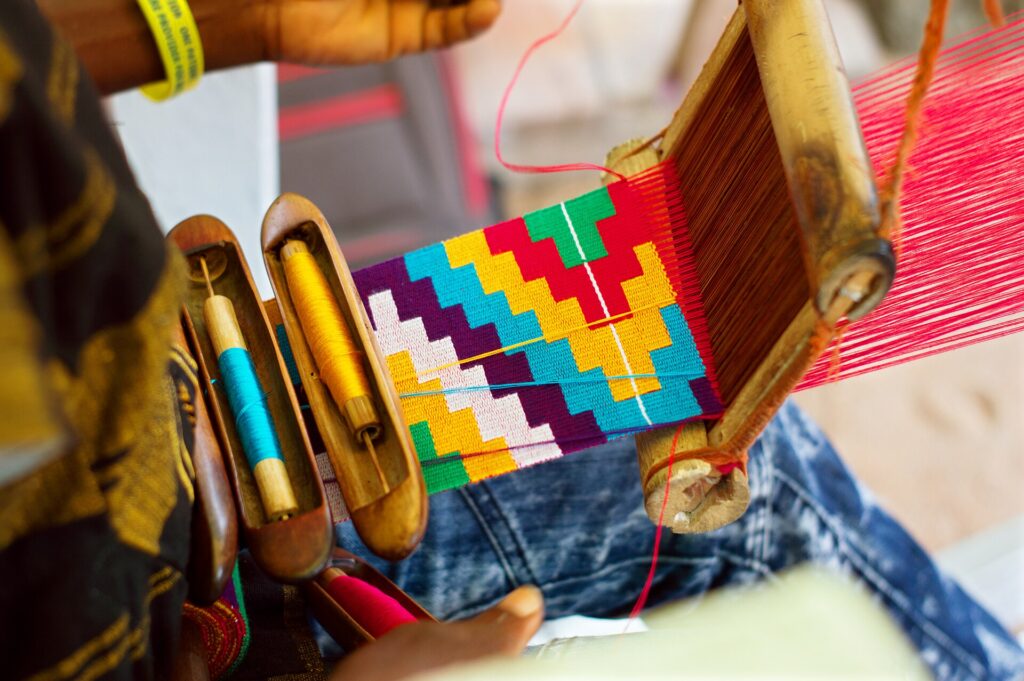
Kente comes from Bonwire, a town near Kumasi in the Ashanti Region of Ghana, where the king’s weavers have worked for centuries alongside the goldsmiths, stool carvers, and umbrella makers who served the Asante court. In Twi the cloth is called nwentoma, woven cloth. The name kente is commonly traced to kenten, the word for basket, a reminder that the earliest strip weaving in the region drew on the logic of plaiting fiber.
Asante oral tradition gives the craft a precise origin. Two weavers studied a spider, Ananse, as it built its web in the forest and carried what they learned back to Bonwire, where it was brought before the Asantehene Osei Tutu. He claimed the cloth for the court. Historians place this in the early eighteenth century and locate it inside a much older West African strip-weaving tradition that long predates the Asante kingdom. The legend and the history agree on one point. From the beginning, kente was about who held knowledge and who was permitted to wear it.
The method has not fundamentally changed. A weaver works a narrow horizontal loom that produces a band roughly four inches wide. The warp threads, often more than ninety feet long, are dressed onto the loom before a single pick of weft is thrown, and their color is fixed for the entire length of the strip. The weaver builds pattern by alternating warp and weft in exact, memorized sequences, then the finished strips are cut and hand-sewn edge to edge into a full cloth. Nothing about this is decorative in the loose sense. The cloth is modular and structural, its pattern built into the warp and weft rather than laid over them.
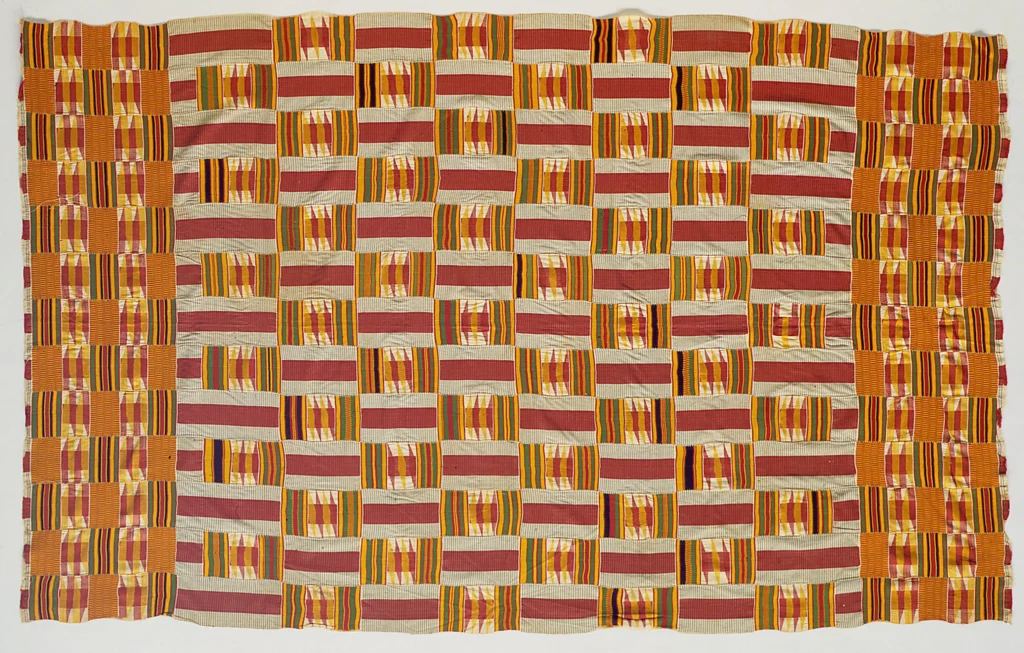
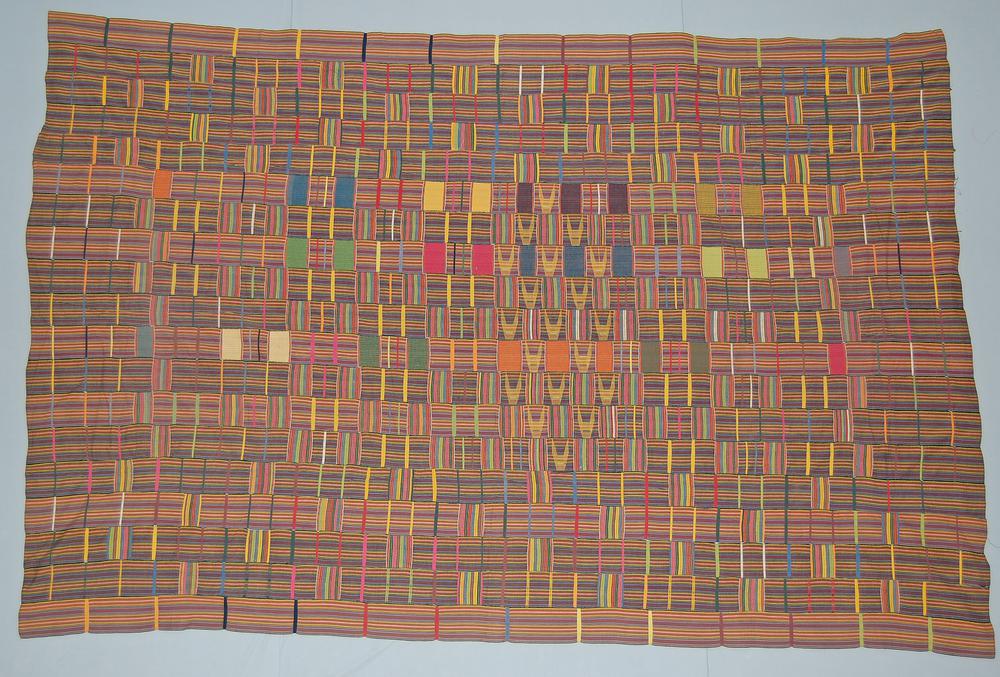
This is the part of kente that rarely travels. Asante weavers prefer geometric blocks that run the length of the strip. Ewe weavers, in the Volta region around Kpetoe, work differently, often setting figurative motifs into the weave so that a scorpion or an elephant carries its own meaning. To speak of kente as a single Asante invention is to erase the Ewe tradition that runs beside it. The cloth has always been plural.
The uncertainty reaches into the museums. Major collections, the Met among them, catalogue individual cloths as “Asante or Ewe,” the attribution left open because the cloth itself does not always announce which tradition made it. Learning to read kente has been difficult even for the institutions that hold it.
Each finished kente has a name, and the name is the meaning. Adwenasa, the master cloth whose name translates roughly as “my skill is exhausted,” packs so many motifs into a single design that the weaver claims to have spent every pattern he knows. Sika fre mogya binds wealth to kinship, the proverb that money draws blood relations near. Fathia fata Nkrumah, “Fathia is worthy of Nkrumah,” is read as a tribute to the Egyptian wife of Ghana’s first president. The design is also known by another name, baako mmu man, “one person does not rule a nation.” Which name a cloth carries has itself been a political act.
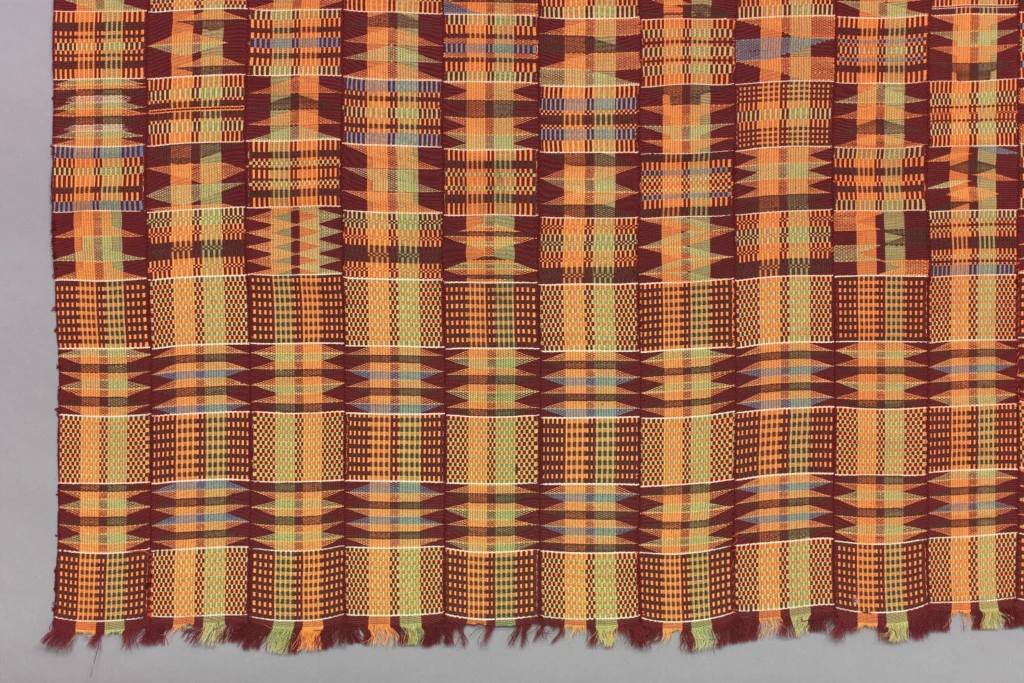
Color carries its own register. Gold reads as royalty and wealth, blue as harmony, green as growth, black as spiritual depth and maturity. Color is the easiest part to read and the smallest part of the meaning. The rest lives in the named cloths and the proverbs they carry, and that is what gets left behind when kente travels as a palette. The Institute of African Textile makes the same point across this series. A cloth loses its meaning when it is flattened into a vibe.
Reading kente is the whole point. The cloth was built to be legible, and most of its global life has been looking without reading.
The Cloth Was Always Political
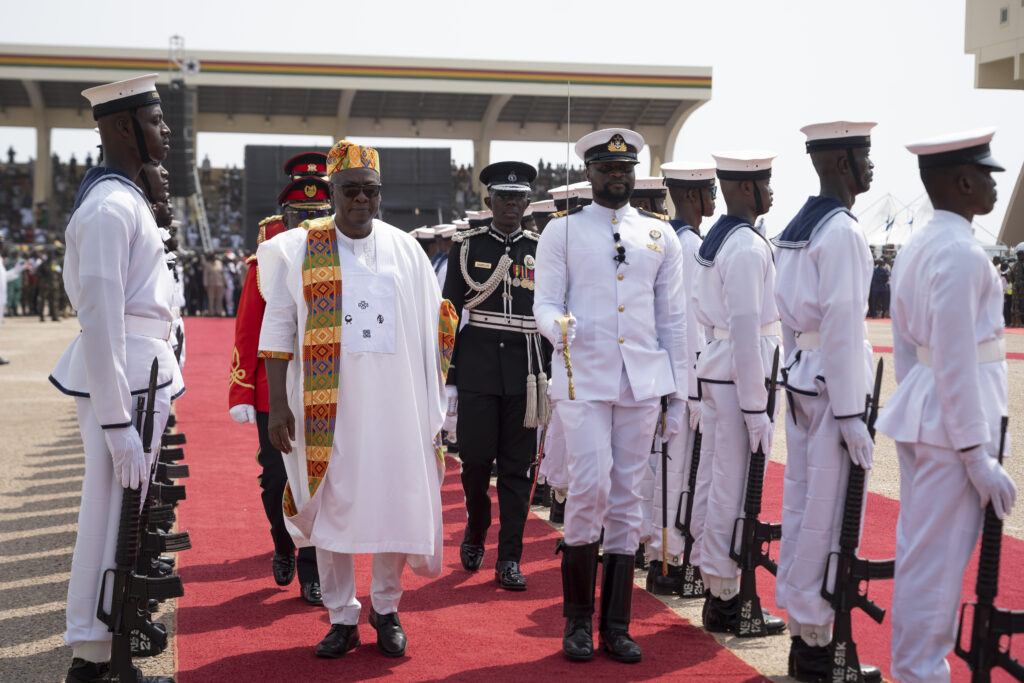
Kente was political long before it left Ghana. It was political on the loom. The Asantehene reserved it for the court and for sacred occasions, and access was a form of rank. To wear a particular cloth was to make a claim about who you were and what you were entitled to say. The contemporary debates about kente are arguments about exactly this question of authority, transposed onto a much larger stage.
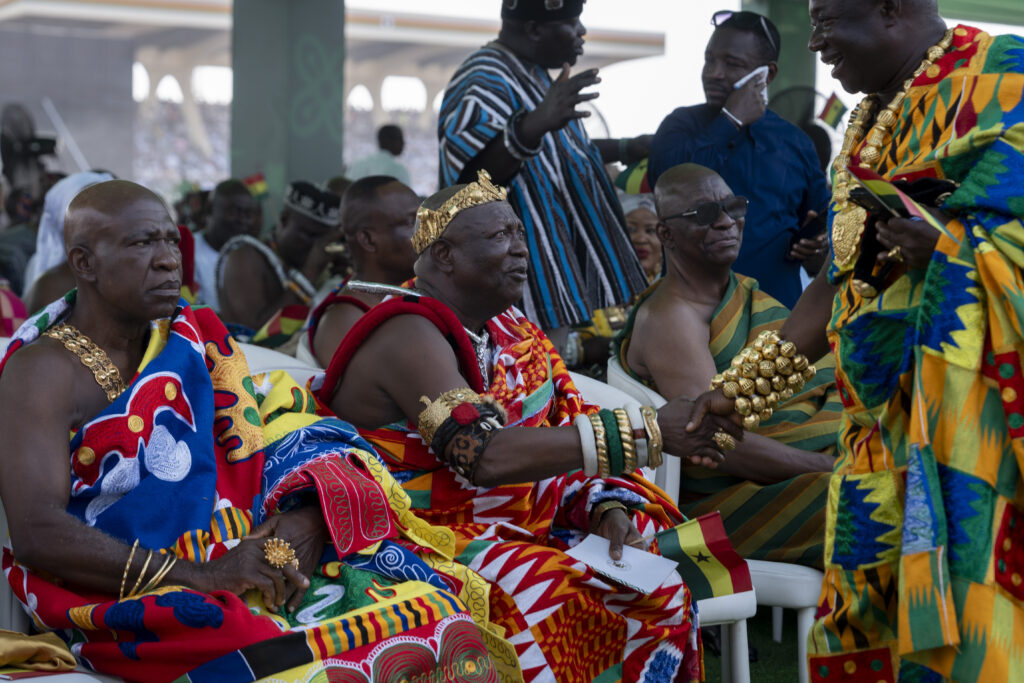
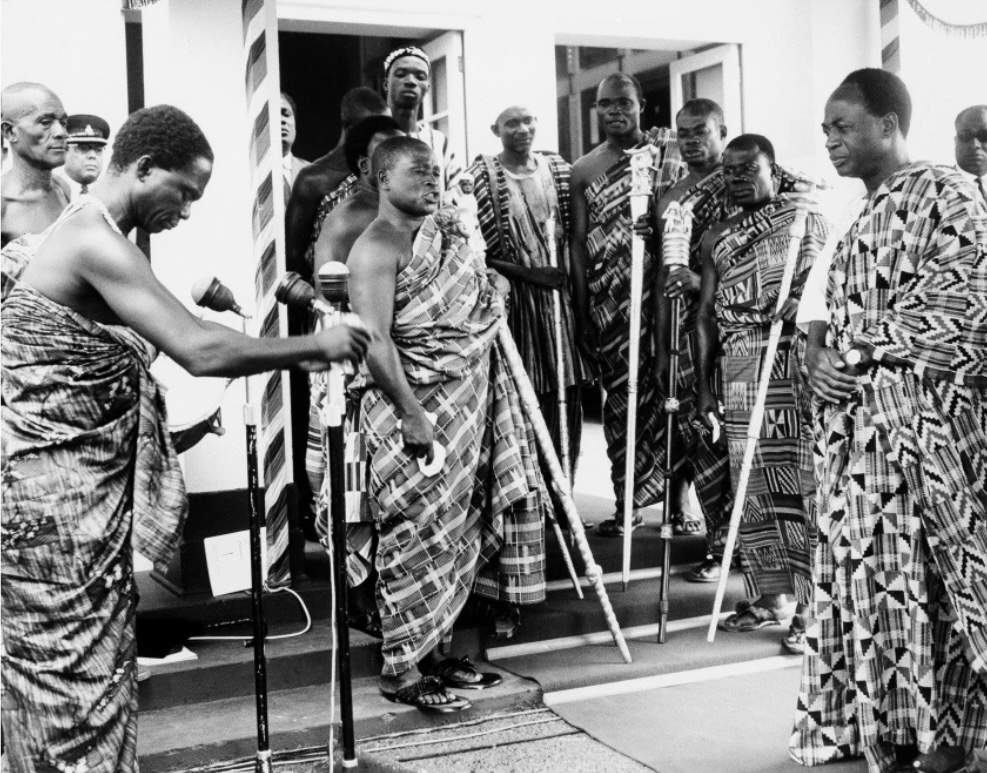
When Kwame Nkrumah wore kente into Ghana’s Parliament and onto the world’s platforms at independence, he was using the cloth as it had always functioned, as a statement of sovereignty legible to anyone who knew the system. When W. E. B. Du Bois accepted an honorary doctorate from the University of Ghana on his ninety-fifth birthday in 1963, the ceremony photographs show kente over his academic gown, the cloth marking a diaspora reconnecting with a source. The graduation stole worn across American campuses today, documented in the 1998 Fowler Museum exhibition Wrapped in Pride, emerged from the same diasporic embrace of kente. In each case the cloth did real work because the wearer stood in a recognized relationship to it.
The Capitol moment exposed exactly that gap between symbol and substance. The lawmakers in kente had no legible relationship to the cloth, and the reform they introduced did not survive. The criticism that followed was less about fabric than about the moment asking the cloth to carry weight it could not bear.
Virgil Abloh’s 2021 collection for Louis Vuitton sits on the more difficult end of the same question. Abloh, of Ghanaian parentage, wove the LV monogram into kente and draped it in the toga line that Ghanaian men have always used to wear cloth, then placed the collection inside a reading of James Baldwin’s Stranger in the Village. Some saw a luxury house monetizing a sacred textile. Others, including Ghanaian commentators, saw a designer with a real claim to the tradition arguing for its place in the global canon. Amanda Gorman wore one of the looks on the cover of Vogue. The collection did not resolve the appropriation question. It staged it, which is closer to reading the cloth than ignoring it.
What the Market Is Doing to the Loom
The most immediate threat to kente is not on a runway or in a legislature. It is in the marketplace. Roller-printed imitations, many imported, now flood markets with cloth that mimics kente patterns at a fraction of the price and none of the labor. Where tradition called for silk and cotton, cheaper rayon substitutes for the silk that Asante weavers once obtained by unpicking imported European fabric and reweaving the thread. The printed version does not run or fade, and it requires no weaver. It also carries no name and no maker.
This is the same pressure the series documented in Guinea and in Mali. When the value of a textile shifts toward durability, price, and convenience, the systems that depend on time and transmission weaken. A Bonwire weaver who offers rayon is surviving inside an economy that pays for the look of kente and not the knowledge in it. The honest version of this story treats that choice as evidence, not embarrassment.
In 2025, Ghana secured geographical indication protection for kente, the country’s first, legally tying the name to its origin, the same kind of protection extended to Guinea’s léppi. The designation covers weaving communities in both the Ashanti and Volta regions, acknowledging in law the plurality that has always existed within the cloth. Recognition on its own changes little. It has to be matched by markets that pay weavers for authorship, by buyers who learn to tell a woven cloth from a printed one, and by institutions willing to name the makers rather than the motifs. The cloth survives through practice, and practice survives through structure.
The cure for misreading kente is not to lock it back inside the palace at Kumasi. The cure is to read it. The cloth will keep traveling, the way legible things do. The only question is whether the world learns to read it, or keeps borrowing the surface.
In This Series
Material Literacy: The Knowledge in Cloth Mariama Camara on authorship, ownership, and the distance between admiration and accountability. The series launch.
Guinea: A Textile Civilization in Four Systems The four ecological zones of Guinea, and the textile systems each one produced.
Understanding Bògòlanfini: The Malian Textile Written in Mud and Cotton Iron-rich mud, boiled leaves, and a written language fixed onto handwoven cotton.
Kente and the Politics of Being Read You are here.
Next in the series: Aso Oke.
Read the cloth before you wear it. Subscribe to follow Material Literacy across the continent.