


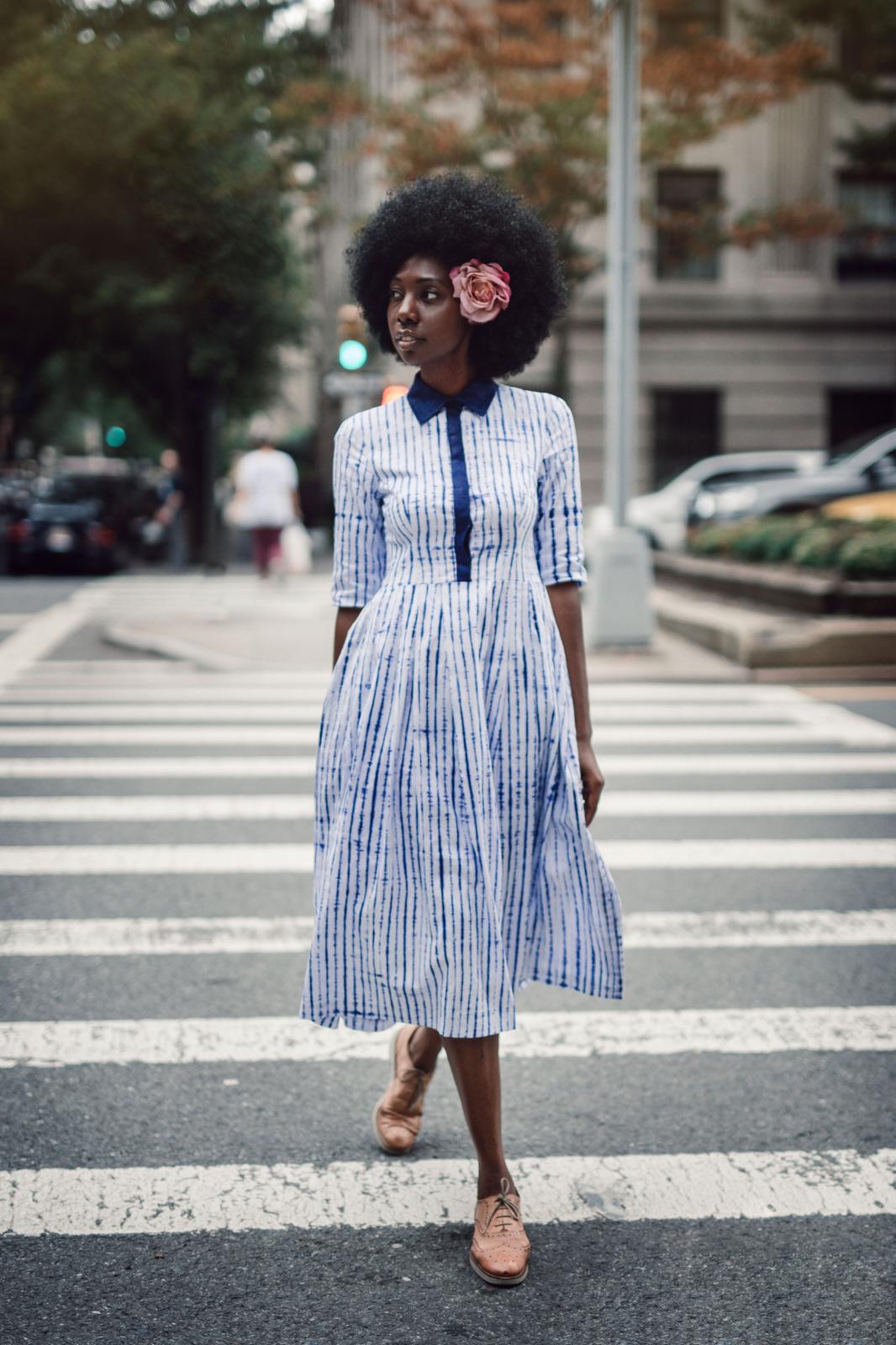
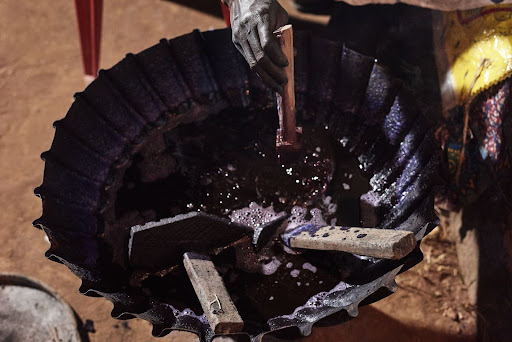
Mariama Camara is four years old, standing at a careful distance in a courtyard in Yimbaya, Conakry, Republic of Guinea. Her mother, Mafoudia Bangoura, and her aunts work over boiling dye pots. She is not allowed to touch. But she is allowed to witness.
“I did not have the words for what I was seeing,” she recalls. “I only knew that something extraordinary was happening, that plain cloth could become something alive.”
That moment was not instruction, it was initiation and the education that followed was geographic. Guinea is not one place but four distinct worlds: four regions, four material cultures, four ways of understanding what cloth can do. The deep indigo of Guairai cloth from Kindia communicates differently from the ochres of the Sacred Forest in the forest region. The striped geometry of Leppi speaks a different language from the resist patterns of Basse-Guinée tie-dye. Growing up between the coast and the interior, between the Susu world and the Fulani highlands of the Fouta Djallon, she learned early that color is never decorative. It is information. Every pattern has an author. Every color has a source. Every textile carries a community behind it.
What the global fashion industry calls “inspiration,” she identifies as intellectual production.
When she moved to New York in 2001, she entered an industry that admired African textiles but rarely understood them. Her path into fashion was not singular. She worked across modeling, makeup artistry, styling, and design, building a layered understanding of the industry while remaining connected to artisan communities across the continent.
The terms used to describe African textiles were telling: bold, expressive, ethnic. Words that celebrated surface while erasing structure. The knowledge she had witnessed in a courtyard in Conakry had already traveled. By the time it reached New York, it had simply been renamed.
The friction she encountered was specific. “I have been in New York and seen a silk fabric at a major fabric store priced at thirty-eight dollars per yard,” she says. “Then I bring a handmade African textile produced by skilled artisans using techniques refined over generations, and someone offers me ten dollars.”
The misconception that African textiles are cheap is compounded by a second one: that everything from the continent is folkloric. Too colorful. Too bold. Too ethnic for the luxury space. That stereotype has cost African artisans and designers incalculable economic value. What was missing was not access. It was context.
“I understood what the Western market needed, and what African artisans produce.”
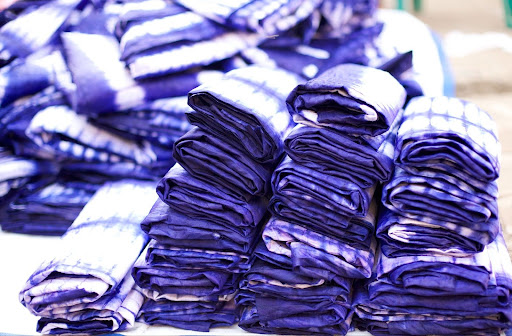
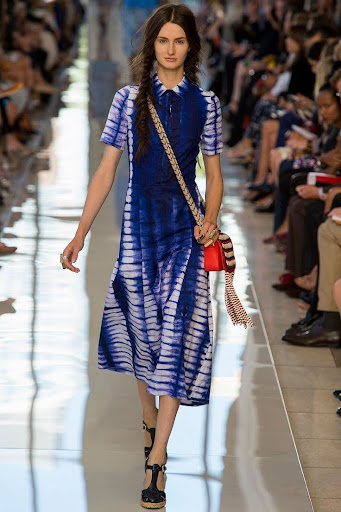
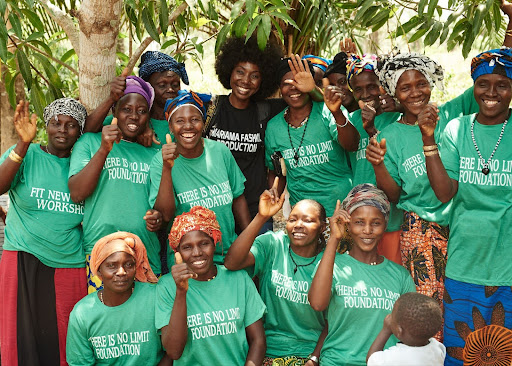
In collaboration with Tory Burch, she facilitated the production of textiles by more than 300 women tie-dyers in Kindia, Guinea, organized through the There Is No Limit Foundation, starting with Fatoumata Bangoura as the first recipient. Their work traveled from local workshops to Mercedes-Benz Fashion Week in New York and into Bloomingdale’s, Bergdorf Goodman, and Galeries Lafayette in Paris. Michelle Obama wore it. Reese Witherspoon wore it. In 2013, the artisans of Kindia were documented in the New York Times bestseller Tory Burch: In Color, with a foreword by Anna Wintour.
It was the first time in history that Guinean artisan textile work had been brought to an international stage of that scale.
By every visible metric, it was a success. The work moved at the highest levels of the industry. And yet, the structure that contained it remained intact. The artisans were part of the story. They were not yet part of the system.
The collaboration was made in Guinea, where she is from, in Kindia, where her great-grandmothers built their textile legacy, by women. That convergence was not incidental. It was vision, realized. And from that moment, she began to imagine what could be done not with 300 women in one city, but across the entire continent.
That vision became Mariama Fashion Production, and eventually the Institute of African Textile.
Through Mariama Fashion Production, she connects global brands with African artisans across techniques while maintaining authorship and traceability. Through the Institute, she is developing a framework that treats textiles not as export goods but as intellectual property: documented, contextualized, and protected. Her role is not simply that of a producer but of a custodian.
“Respect is not only spoken loudly,” she says. “It is structured. You structure yourself, you structure your ecosystem, and then the world has to reckon with that structure.”
Despite growing global interest in African textiles, the underlying dynamics remain largely unchanged. Techniques are replicated without attribution. Patterns are reproduced without context. Artisans remain positioned as labor rather than authors. This is further complicated by what she calls “fast textile”: the mass production of imitation African prints that undercut artisans and distort the value of their work. Without systems of documentation and protection, visibility risks becoming another form of extraction.
Archiving Against Disappearance
Her great-grandmother, Mafoudia Touré, was one of the most accomplished textile designers in Guinea’s history. She traveled by boat to Dakar and Côte d’Ivoire, carrying her work, training women, building a commercial network across West Africa long before global recognition existed. She died in 1964. No major publication documented her. No archive holds her name. Her knowledge survived only because she transmitted it to the women around her, including Mariama’s mother and aunts.
That absence is not incidental. It is systemic.
“We document because the alternative is disappearance.”
Today, the Institute’s work extends across all fifty-four nations of the continent, asking the questions that formal archives have neglected: why communities wore what they wore, how they made it, what difficulties they faced, how the ancestors did it, and how that knowledge continues to be transmitted. The scope includes not only cloth as worn, but cloth as it appears on masks, on sculpture, in ceremony, in initiation. Textile encoded the full life of a civilization.
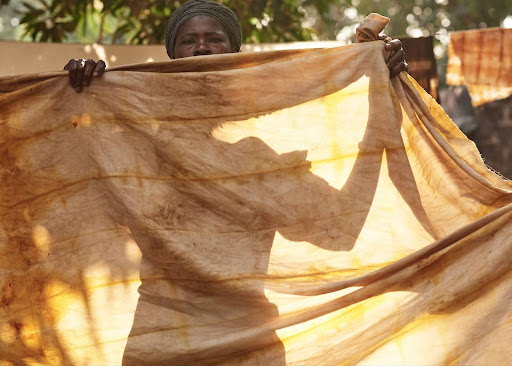
At the core of the work is material literacy: the ability to understand what we create, where it comes from, and who it impacts.
She works exclusively with natural fibers, cotton and silk, while reviving plant-based dye systems rooted in local ecosystems. The commitment is practical as much as principled: synthetic dyes have, over time, compromised both the quality of the textiles and the health of the women producing them.
In 2019, collaborating with Dr. Theanne Schiros of the Fashion Institute of Technology and Columbia University, and photographer John Brown, she led workshops in Modiya, Kindia and in Côte d’Ivoire, training artisans in dye processes derived from food waste, bark, leaves, roots, compost, and locally grown indigo. They produced over one hundred natural dye samples, each functioning as both formula and archive: records of how ancestral knowledge and contemporary science can coexist without erasure. That archive is on permanent exhibition at the FIT Museum and at www.6875kilometers.com.
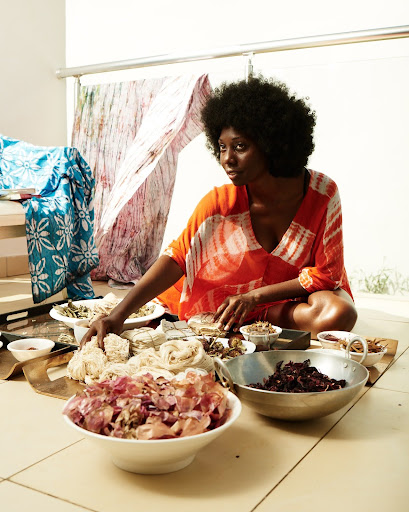
“The fabric is the artisan,” she says. “You cannot separate the quality of the cloth from the knowledge, the skill, and the lived experience of the person who produced it.”
Her work with the women tie-dyers of Kindia, beginning with the founding of the Association of Women Tie-Dyers of Kindia alongside her sister Aissata MB. Camara, was built on this principle. “When I work with artisans, I am not commissioning a product,” she says. “I am entering into a relationship with a knowledge system that is centuries old.”
That relationship demands fair compensation, long-term collaboration, and recognition that authorship does not end at production. Her work centers women artisans as co-creators, not suppliers.
The Voyage
Africa’s biodiversity, material intelligence, and cultural depth already offer viable responses to fashion’s sustainability challenges. Fifty-four nations, each with its own distinct textile tradition. That is a depth of creative and material intelligence that no other continent can match.
“Africa is not the future. Africa is now,” she says. “We have quality work. We have great creatives. We have knowledge, history, and vision. I want readers to see us as equals, because we are.”
As the opening voice of Material Literacy, Mariama Camara does not propose a new way of appreciating African textiles. She proposes a new set of terms: documentation over admiration, protection over access, ownership over visibility. What she is building through the Institute, through Mariama Fashion Production, and through the frameworks she has spent two decades developing is not a body of work. It is infrastructure.
The series that follows will travel the continent, region by region, textile by textile, mapping the knowledge systems that cloth carries and the communities that author them. This is the first page.
Material Literacy is produced in partnership with the Institute of African Textile.