


Learning to Read Ndop
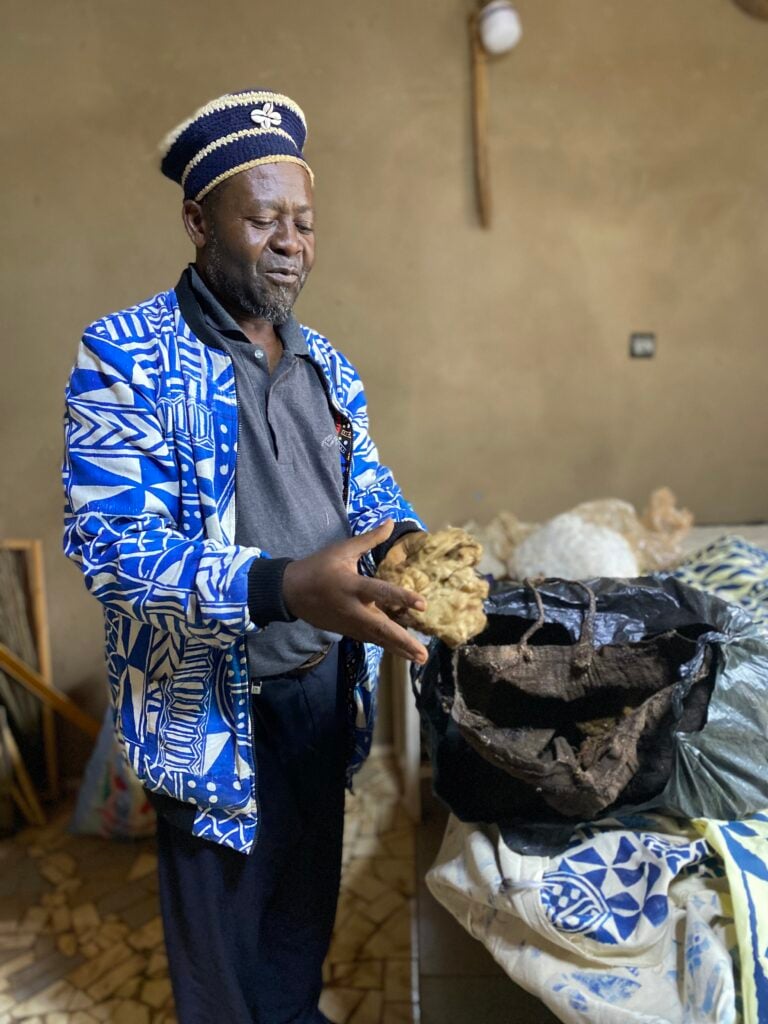
On a video call from Foumban, in western Cameroon, Professor Idrissou Njoya lifts a length of pale cotton towards the camera. Drawn lines run across the fabric, and part of it has already been gathered into tight raffia stitches. It is ndop in progress. After the dye bath, the bindings will be cut away, exposing the areas they have protected from the colour.
Njoya, a professor of art history and an artist, often draws the motifs himself. His interest began with his grandmother, who spun cotton and took it to market. When he asked what it was for, she explained that it would become cloth. He still keeps her bag and the cotton she left behind. His father, who he says headed the Bamoun royal army, told the family stories of military history and, through them, how ndop arrived in the kingdom.
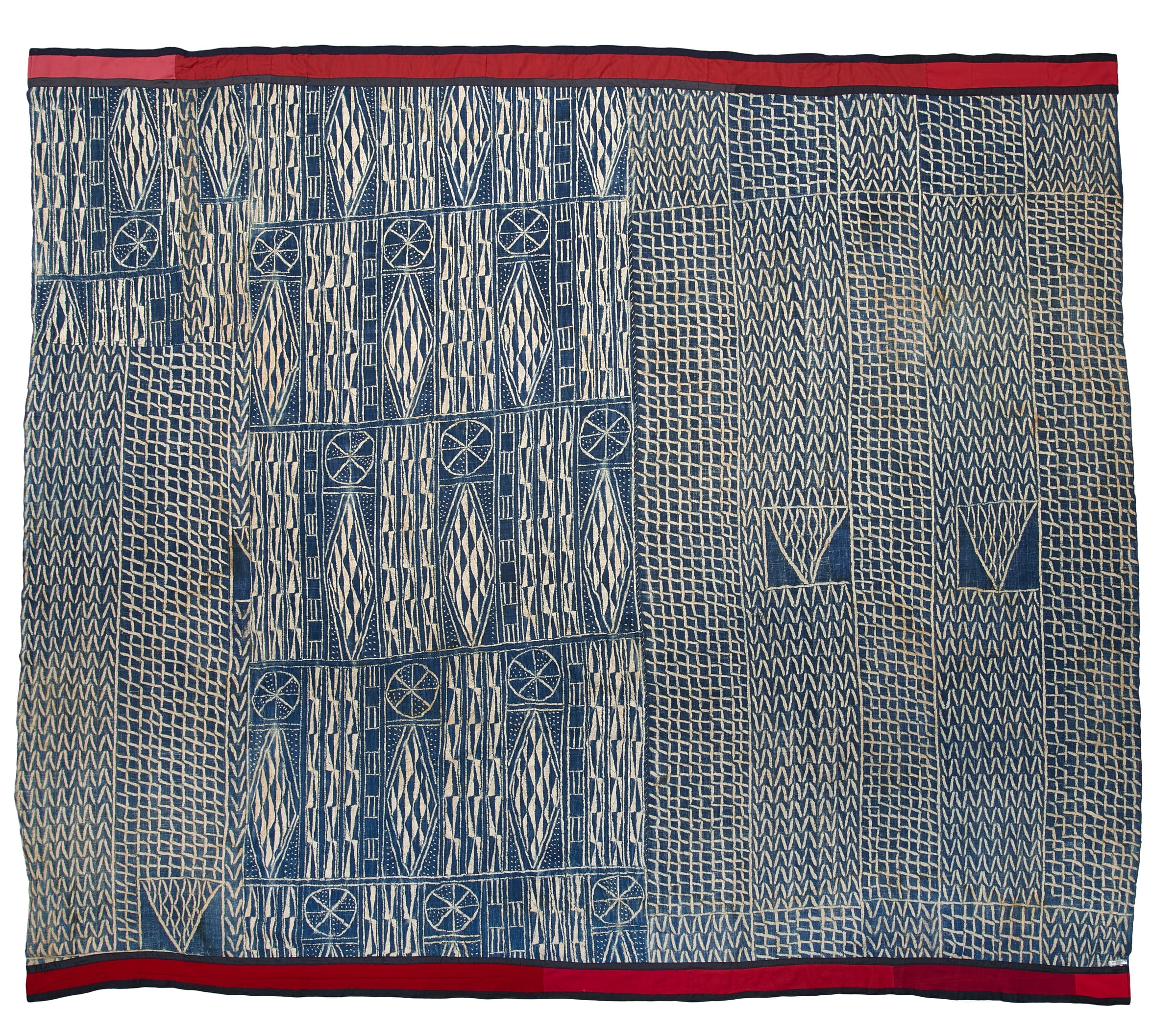
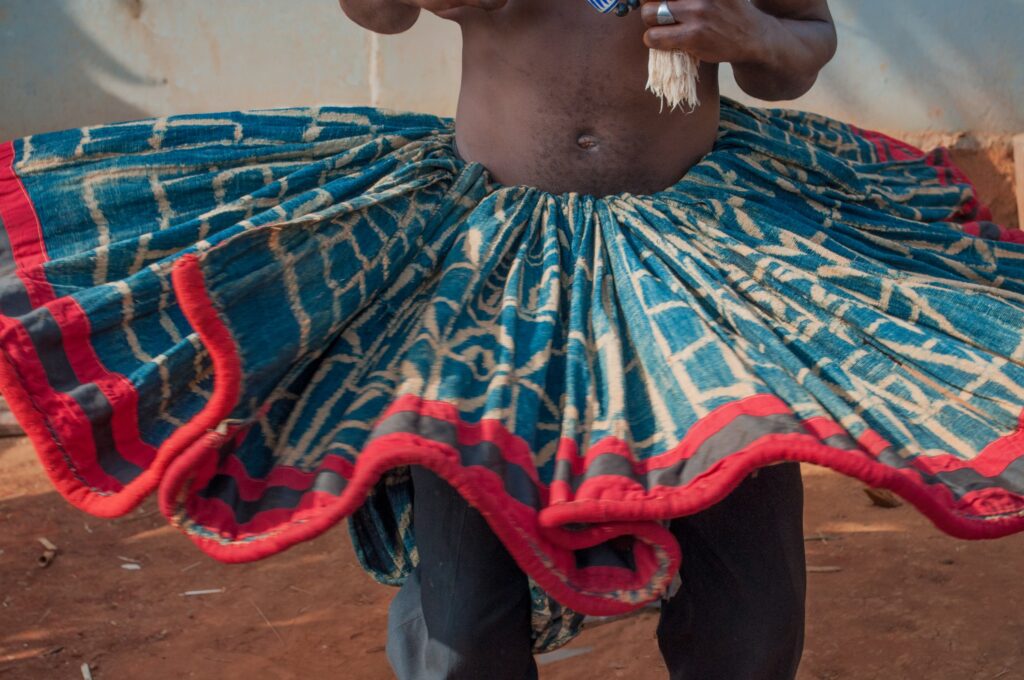
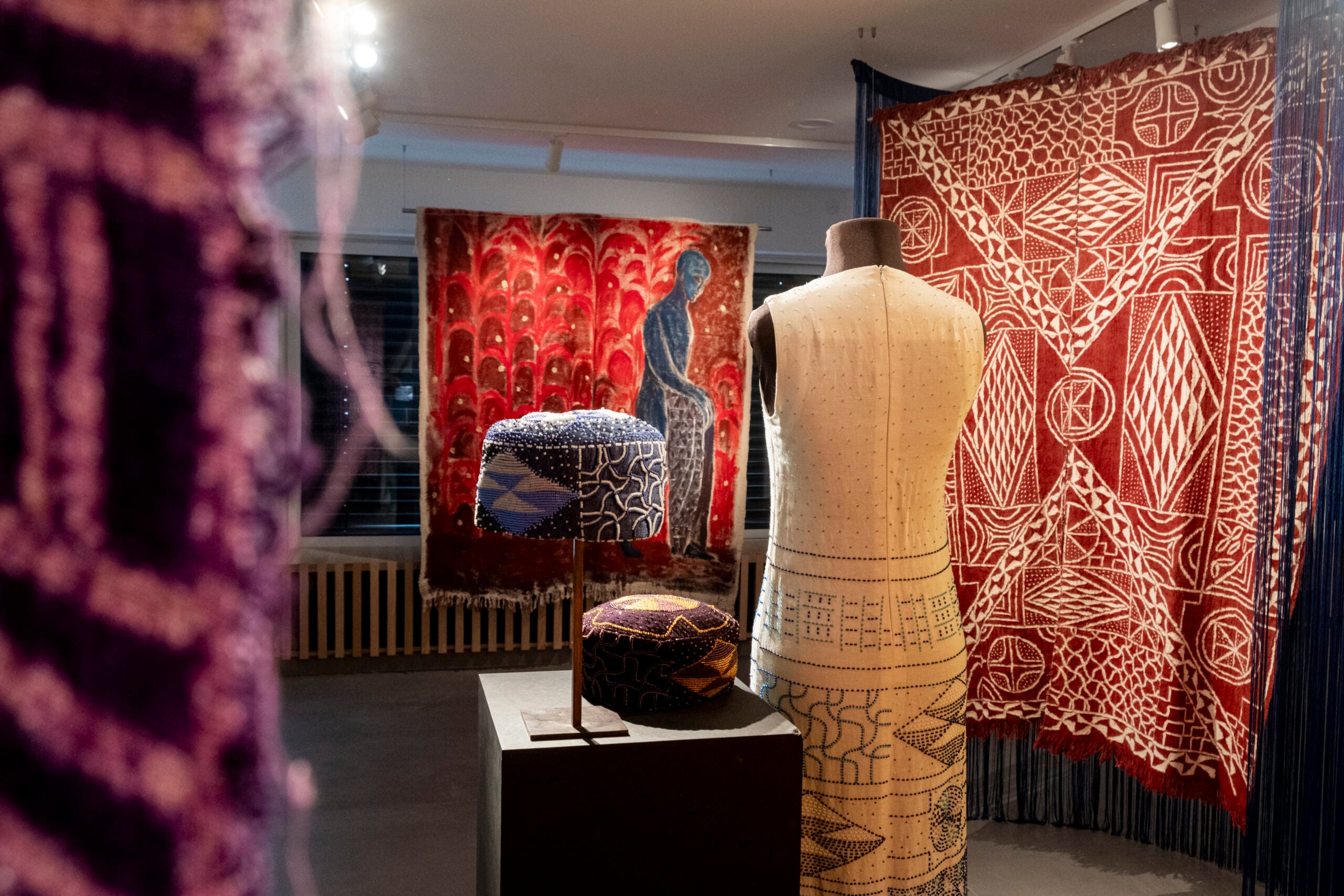
The blue-and-white cloth is associated with the Grassfields of western Cameroon, where it is worn and displayed in ceremonial life. At Maison Gacha in Paris, Ndop, filer le bleu pour raconter un monde follows the cloth from its making across Cameroon to its uses in the Grassfields chiefdoms and its place in contemporary practice. The historical pieces come from the Gacha-Dumas collection, assembled by Ly and Frédéric Dumas: monumental ceremonial hangings, a complete costume of an initiation society, beaded elephant masks and a throne with a ndop backrest.
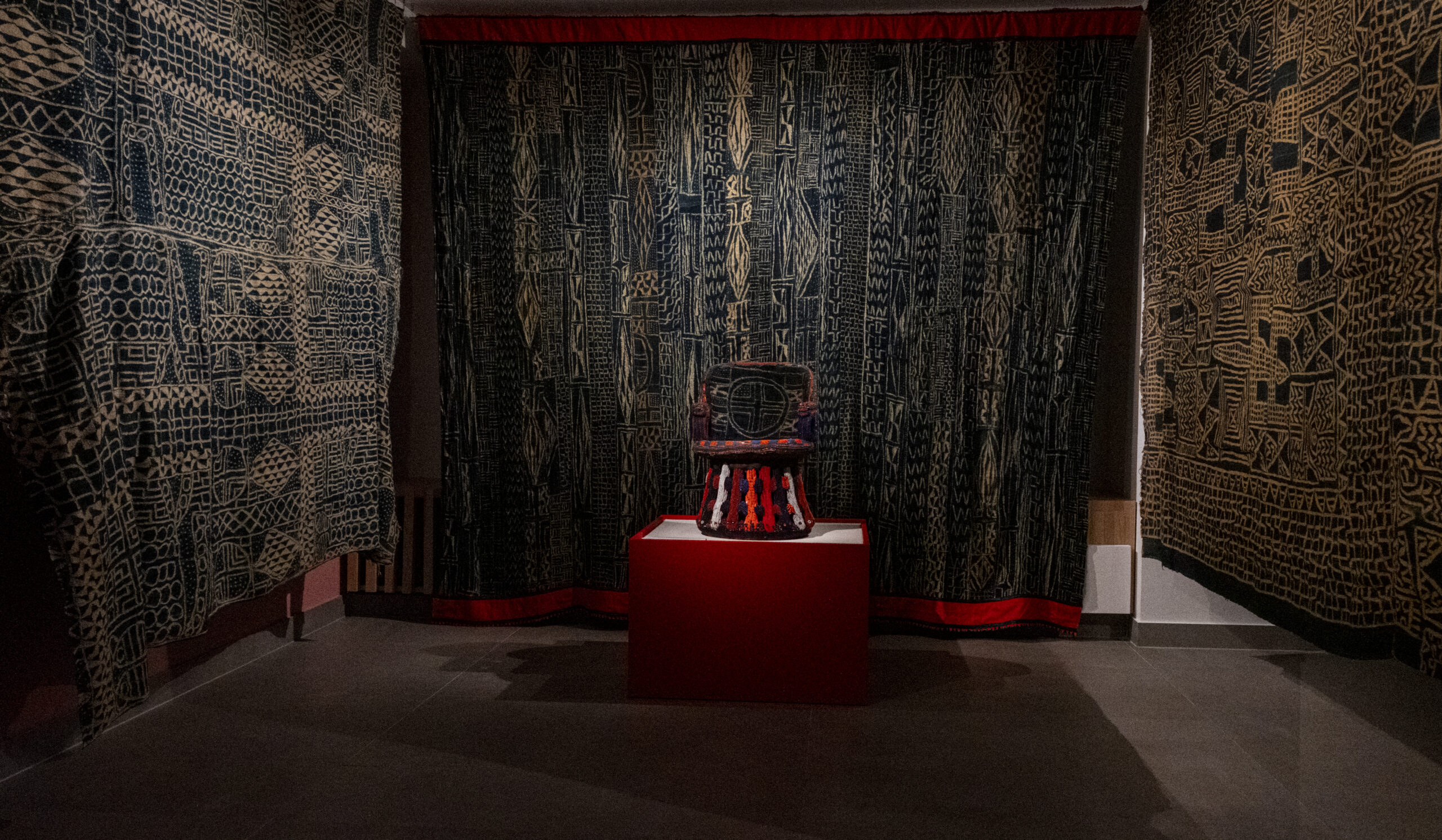
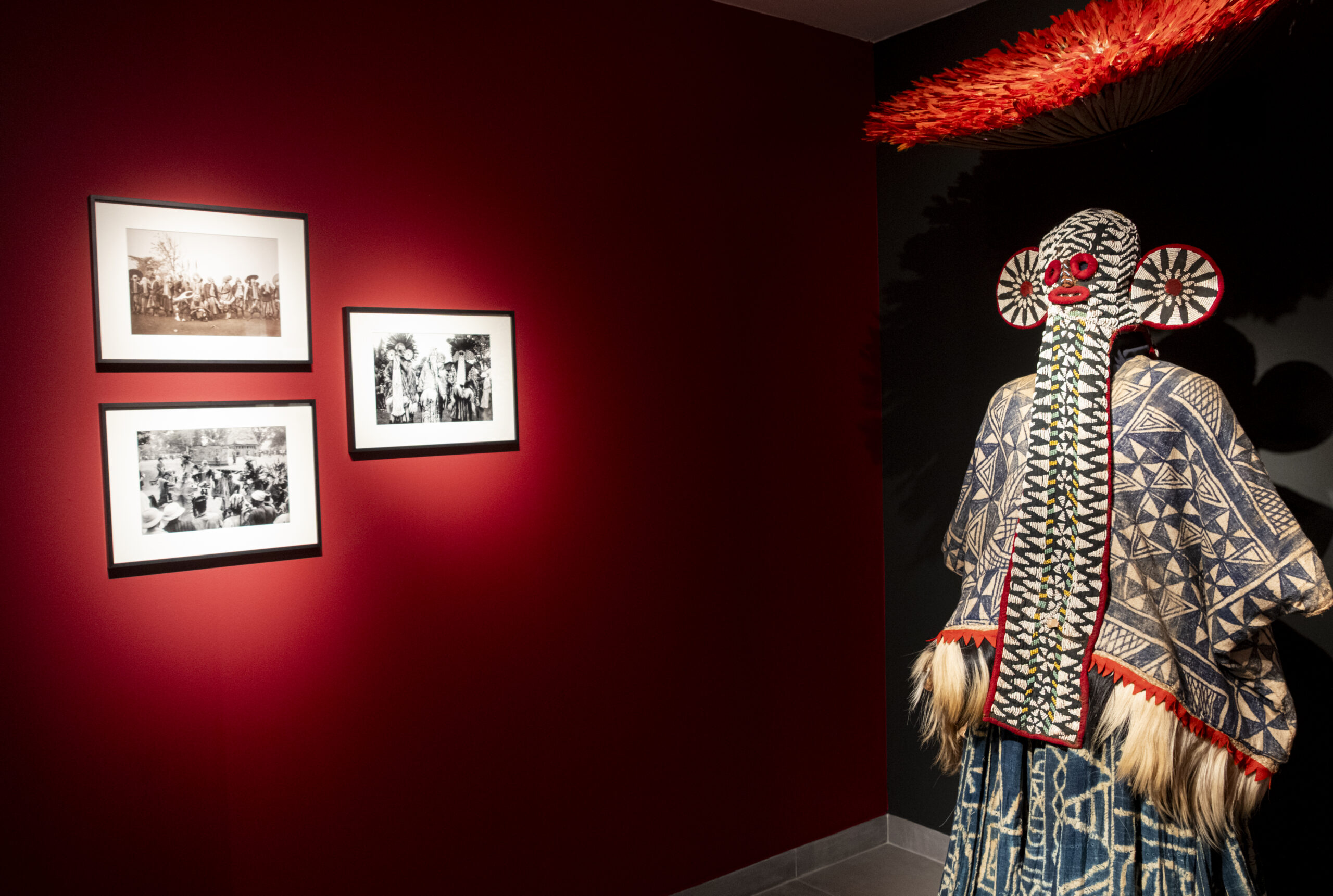
Alongside them are a ndop by the master maker Kamwa Simo, commissioned by Ly Dumas, and Dumas’s own designs, which set aside the blue for orange and violet and redraw the motifs in beads rather than thread. The exhibition also includes two works by the Franco-Senegalese artist Rachel Marsil, who won the residency run by Maison Gacha and the Fondation Jean-Félicien Gacha. During that residency in Cameroon, Marsil tried the stitching herself.
When asked how a cloth is made, Njoya begins with the cotton seed. In his account, men and women prepare the fields; after the harvest, women clean the cotton and spin it into thread for the weavers. Drawing follows weaving, and the design then passes to the person who stitches it with raffia, tightly enough to keep dye out of the areas meant to stay pale. The cloth is then immersed in the dye. Once the bindings are removed and the pale areas appear, it is laid in the sun.
Older cloths preserve evidence of that work. A ndop in the Textile Museum of Canada consists of narrow strips of handspun cotton sewn together before the pattern was stitched. Some raffia thread remains attached. Njoya identifies the joined strips as a feature of older ndop, which he says is particularly prized.
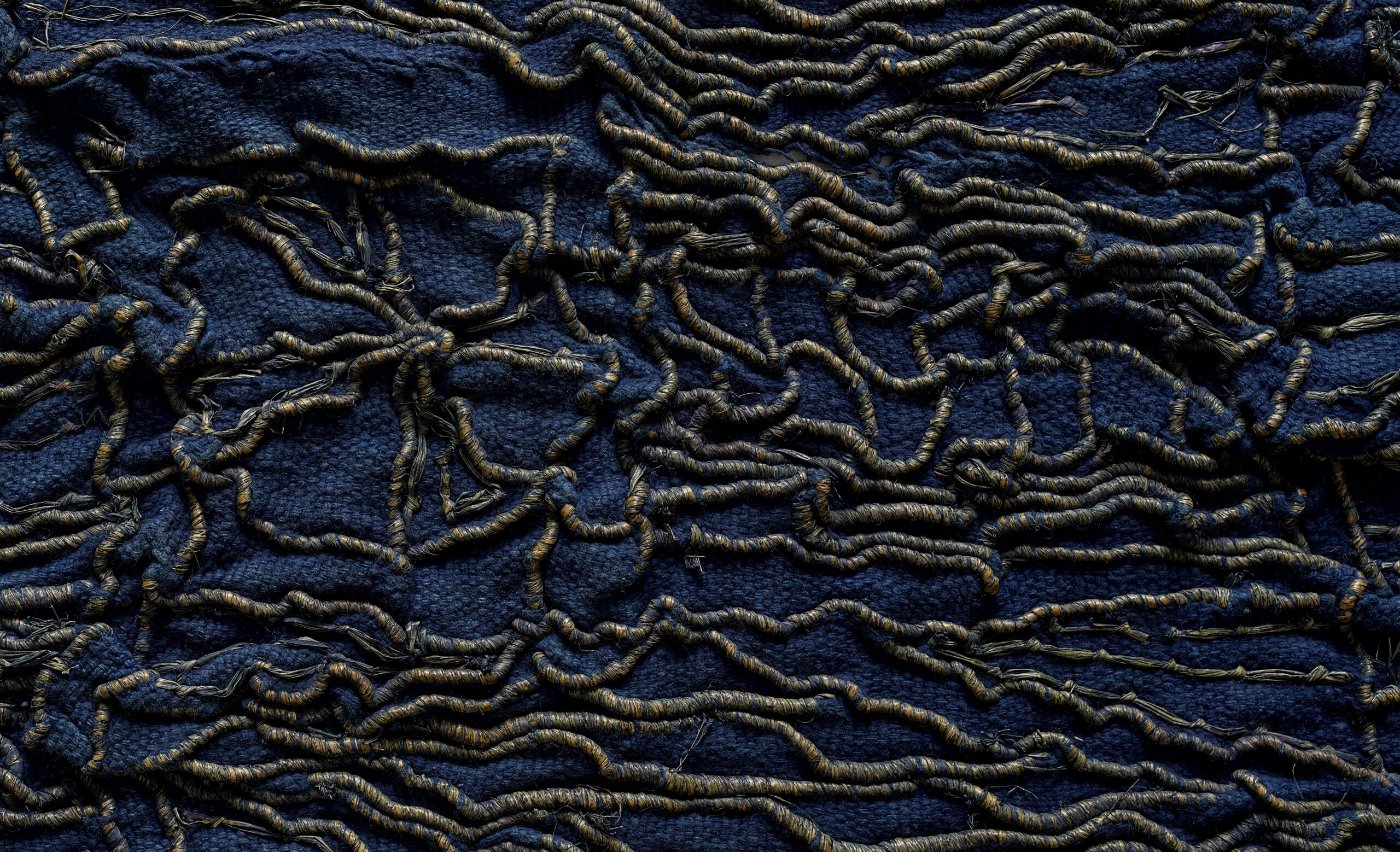
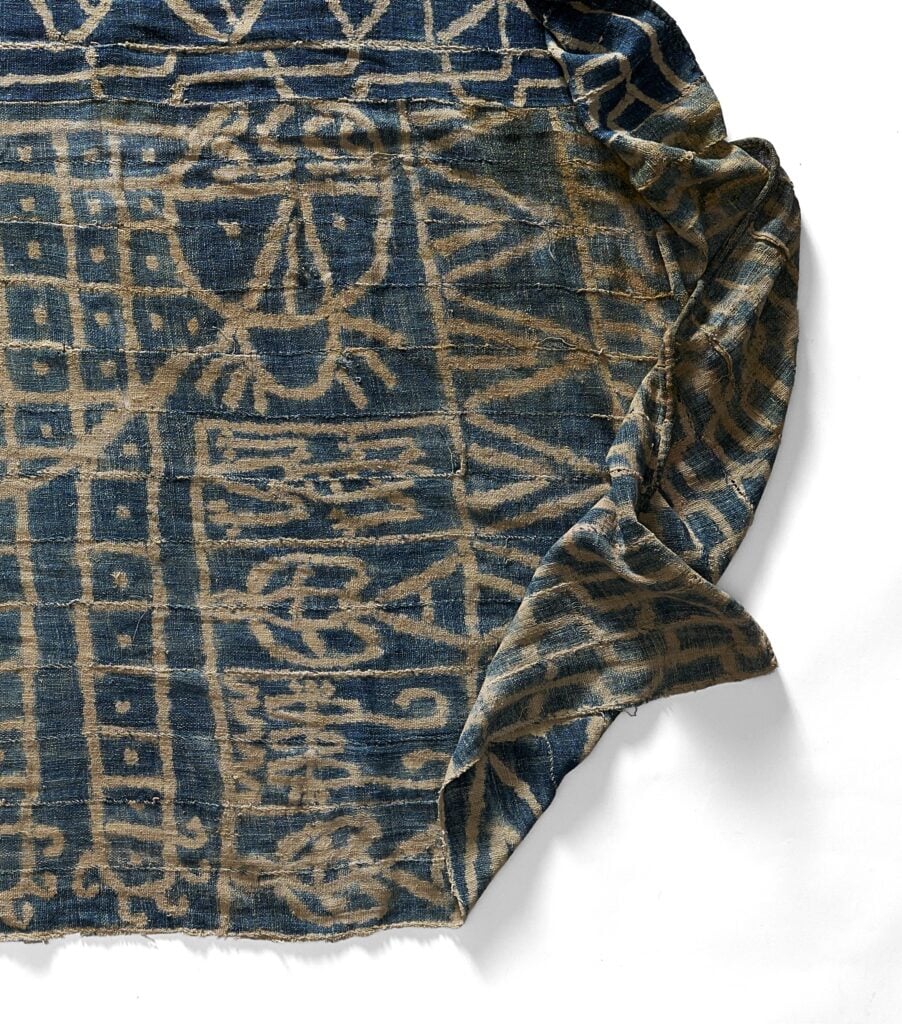
The cloth’s history crosses what is now the Nigeria–Cameroon border. The Canadian museum traces nineteenth-century imports to the Jukun of the Wukari region. Njoya’s Bamoun account also places Wukari traders in the history of weaving and dyeing in Foumban, where he says they established dye pits under King Njoya.
Maison Gacha’s exhibition dossier describes a production route across Cameroon: cotton is spun in the north; the woven cloth is drawn and stitched with raffia in the west, then dyed with indigo in Garoua before returning west for the bindings to be cut.
Maison Gacha’s team, answering follow-up questions about the cloth Njoya discussed, described a different arrangement. The cotton fabric was imported, and the drawing, resist stitching and dyeing took place in the same workshop. The team also reported difficulty obtaining good-quality indigo and the use of chemical dyes. Njoya had described a similar change in the work he knows.
Stitching times vary with the size of the cloth and the artisan’s other commitments. Njoya says a large piece might occupy someone for two or three months; a faster worker could finish comparable work in three weeks or a month.
Maison Gacha’s team later confirmed Njoya’s price example: for a cloth of about 100 by 150 centimetres, 15,000 to 20,000 CFA francs (about €23–30) for stitching and a selling price of 30,000 to 35,000 CFA francs (about €46–53). They did not give a full breakdown of costs or say how long that piece took. Njoya says he is unsure how to put a value on his own drawing.
Marsil encountered the demands of the stitch during her residency with the Fondation Jean-Félicien Gacha in Bangoulap. At the Baham museum, Anibel Yvel Mbouche Pokam introduced her to three elder women who demonstrated their specialities and invited her to try. They showed her drawing on cotton, raffia embroidery, immersion dyeing and the cutting of bindings, as well as how raffia is harvested and prepared.
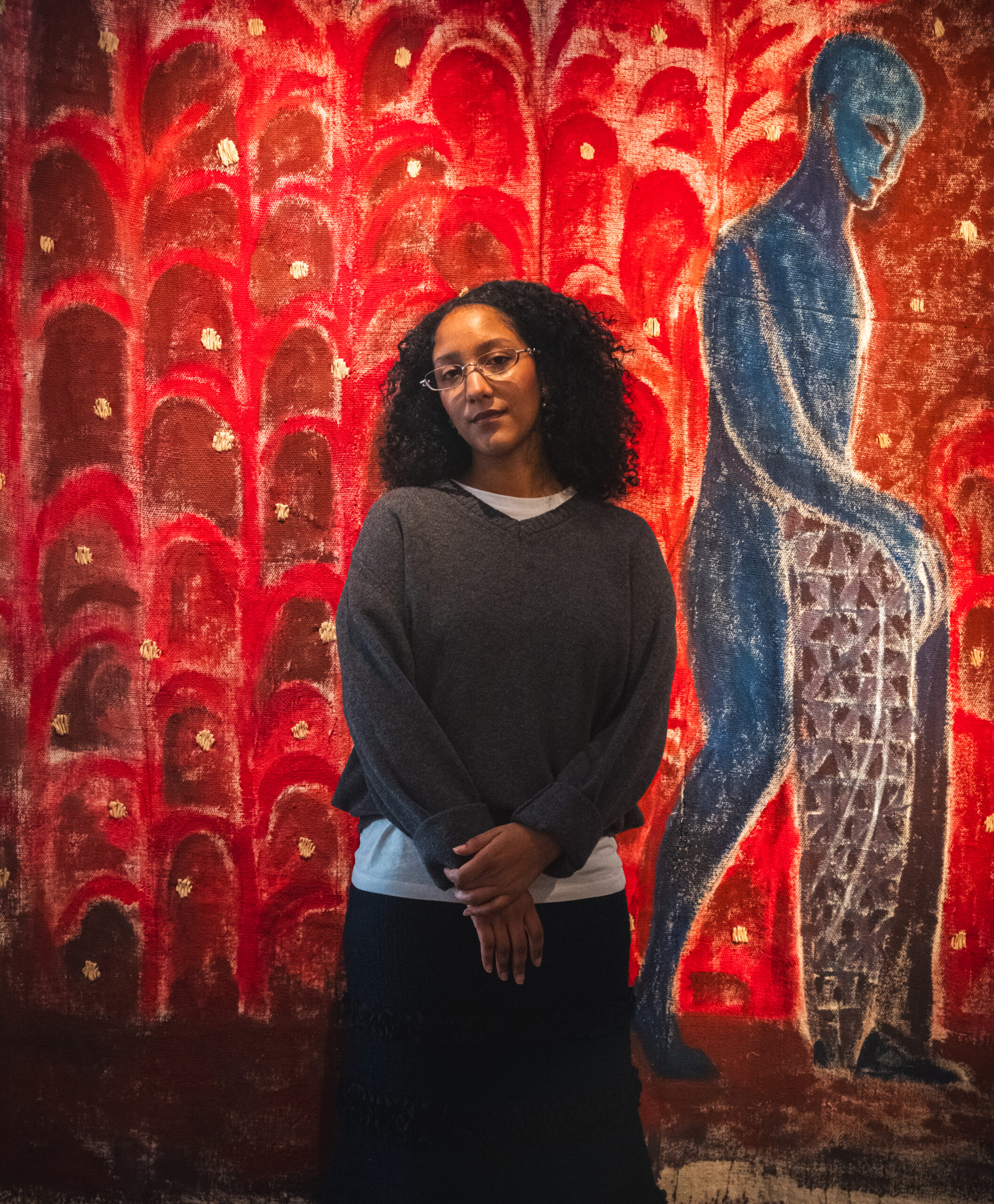
“I’ve always embroidered flat or with sequins; here I had to think about the resist, and about the fibre that would then be cut to reveal the white of the cotton,” Marsil writes in French answers to Guzangs. She makes a distinction between trying these techniques and learning ndop-making as a whole. Her purpose was to understand how she might work with the textile as an artist.
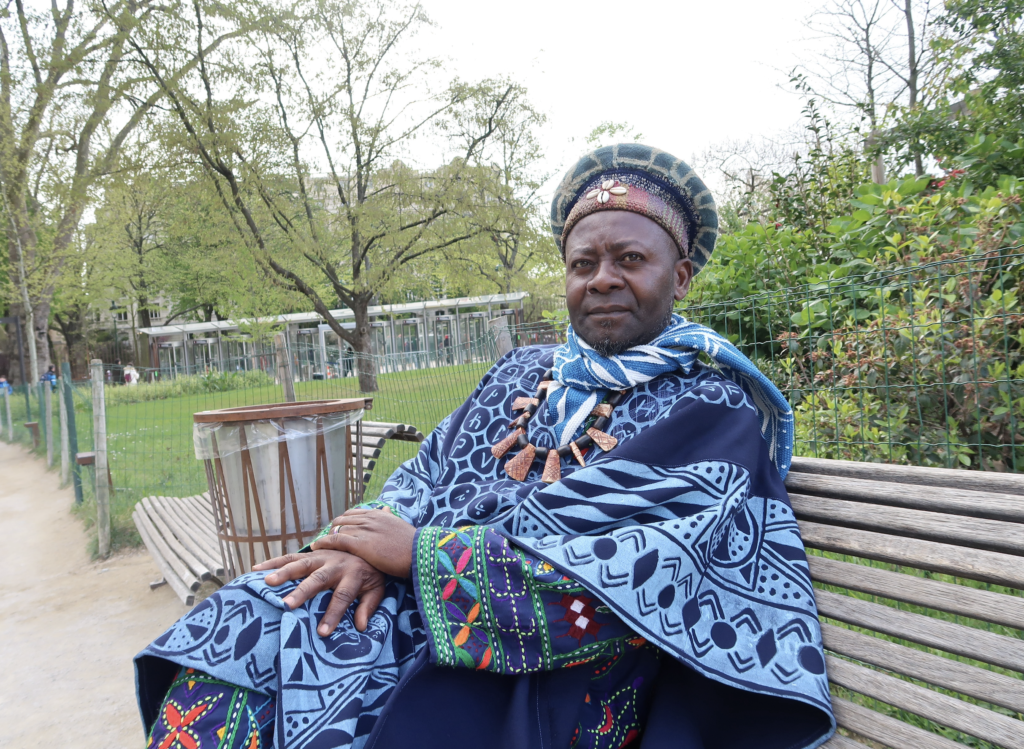
Njoya approaches ndop through Bamoun knowledge, and says at the outset that different communities tell its history differently. When he began working in decorative arts, he found that art historians paid more attention to masks and objects in wood or metal than to dress. He began studying costume and its uses. In 2014, he says, a commission to decorate the royal palace drew him further into the motifs and their relationship with authority.
During the call, he turns to the cloth behind him. A two-headed serpent signifies power and vigilance in the Bamoun cosmology he describes. The double bell recalls the instrument a king sounded to assemble people and direct warriors on the battlefield.
Crocodile scales, ntu’ngên in Bamoun, evoke the king through the animal’s longevity and its ability to live in water and on land. A ruler, Njoya explains, must adapt to different situations. He reads a winding border, nkùp, through rattan and the royal seat, and also as a labyrinth: approaching a king without care risks losing one’s way.
In Njoya’s account, ndop was initially worn by princes in mourning for another prince, and its use later extended to the nobility and members of secret societies. The king himself rarely wore it, he says, though he might do so to accompany his children.
Marsil had decided before travelling that she wanted to paint on indigo-dyed cotton. She and the Paris team planned around the rainy season, which disrupts drying after dyeing, and the team in Bangoulap prepared the fabric before she arrived. Her conversations with Njoya, the artist and professor Olivier Tima, and members of the foundation’s team led her to reconsider how she would use ndop’s motifs.
Her diptych Au delà du visible, 2026, was the last work she made there. At night, the trees outside her bedroom window appeared as shadows. She painted that forest on the dark cloth and embroidered birds that had become markers of daybreak and nightfall. Across the residency works, she alludes to ndop’s symbols, including the cross and peace tree, outside their usual compositional grid.
Although she had expected to work alongside artisans, Marsil completed the painting and embroidery herself, using raffia brought from her studio. The foundation supplied the base textile.
Njoya also shows a piece of stencil-printed fabric, which he describes as a variation on ndop. It has a different standing from the stitched cloth reserved, in his account, for noble or initiated wearers. The printed version can be worn by anyone.
He sees a place for fashion designers in both forms: making ndop for those entitled to wear it, or working with the printed adaptation for a wider public. He wants children to encounter the motifs and learn the histories attached to them.
Ndop, filer le bleu pour raconter un monde is at Maison Gacha, 5 rue des Épinettes, 75017 Paris, until 27 February 2027, Tuesday to Saturday, 11am–6pm. Admission is free.
In This Series
Material Literacy: The Knowledge in Cloth. Mariama Camara on authorship, ownership, and the distance between admiration and accountability. The series launch.
Guinea: A Textile Civilization in Four Systems. The four ecological zones of Guinea, and the textile systems each one produced.
Understanding Bògòlanfini: The Malian Textile Written in Mud and Cotton. Iron-rich mud, boiled leaves, and a written language fixed onto handwoven cotton.
Kente and the Politics of Being Read. From royal courts and politics in Ghana to its significance at the United States Capitol and graduation stages.
Aṣọ-Òkè: The Cloth We Inherit. How a centuries-old Yoruba textile became an heirloom of memory and identity.
Adirẹ and the Wrapper-Wearers. How an artist transforms adirẹ ẹlẹ́kọ into a photographic process, that traces the legacy of the 1947 Abeokuta Women’s Revolt.
Alia Baré and the Language of Senufo Textiles. The Nigerien designer lifted the painted figures of Korhogo cloth off the loom and onto a digital print.
The Textiles That Found Home on the Swahili Coast. For centuries, textiles travelled across the Indian Ocean and arrived on the shores of East Africa. But what happened when foreign cloth became part of the cultures that received it?
Learning to Read Ndop. You Are Here.
Subscribe to read Material Literacy as we publish it.