


The Scaling Gap, in Beauty

In Accra, Victorine Sarr is managing customer orders while navigating shipping delays, rising supplier costs, and limited local manufacturing capacity. In London, Mimi Koné is building her beauty brand with closer proximity to retailers, investors, and international distribution networks. Both founders operate within the same global beauty industry, but not within the same systems of support.
The global beauty market is worth more than $500 billion, fueled by skincare innovation, e-commerce expansion, and growing demand for culturally specific products. Yet the infrastructure that determines which brands are able to scale remains deeply uneven. Access to institutional capital, accelerator networks, retail introductions, experienced operators, and investor ecosystems continues to shape who can absorb risk, survive setbacks, and grow beyond early traction.
In the United States, venture-backed brands like Topicals illustrate what that infrastructure can produce. Co-founded in 2020 by Olamide Olowe and Claudia Teng, formerly of Stanford’s Department of Dermatology, the brand was able to secure institutional funding, access major retail channels, and scale within an ecosystem designed to support high-growth startups through failed pitches, investor turnover, and operational setbacks. The structural point is not that founders inside that system have it easy. Olowe has spoken publicly about how difficult fundraising remained even as the brand grew. The point is that the system exists at all. For founders like Sarr and Koné, growth often depends on navigating far more fragmented systems, where capital is limited, manufacturing networks are weaker, and access to global distribution is far less guaranteed.
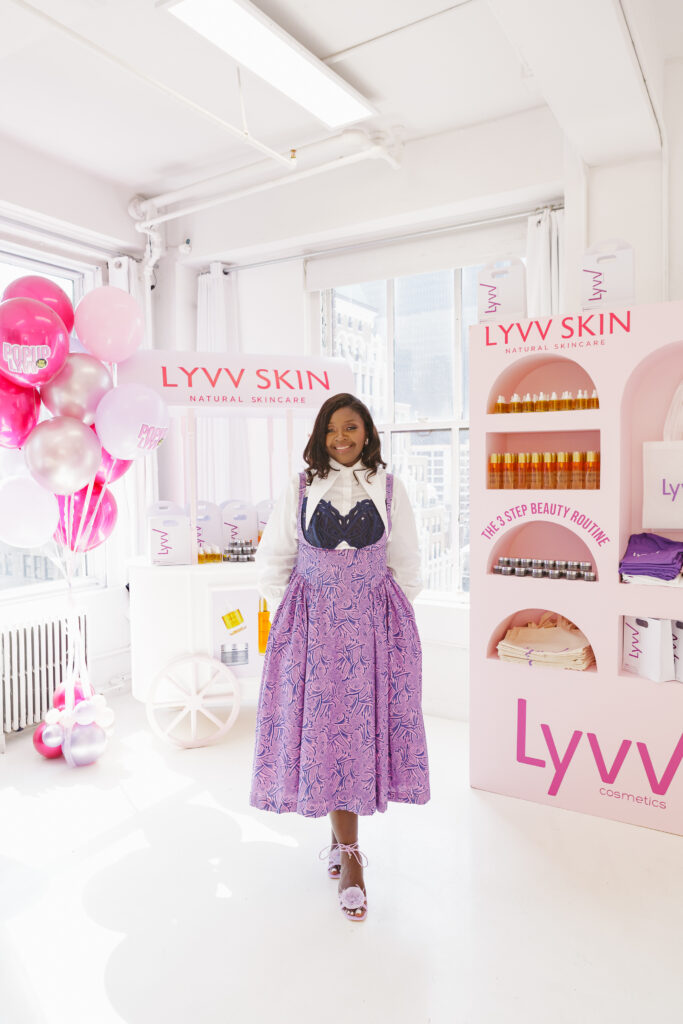
Victorine Sarr, founder of Lyvv Cosmetics, is building a beauty brand between Senegal and Ghana, with full control over manufacturing through her own facility. Her focus is precise: formulations designed for dark-skin women, not as an extension of inclusivity, but as a starting point.
“That was the wound that became the mission.”
“Every formula, every shade, every product is made with dark-skin women in mind, not as a niche, but as the standard.”
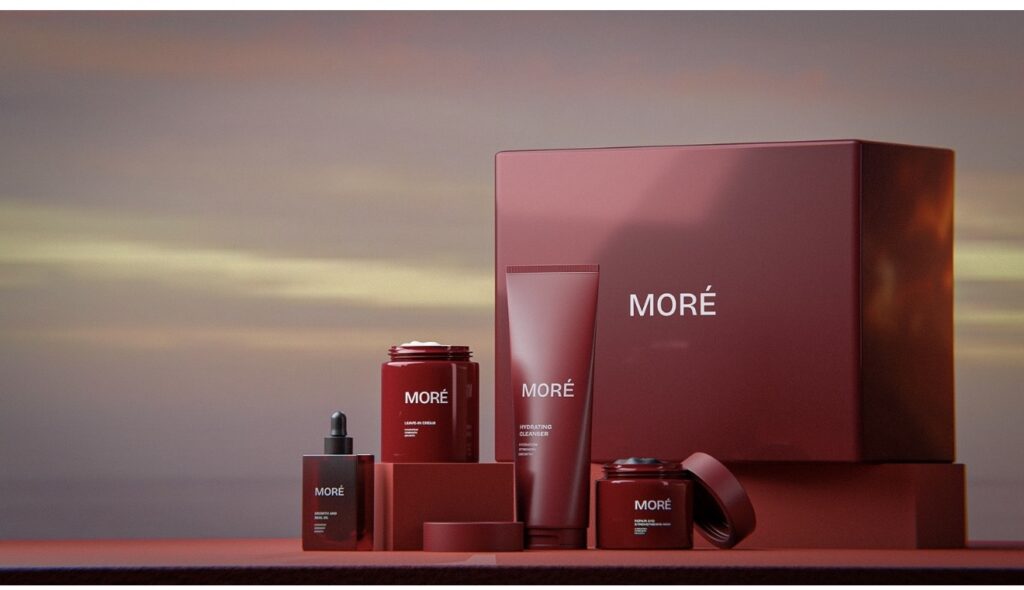
Mimi Koné, founder of MORÉ, operates between London and San Francisco. Before launching her brand, she spent a decade building Mimi et Mina into one of London’s most respected salons, working alongside global luxury houses including Dior, Chanel, and Balenciaga.
“That decade of proximity to excellence is what led me to build MORÉ.”
Her diagnosis of the market is direct:
“There was noise, but very little substance.”
MORÉ is not positioned as a niche brand, but as a category intervention. Prestige haircare has historically centered straight hair, or failed to apply clinical rigor to textured hair. MORÉ enters the market with a different premise: that textured hair deserves the same level of scientific innovation and luxury positioning as skincare. The credentialing matters. Olaplex was founded by a chemist. Kérastase emerged from L’Oréal’s professional division. MORÉ is being built out of nearly a decade of clinical and stylist-level engagement with textured hair, in a category where that depth of operator experience has historically been absent at the prestige tier.
Both founders are operating within the same global industry. But not within the same system.
At its core, beauty is not just creative. It is capital-intensive.
Before a product reaches market, founders must fund formulation, testing, packaging, regulatory compliance, manufacturing, and distribution. Revenue follows later.
Retail expansion adds another layer of pressure: brands often finance production months in advance of payment. Standard retail terms, typically 30 to 90 days, mean that as distribution grows, so does the cash flow gap.
Building a beauty brand often means negotiating with suppliers, managing failed batches, navigating compliance requirements, and constantly recalculating costs as production expenses shift. The public-facing image centers aesthetics and aspiration. Most of the actual work is operational problem-solving, financial risk, and logistical coordination.
For founders without external funding, these constraints are not theoretical. They define the pace and limits of growth.
Neither Sarr nor Koné began with institutional funding.
Sarr built Lyvv over nine years through personal capital and reinvestment.
“Nine years of building on my own terms.”
“When you are serious about building something real, you make choices. I chose Lyvv.”
Koné followed a similar path, funding MORÉ through savings.
“When it’s your own money, you make different decisions.”
Without external capital, growth becomes incremental. Expansion is tied directly to available cash flow. Risk is absorbed personally.
The result is not just slower scaling. It is a fundamentally different business trajectory.
The infrastructure gap, and the cost of time
Beyond capital, infrastructure is one of the most decisive factors in scaling a beauty brand.
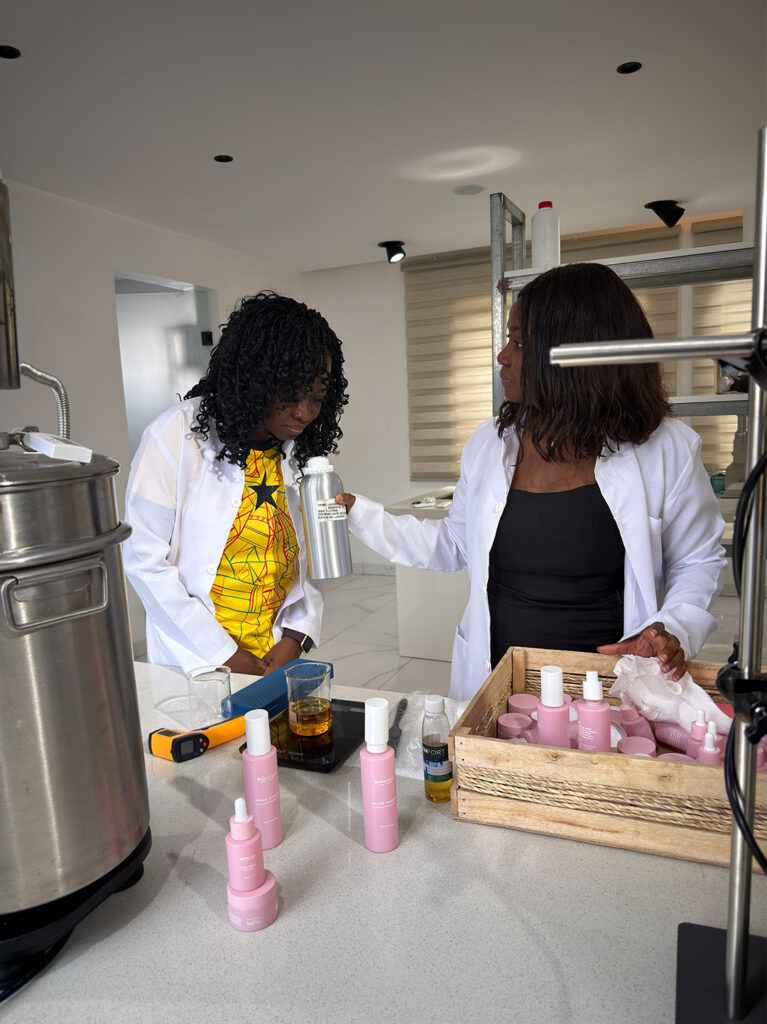
Sarr chose to build her own manufacturing facility in Ghana, giving Lyvv control over production, quality, and timelines.
“We are not just selling beauty products. We are showing what African excellence in manufacturing looks like.”
That decision comes with a cost.
In developed markets, manufacturing infrastructure already exists. In many parts of Africa, it does not, forcing founders to build it alongside their brands.
The result is a hidden but critical variable: time.
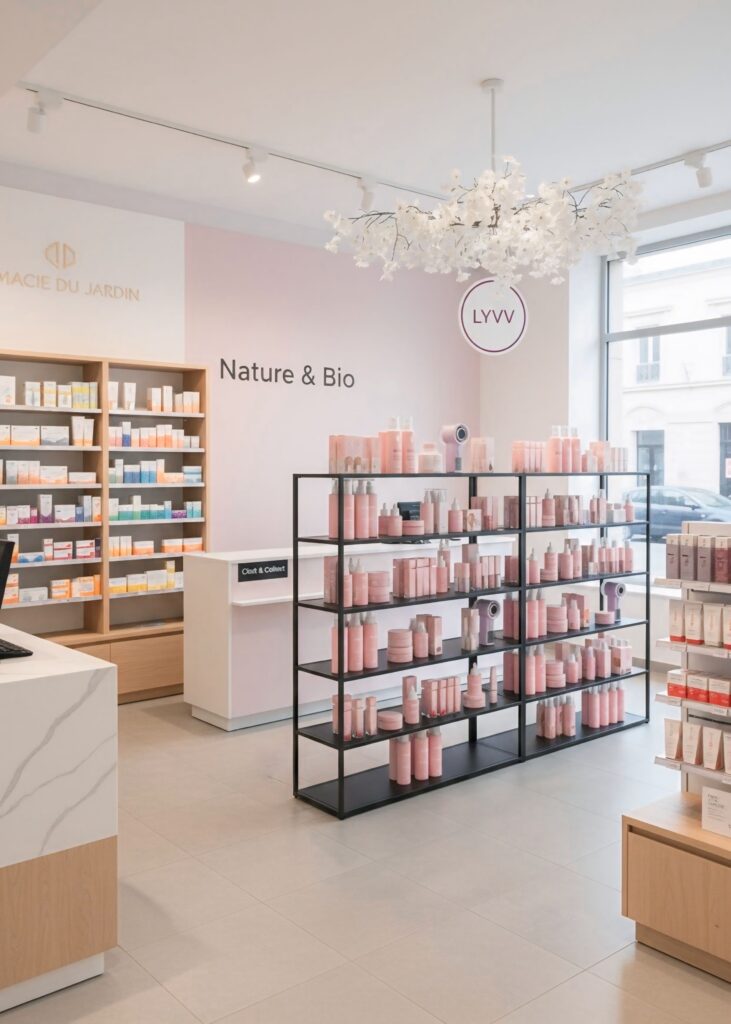
Years that founders elsewhere can dedicate to scaling are instead spent constructing the systems required to operate at all. Vertical integration, in this context, is not a strategic luxury. It is a structural response to absence. The same control that earns a French pharmacy brand decades of category authority is being built by Sarr in real time, while she also runs the company.
This is not inefficiency. It is structural reality.
Even within established ecosystems like the UK, constraints persist.
For Koné, production capacity remains the primary bottleneck.
Minimum order quantities (MOQs) require early-stage brands to commit to volumes that often exceed immediate demand.
“The gap between where MOQs start and where you need to be is where many brands stall.”
This creates a paradox: brands must scale production before they have fully secured the demand to justify it.
Opportunities, retail partnerships, and expansion are sometimes delayed or declined, not due to lack of demand but due to production limitations. Distribution adds another layer. In the United States, textured haircare has become increasingly visible across mass retail, with Black-owned lines stocked at Target, Walmart, Sephora, and Ulta. In the UK, textured hair products remain largely confined to specialist shops, select retailers, or direct-to-consumer channels. The route to scale is structurally narrower.
Venture-backed brands operate within systems designed to absorb risk: investors, accelerators, established distribution networks.
For many founders, particularly those building outside these ecosystems, access is fragmented.
“You find a way. But I will not pretend the playing field is level, because it is not,” Sarr says.
Koné echoes this from within the UK market:
“I’ve had to build my own access.”
In the absence of formal pathways, networks become critical infrastructure, determining who gets introductions, funding meetings, and retail opportunities.
Access, in this context, is not just about capital. It is about proximity to systems that enable scale.

Pricing remains one of the most commercially sensitive questions in beauty, particularly for brands serving Black consumers. Founders are not only competing on formulation or branding, but also against longstanding market assumptions about what Black beauty products should cost.
For Sarr, pricing is shaped directly by production realities. The brand sources high-quality ingredients, maintains strict formulation standards, and operates with fewer manufacturing advantages than larger Western beauty companies. Instead of competing with mass-market skincare, Lyvv positions itself closer to premium French pharmacy and dermocosmetic brands associated with efficacy and ingredient quality.
“At Lyvv, we made a deliberate choice from the beginning: we would not compromise on quality to make the price more comfortable,” Sarr says. “The ingredients, the formulation, the manufacturing standards, those are non-negotiable.”
Rather than lowering standards to meet market expectations, Lyvv has focused on creating different entry points into the brand through smaller products while maintaining its premium positioning. For Sarr, the issue is ultimately larger than affordability alone.
“Women of color deserve genuinely excellent products, not a cheaper version made specifically for them because someone decided they couldn’t or wouldn’t pay for the real thing.”
For Koné, pricing was also positioned deliberately from the beginning. Rather than entering the market as an affordable alternative, MORÉ sits closer to the premium haircare category occupied by companies like Kérastase and Olaplex, where performance, treatment-based care, and specialized formulations justify higher pricing.
“I price for the quality of what I make, not for what I think people want to pay,” Koné says. “Underpricing your product tells the market you don’t believe in it.”
Koné says many of MORÉ’s customers are highly informed consumers who compare ingredients and formulations before purchasing. The larger challenge is confronting the expectation that Black haircare should automatically exist at a lower price point.
“There’s still a tendency to expect Black haircare brands to be the affordable option,” she explains, “as if our hair deserves less investment than anyone else’s.”
For both founders, pricing is not simply a commercial decision. It reflects larger questions about value, perception, and who the beauty industry assumes deserves premium products in the first place.
When asked what additional capital would enable, neither founder speaks about product expansion.
Sarr points to people: the ability to build a team capable of executing at scale.
Koné points to production: the ability to meet demand and pursue larger retail opportunities.
In both cases, capital is not abstract. It directly determines speed, capacity, and reach.
A misalignment at the heart of the industry
The global beauty industry continues to expand. Demand for culturally relevant products is rising. Innovation is not lacking.
What remains misaligned is capital.
In the United States, Black consumers account for roughly 11 percent of total beauty spending, while Black-owned and Black-founded brands hold approximately 2.5 percent of industry revenue. McKinsey has called the resulting gap a $2.6 billion opportunity. That figure is the floor, not the ceiling. It does not account for the African continental market, the diaspora consumer base outside the United States, or the international textured-hair category. In the United Kingdom, Black women account for around 10 percent of total haircare spend while making up roughly 2 percent of the adult population, contributing an estimated £168 million annually to the category. Across the African continent, the beauty and personal care market was valued at roughly $62 billion in 2022 and is projected to reach $103 billion by 2030, expanding at more than 6 percent annually. The pattern is consistent across markets: significant consumer spending power on one side of the ledger, structurally underfunded brands on the other.
The gap is not simply about representation. It reflects who receives institutional backing, distribution access, operational support, and the time necessary to scale. Venture capital funding for Black-owned beauty brands in the United States has historically captured a fraction of total beauty venture funding, with Black brands raising on the order of one-tenth of what their non-Black counterparts have raised at comparable stages.
“Investment in underserved communities is not charity. It is a massive commercial opportunity,” Koné says.
That opportunity is increasingly visible. Retail pledges committing shelf space to Black-owned brands, accelerator programs targeting underrepresented founders, and consumer-focused incubators have all begun to address parts of the gap. Climate-aligned and impact-oriented funds are starting to underwrite manufacturing infrastructure in markets that have historically been overlooked. But meaningful alignment requires more than diversity campaigns or short-term trend cycles. It requires long-term capital, manufacturing ecosystems, regional distribution networks, and support structures that allow founders to spend less time compensating for infrastructure gaps and more time building durable companies.
Sarr frames the long-term stakes more directly:
“The founders who come after me should not have to build the road and walk it at the same time.”
The business of beauty is often defined by its most visible success stories. Visibility can obscure structure.
Founders like Victorine Sarr and Mimi Koné are building within the same global industry as venture-backed brands like Topicals, yet under materially different conditions shaped by geography, infrastructure, and access to capital.
The difference is not ambition. It is not capability.
It is whether the system is built to support your growth, or whether you are building it yourself.
Subscribe for our weekly newsletters.