


The Machine Has Started Shopping
African businesses spent a decade learning to be visible online. The next contest is whether a machine can act confidently on what it finds.

A hotel in Dakar can lose a booking before anyone at the property knows a traveller is coming.
The traveller asks an AI assistant for four nights near the water, under $250 a night, with breakfast and a cancellation policy forgiving enough to survive a changed flight. She does not compare twenty tabs, study three years of reviews, or send a WhatsApp message asking whether the room facing the ocean is actually available. She describes the stay she wants and lets the machine assemble the market around her.
One hotel can answer, because its room types, live rates, taxes, availability and cancellation terms can be read across systems. Another may be more beautiful and more rooted in the city, but its prices sit inside a PDF, the airport transfer is mentioned in an Instagram caption, its rooms carry different names across three booking sites, and the only reliable inventory belongs to the person holding the reservations phone. The assistant books the first hotel. The second never learns it was considered.
The third entry in this series argued that the index has become the institution: as search collapses into machine-assembled answers, structure decides what can be found. The machine has now moved from retrieval to action, and the stakes have moved with it. Call it the difference between being machine-readable and being machine-executable. Before an agent commits a customer’s money, it must verify what is available, what it costs, what the terms permit and what happens if the promise fails. Agents may widen the range of businesses a customer can discover. But when money begins to move, they are likely to concentrate transactions among the businesses whose claims a machine can verify.
The plumbing is going in
The standards arrived in a rush. In September 2025, Stripe and OpenAI released the Agentic Commerce Protocol, a shared language for exposing products, prices and checkout to AI agents, and Instant Checkout went live with US Etsy sellers the same day; Shopify merchant onboarding began in January 2026, with OpenAI taking a 4 per cent fee on completed purchases. Google moved in parallel, launching its Universal Commerce Protocol in January 2026 with Walmart, Target, Shopify and Etsy among the partners.
The payment and authentication layers followed. Google’s Agent Payments Protocol, backed by more than sixty payments and technology companies, was donated in late April 2026 to the FIDO Alliance, the industry alliance behind passkey standards. By June 2026, Visa had announced the integration of its agentic payments system into ChatGPT and Mastercard had extended its Agent Pay framework to software-to-software transactions.
Travel shows how fast the ground is moving. When Google announced agentic flight and hotel booking in November 2025, working with Booking.com, Expedia, Marriott, IHG, Choice and Wyndham, shares in Booking Holdings and Expedia fell between 4 and 7 per cent following the announcement, an indication that investors saw agent-mediated distribution as a threat to the companies that currently control much of the booking journey. Restaurant booking through Google’s agents has been generally available in the United States since November 2025 and expanded to eight more markets, including the UK, Canada and Australia, in April 2026. In May 2026, Google named hotel booking the next vertical for its commerce protocol, with a detail that matters for every independent property: under the lodging implementation the hotel, not the platform, remains the merchant of record and keeps the guest relationship.
None of this means the machine completes most purchases today. OpenAI stepped back from its standalone Instant Checkout model in March 2026, shifting more of the transaction toward merchant-owned environments, and Google’s hotel booking has a roadmap rather than a launch date. The demand is not waiting, though: Google reports that search interest in “AI travel assistant” has grown 350 per cent over the past year, with “AI flight booking” up 315 per cent. What has already moved is the consideration set. When an assistant assembles a shortlist, the decisive competition may happen before the customer sees anything. A business with incomplete or unreliable data is less likely to enter the field, and more costly to verify when it does.
A field left blank
OpenAI’s merchant documentation makes the new architecture unusually legible. Businesses push a structured product feed, refreshed as often as every fifteen minutes, covering identifiers, pricing, inventory and fulfilment, so that for this channel the system does not have to rely on web crawling alone; the merchant supplies a structured, regularly refreshed record. The specification also contains two separate switches, one controlling whether a product can be found in ChatGPT and another controlling whether it can be bought there, which means a product can be visible inside the system and still unavailable for purchase through it. Those two switches decide, in effect, who gets left out of the next round of commerce. Every field in these specifications contains a theory of commerce: each one carries a judgement about what counts as a product, what makes a merchant trustworthy and what proof of availability is good enough. The businesses that look most like the people writing those fields will be the easiest to fit inside them.
Structured information gets a business in the door, but it is only the start. A business the machine can actually buy from needs more: current inventory, a verified identity, payment authorisation, clear rules for fulfilment and some way to fix an order when it goes wrong. Google’s lodging protocol, as announced, extends to reservation orchestration and payments, not just descriptions, and the terms published for Paystack Index, an experimental agentic checkout built in Lagos, devote as much attention to permissions, agent authority and liability as to the transaction itself. A feed can place the hotel into consideration. It cannot, on its own, guarantee that the stay can be sold.
The gap between how creative businesses hold their information and what these systems require is measurable enough that companies have built products against it. The Folklore, which connects more than four hundred brands from Africa, the diaspora and other emerging markets to retailers including Nordstrom and Bergdorf Goodman, now sells AI-optimised product listings to its brands, built because the raw data these brands arrive with is not what an enterprise buying system can use. When a company builds a product to close that specific gap, it is marking exactly where the friction sits.

Moulaye Tabouré has spent a decade working across that divide. He co-founded Afrikrea, later ANKA, which made more than twenty thousand African sellers transactable to buyers in 170 countries, and ANKA’s sales patterns repeatedly showed him the commercial value of current product information: “The sellers that sold the most were the ones uploading and updating their products most often. It looks like busy work that you just leave to the seller, because most people see the African seller as a supplier. At ANKA, the seller, the creator, was always our first customer.”
“African sellers are already online. The data is there. The question is the quality of the information we give.”
— Moulaye Tabouré, co-founder, ANKA
The conversation the machine cannot reliably close
Much of the continent’s creative commerce runs on precisely the opposite architecture, and runs brilliantly. A Lagos designer sells a collection through Instagram messages, a Dakar gallery closes sales on WhatsApp, and many independent hospitality bookings are confirmed by voice note and mobile money transfer. This is relationship commerce, negotiated in real time between people who come to trust each other, and it has carried African fashion, art and hospitality further than formal infrastructure ever did.
An agent may be able to open that conversation; agents are being built to interpret prose, translate languages and even place calls. What most direct-message commerce does not yet expose is current inventory, terms and payment permissions in a form an external purchasing agent can reliably query, and turning a conversation into a repeatable, trusted transaction is the harder problem. An agent can work through a conversation only when that conversation is wired to reliable records and a way to take payment. The less structured a business is, the harder and costlier it becomes for an agent to evaluate, and options that are hard to evaluate quietly drop off the shortlist.
This future could also cut the other way. Agents might lower the penalty for weak infrastructure rather than raise it, precisely because they can read prose, work through intermediaries and assemble information from sources conventional booking systems ignore, which could make a small property more reachable than it has ever been. The limitation is reliability: an agent can discover an informal business and still hesitate to commit a customer’s money without current rates, enforceable terms and a trusted path for resolving failure. More likely, both happen together: agents widen what a customer can find while steering the actual transactions toward the businesses they can verify.
The translation is being built from the merchant’s side. Bumpa, the Lagos-built commerce platform used by tens of thousands of merchants, expanded into Kenya in June 2026 with M-Pesa integration, and is integrating its platform with Meta so that merchants can receive social messages, share products, send invoices and request payments through a more structured business layer. What that layer serves today is the merchant and the human customer; the open question is whether it becomes something a machine can buy from.
The exposure lands unevenly. International hotel groups already sit inside the reservation and connectivity systems agentic booking will reach first, while the independent Gorée guesthouse, the Accra gallery, the Abidjan atelier and the festival that sells out every year through word of mouth hold their facts in someone’s head, someone’s chat history and someone’s notebook. They are the reason a traveller goes to Dakar in the first place, and they are the least visible to the machine now assembling her itinerary.

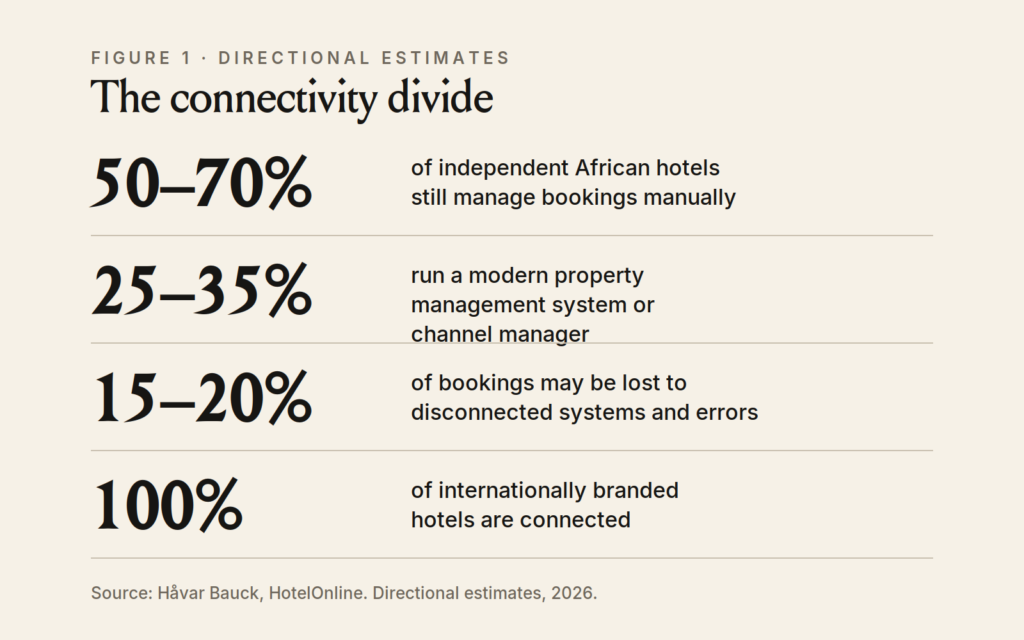
Håvar Bauck watches that gap in the aggregate. He co-founded HotelOnline, which says its technology serves more than six thousand properties across twenty-seven African countries. “Fewer hotels now rely entirely on paper notebooks, yet most independent, non-branded properties still manage bookings through tools such as Excel or Google Sheets,” he told Guzangs. Asked to put numbers on it, he offers estimates he is careful to call rough and directional, drawn from HotelOnline’s experience: somewhere between 50 and 70 per cent of the continent’s unbranded hotels still manage bookings manually, only 25 to 35 per cent run a modern property management system or channel manager, and disconnected systems may cost a property 15 to 20 per cent of its bookings through losses and errors. Internationally branded hotels, by contrast, are effectively 100 per cent connected, which means the connectivity divide tracks the brand divide almost exactly. Without connected systems, reservations arrive by email and phone: “Emails get caught in spam folders, phone bookings are scribbled on Post-it notes and sometimes lost or forgotten, guest details are recorded incorrectly, and rooms are inadvertently overbooked.” The core configuration, he says, can be brief once a hotel’s information is ready; preparing and maintaining that information, and avoiding costly mapping errors, is the expertise a company like his sells.
Nor does he consider the agentic question premature for the continent. “A traveller using an AI agent in London, New York or Nairobi may be searching for a hotel in Zanzibar, Mombasa or Lagos. Hotels in our markets therefore need to be ready.” The fork he lays out is one many independent properties face: “If agents source inventory and complete transactions through OTAs, the existing commission model remains firmly in place. If a hotel can present its rates and availability directly in a format that agents can understand and transact with, it has a chance to secure the booking without an OTA.”
“Those that invest in the right digital infrastructure can reduce their dependence on OTAs. Those that do not may become even more dependent on them.”
— Håvar Bauck, co-founder, HotelOnline
Legibility is not sameness
The trap would be to conclude that every African creative business must come to resemble an American retailer. The subtler danger in these specifications is not being left out but being filed under the wrong heading: the atelier filed as a warehouse, the cultural programme sold as a ticketed product, the seasonal maker listed as a permanently available supplier, the hospitality ritual reduced to an amenities field. Infrastructure carries the assumptions of the markets it was built in, and no one has to intend that for it to happen.
Refusing to structure your business protects nothing. The machine will still sort you; refusing only means it does the sorting without your say. The work is to become legible in forms that preserve the distinctions the market needs in order to remain itself, so that a made-to-order label reads as a production model rather than a warehouse, and a cultural institution can say, in data, what can be booked, what can only be requested, and what should never be converted into a transaction at all. The real question is who gets to write the categories in the first place, and that is where a transaction problem becomes an institutional one.
It is the line Tabouré keeps returning to: African sellers are already online, the data is there, and the question is the quality of the information sellers give. AI may improve how the work is found, he argues, but it cannot replace the taste a creative acquires through experience, or the harder discipline of delivering, in real life, on the promises made online.
Testing the rails at home
The payment side of the answer is already being built on the continent. Paystack Index went live in June 2026 out of TSG Labs, the venture studio inside Paystack’s parent group, deliberately small and with a curated merchant list, and Shola Akinlade, Paystack’s chief executive, has said publicly that the product is about building with the continent’s early adopters now rather than waiting for the market to mature. A company that already settles cards, bank transfers and mobile money across African markets is testing agentic checkout at home, on local rails, while the global protocols are still being standardised and adopted. The ability to accept a machine’s payment is coming into place, which leaves the scarcer half of the problem untouched: the merchant data the machine needs before it decides where the money goes.
The sale that leaves no trace
The agent stacks a transaction on top of everything this series has traced, and the losses it creates are harder to see than the old ones. Absence from search at least left a measurable silence in the traffic, whereas absence from transactional infrastructure costs the sale itself and leaves nothing behind: no rejection, no abandoned cart, no record of the customer who was never shown the option. The agent is not the first to meet this absence; lenders met it long ago. The businesses hardest for a machine to buy from are so often the ones hardest for a bank to finance, because both are reading for the same records.
Asked who will hold the structured records of African hospitality, the data layers through which agents may eventually book, Bauck declines to crown anyone. “I don’t expect one company or category of players to become the dominant supplier of agentic bookings. Everybody wants a share of this market, and the competition will be intense.” The group he watches closest is the international hotel brands, asset-light for two decades and heavy with loyalty programmes and direct-distribution technology, and the contest lands with particular force in Africa, where brand penetration remains low while the branded development pipeline sits at a record high. “We are entering the most consequential period of disruption in hotel distribution since the rise and consolidation of the OTAs in the 2000s and early 2010s,” he says. “The current hierarchy is unlikely to survive unchanged.”
For a continent whose hospitality, fashion, tourism and design run disproportionately on informal rails, the immediate work is translation. It means moving the rooms, inventories, terms and provenance of African businesses into structured forms an agent can act on, without surrendering the relationships that made the commerce work in the first place. That structuring will happen either way, and the consolidation is already underway. ANKA, the platform Tabouré co-founded, was acquired in October 2025 by Global Shop Group, a US company, after the liquidation of ANKA’s French parent; the platform and its commercial infrastructure now sit under American ownership.
Tabouré is unsentimental about why the rails point west. “Europe is less and less favourable for payments for sellers from other regions, and more and more controlling,” he says. “The US is still the place where African sellers will get the most consumers and the best experience. But it requires a local presence, and the US is very hard to access for people who are not from there.” He does not read the sale as a simple loss, noting that “there are people from our diaspora and from our continent who are there, who have the network and the ability to make these things happen.” His observation complicates the story without settling the question of sovereignty, because control also lives in ownership, jurisdiction, contracts and the rights merchants retain over the records they create. Sovereignty follows whoever controls the infrastructure, whatever passport they happen to hold.
Who assembles the record for everyone else, who holds it, and on what terms: that is where this series goes next.
When the machine becomes the customer, the storefront is data. Subscribe.
Valdes Tita is Head of Editorial and Partnerships at Guzangs, where he writes about culture, technology and African creative economies. He previously worked on AI-powered destination discovery at Expedia Group.
The Sovereign Stack is a Guzangs series on the systems African and diaspora creative economies run on. Previously: Part One, Part Two, Part Three.