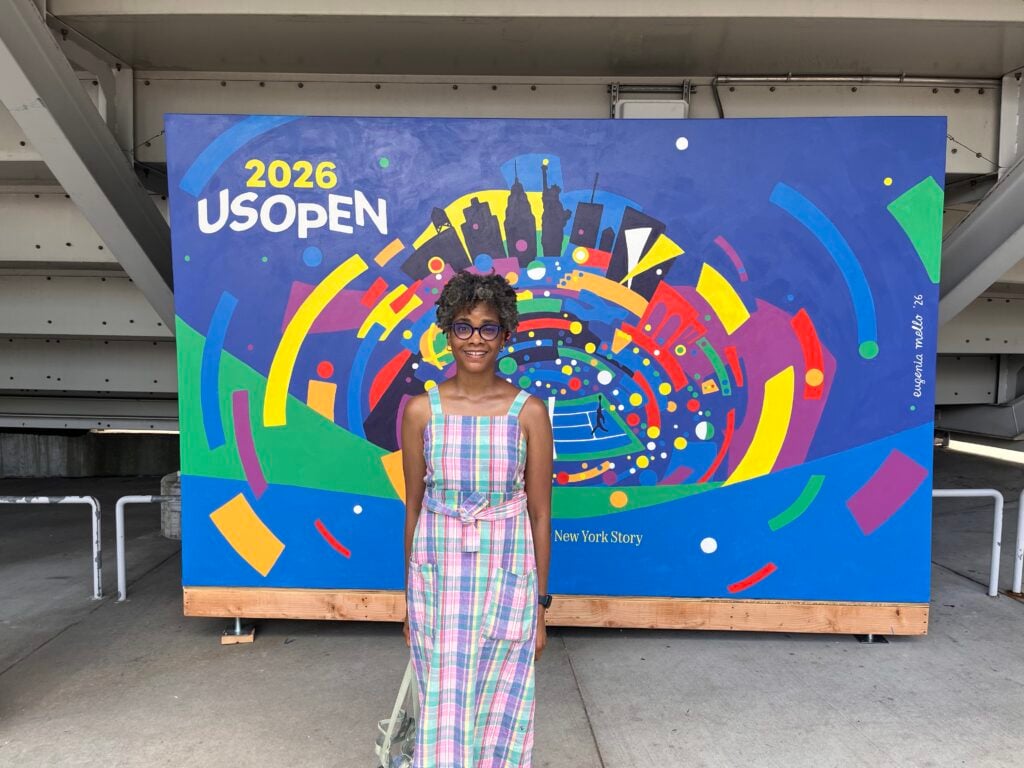
Before Arthur Ashe Was a Stadium, He Was a Problem for Apartheid
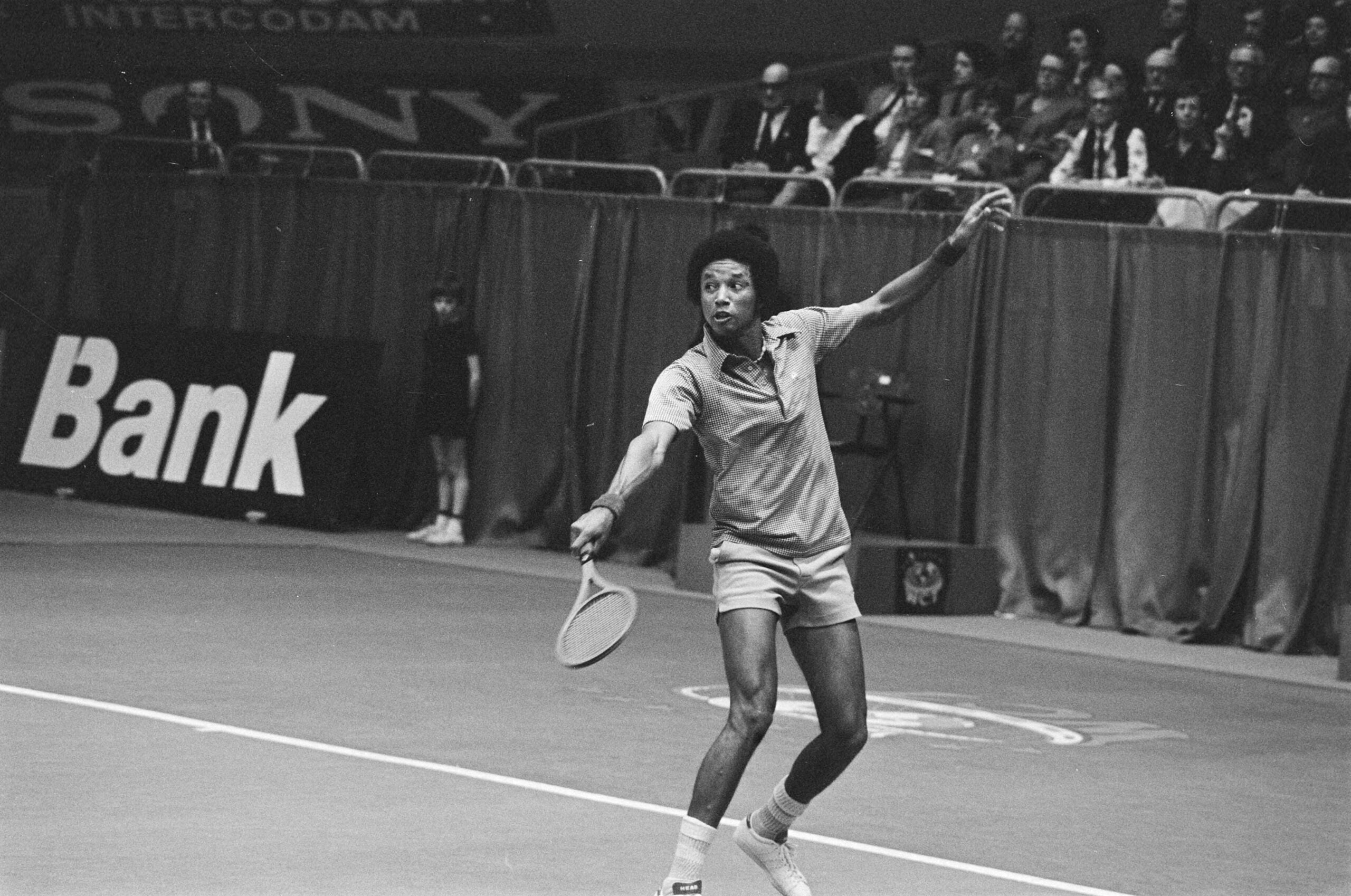
Every late August in New York, Arthur Ashe becomes a place. More than 23,000 people fill the stadium carrying his name. Players walk through its tunnels, and commentators use the name as geography: Night session at Ashe. Meet me outside Ashe.
Fifty-three years ago, another country was trying to keep Arthur Ashe out.
South Africa refused him a visa in 1969, again in 1970 and again in 1971. Officials said the problem was his politics: he had called apartheid a racist wall and backed the campaign to throw South Africa out of international sport. Race was the system. His opposition to it was the pretext they put on paper. By the time Pretoria let him in, in 1973, Africans had spent more than a decade building a campaign to isolate apartheid from international sport. Many of the people in that movement thought he should stay away.
Ashe went anyway. He came home with a different idea of what a famous athlete could do.
The architecture was African
Ashe’s road to South Africa began, by his own account, in a conversation. Professional tennis had just entered the Open Era, the calendar was filling with new tournaments, and Ashe was sitting with other players at Wimbledon, talking about where they would compete next. Cliff Drysdale, the South African, told him that his country would never let Ashe in.
In Days of Grace, Ashe recalled being startled. He had assumed the obstacle would be the tennis federation. Drysdale corrected him: the obstacle would be the government visa. Ashe applied anyway. Another South African player, Ray Moore, first told him about an imprisoned lawyer named Nelson Mandela and predicted that Mandela would one day lead the country and become its first Black president.
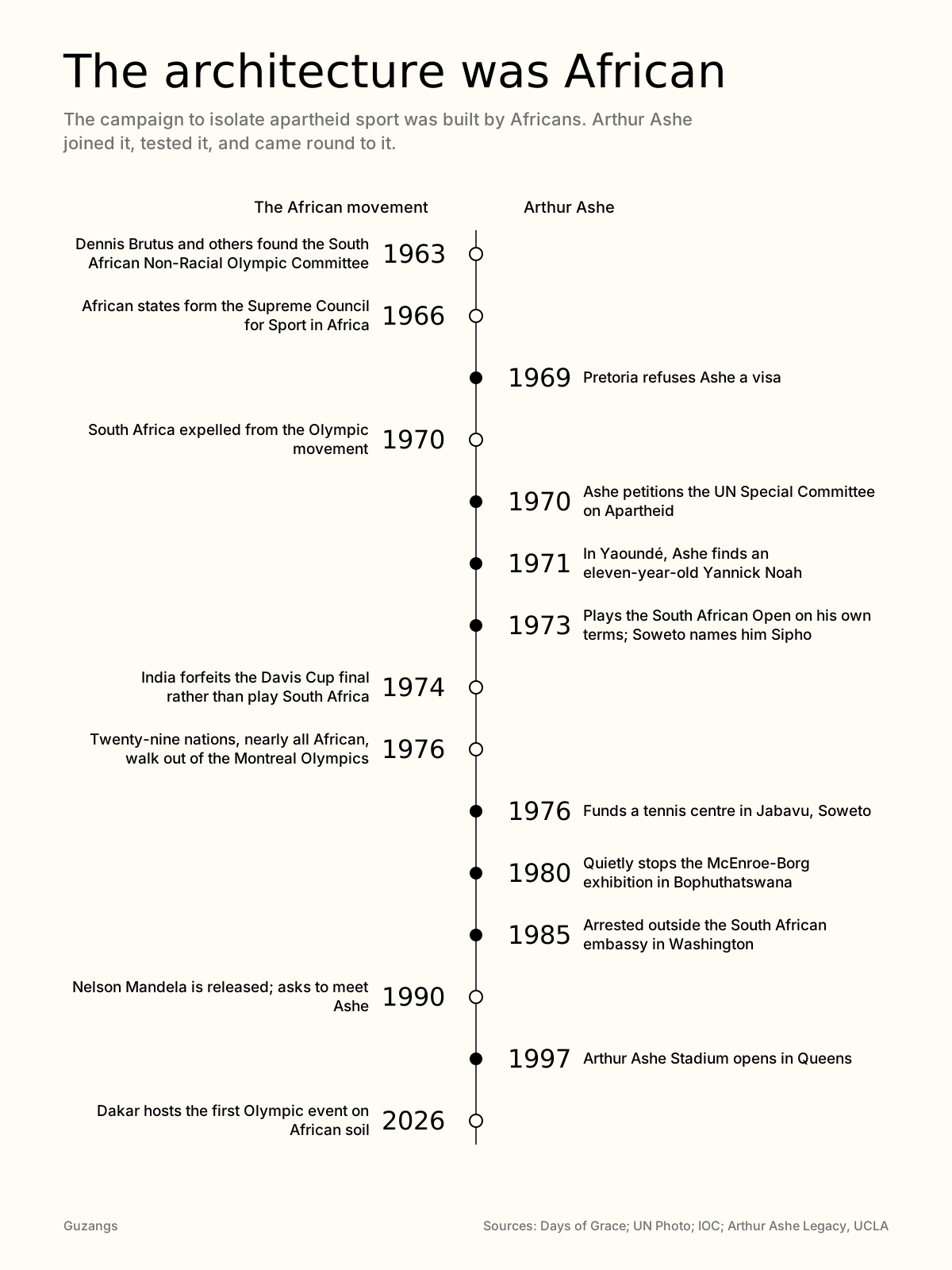
But Ashe was entering a story that had begun without him. By the time he applied for his first visa in 1969, the campaign to isolate apartheid sport was nearly a decade old. The South African poet and activist Dennis Brutus helped establish the South African Non-Racial Olympic Committee, formally founded in January 1963, and pursued the country through the institutions of international sport. That work cost him imprisonment on Robben Island, where Mandela was also held.
African states built on that foundation. In December 1966, they formed the Supreme Council for Sport in Africa, a pan-African body based in Yaoundé. South Africa was excluded from the Olympic Games in the 1960s and expelled from the Olympic movement in 1970.
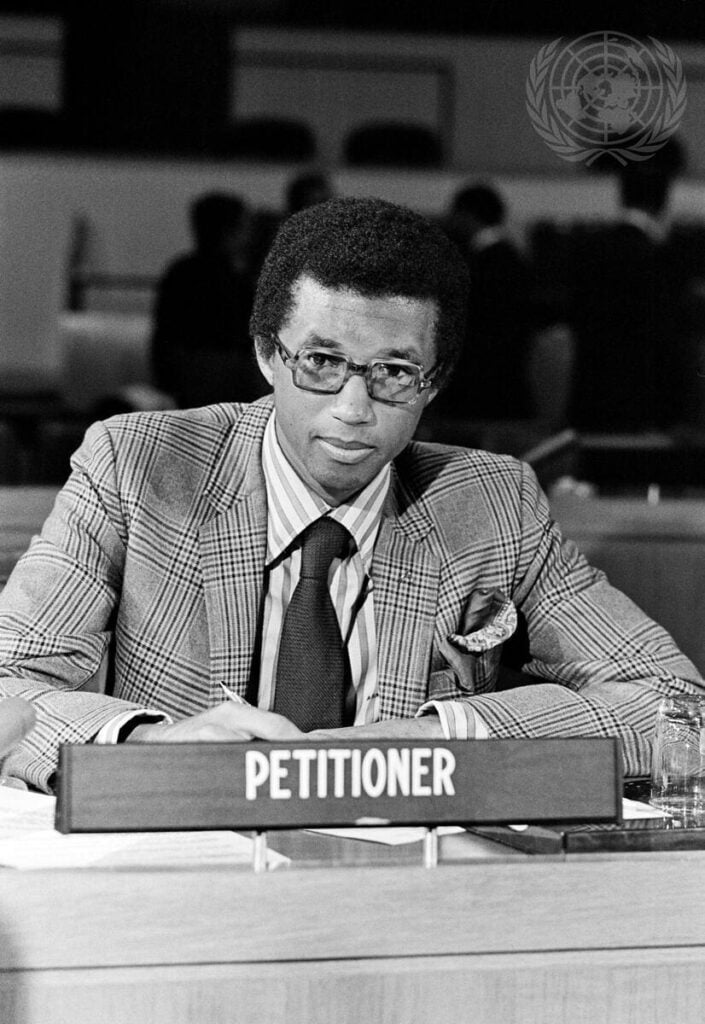
The familiar Ashe story can flatten this chronology. His exclusion made headlines, but it became one more piece of evidence in a case African activists and governments had already built. Ashe understood that. On 14 April 1970, he petitioned the United Nations Special Committee on Apartheid. He urged the United States, Britain, France, Australia, West Germany and Italy, the countries with privileged voting power in international tennis, to expel South Africa from the International Lawn Tennis Federation and bar it from the Davis Cup.
The committee’s record shows Ashe arguing that total isolation could force change. Years later, he credited South African anti-apartheid activists with teaching him why: for 21 years, he wrote in 1990, they had told him that sport was the white man’s Achilles’ heel. The idea belonged to the movement. Ashe helped carry it into rooms that listened to him.
The experiment
In 1973, after years of refusals, South Africa granted Ashe a visa. Getting in presented a harder problem than exclusion ever had. Brutus and many in the isolation movement argued that Ashe should stay away. One celebrated Black visitor, they warned, could help Pretoria sell an image of reform while apartheid continued untouched.
Ashe saw the trip differently, though he did not imagine that he could change the country by himself. His friend Richard Evans, the journalist who travelled with the tour, remembered Ashe saying that people constantly asked him about South Africa, yet he had never seen it. In Days of Grace, Ashe was plainer: he wanted to learn how people lived there, especially those whom apartheid classified as nonwhite.
He went to learn before he spoke.
He also tried to set conditions. Before agreeing to play the South African Open, Ashe pressed organizers about racial access at Ellis Park and rejected the fiction that he would enter as an “honorary white.” Tennis officials made tickets available to nonwhite spectators in sections that had previously been segregated, a concession that fell short of the integrated stands he wanted. In the diary later published as Portrait in Motion, he treated the trip as an uneasy bargain. Both sides expected to gain something. At best, his presence might interrupt the rules of apartheid for a moment and make the next interruption easier.
Ashe became the first Black professional to compete in South Africa’s national championship. He reached the singles final, losing to Jimmy Connors, and won the doubles title with Tom Okker. Black South Africans called him Sipho, a name meaning “gift.” The matches mattered. What happened away from the scoreboard mattered more.
What South Africans made of him
In Johannesburg, the banned poet and journalist Don Mattera arranged for Ashe to meet a roomful of Black journalists. Evans remembered the heat, the hostility and a man in the back muttering “Uncle Tom.” Others made the objection directly: Ashe would play, be celebrated and fly home. They would still be living under apartheid.
Ashe listened. Mattera later gave him poems, including one written after their meeting, and told him he had shown Black youth that they could compete with white players and win. The two men remained friends.
In Alexandra township, a teenager named Mark Mathabane followed Ashe’s matches. Mathabane later recalled telling him, “You are the first truly free Black man I have ever seen.” Tennis eventually carried Mathabane to the United States on a college scholarship, and he became the author of Kaffir Boy. To him, Ashe was not an abstraction. Here was a Black man who travelled freely, spoke freely and met white men across the net as an equal.
But inspiration was not liberation.
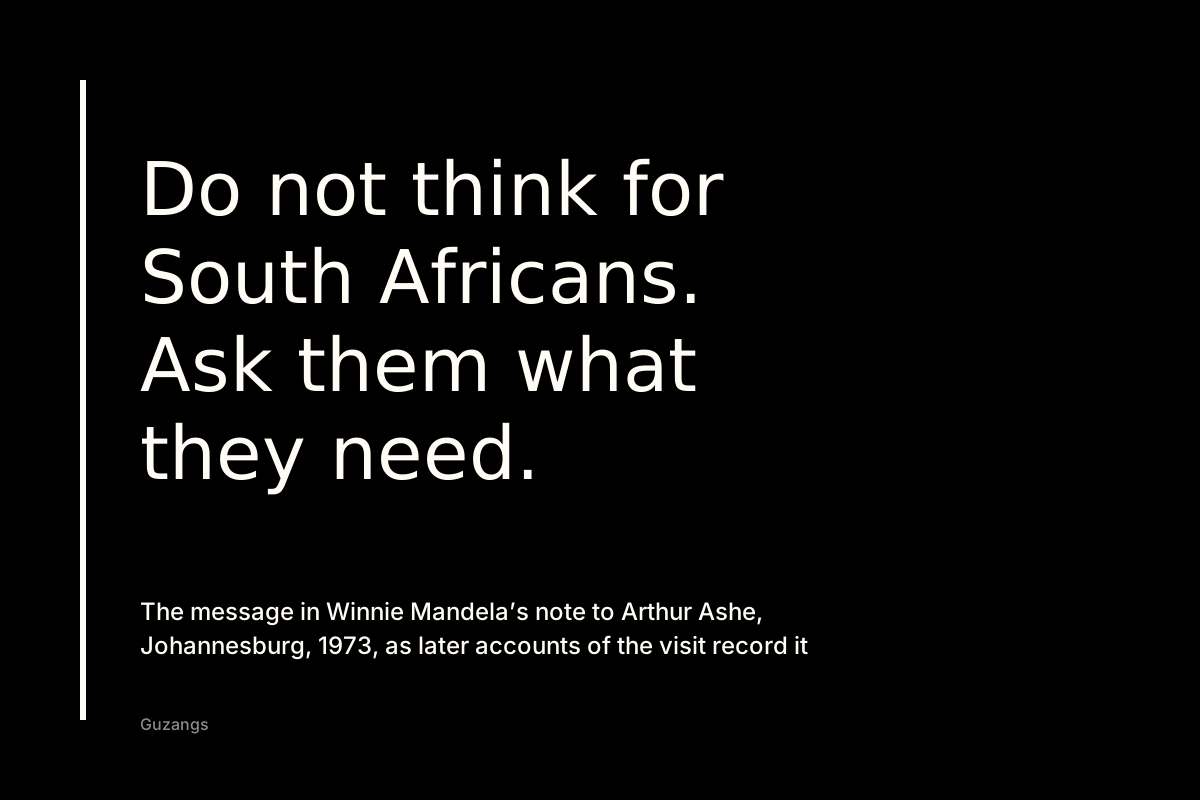
The clearest instruction came from Winnie Mandela, then living under banning orders while her husband was imprisoned on Robben Island. According to Ashe’s account in Days of Grace, she sent him a note as he left Johannesburg: “The best thing you can do is ask the South Africans what you can do to help in their struggle.”
There is no shorter description of the difference between showing up and taking over. Ashe had arrived hoping his visibility could be useful. Mandela reminded him that the struggle already had leaders. His job was to ask what they needed.
Rereading Days of Grace, I think he was ready to hear that because restraint had been trained into him long before South Africa. He grew up in segregated Richmond, Virginia, where his father managed a park reserved for Black residents. His coach and mentor, Dr. Robert Walter Johnson, insisted that Ashe be unfailingly polite on court and calm off it, so no white opponent could accuse him of meanness.
Ashe wrote that when he looked at photographs of the skinny child he had been, he saw that he was his racquet and his racquet was him. Years later, Jesse Jackson told him he was not arrogant enough. Ashe agreed and did not think it made him less effective. Still, he admitted that he sometimes wondered whether what he called principle was really fear.
South Africa did not create that question. It gave him another way to answer it. The boy taught to let his racquet speak had gone to a country where Black people were systematically denied a political voice. There he learned that listening could also be an act.
The movement was right
Listening did not leave Ashe where it found him. With South African promoter Owen Williams, he helped finance an eight-court tennis centre in Jabavu, Soweto. The complex was completed in 1976, the year of the Soweto uprising, and fell into disrepair. Attempts to restore it in the 1980s and 1990s did not last. A major rebuilding project finally reopened the centre in 2007.
After the 1976 uprising and the African-led boycott of that year’s Montreal Olympics, Ashe vowed not to return to South Africa until the government changed its policies. He had entered the country believing that presence could open useful space. Over time, he moved towards the movement’s harder conclusion: sometimes refusing legitimacy carries more force than negotiating access.
In 1980, John McEnroe agreed to play Björn Borg in an exhibition in Bophuthatswana, one of the nominally independent “homelands” created by apartheid, for a reported $1 million. Ashe was among those who pressed him to pull out, meeting McEnroe himself while others approached his father. McEnroe withdrew, and the match, scheduled for that December, never took place.
In 1983, Ashe and Harry Belafonte founded Artists and Athletes Against Apartheid, encouraging performers and athletes to boycott South Africa. On 11 January 1985, Ashe was arrested outside the South African Embassy in Washington during a protest against apartheid.
He had not discovered that visibility was useless. He had learned its limits. That willingness to revise himself may be a more valuable legacy than having been right from the start.
After Mandela’s release in 1990, he was asked which American he wanted to meet. Ashe’s agent, Donald Dell, recalled his answer: “How about Arthur Ashe?” They met that June, when Mandela came to New York, and Ashe wrote afterwards of being pulled into a long embrace by a man who had read his history of Black athletes in prison. In 1991 Ashe returned to South Africa with a delegation invited by Mandela. The exchange was not a liberation movement thanking an American saviour. It was one serious political mind recognising another.
The question, asked again
The problem Ashe faced in 1973 has not disappeared. When does entering a compromised place create room for change, and when does participation lend it legitimacy?
Tennis is still arguing about the answer. In 2024, the women’s tour took its season-ending championship to Riyadh, with record prize money and objections from Martina Navratilova and Chris Evert, who pointed to Saudi Arabia’s record on women’s rights. In July 2026, the WTA said it had asked to end the arrangement a year early and moved the 2026 Finals to Indian Wells. Leaving Riyadh was not the same as leaving the money: Saudi Arabia’s sovereign wealth fund, the Public Investment Fund, remains the naming partner of both the men’s and the women’s rankings.
South Africa in 1973 and Saudi Arabia today are not the same political situation, and a tour is not a person. The underlying questions remain: what does access accomplish? What does participation legitimise? Who gets to decide when the bargain is no longer worth making?
Some of the clearest answers are coming from African players. On 1 March 2023, eight days after Tunisia’s president described migration from sub-Saharan Africa as a plot to change the country’s demographic makeup, Ons Jabeur posted a message for Zero Discrimination Day. As a proud Tunisian, Arab and African woman, she wrote, she celebrated everyone’s right to live with dignity. Jabeur, the first African woman to reach a US Open singles final, placed her identity beside the Black Africans being evicted and attacked in her country, and made clear who belonged in the definition of it.
The name above the gate
There is one more African ending. In July 1976, weeks after the Soweto uprising began, leaders of the Supreme Council for Sport in Africa pressed for a boycott of the Montreal Olympics over New Zealand’s rugby tour of South Africa. Tanzania withdrew first. By the end, 29 countries, most of them African, had stayed away. Senegal and Côte d’Ivoire were the only African nations that remained.
On 31 October 2026, Senegal will open the Youth Olympic Games in Dakar, the first Olympic sporting event held in Africa. Fifty years separate Montreal and Dakar. At one, African states showed their power by refusing to participate. At the other, the Olympic movement will arrive on the continent as a guest.
Sport was never only sport in this history. It was recognition, legitimacy, access and sovereignty. Ashe learned that slowly, from people who had understood it all along.
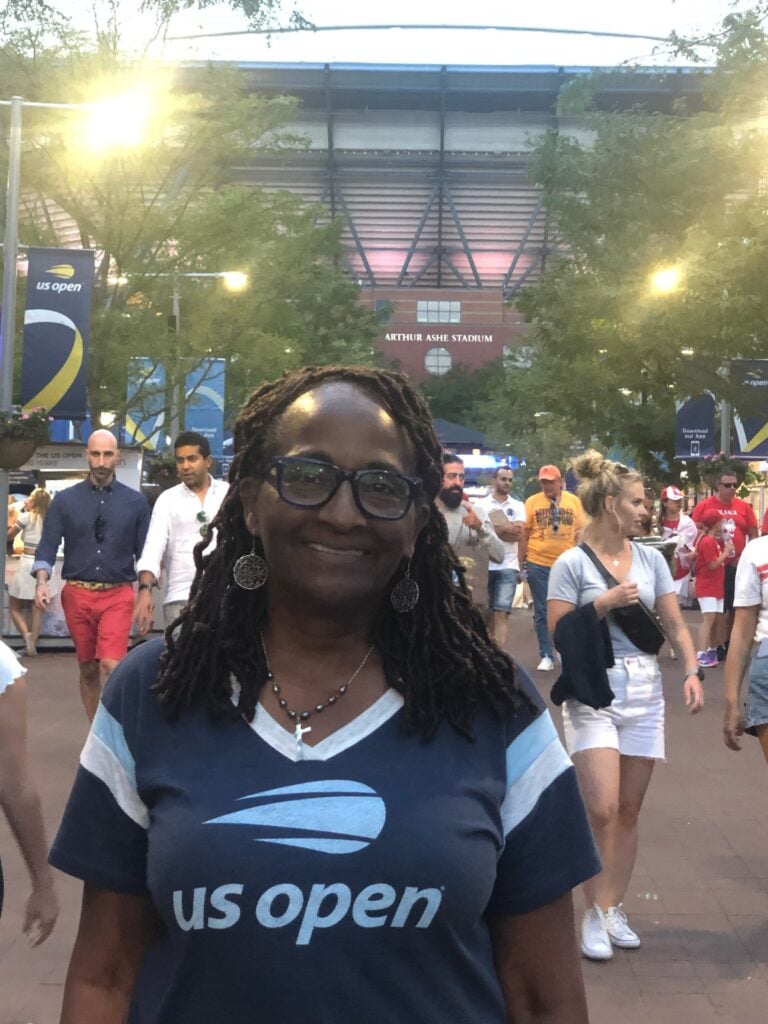
He died in 1993. Four years later, the US Open opened the stadium that carries his name.
The name has become so familiar that the man can disappear into the architecture: the first Black man to win the US Open, the gentleman in glasses, the trophy, the stadium. In 2020, Naomi Osaka walked onto that court for seven matches wearing seven masks, each bearing the name of a Black person killed by police or racist violence. She said afterward that she wanted people to start talking.
The medium had changed. The question had not: what can an athlete put before an audience that the audience would rather not see?
The fuller story crosses the Atlantic. Africans built and sustained the campaign that made apartheid sport untenable, at a cost that included prison, exile and years of institutional warfare. Ashe’s greatness was not that he arrived to lead it. It was that he arrived curious enough to listen, let the people living under the system challenge him and stayed with the argument long enough to change.
Hundreds of thousands of spectators will pass beneath his name in Queens before the tournament ends. The best way to honour it is to remember the instruction that reached him in Johannesburg in 1973. The struggle already has authors. Ask them what they need.