


Francis Kéré Builds the Goethe-Institut Dakar from the Ground Up
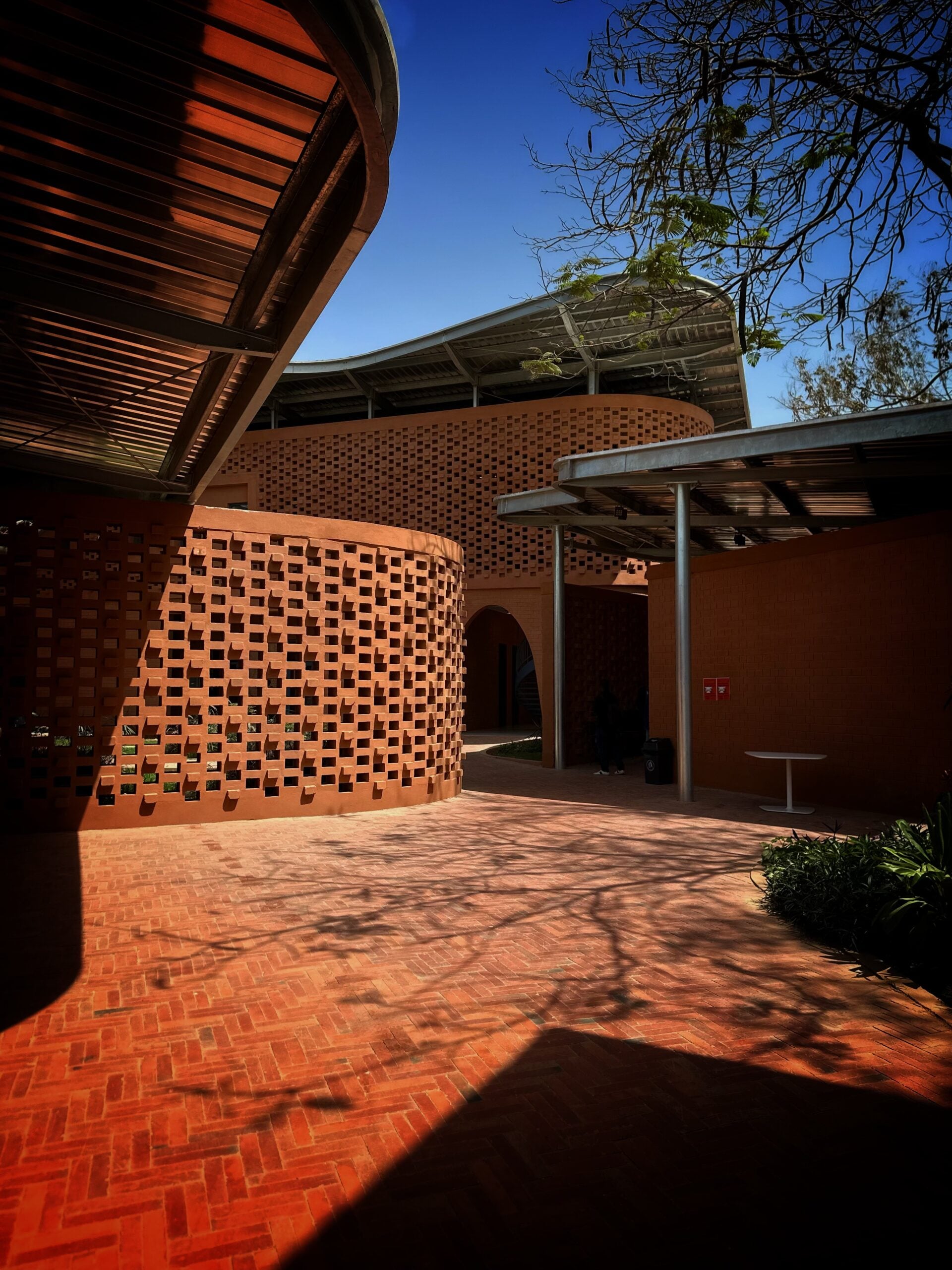
In Dakar, a new cultural landmark is rising from the soil. Designed by Pritzker Prize–winning architect Diébédo Francis Kéré, the new Goethe-Institut Senegal turns earth, memory, and craftsmanship toward a new era of African architectural possibility.
In Dakar’s Fann neighbourhood, a baobab tree stands at the centre of a building that appears to have grown around it. Walls of earth rise from the same laterite soil that colours much of Senegal’s landscape, while shaded courtyards channel Atlantic breezes through spaces designed for gathering and exchange.
The new Goethe-Institut Senegal is a cultural centre that doubles as an argument for a different architectural future.
Situated near the Atlantic coast, the Musée Senghor, and the former residence of Léopold Sédar Senghor, Senegal’s first president, poet, and one of the defining voices of the Négritude movement, the building occupies a site long associated with knowledge and intellectual exchange. Since opening its doors in Senegal in 1978, the Goethe-Institut has served as a bridge between Senegal, Germany, and the wider world. Its new home extends that mission and makes the architecture itself part of the dialogue.
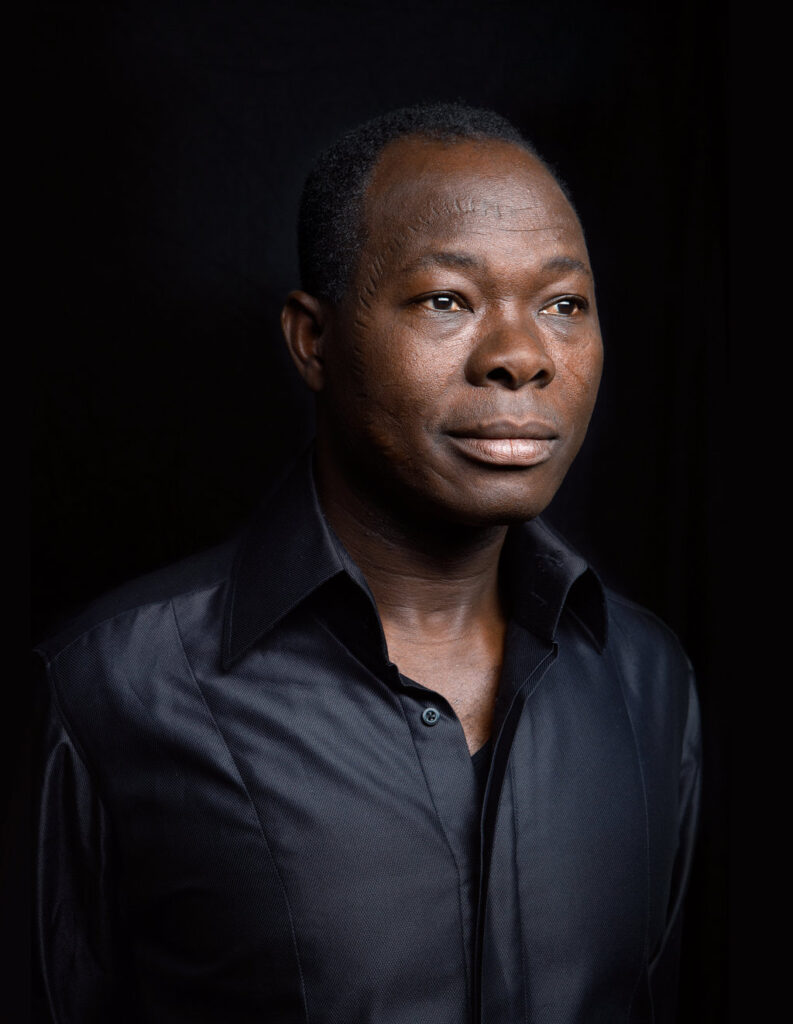
Designed by Kéré, the architect and first African recipient of the Pritzker Architecture Prize, the project reflects a philosophy that has defined his work for more than two decades. From his primary school in Gando, Burkina Faso, to cultural and civic projects across Europe, North America, and Africa, Kéré has consistently explored how architecture can emerge from local materials, climatic intelligence, and community participation.
“Every building I design seeks to reflect local culture, engage the community, and respect the environment,” Kéré explains. “The Goethe-Institut Dakar is a space where civil society can meet, learn, and share. This is where architecture becomes a vehicle for dialogue and creativity.”
The project begins with the earth beneath our feet.
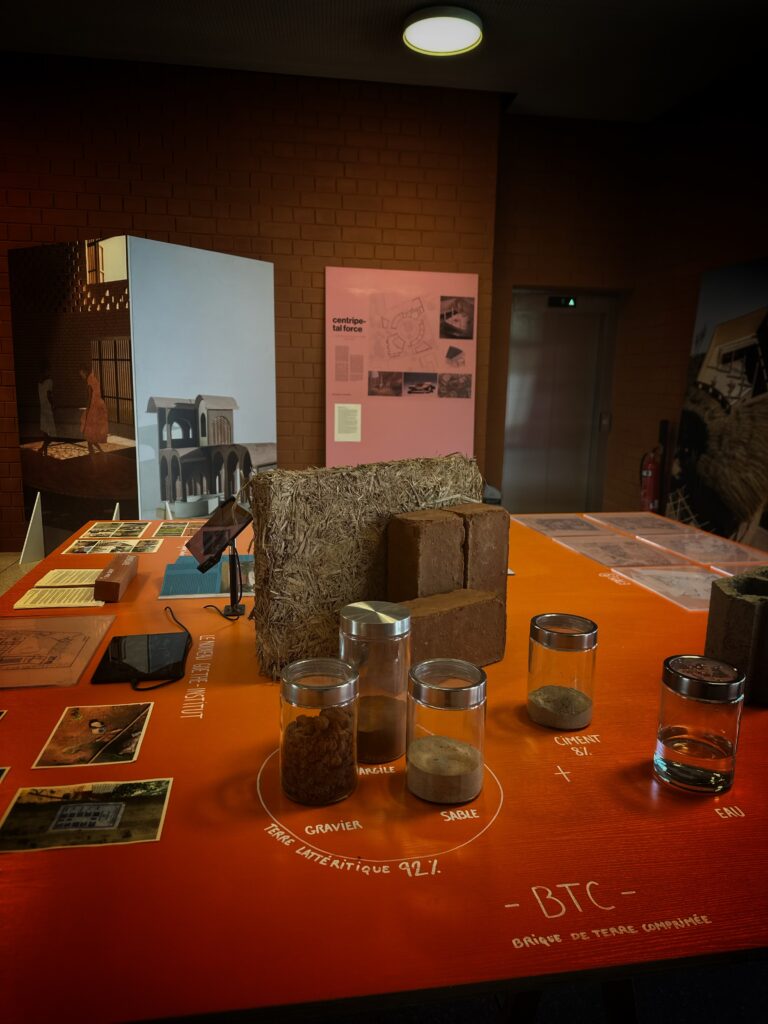
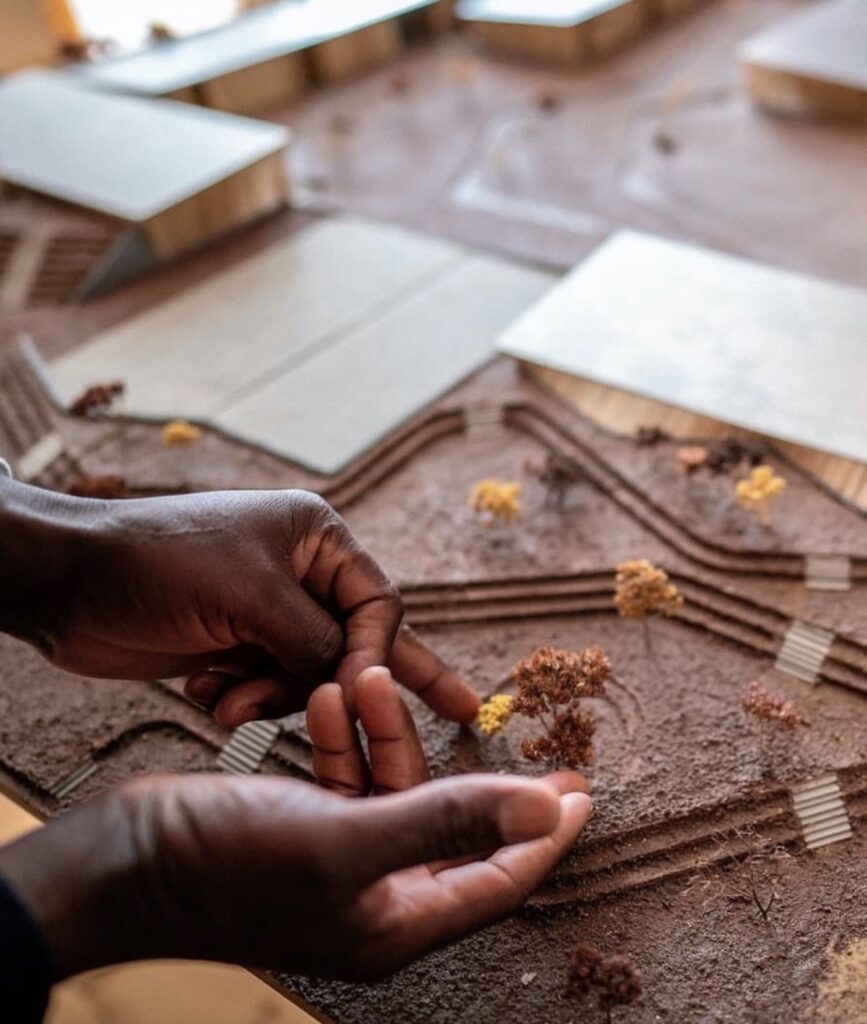
The compressed laterite blocks that form the walls, and the architectural scale model of the institute. Photos: Oury Sène.
For generations across Africa, earth has been one of the continent’s most enduring building materials. Yet in many rapidly modernising cities, it has often been dismissed as a relic of the past, replaced by imported concrete, steel, and glass.
The Goethe-Institut Dakar challenges that assumption with walls built from 124,000 compressed earth blocks made from laterite soil sourced from the Dakar region and produced locally by the Senegalese company Elementerre. Through a combination of traditional knowledge and contemporary engineering, the material has been transformed into a distinctly modern architectural language.
The earth blocks do more than define the building’s appearance. Their thermal mass helps regulate indoor temperatures throughout the day, reducing dependence on mechanical cooling while reconnecting contemporary construction with centuries of building knowledge developed across the Sahel. The building feels inseparable from its environment, visually as much as climatically.
The material palette extends beyond earth alone. Above the laterite walls, a lightweight steel canopy stretches across the site, creating generous shaded areas while allowing warm air to rise and escape. Combined with open courtyards and carefully positioned openings, the roof forms part of a passive cooling strategy that responds directly to Dakar’s tropical climate. Earth, steel, vegetation, light, and air work together to give the building its character, and to show how contemporary architecture can take its cues from the environment it sits in.
The decision to build with local materials also extends beyond environmental considerations. By working with local producers, engineers, and craftspeople, the project supports employment, strengthens technical expertise, and reduces the carbon footprint associated with transporting conventional construction materials over long distances, making the building a collaboration between architects, artisans, engineers, and the landscape itself.
This relationship between land, memory, and construction is explored further in Un-Broken Ground, the inaugural exhibition accompanying the opening of the new Goethe-Institut. As the exhibition’s curatorial text notes, “The ground on which it rests is not an inert surface to be dominated, but a terrain of memory rich with new spatial possibilities.”
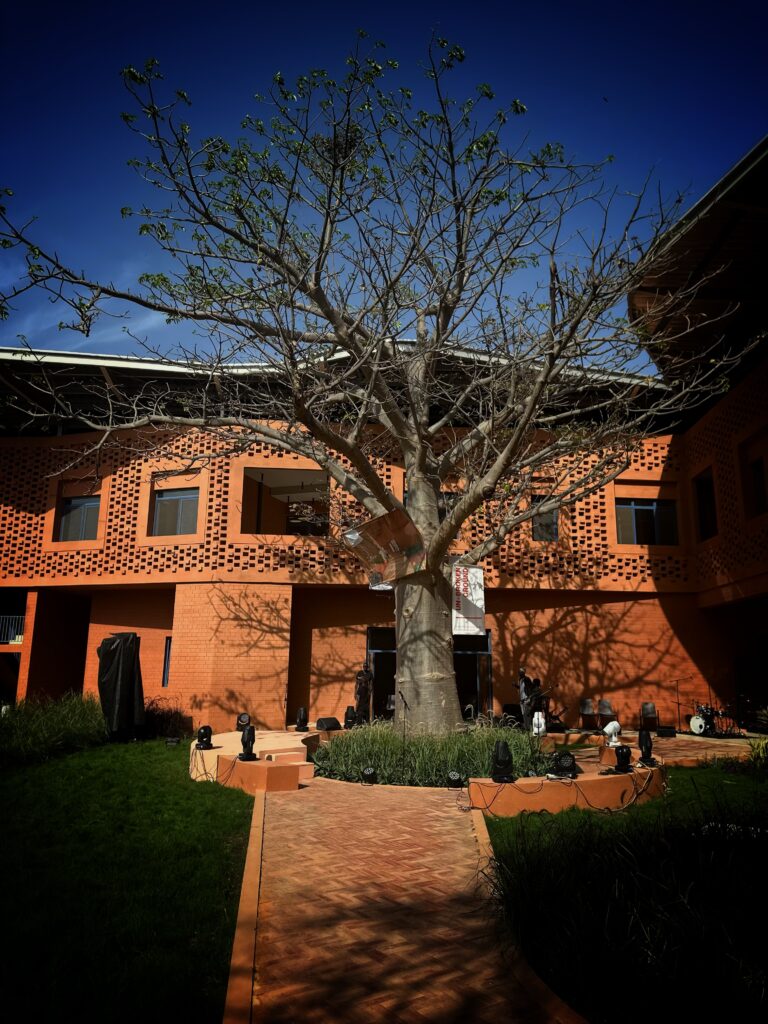
At the centre of the Goethe-Institut Dakar stands a baobab tree.
In Senegal, the baobab carries significance that extends far beyond its silhouette. For generations, it has served as a symbol of gathering, wisdom, and collective life. Beneath its branches, communities have exchanged stories, debated ideas, resolved disputes, and passed knowledge from one generation to the next.
That tradition shaped Kéré’s design, which embraces the tree rather than clearing it. The building curves around the baobab, creating a central courtyard inspired by the arbre à palabres, the traditional tree of discussion. The courtyard functions as a contemporary gathering place where visitors, artists, students, and researchers can meet, exchange ideas, and participate in cultural life.
The architecture reinterprets that tradition instead of imitating it. Tree-like columns support an expansive roof that shades the site, while natural ventilation circulates through the interconnected spaces. The transition between indoors and outdoors remains fluid, encouraging movement and conversation, so that the place reads less as a closed institution than as a living ecosystem.
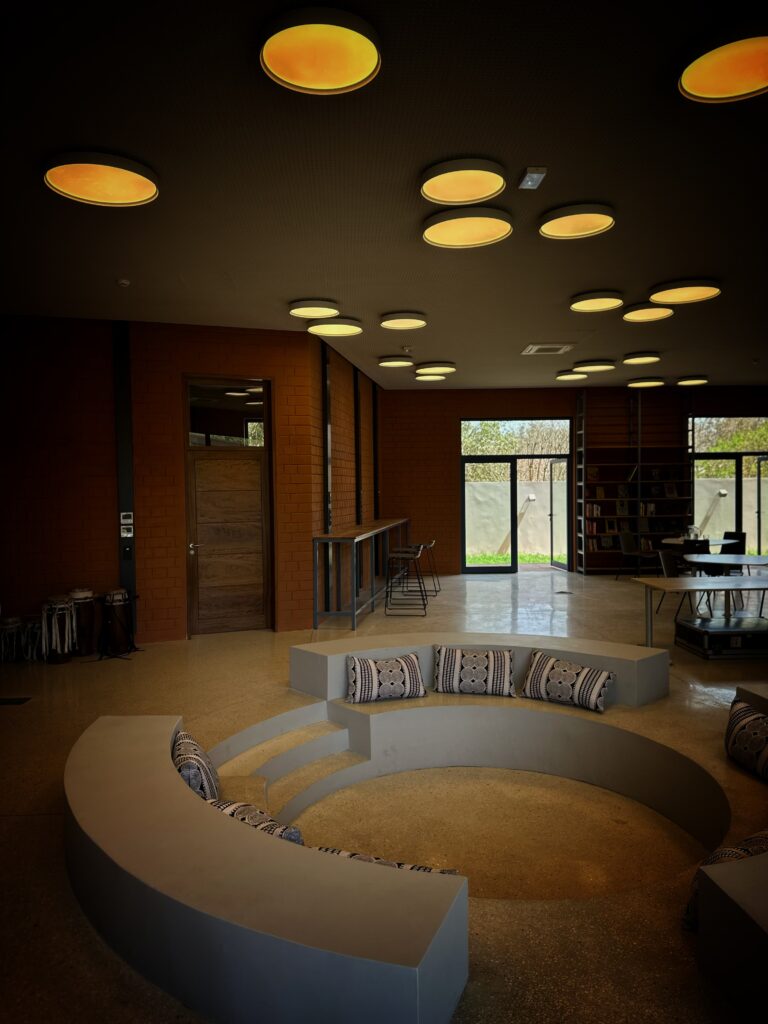
At the centre of the Goethe-Institut’s mission is a reimagining of how knowledge is preserved and exchanged.
The new library moves beyond the conventional idea of a quiet room defined solely by books, exploring instead the relationship between written knowledge, oral traditions, and digital technologies. Its concept draws on the idea of the decolonial library, one that recognises the multiple ways knowledge has been produced, transmitted, and preserved across African societies. In Senegal, where history and culture have often travelled through voice as much as through text, this approach feels particularly resonant.
Books sit alongside podcasts, recordings, oral histories, and multimedia production spaces. A dedicated studio will support the preservation of spoken narratives while enabling new forms of storytelling. In this space the legacy of the griot meets contemporary technology, and the library becomes a repository of knowledge as well as a place where memory and creativity coexist.
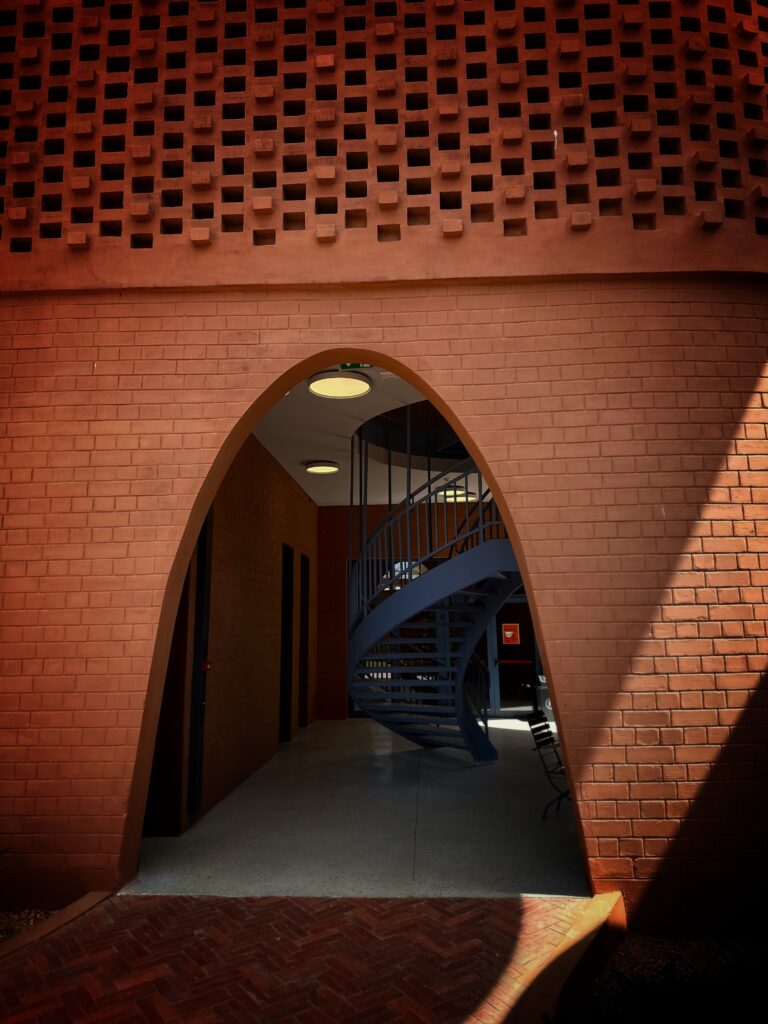
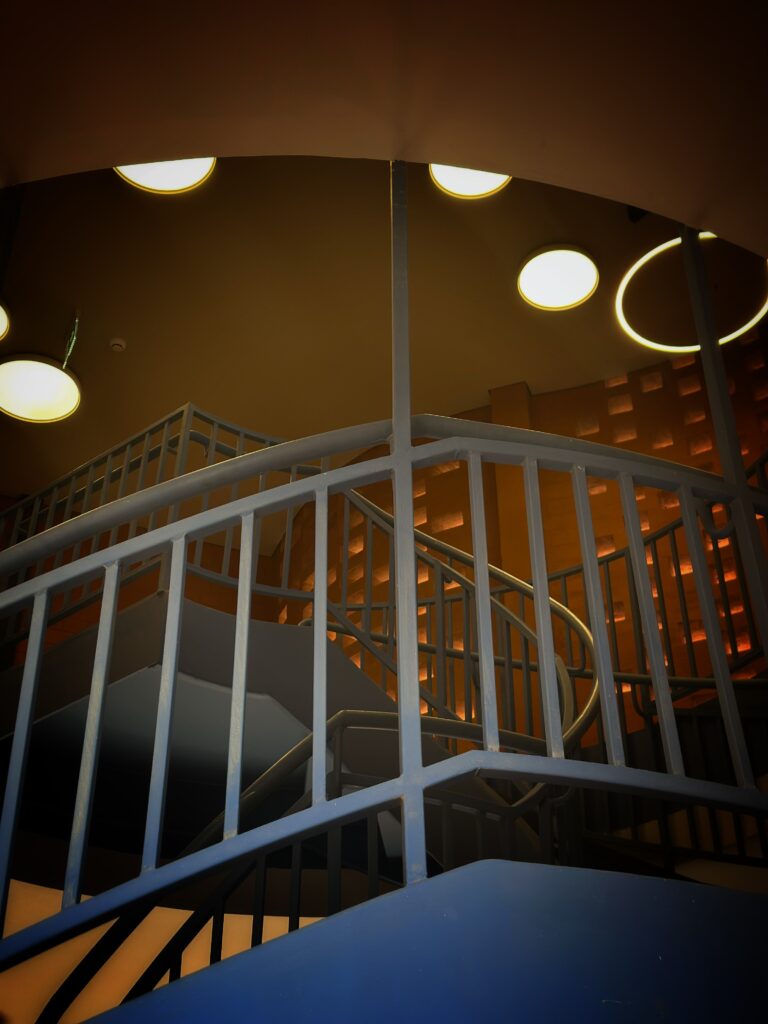
Steel staircases meet laterite brick, blurring indoor and outdoor. Photos: Oury Sène.
The project is also a story of collaboration. Alongside Kéré Architecture, it brought together the German engineering firm Rebuild.ing, the Dakar-based studio Worofila, and a network of local companies, builders, and craftspeople.
For Worofila co-founder Nzinga B. Mboup, the project marks a shift in the evolution of African architecture.
“The fact that the new Goethe-Institut Senegal is a raw earth building based on bioclimatic principles is very important,” she says. “It allows a wider public to discover the thermal advantages of earth buildings and shows that they can exist in urban environments while expressing a refinement worthy of modernity.”
Her point speaks to a broader shift across the continent, where African architecture increasingly draws confidence from its own landscapes, materials, climates, and cultural histories rather than relying solely on imported models of development. Buildings such as the Goethe-Institut Dakar show that contemporary design and local knowledge can work together.
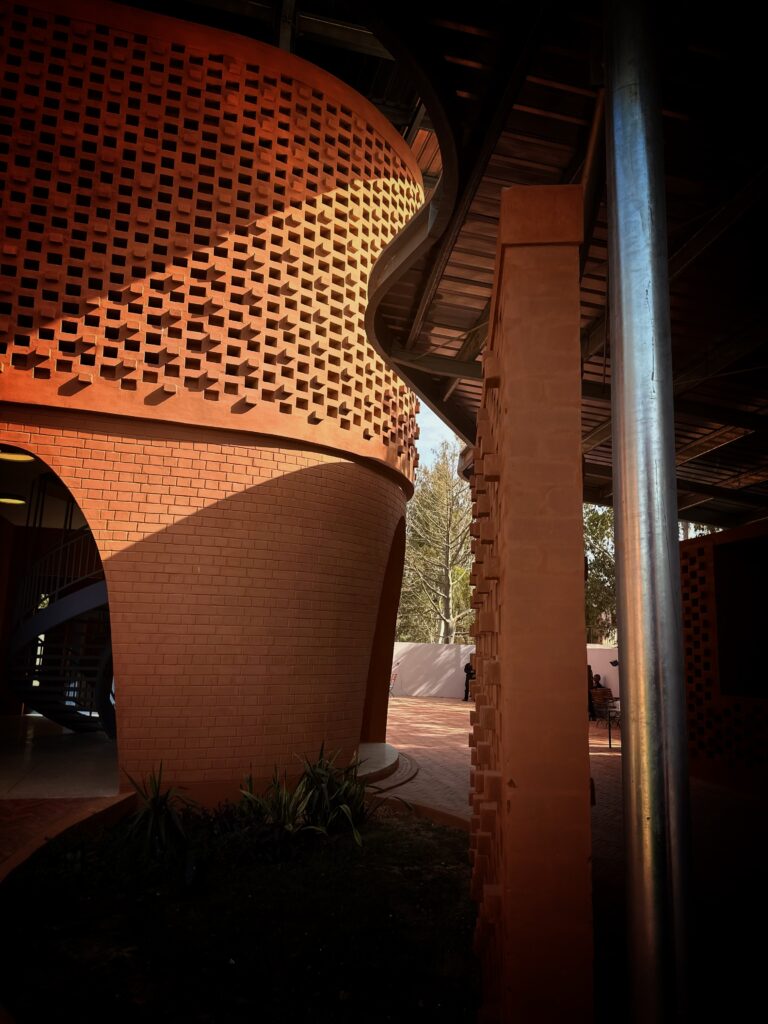
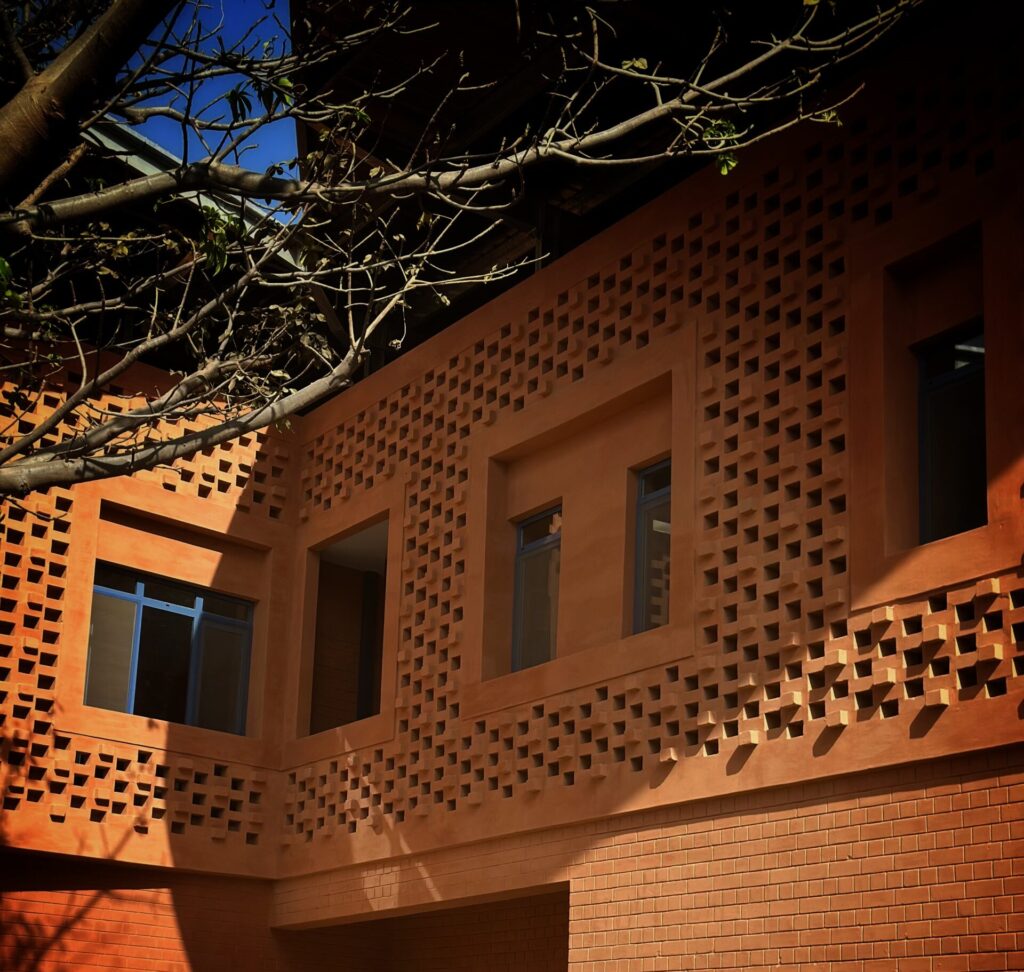
The perforated laterite façade that filters light and draws in Atlantic breezes, its openings ventilating the interior. Photos: Oury Sène.
The Goethe-Institut Dakar will welcome artists, students, researchers, and communities through classrooms, exhibition spaces, a performance venue, a digital centre, collaborative workspaces, and its new library.
The building’s significance extends beyond its programme. It proposes that cultural institutions can be environmentally responsible without sacrificing beauty or ambition, and that innovation can emerge from tradition, with local materials participating in global conversations about architecture, sustainability, and cultural identity.
At a moment when many African cities are defined by glass towers, imported materials, and architectural languages borrowed from elsewhere, the Goethe-Institut Dakar offers another proposition. Built from laterite earth, shaded by steel canopies, and organised around a living baobab, it argues that the future need not arrive from outside. It can come from the soil underfoot, from the local climate, and from people who have long known how to build with both.
In Dakar, Kéré has made a building that asks what African modernity looks like when it grows from its own ground.
Subscribe to Guzangs for dispatches on the architecture and culture remaking the continent.