

The New Stewards of El Fenn
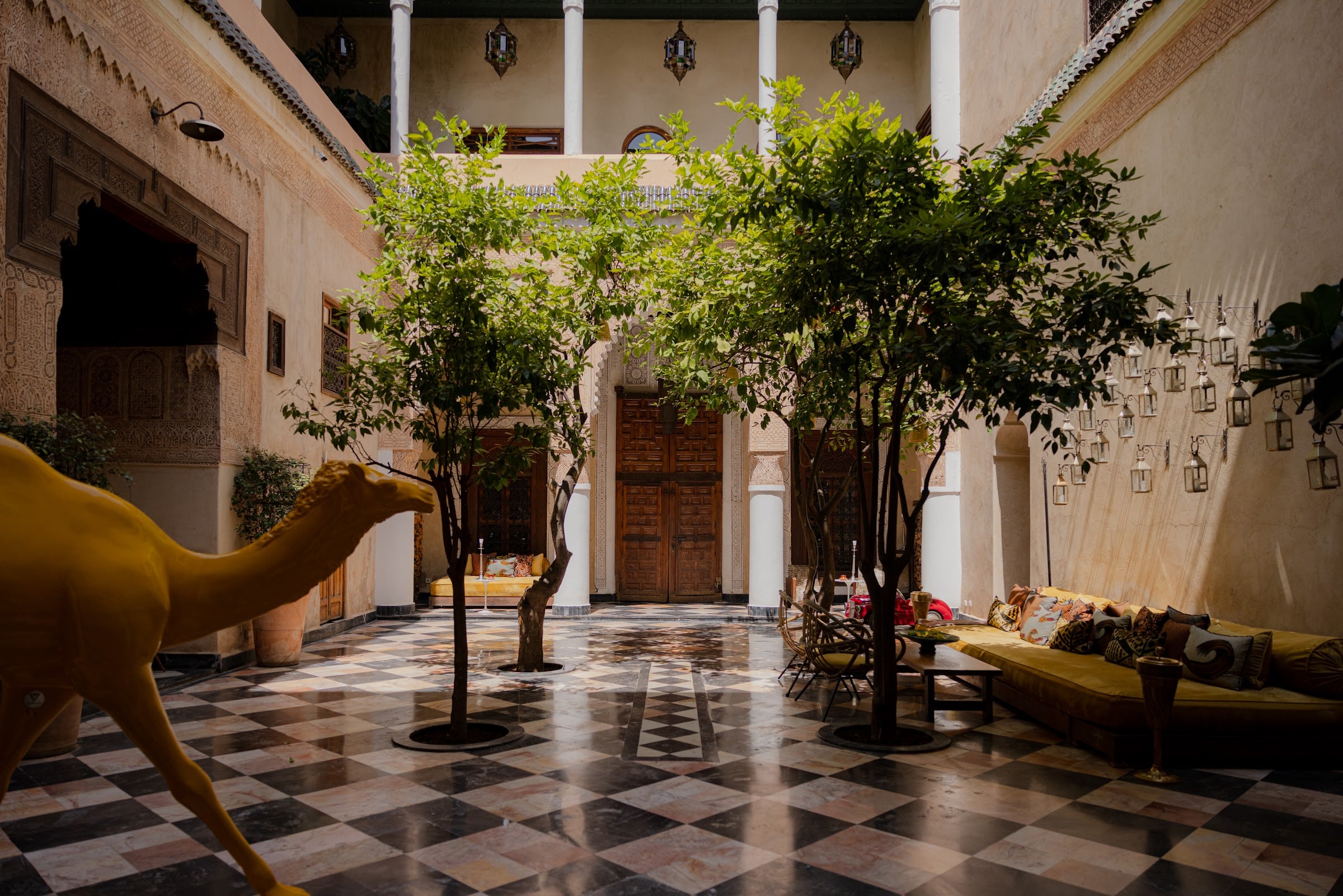
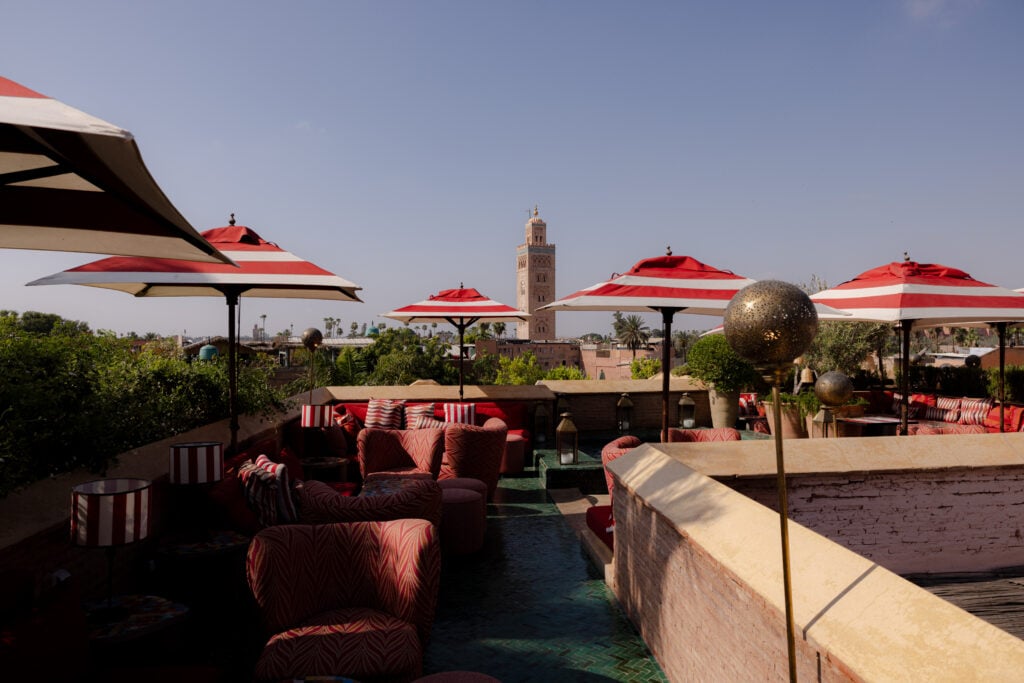
It requires remarkable restraint to be uncharmed by El Fenn. Hidden behind rosy, sun-drenched walls inside the centuries-old medina, the hotel has long existed as one of Marrakech’s defining creative addresses, where the cedar doors and tadelakt walls feel less like a hotel than a private home opened to the world. From the rooftop, the Koutoubia holds the skyline the way it has held it for eight centuries, and the city arranges itself below in terracotta and dust.
In November 2025 it changed hands. Dar Taarji, a Marrakech-based family holding company, bought the company that owns El Fenn from Vanessa Branson and her partners, putting one of the city’s most recognisable cultural landmarks under Moroccan ownership.
Vanessa Branson and Howell James went looking for a house in the medina in 2002 and came away with five. By the property’s own account, they intended to buy a single part-ruined building and learned only at the signing that the way the title deeds were structured meant four neighbouring houses came with it. Within six months they had brought in the Moroccan architect Amine Kabbaj to oversee the reconstruction, and it took two years before six rooms were ready to open in 2004. The complex kept growing, absorbing further riads and stitching them into an interconnected whole. A later phase, designed with Sylvain Raguenau of Aire au Carré, added the Colonnade bar, a private dining room and the spiral staircase to the roof. The plan reads today as a labyrinth, 41 rooms and suites deep, and a guest can still get lost between them.
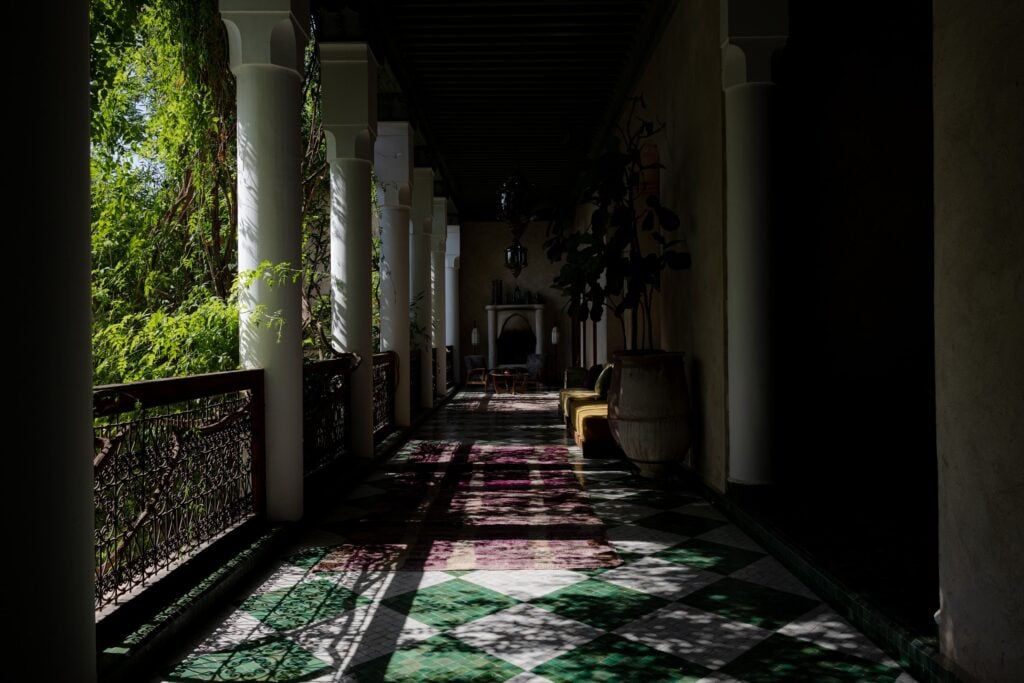
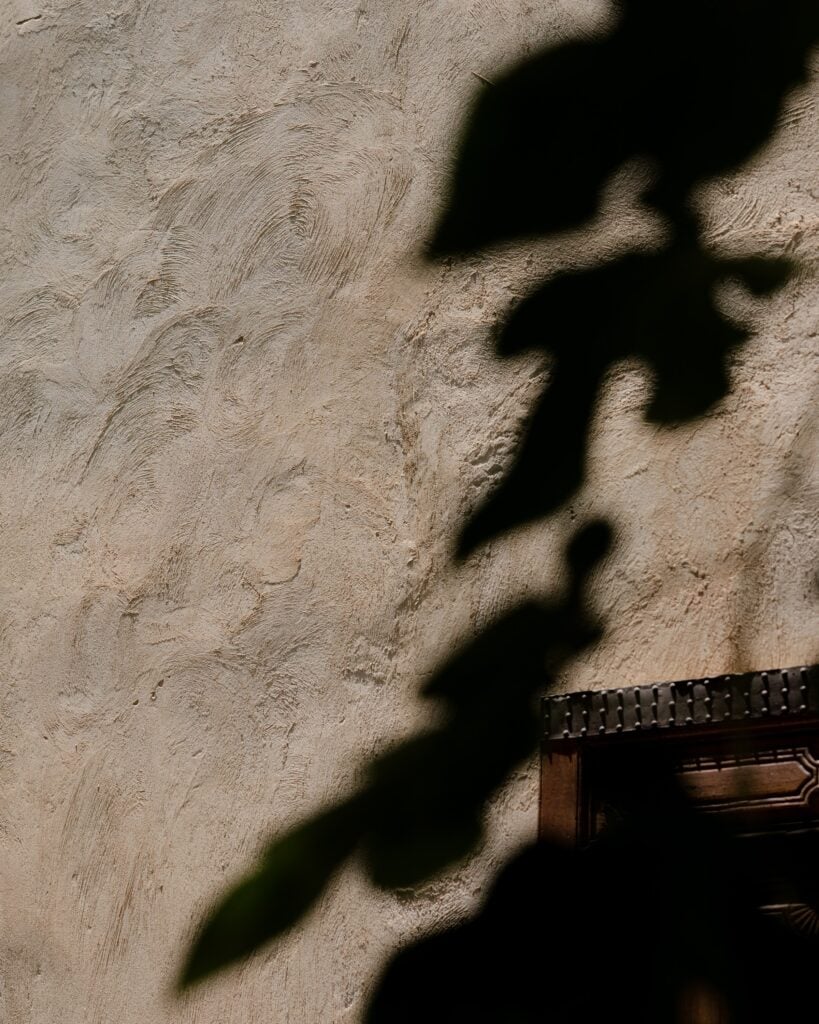
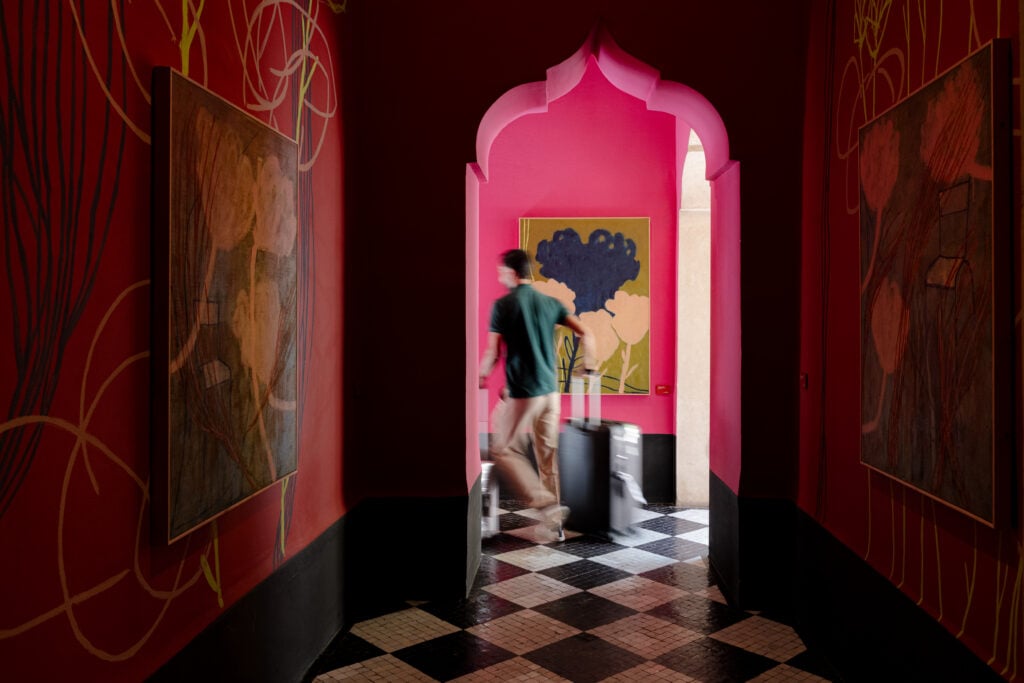
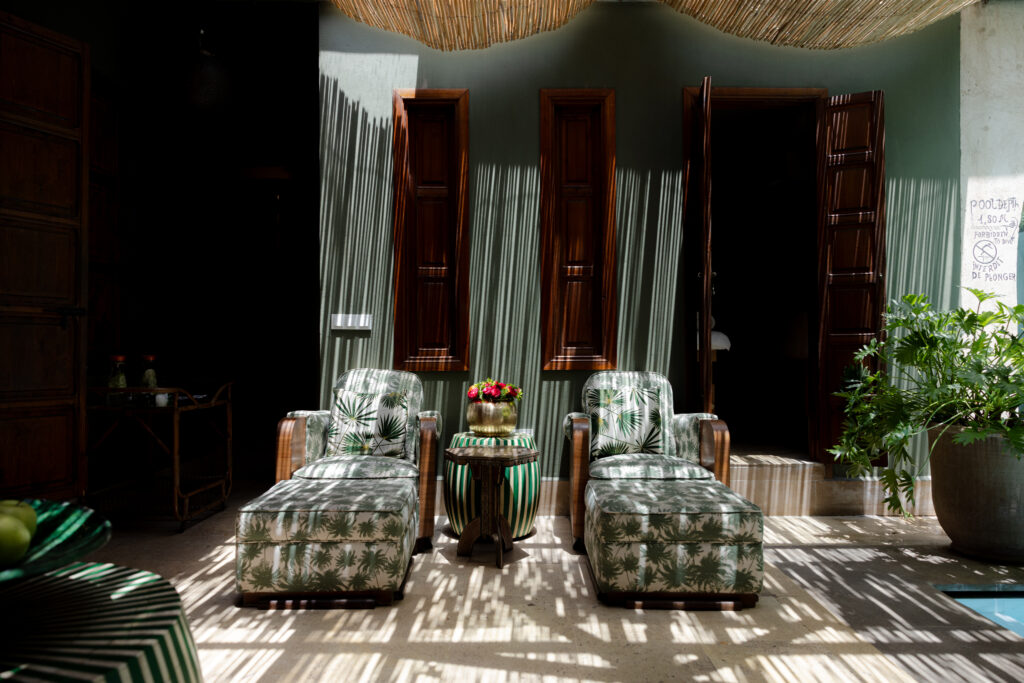
Tadelakt carries the walls, burnished lime plaster mixed by hand, polished with river stone and sealed with black soap, shifting between pink and ochre depending on where the light falls. Zellige runs underfoot and up the fountains, cut by hand and set by eye. The plasterwork is carved, the doors are cedar, and some suite floors are laid in hand-stitched camel leather. No two rooms are alike. Some are hot pink, some teal, and the house makes a point of saying so. Above them all sits a roof terrace of 1,300 square metres, wide enough to hold restaurants, a pool and a view that runs from the Koutoubia to the Atlas.
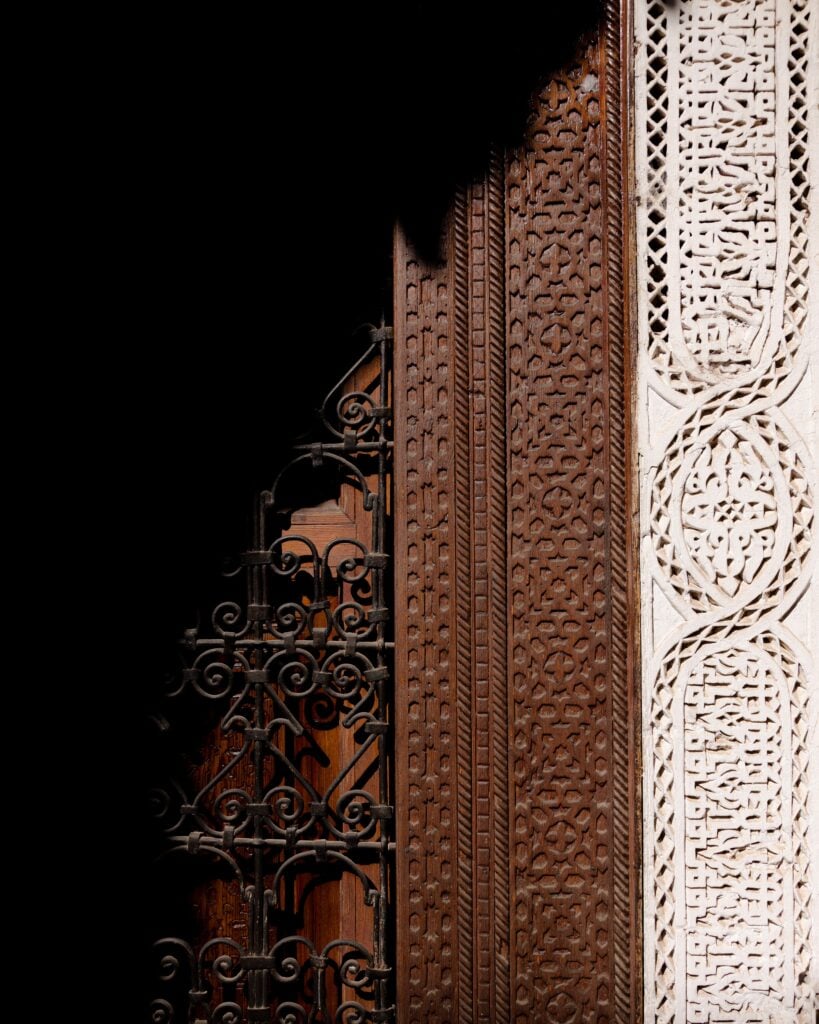
Speaking to HEC Stories in December 2025, Jalil Benabbés-Taarji noted that the rooms have no keys. He described the Pink Courtyard, and the Orange Courtyard, where a single tree has been grafted to bear both oranges and lemons, the work of someone who expected to be around for the harvest.
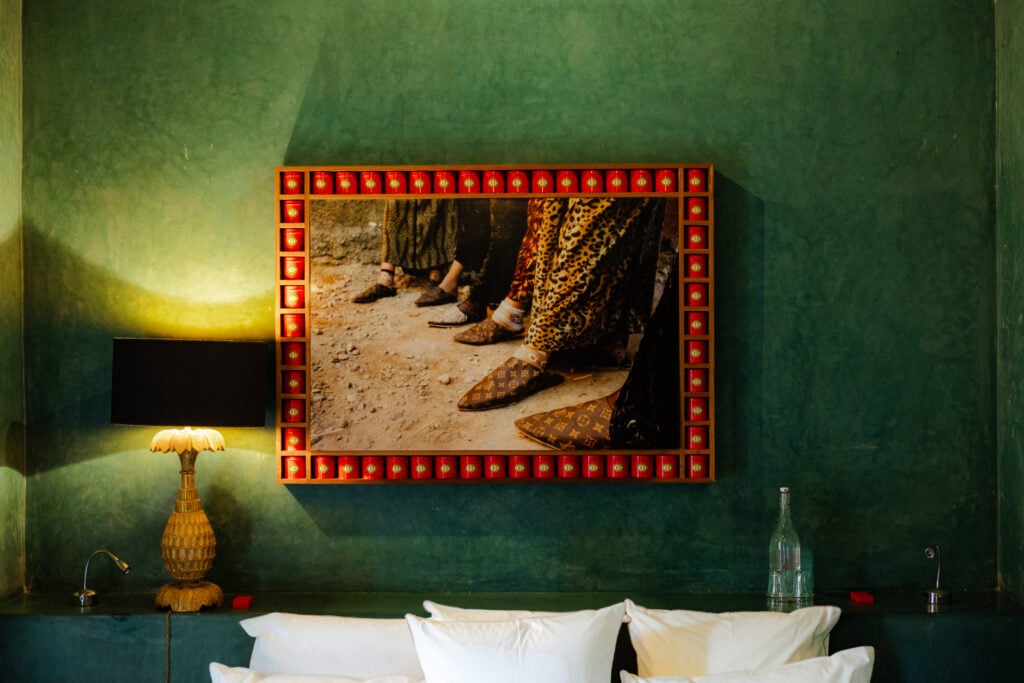
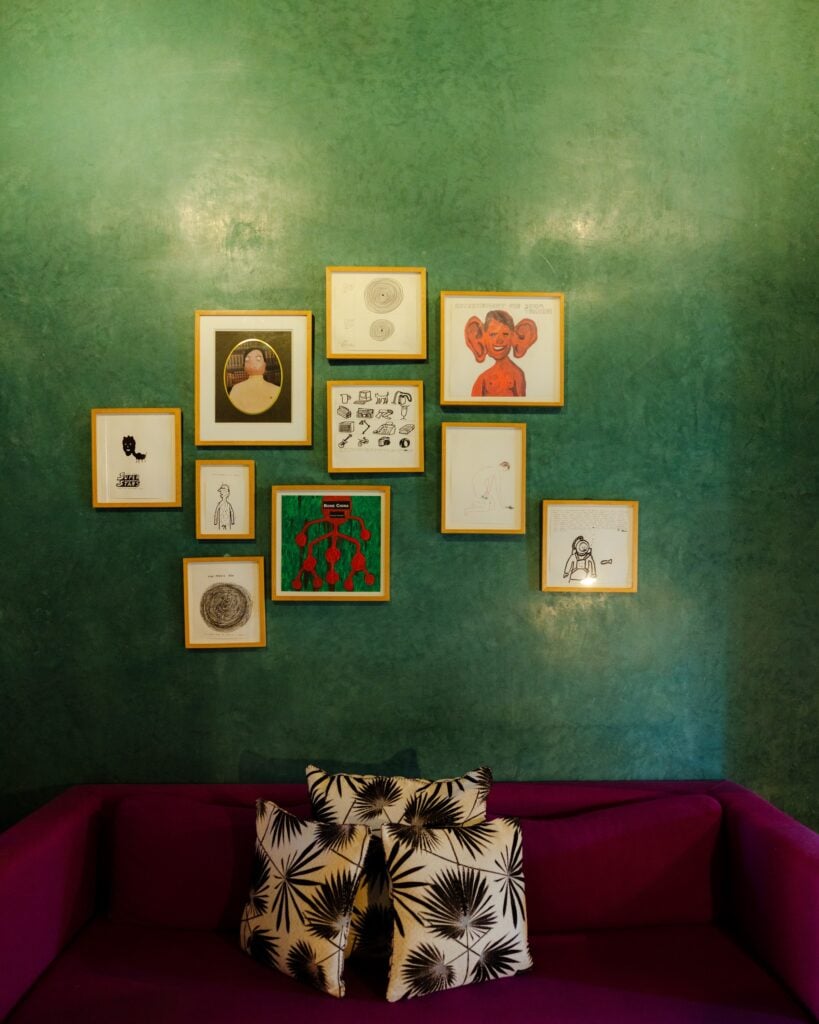
El Fenn means art in Arabic. The property presents its original name, Riad El Fenn, as meaning house of art. Both names are still in use, and the older one is the more accurate. The founding collection came out of Branson’s personal holdings, and the early walls carried Bridget Riley, William Kentridge, Terry Frost and David Shrigley. It was work that put international contemporary art in conversation with traditional Moroccan architecture at a moment when few hotels anywhere were attempting it. The collection has since grown, and it hangs where people live rather than where they queue. Hassan Hajjaj appears more than once: two figures in hooded djellabas reading fashion magazines, mounted above a sofa; another work above a bed, its subjects’ feet in babouches and leopard print. Both sit inside the ranked tins of tea and soda that are his signature frame, work about consumption hung in rooms where guests sit and sleep. Leila Alaoui’s Moroccan Series is hung along a route rather than in a room, something to be passed rather than presented. In a salon, nine small David Shrigley drawings are grouped on a wall of green tadelakt above a magenta banquette, deadpan and a little rude, the founding collection still on duty twenty years on.

In 2005, Branson co-founded with Abel Damoussi the festival that became the Marrakech Biennale, North Africa’s first major trilingual arts festival, which ran six editions until 2016 with a widening focus on artists from Africa, the Middle East and their diasporas. El Fenn became one of its unofficial living rooms as the Biennale grew, the place where the conversations continued after the galleries closed. Its Curated Art Weekends programme, launched in January 2025, formalised what the house had been doing informally for two decades.
Hotels are usually discussed in the language of assets and amenities: occupancy rates, room counts, design accolades, average nightly rates. Some places outgrow those metrics. They preserve endangered craftsmanship through restoration. They create work for local makers, host the conversations that shape creative communities, and become woven into the cultural life of a city. In time they cease to function solely as hotels and begin to resemble institutions.
The transaction was announced without fanfare. Dar Taarji acquired 100 percent of Equilibrium, the company that owns El Fenn, from Vanessa Branson, Howell James, Graham Head and Madeline Weinrib, the latter two having become partners in the property in 2018. No purchase figure has been disclosed. El Fenn joined AKAN, the collection Dar Taarji created to structure its hospitality portfolio, alongside La Villa des Orangers and Les Deux Tours.
At first glance it looked like another hotel acquisition. It wasn’t, because El Fenn has never merely been a hotel. It is one of the rare hospitality spaces whose influence extends past tourism into culture itself, and a change in its ownership carries weight well beyond the business pages.
Speaking after the acquisition, Youssef Benabbés-Taarji, Vice-President of Asset Management and Development at Dar Taarji, chose his words carefully. “For us, El Fenn is not one more acquisition, nor a simple commercial transaction,” he told Moroccan press. “It is a transmission imbued with heart. El Fenn is the embodiment of art, of hospitality, and of a devotion to Moroccan culture.” (Translated from the original French.)
Nothing in that statement is deal language. Transmission belongs to inheritance and succession, to the handing down of something that was never entirely yours to begin with. It recasts what Dar Taarji believes it has taken on. The asset is a profitable hotel. The obligation is to a house that has become part of how Marrakech understands itself.
Jalil Benabbés-Taarji has described his family as having lived in Marrakech for five generations, present through the city’s evolution from a centre shaped by merchants, artisans, storytellers and builders into one of the most photographed cultural destinations in the world. Their vocabulary is more revealing than their portfolio. They speak of stewardship rather than reinvention, a philosophy that treats hotels as living institutions, shaped as much by memory, architecture and people as by balance sheets.
AKAN takes its name from the Berber word for foundation, and the structure behaves like one. It was never meant to be a brand. When the family established the collection, they set out to protect what already made each house distinctive: its architecture, its history, the rhythm particular to that address. Hospitality groups at this level tend to pursue a recognisable aesthetic and a repeatable experience. The Benabbés-Taarjis went the other way. Under AKAN, the houses are not expected to resemble one another. They are expected to remain themselves.
Jalil Benabbés-Taarji has put the principle more bluntly. “Our goal is not to change El Fenn,” he told HEC Stories. “We pay tribute to those who created it. We are caretakers, not inventors.”
Vanessa Branson never left. As of January 2026 she holds the role of Founder and Brand Ambassador at Large, a position the announcement frames as ensuring the continuity of the hotel’s creative spirit, and she continues to guide El Fenn’s artistic identity, advise on the collection, lead art tours and retreats, and represent the property at international art fairs. In her own statement on the handover, Branson described two decades at El Fenn as the great adventure of her life, and said the family “understands the magic ingredients” that make the place work.
It is an unusual arrangement in an industry where acquisitions are often followed by rebranding, refurbishment and the slow erasure of a property’s original character. Keeping the founder inside the story is a decision with consequences, and it complicates any lazy handover narrative. Visitors are unlikely to find a radically different hotel. The pink-washed courtyards, the layered tadelakt, the art on the walls, the rooftop above the medina and the intimate rhythm that has defined El Fenn for more than twenty years are expected to remain. If change arrives, it is likely to arrive quietly: in restoration work, in investment in the building’s long-term preservation, in programming that keeps the house functioning as more than a destination.
For decades, the story of Africa’s creative economy has been told through its arrivals elsewhere. We celebrate African artists exhibiting in London, designers showing in Paris, galleries taking booths at international fairs. Far less attention is paid to who owns the institutions that sustain creative life on the continent itself, or to what happens to them when their founders step back. Ownership determines what is preserved, what evolves and what a cultural landmark ultimately becomes, and those decisions are usually made a long way from where the culture is actually produced.
El Fenn’s transfer moves that question closer to home. Moroccan ownership guarantees nothing on its own; the house was founded through international ownership and exchange, and it built something real that way. What changes is proximity. Authority, returns and the long horizon of decisions now sit nearer to the ecosystem that produces the value: the craftspeople, the curators, the artists, the city. Marrakech stops being the setting for an extraordinary hotel and becomes the ground its future is imagined from.
Whether the family’s language becomes an operating philosophy will take years to establish, and the acquisition is eight months old. What it means in practice will surface in the artists El Fenn supports, the craftspeople it commissions, who can afford to walk through the door, and whether its cultural life stays connected to Marrakech rather than merely marketed through it.
The measure will not be whether the walls are repainted or another wing folded into the labyrinth. It will be whether, fifty years from now, artists still arrive with unfinished ideas, whether Marrakech’s craftspeople continue to leave traces of their hands in the building, and whether the people shaping the city’s cultural life still regard the house as partly theirs. Ownership has changed. What matters now is what that ownership makes possible.
Photography by Abderrahmane Ajja © 2026.