

Whose Taste Is It Anyway? The Cultural Renaissance of the African Home
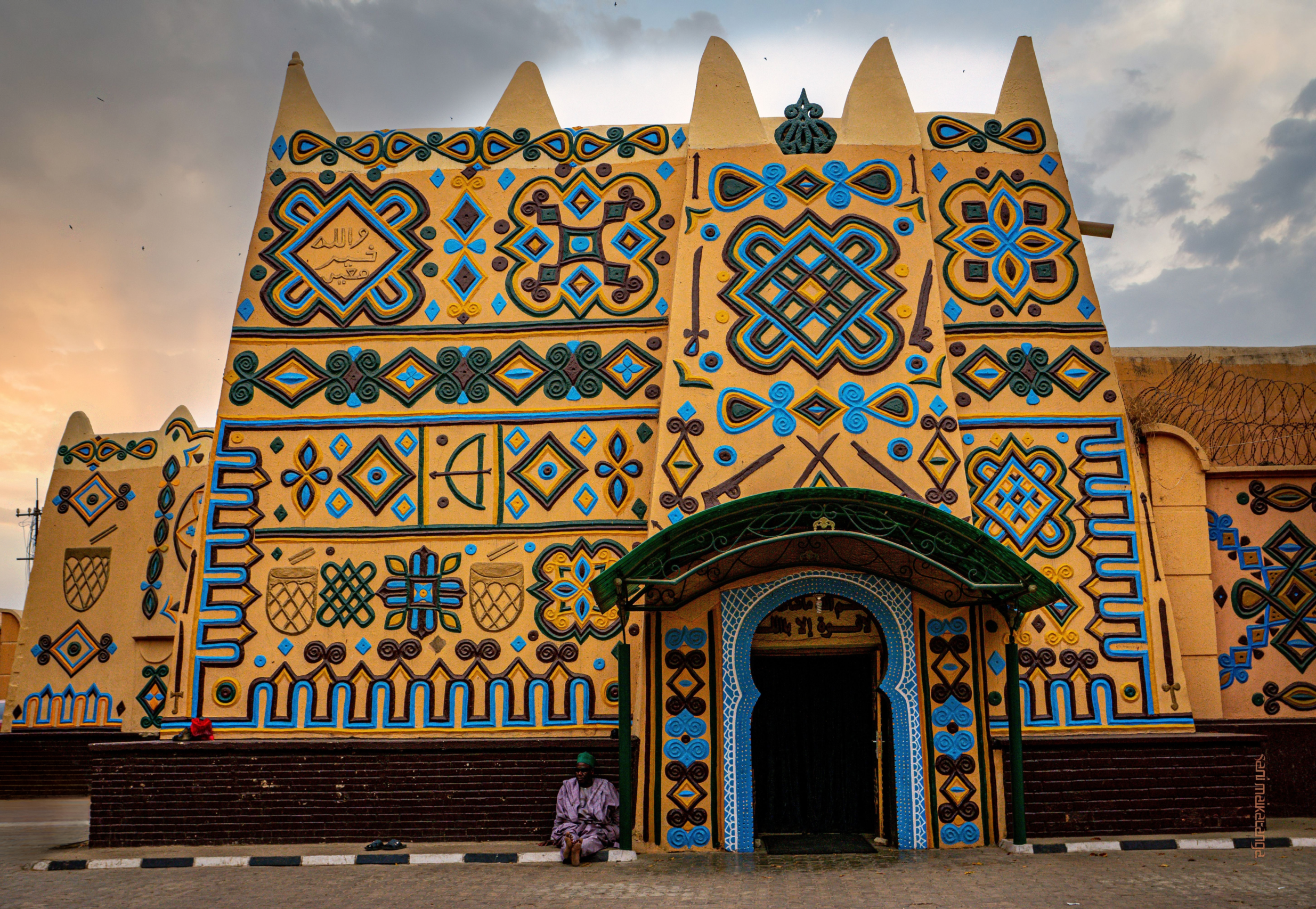
In the 2009 published book Yoruba Proverbs and Philosophy, author and traditional leader Chief F.I. Sotunde coined the term “westernosomiasis,” a condition he believed was draining African youth of cultural pride, treating their heritage with indifference while embracing anything Western. He wrote about what was at stake for future generations and the significance of returning to one’s roots.
I’ve been thinking about it in relation to our homes and the ongoing conversation around design, taste, and what influences our choices. In many modern African and diasporic homes, the deference for European restraint has been the dominant aesthetic. While taste is subjective, it’s worth asking why so many Africans’ default design preferences favor Western minimalism so far removed from their core identities. And if you do consider yourself tasteful, by whose standards? And what informed them?
Thought leaders like Kemide Lawson, author of House Proud: Black Interiors and Architecture Across Continents and Centuries, are leading that conversation. House Proud documents Black homes across cultures and centuries, from devastatingly humble dwellings to spectacularly extravagant estates, inserting them into a global canon of great architecture and design from which they have long been excluded. Every home in the book tells a story and every story makes the same argument: Black-designed homes have always had a sophisticated design language of their own, one that communicates value, identity, community, and spiritual connection in ways that Western minimalism was never built to express. The intentional erasure of Black design has meant generations of people disconnected from the design language of their own heritage. Kemide’s book is part of reestablishing that lost history, arguing that African aesthetics are a luxury language in their own right.
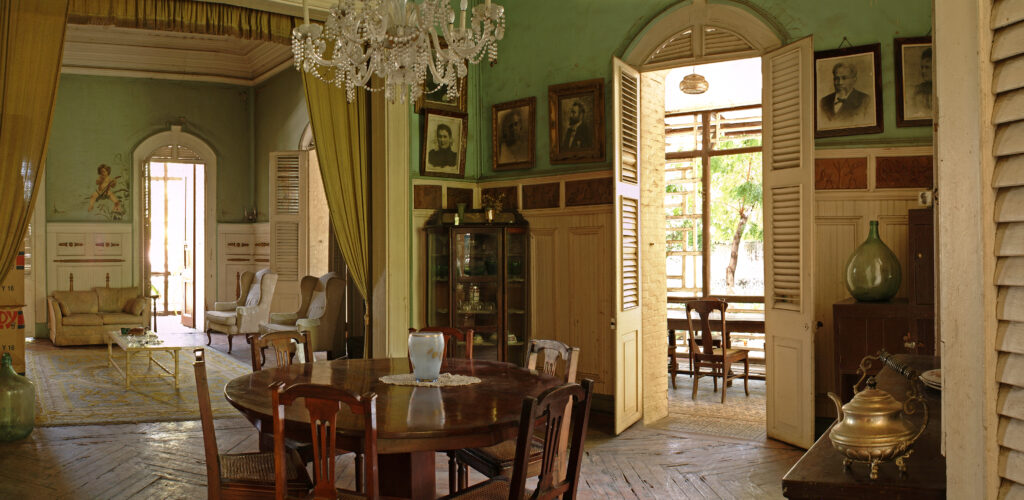
In his essay Ornament and Crime, Austrian architect Adolf Loos argued that decorative expression was a remnant of primitive culture and that restraint was a more evolved design principle. His thesis was born of the colonial attitudes of 20th century Europe, which regarded anything indigenous as backward. Their style emphasized clean lines, functional purity, and the removal of anything superfluous. That framework became the foundation of modern architecture. Capitalism ensured it stuck. Restraint is simply cheaper to build and easier to sell. As homes became investment assets rather than expressions of identity, people grew afraid to commit to their own taste. “They’re worried: is this too much? Will the next buyer want this?” Kemide says. This has resulted in the beigeification of homes, the flattening of personal and cultural expression in service of trend and resale value.
The architects who followed Loos pushed the logic further. Le Corbusier, one of the most influential modernists of the 20th century, famously declared in his 1923 foundational manifesto Towards an Architecture, that the home is “a machine for living in,” as if a home is something you operate rather than something you inhabit. This design philosophy, which became the mainstream of contemporary architecture, is completely opposed to how African culture has historically understood the home, as a sacred place, somewhere to commune, to live in harmony with nature, to tell the story of who you are and where you come from. “Western design focuses on consumerist culture,” Kemide says. “They want us to buy things and dictate what taste is so they can mass produce it.” The denigration of indigenous living principles is good for capitalism because “ornament”, or true adornment is expensive, skilled, and impossible to scale. But isn’t that the point of luxury?
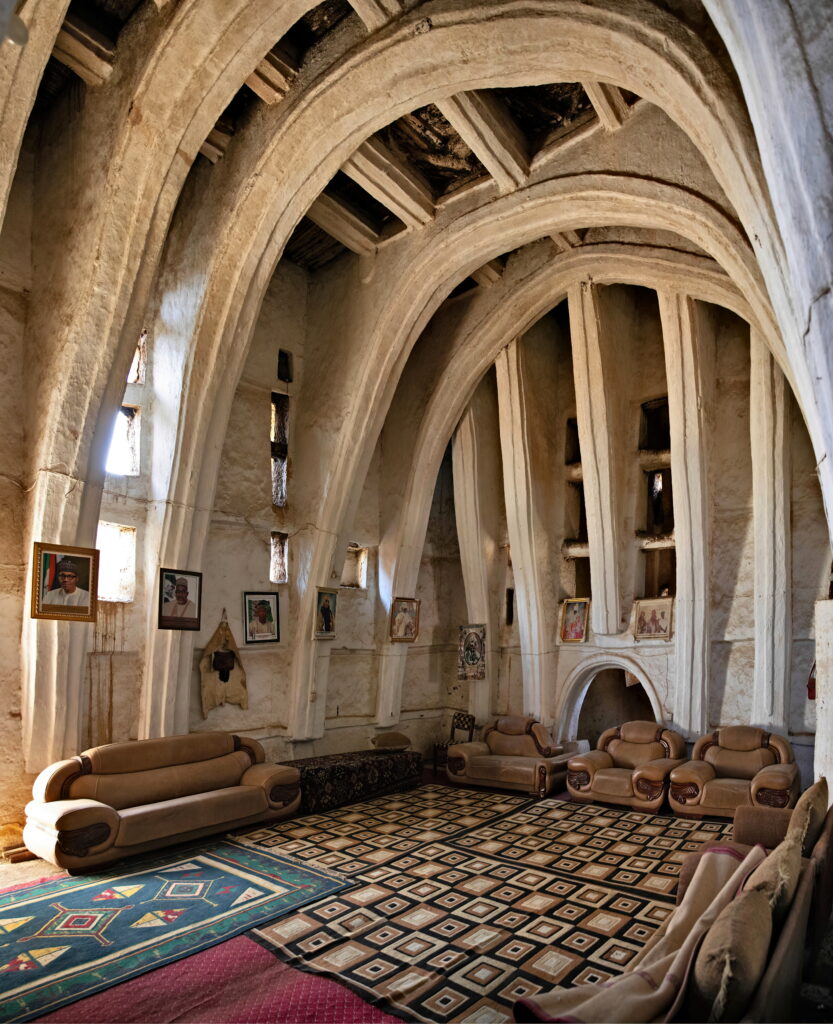
Pre-colonial homes in Nigeria were deeply ornamental, featuring intricate details and engineering using sustainable materials that promoted cohesion, community, and spiritual alignment. “We’re still recovering from centuries of being told that everything to do with Africa is primitive, everything is fetish,” Kemide says.
The work of Olowe of Ise is the most precise rebuttal to Loos and his contemporaries’ Western design philosophy. A Yoruba master carver and innovator of the Oju-ona design style, Olowe created intricately carved palace doors commissioned by Ekiti-Yoruba kings, works now held at the British Museum, the Metropolitan Museum of Art, and the Musée du Quai Branly in Paris. When his door for the palace of the Ogoga of Ikere was displayed at the 1924 British Empire Exhibition in London, British Museum experts described it as “the finest piece of West African carving that has ever reached England.” They acquired it in exchange for a British-made throne and displayed it anonymously for the next quarter century. The work was extraordinary enough to collect. By any measure, this is luxury but Adolf Loos would have called it primitive.
If we were actually educated in the knowledge of our design intelligence, we’d be able to respond with how eco-friendly, fire-resistant, and damp-proof it is.
Kemide Lawson
Lawson argues that the most powerful effect of Western colonialism on design is making you believe your taste is merely a matter of personal preference, when in reality it has been strategically programmed. During the process of writing her book, she found herself repeatedly struck by how deliberately the genius of ancestral African design had been reframed as inferior rather than celebrated for its ingenuity. “Growing up in the diaspora, a common insult would be ‘go back to your mud huts,'” she says. “If we were actually educated in the knowledge of our design intelligence, we’d be able to respond with how eco-friendly, fire-resistant, and damp-proof it is.” Knowledge is power precisely because it keeps the narratives others build about your heritage from being used against you.
One of the current trending home aesthetics is “Hotel Luxury”. “You collect pieces from luxury interior brands, along with your designer coffee table book and think ‘wow, I’ve really made it,'” she says. “But you’re operating at a profound loss that you’re not even aware of, with someone else informing your identity.” A Black-identified home, she argues, is something the hotel-luxury model cannot manufacture. “It’s about connection to family, to joy, to nature, and community.” That’s what African design philosophy has always carried, and House Proud is asking us to retain that core aspect of our identity.
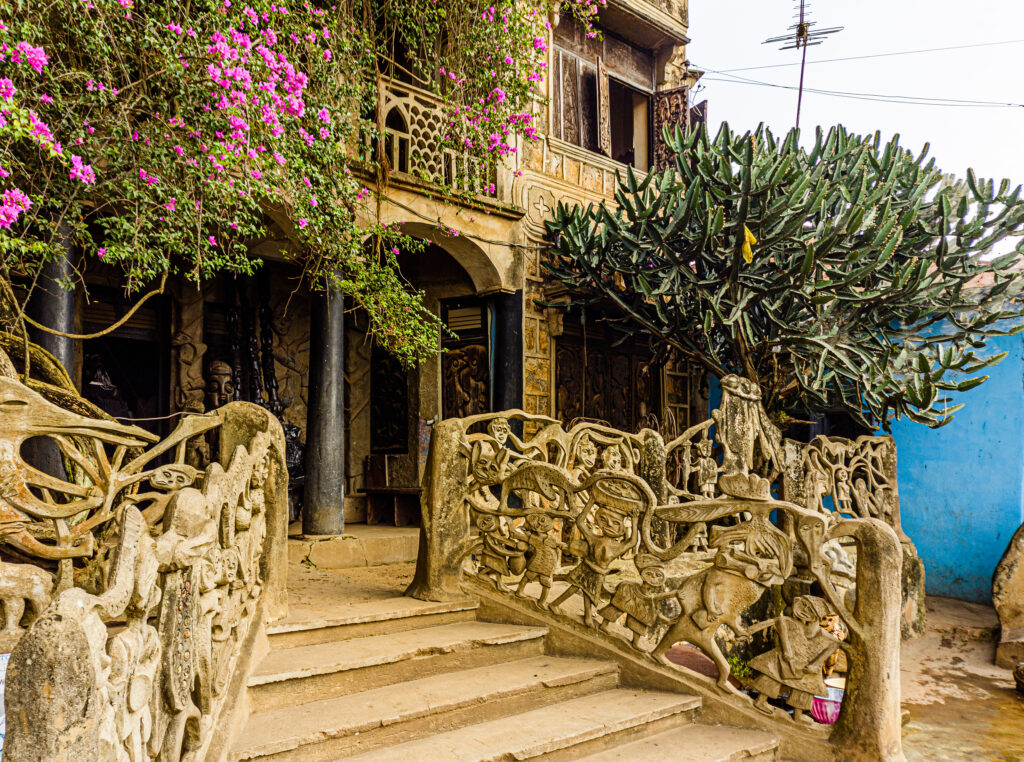
When African design is acknowledged, it is usually framed as an abundance of vibrant colour and pattern, marketed as “Afrocentric” or “African maximalism,” labels that reduce a sophisticated design philosophy to an aesthetic mood board. Lawson centers something more precise: Ancestral Intelligence. She defines it as the creativity, technology, and spiritual knowledge embedded in how Black people have historically made home, and how those principles can be applied to modern life. It was the common thread she traced across Black homes spanning continents and centuries, a design philosophy rooted in a living connection to nature, community, and cultural memory.
Ancestral Intelligence has three components. The first is eco-technology, building with and through nature rather than against it. Ancestral homes created cooling and heating systems constructed from renewable materials that modern architecture is only beginning to rediscover. “Using materials as diverse as bamboo leaves, medicinal herbs, and cow dung still have much to teach us as we search for solutions to the climate crisis,” Lawson writes. The contrast with contemporary design is stark. “When you go to Lagos and you see a ten-story glass office building, that is working against nature,” she says. “You’re basically building a greenhouse for your employees.”
The second component is what Kemide calls the architecture of joy. “Ancestral homes often carry a wit, playfulness, and charming irreverence,” she writes. “Joyful design, in colour, illustrations, symbols, and geometry that expressed spiritual beliefs, storytelling, and celebrated cultural identity.” This is not maximalism. It is a visual language with intention and meaning behind every element.
The third is community. “Our ancestral homes were built for the community,” she says. It was never just supposed to be for mom, dad, and 2.5 kids. In House Proud, she highlights the Ghanaian Adinkra symbol Fihankra, translating as “house circle,” which represents rooms arranged around a central courtyard. “The symbol signifies safety, security, completeness, and solidarity, a reminder of how much support can be found within a collective.”
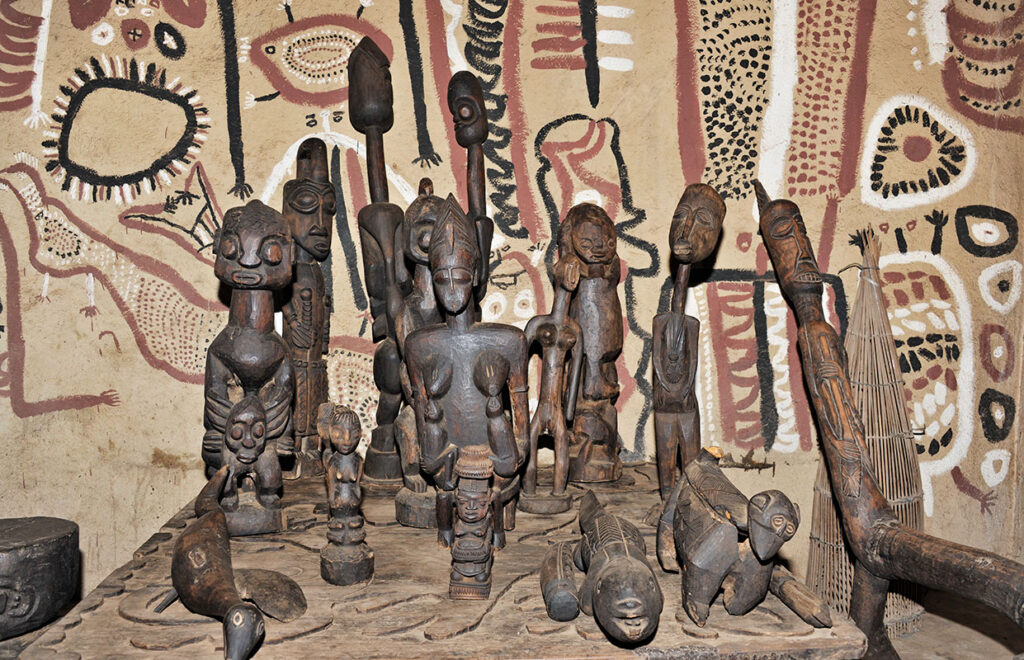
One of the more critical absences in many modern African homes is the reverence for ancestors that was once inherent to the space itself. “In traditional homes there was always an element, altar, or threshold devoted to revering our ancestors or spiritual beliefs that brought a feeling of church to the home,” Kemide says. “You didn’t have to go somewhere else to do it. Religion should be inherent in your home.”
She recalls picking up her daughters from an Indian friend’s home and pausing at the altar in the entryway that was displayed unapologetically and with deep reverence. “Africans have no issue appreciating other cultures’ ancestral altars,” she says. “But when it comes to our own, we start hearing fetish accusations. I wonder how much we’ve lost because of it.”
What has been lost, in part, is a design language that doubled as cultural memory. “A little Black child’s first museum is often their grandmother’s front room, with its old photographs, collected objects, and accumulated meaning,” Kemide says. Over time, this creates a family’s own design language, one that should be revered rather than dismissed as kitsch or outdated.
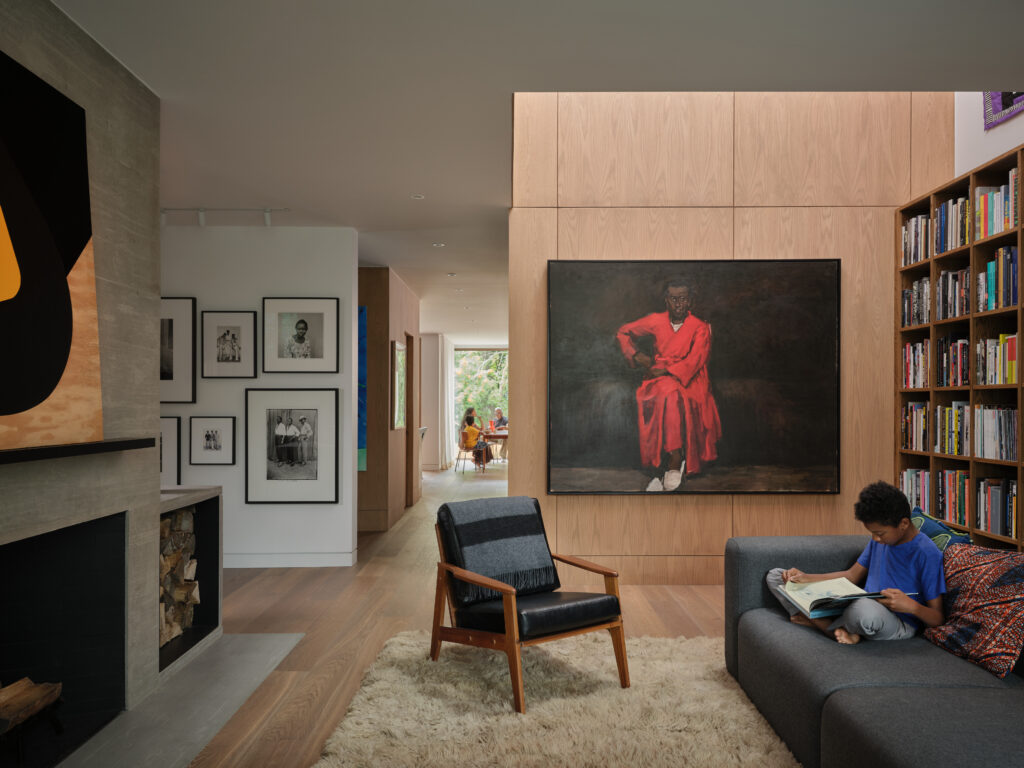
The cultural shift currently taking place can be seen through the increase of African collecting more African art, archival books like House Proud being published, and Yoruba masks and sculptures, dismissed as juju since the 1960s, now being proudly displayed. People are reclaiming more and that’s now extending to their design language.
But Kemide is careful about calling it permanent. “The only way we can guarantee that this is structural change and not a moment,” she says, “is when we’re not beholden to Western tastemakers. When we have our own internal magazines, our own ecosystems that we turn to for what makes good taste.” Purchasing power matters. So does who gets to publish, who gets to define luxury, and whose artisans and textile industries survive long enough to be passed on.
House Proud is not just a book about interiors. It is an argument for infrastructure, for the ecosystems, institutions, and publications that make cultural continuity possible. The homes have always been there, but the stories haven’t been told in the language that they deserve.