

In Mwangola, Gelmira Gourgel Exhibits the Music That Fueled Angola’s Independence
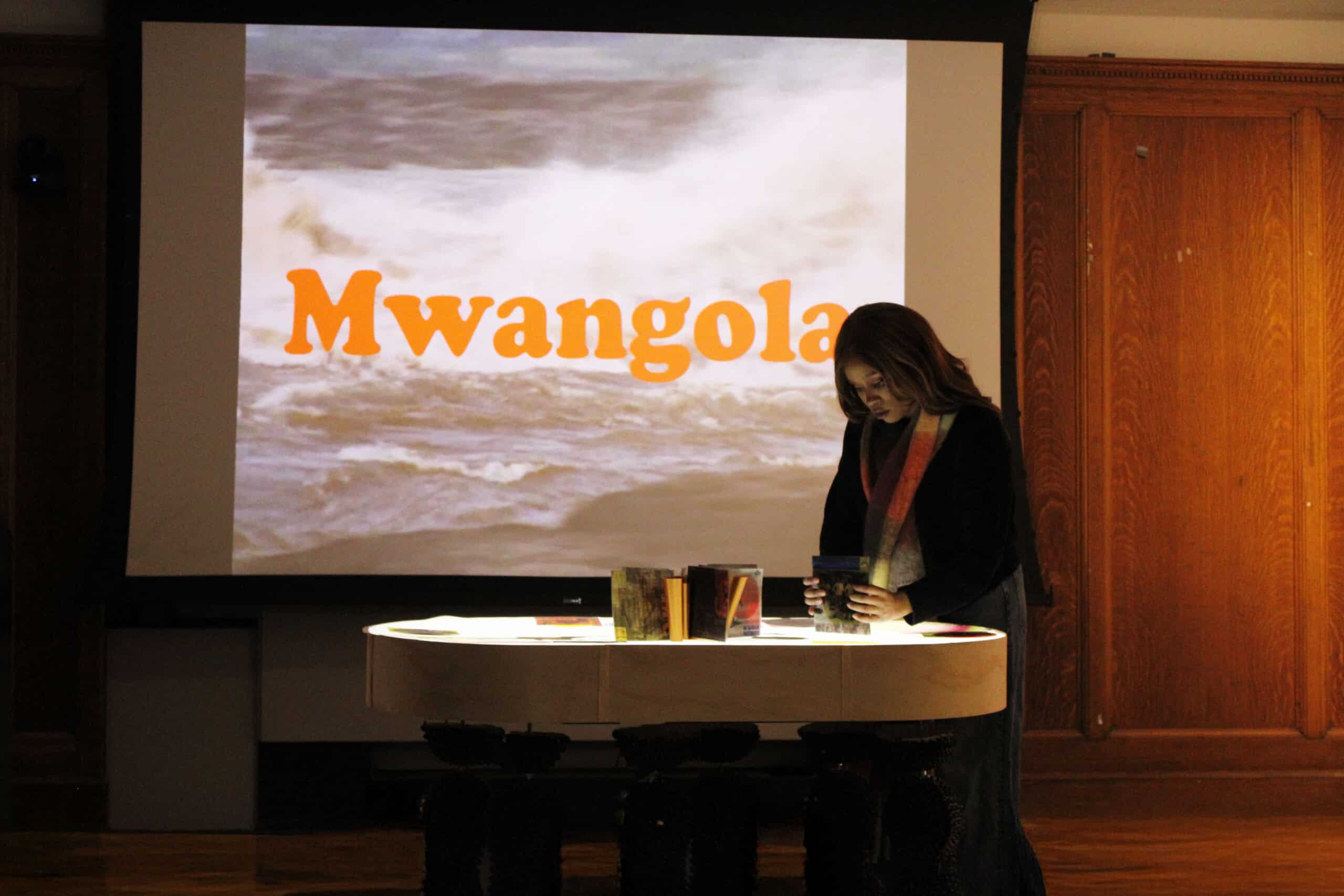
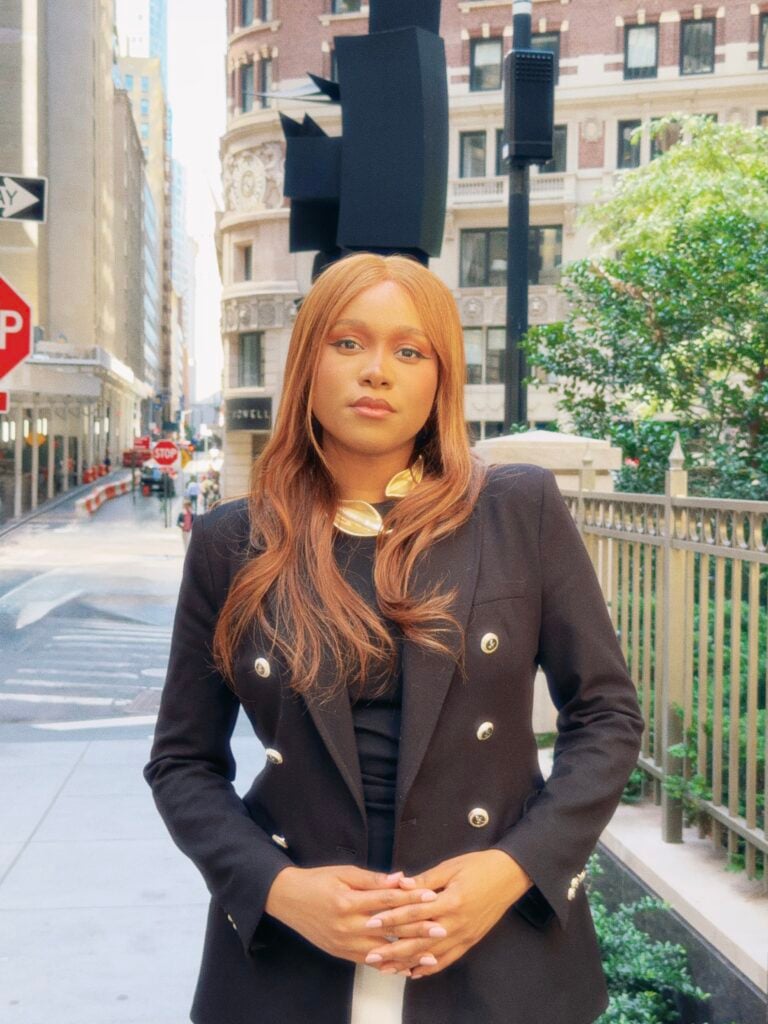
Gelmira Gourgel, an Angolan architectural designer and curator, wants people to see Angola in all its depth, not as the country that rarely enters conversations about Africa, but as a nation whose rich cultural traditions, enduring craftsmanship and creative resilience have long shaped the continent’s artistic imagination.
In her own words, it is a politically complex nation on Africa’s Atlantic coast, defined by a rich cultural diversity, and has Portuguese as its official language alongside Indigenous Bantu languages such as Umbundu, Kikongo and Kimbundu. Its history is equally layered. The Portuguese arrived in the late 15th century, beginning centuries of colonial rule marked by the extraction of both natural resources and people. Angola’s fight for independence began in the early 1960s and culminated in 1975, but a devastating civil war prolonged the country’s conflict until 2002. Today, although the country’s economy is evolving, it remains heavily dependent on oil production.
But Gourgel believes these facts only tell part of the story. Beyond its political and economic realities, Angola is a country where music, dance and communal gatherings are deeply woven into everyday life. “It’s very rich in resources,” she says, “but I think the richest aspect of the country is its culture and its people.”
This is the driving force behind Mwangola, an archival curatorial project that excavates the memories of Angola’s revolutionary music of the 1960s and 1970s, tracing how it became a powerful vehicle for resistance against colonial rule and the exploitation of the country’s oil wealth. “The idea of Mwangola came from my research within the architecture of solidarity realm. I’m interested in how this theme really shaped the history of liberation within Angola,” she tells Guzangs.
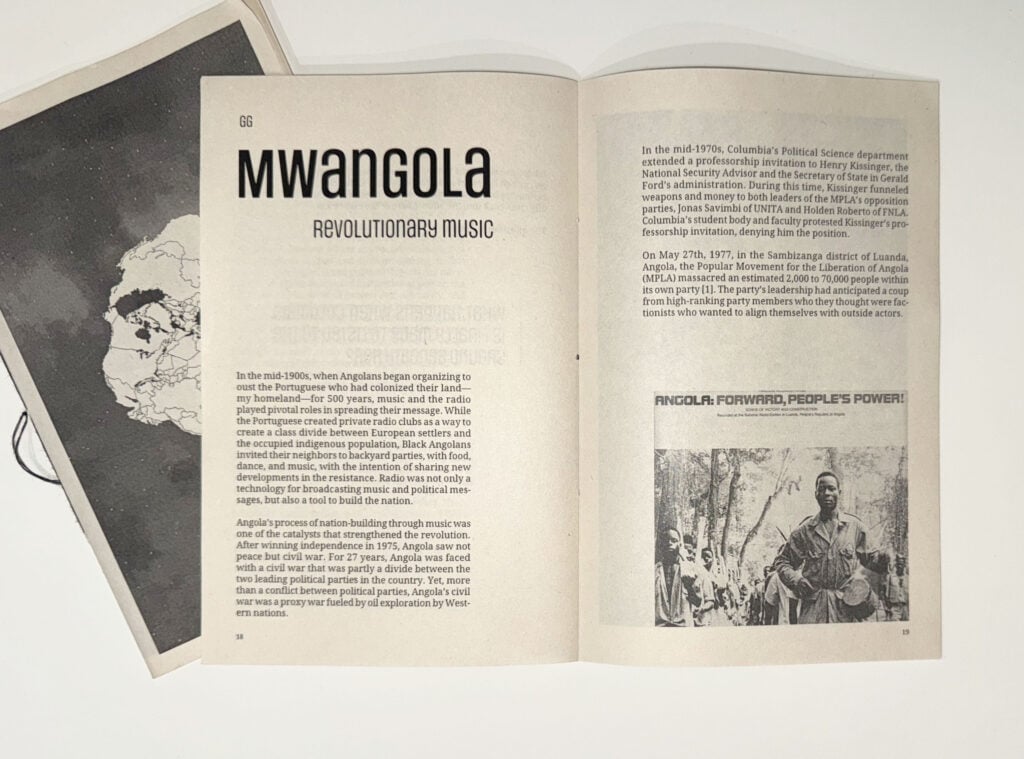
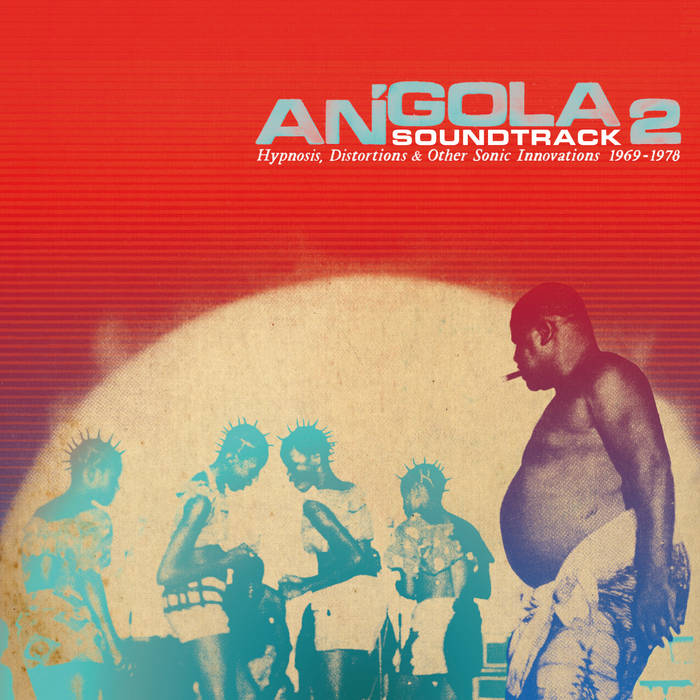
When Gourgel speaks of architecture of solidarity, she means all of the systems that supported these movements, she means the ideas, spaces, cultures, and how they exist within the past, present, and future, reconnecting older generations with newer ones. “As Angolans, we’ve listened our entire lives, since childhood, but we don’t quite understand all of the backstory and motives of these songs we love and dance to. It seems the deeper meaning has been lost over the years,” she says.
Gourgel recently graduated with a Master of Architecture from Columbia University. Her practice centers on the relationship between space, culture and human behavior, drawing on research, prototyping and spatial analysis to understand how people inhabit and experience a place. And she uses this analysis to develop Mwangola, which Gourgel describes as a deeply personal project.
As an Angolan who grew up immersed in the country’s culture, she saw the project as an opportunity to connect Angola’s struggle for independence with its cultural production but there were parts of this history she wasn’t comfortable with and it took so much strength to open herself to. “I needed to open myself up to Angola’s painful history of bloodshed and violence that came from decades of civil war and break it down, digest it, and share with my fellow young Angolans,” she explains. “Through this process of viewing music, dance, and party as resistance, I’ve come to understand that there is still joy to be found in people facing colonial oppression.”
Angola’s war of independence against Portuguese colonial rule, fought between 1961 and 1974, was waged not only on the battlefield but also through culture. Across the country, from the musseques of Luanda, the segregated and impoverished African neighborhoods on the city’s outskirts, to rural communities, musicians transformed rhythm and language into instruments of resistance. The period, now regarded as the golden age of Angolan popular music, saw songs become vehicles for political dissent, coded communication and the collective imagination of an independent nation.
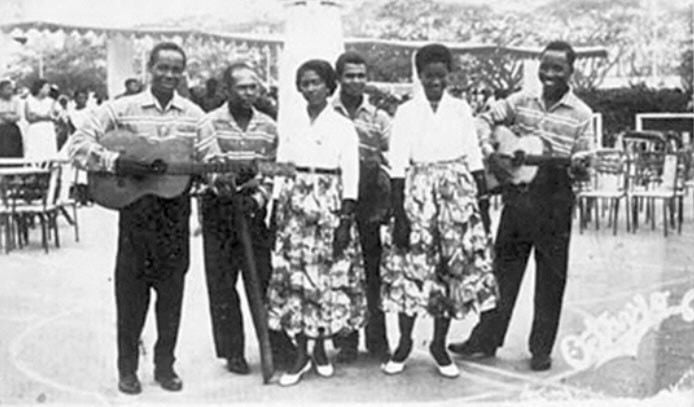
As the Portuguese colonial regime enforced assimilation policies designed to suppress African identities, pioneering groups such as Ngola Ritmos, founded by Liceu Vieira Dias, responded by blending Indigenous musical traditions with acoustic guitars and percussion. The result fed angolanidade, a distinctly Angolan musical identity that transcended ethnic, linguistic and regional divisions. And for a country fractured by colonial rule, music became more than a shared cultural language; it united people around the idea of a nation that did not yet formally exist.
Gourgel also sought to establish an intentional contrast within the exhibition, juxtaposing Portugal’s extractive colonial machinery and exploitation of Angola’s natural resources with the country’s revolutionary music. “The connection between the oil industry and revolutionary music in 60s and 70s Angola is a story of asymmetric warfare,” she says. “On one side, the Portuguese colonial regime used oil to finance a brutal military occupation. On the other side, Angolan freedom fighters used cultural capital such as Semba as one of the tools to build a unified national consciousness capable of breaking that occupation. Semba became the direct antidote to this dehumanization.”
What the liberative music of Semba and bands like Ngola Ritmos and Os Kiezos did was to remind Angolans that they were not cogs in a colonial extraction machine, but people with an enduring culture and a right to self-determination. Gourgel also emphasizes the distribution of this music. At the time, radio was one of the country’s most vital channels of communication, carrying news and information into homes across Angola. Small portable radios had become a fixture of daily life in many households. But beyond broadcasting the news, it amplified something far more enduring. Music became woven into the fabric of Angolan identity, serving not only as entertainment but as a means of resisting colonial oppression and preserving Indigenous languages and cultural traditions across generations.
In every portrait, Mwangola tries to frame this arc of nostalgia to the music while asserting that most of the younger generation does not imagine these tracks as political. And Gourgel chose to insert herself as this metaphor. “Bonga’s Mona Ki Ngi Xica is a staple of Angolan music and one of my favorites. I grew up listening to it, and I know how to sing it word-for-word in Kimbundu,” she recalls. “However, only after researching for Mwangola did I learn about the political connotation of the song. It translates to the Kimbundu language as ‘the child I leave behind,’ a poignant song of exile, longing, and resistance. He’s singing about having to leave Angola due to the war, and that Angola is in danger of being exploited by the West, something I didn’t know until creating this project.”
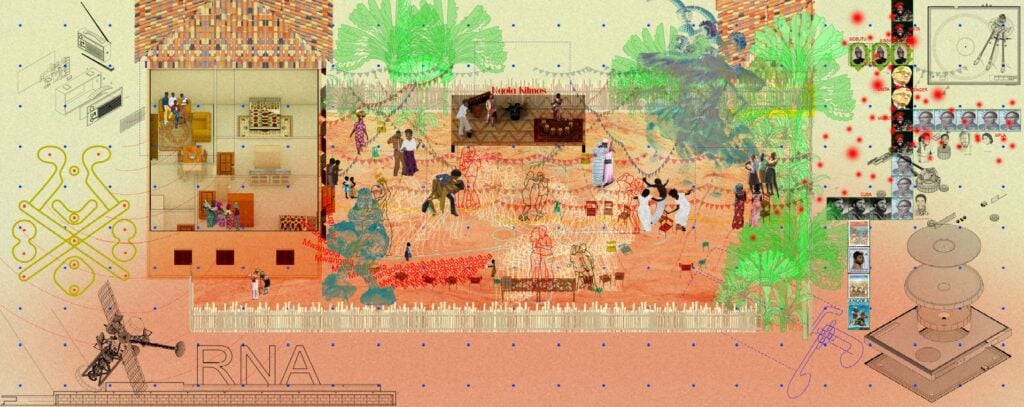
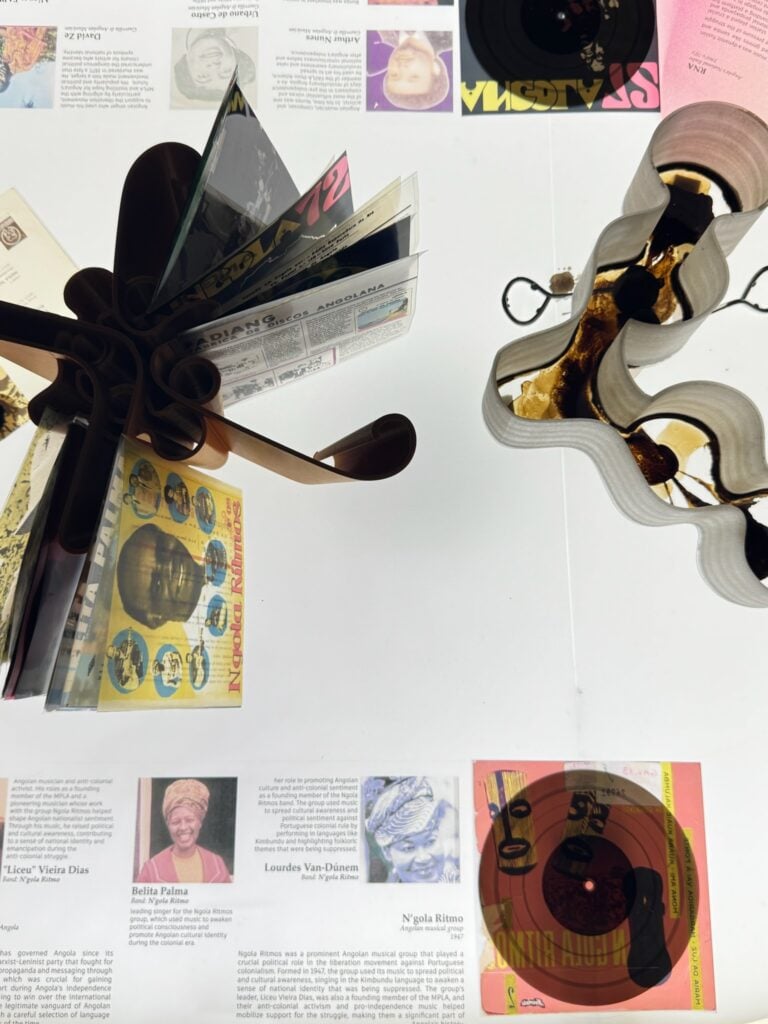
Her training shows in the installation itself, which arranges records, domestic objects and the radio network as a single spatial system, treating the living room and the backyard party as the infrastructure through which the music moved.
At the same time, Gourgel sees the project as a call to her generation. She is acutely aware of the contradictions that define contemporary Angola: many of those who once fought for the country’s liberation now occupy positions of power that, in her view, have failed the people they sought to free.
And she’s urging them to look toward the same cultural tools that sustained the independence movement. “We fight with music, we organize with dancing, we share the message,” she says. And this is what she hopes people take away from Mwangola, a better understanding of Angolan history, both politically and culturally. She hopes that those who experience it feel inspired and, from now on, enjoy Semba from memory and history. “I’m hoping that in the near future, Mwangola can evolve into different formats, allowing more young people and communities at large to engage with the content, without the limitation of a physically grounded spatial setup,” she says.
The exhibition Mwangola was on view at Avery Hall, Columbia University, New York, until January 2026.
For more on the archives shaping African creative memory, subscribe to Guzangs.