

Ewuresi Archer’s Complicated Love Letter to Ghana
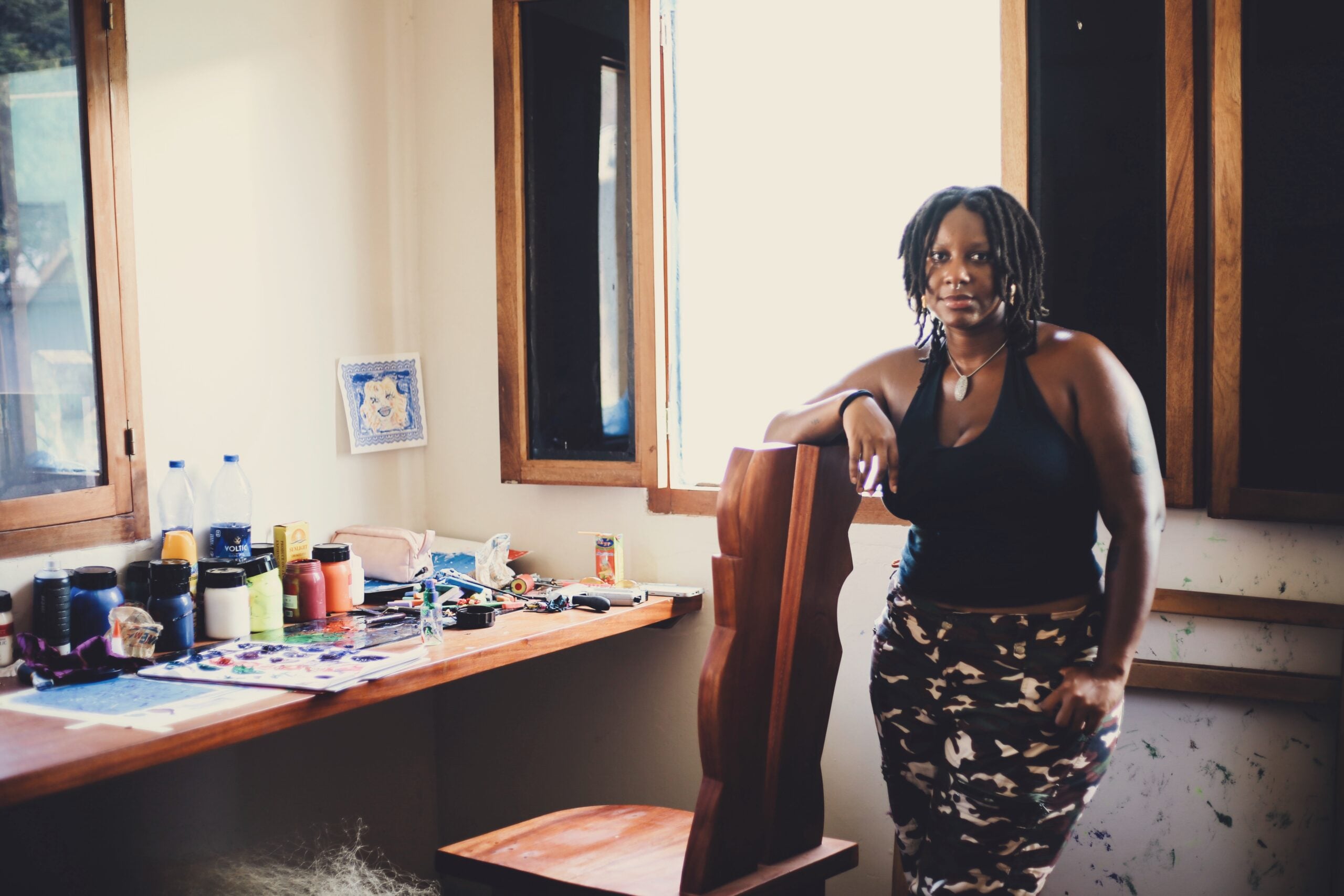
Before the exhibition A Love Letter With Teeth, Ewuresi Archer travelled to Busua, a fishing village in the Western Region of Ghana, where she spent an eight-week residency with Berj Gallery producing the new body of work. Her initial intention was to create works that would celebrate Ghana, a love letter to a country she has known almost all her life but spent only her early days in. But while at the residency, she encountered a number of things that changed the trajectory of her intent, including a conversation with a pedophile that left her in disbelief and the strange practice of a woman obsessed with burning her trash almost every day at odd hours.
These uncomfortable events have come to shape the arc of the exhibition, on view at Berj Gallery through June 7, 2025, and curated by Nana Yaa, who conceived the title after a series of vulnerable conversations with Archer.
Born in the United States but raised primarily in Ghana, Ewuresi Archer has long had a relationship to belonging shaped by movement and displacement. Though her mother gave birth to all her children in America before sending them back to Ghana, Archer’s first conscious experience of migration came in 2010, when her family relocated to Vermont. The transition proved difficult. Surrounded by unfamiliar culture and few people who looked like her, she struggled with identity and belonging, attempting to assimilate through small gestures that helped her fit in. Influenced by American culture, she no longer felt fully at home and found herself relearning aspects of Ghanaian identity. Archer describes herself as constantly “code-switching,” navigating the tensions of existing between two cultural realities while learning to embrace a more integrated sense of self. “When I’m in Ghana, I have a full Ghanaian accent and I feel more like myself. When I’m in the States, I’m performing. I have an American accent that I forced very early in college, but really it formed in Vermont during middle school, and I figured a way to hide it until it’s needed,” she says.
For Ewuresi, visiting Ghana again meant juxtaposing past memories with newer ones. Her earliest memories of Ghana, she recalls, were spent in a compound house in Dansoman, Accra, surrounded by aunties, uncles and a grandmother figure who helped care for her and her siblings. Their days were filled with school plays, birthday celebrations and church on Sundays, while quieter moments included reciting poems to relatives or sitting with her sister at a Liberian hairdresser’s salon, mesmerized by the braiding posters lining the walls.
She recalls simple rituals with fondness: watching Cartoon Network after her family finally got DSTV, eating waakye, buying roasted plantain with groundnuts and spending afternoons playing pretend house with neighbourhood friends.
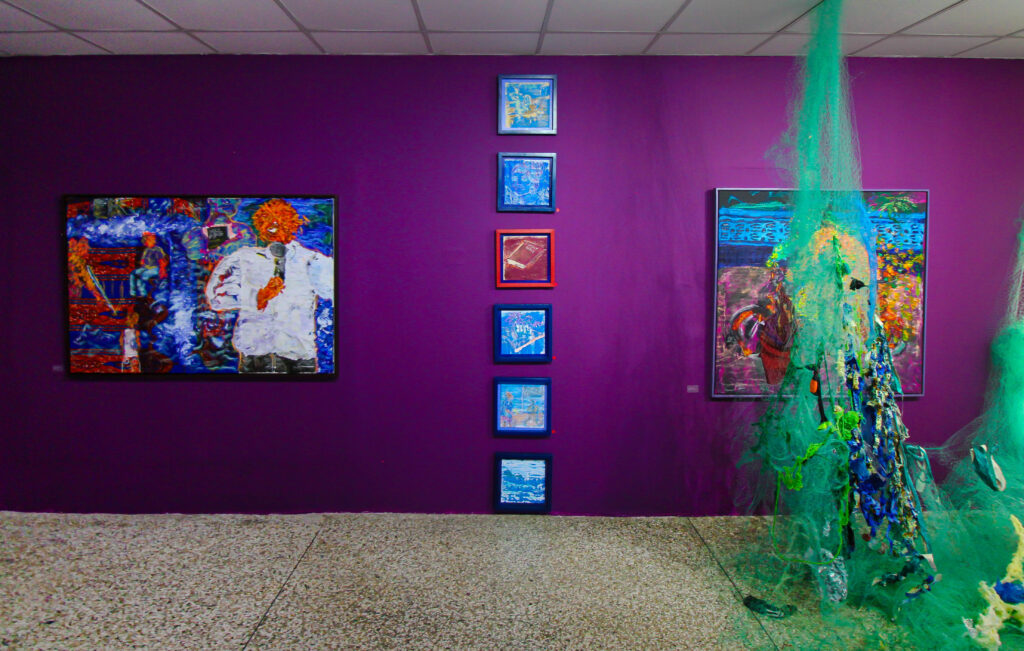
Looking back, she recognizes the nostalgia attached to those memories, but experiencing Busua felt different because she was older. During the residency, she realized there were colonial ideologies still very much in practice, like the conversations about African hair not being beautiful, or men being entitled and strange in the way they interacted with women. In one of her pieces, Too Many Flies Here, she describes an unsettling conversation with a man she came to understand as a pedophile, disturbed by how normalized his behaviour seemed to him, as he argued that pursuing teenage girls was common practice among fishermen in the community. “I felt distorted and like I was pulled into another realm,” she says. “Like, okay, where’s the camera? Cut the show. Pinch me and let me wake up, because this is nuts.”
And there was the case of a woman who burned trash at unpredictable hours almost every day. The smoke often made the space difficult to work in, forcing Ewuresi to spend much of her time at the beach instead. What disturbed her most, however, was the realization that while she had the privilege to leave, the conditions were a permanent reality for the locals sharing the compound, many of whom simply had to adapt whenever the burning began.
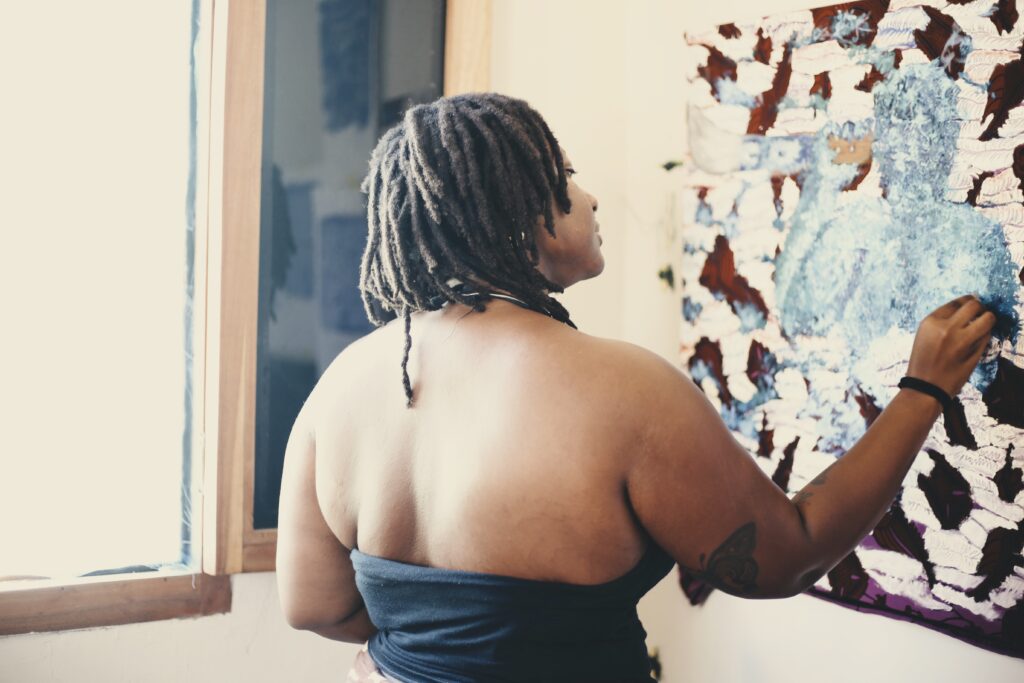
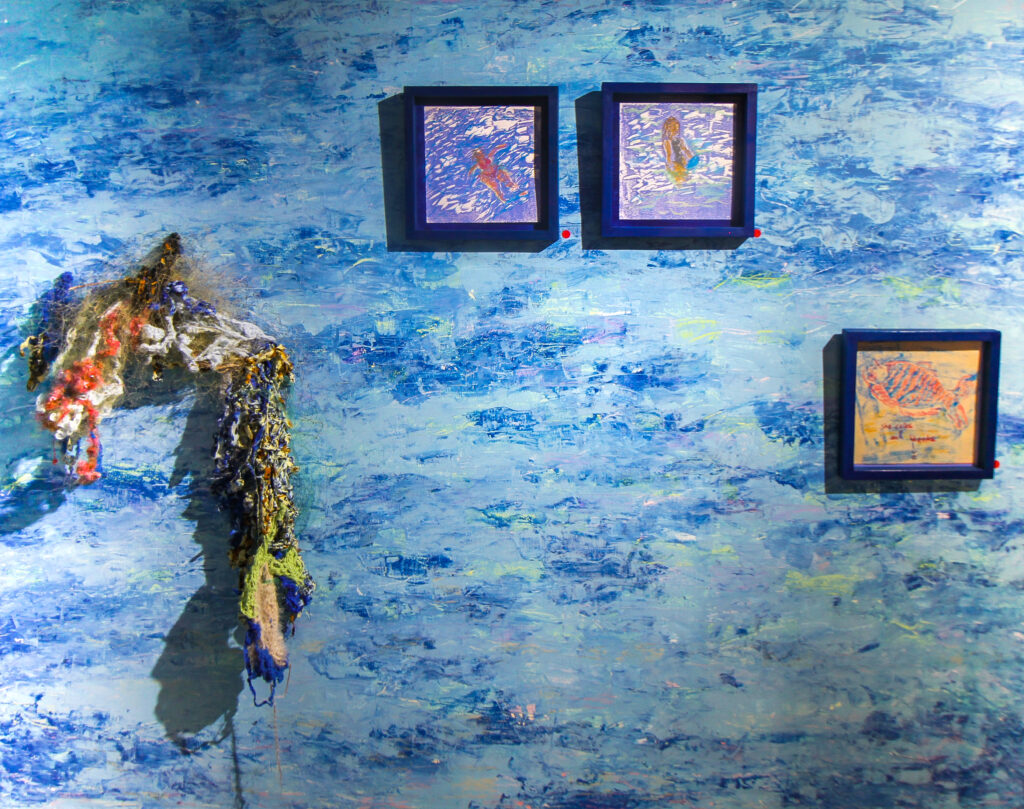
Ewuresi is an artist who works with discarded materials, and her work thrives through accumulation, using paint, pastel, yarn, batik and fishnet, which she layers across surfaces to hold a particular tension between discomfort and admiration. Speaking about her process, she says a piece only feels complete when it evokes exactly what she wants a viewer to feel: seduction, restlessness, anxiety and beauty existing simultaneously. Her approach to colour is often loud and confrontational, which she admits is one of her primary tools.
She is a deeply observant artist who allows herself to absorb both the small and obvious details of her surroundings, often translating them into sketches scattered across notebooks. During her residency in Busua, she intentionally took very few photographs, a decision encouraged by curator Nana Yaa, who pushed her toward greater abstraction. Without photo references, Archer found herself relying only on memory. “When the camera is involved, I find myself trying to depict exactly what I’m seeing,” she says. “Without that extra lens, I have no option but to really convey what I felt and saw.”
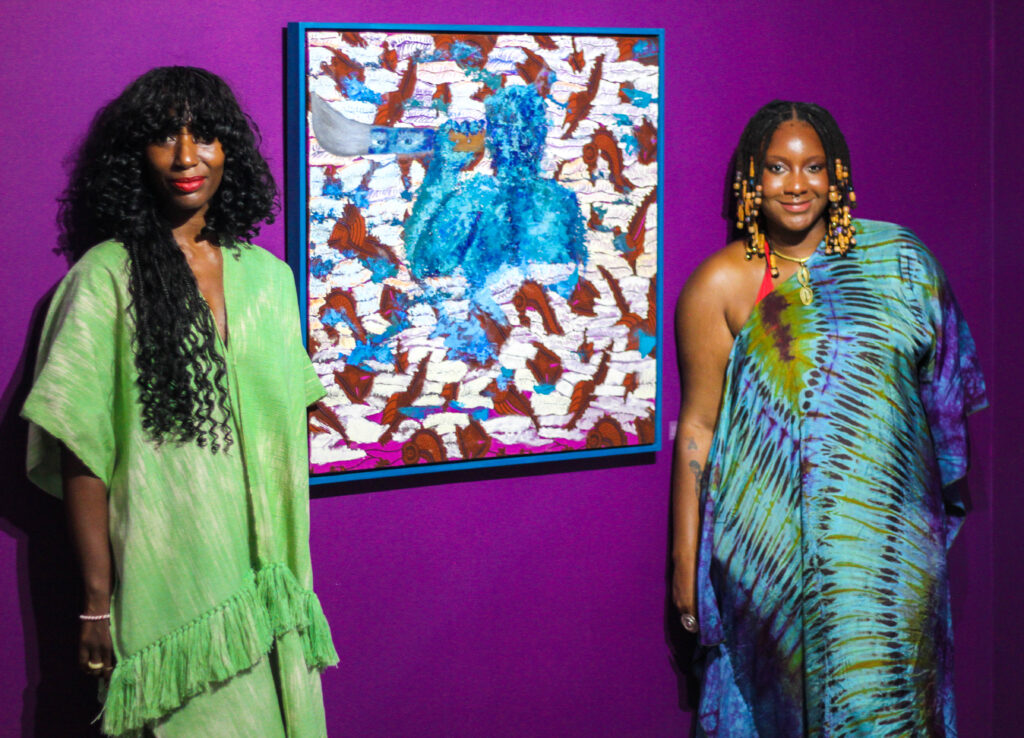
That looseness has become central to her visual language. Her paintings often begin as one thing before transforming entirely through layers of paint, scraping, rebuilding and distortion. Using a palette knife, she builds dense, textured surfaces that mirror the layered contradictions of lived experience. During the Busua residency, even accidents became part of the process. She would intentionally leave the paint bottle open to let it thicken overnight, allowing her to sculpt more heavily onto the canvas, producing textures she had not previously explored.
Improvisation, too, plays an important role. In one instance, she recalls using mascara to sketch a figure’s face after forgetting her pencil case. But perhaps most striking is the role intuition and spirituality play in her practice. Toward the end of her residency, she says, a dream involving the grandmother of her host at Sly Place inspired a series of spontaneous monoprints in the exhibition. The dream, she explains, felt like flipping through fragments of memory, eventually shaping how she documented the small moments that defined her time in Busua.
A Love Letter With Teeth is framed as exactly what its title suggests: a love letter that bites. Ewuresi is not offering romance without friction; she leans into the difficult truths that coexist with affection, acknowledging that love does not always arrive gently.
At its core, the work sought to ask difficult questions: Why does the West remain the benchmark? Why are local aesthetics so often undervalued? Yet experiences encountered during the making of the work complicated that celebration. Put simply, Ewuresi is saying, “I want us to celebrate ourselves and undo the colonial ways that have been forced onto us. Let’s decolonize ourselves.”
Related