


Next week, the last dedicated African art sale at a major international auction house takes place in London. What happens in that room will tell us something about what the market built over the past decade, what it’s quietly losing, and what comes next.
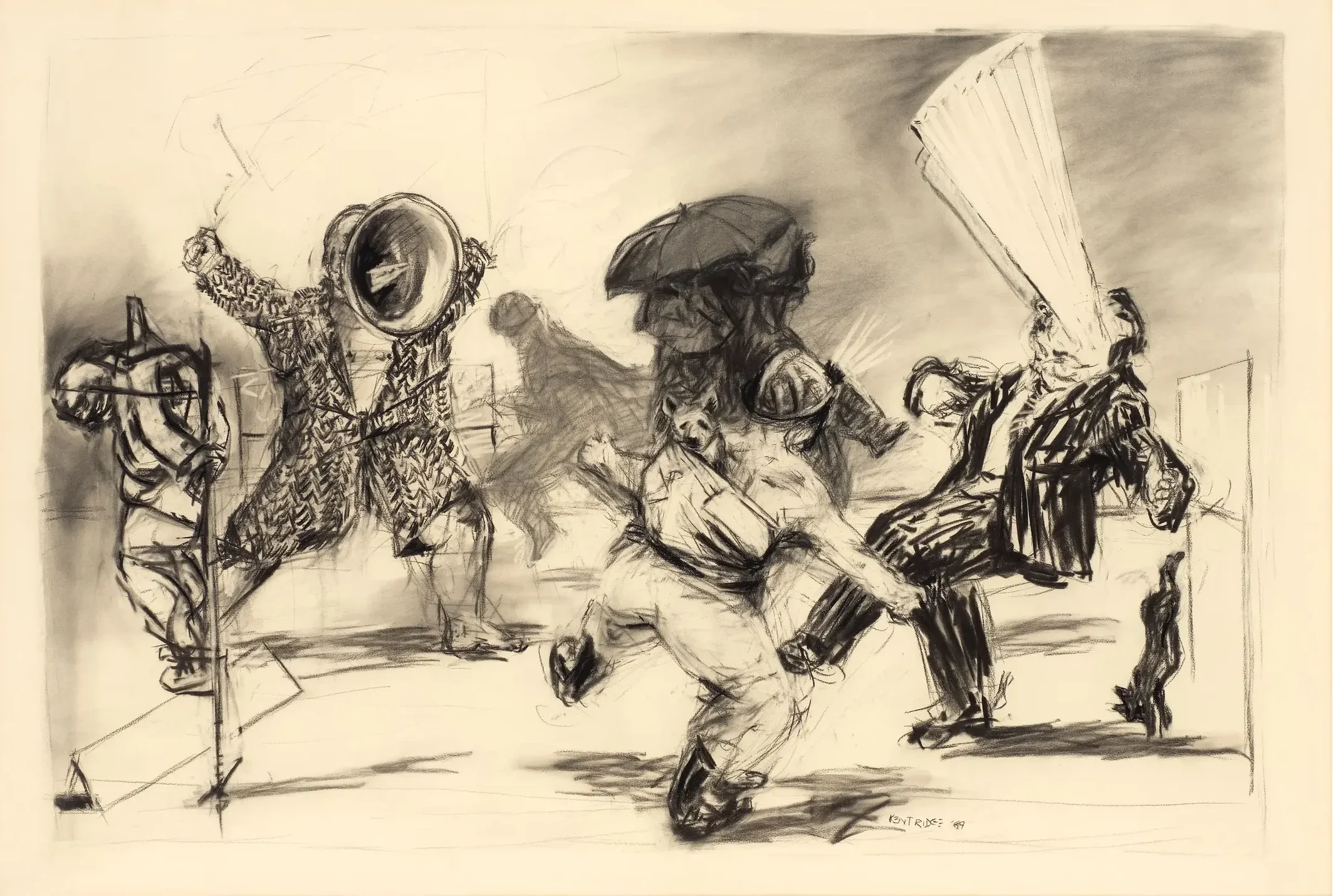
On March 19, Bonhams holds its Modern & Contemporary African Art auction at New Bond Street. The lots tell a particular kind of story. There’s William Kentridge’s Negotiations Minuet, a large-scale charcoal drawing from the late 1980s — all motion, brass instruments, umbrellas, and the charged choreography of South Africa’s transition years, estimated at £200,000 to £300,000. There’s a Magdalene Odundo vessel, smoke-fired and immaculate, the kind of form that collapses the distance between craft and fine art. There’s an Enwonwu-era abstraction vibrating with colour. And a figurative Bell painting grounded in landscape and body, saturated with the earthy palette of mid-century South African modernism.
These works span half a century and several thousand miles of the continent. That range is precisely the point. Dedicated sales don’t just move objects. They build context.
After Sotheby’s dissolved its Modern & Contemporary African Art department in April 2025, folding African works into general contemporary auctions, and Christie’s never having established one, Bonhams is now the only major house maintaining a standalone programme. The question isn’t whether African art belongs in evening sales alongside Picasso and Brancusi. Lisa Brice’s After Embah answered that definitively when it sold for £5.4 million at Sotheby’s in March 2025, more than double her previous record. The question is what gets lost when the dedicated platform disappears.
Sotheby’s made a market argument, and the numbers support it. Hannah O’Leary, who built the department from 2016 and is now Senior Advisor, has framed the integration as a sign of maturity. When a single painting in a general sale exceeds the total of your best-ever dedicated auction (£4 million, October 2019), the commercial logic is hard to dispute. Julie Mehretu’s $10.7 million result at Sotheby’s New York in November 2023, the highest price ever achieved for an African-born artist at auction, happened in a Contemporary Evening slot. The prestige room, not the specialist one.
But the counterargument isn’t sentimental. Dedicated sales created curatorial context. They grouped 70 to 120 works by artists at different career stages, introduced mid-career names to collectors who came for the catalogue, and built specialist knowledge over time. CADA’s decade-in-review analysis, published in February, was direct: when Sotheby’s ended the programme, the market didn’t just lose a venue. It lost a validator.

The broader market data tells its own story. African art auction sales grew from $33 million in 2016 to $87 million in 2022 — a 160% increase. In 2024, that figure fell to $43.9 million, a correction far steeper than the broader art market’s. In 2025, sales recovered to approximately $70.5 million. Transaction volume actually grew even during the downturn: more buyers, at lower price points. The correction separated collectors from speculators. And one structural detail stands out — in 2024, female artists accounted for 52.8% of African art auction lots, a first. Mehretu, Brice, Njideka Akunyili Crosby, and Marlene Dumas dominate the upper brackets. In a global art market where male artists hold the vast majority of top records, the African art segment is doing something different.
Meanwhile, institutions are moving faster than the commercial infrastructure. Centre Pompidou’s Paris Noir added 40 African and diaspora works to its permanent collection. Tate Modern staged a seven-month Nigerian Modernism survey. The Met opened new African art galleries. Koyo Kouoh, the first African woman to curate the Venice Biennale, left a fully conceived exhibition, In Minor Keys, before her death in May 2025. It opens in Venice on May 9 with 111 artists and collectives. The institutional layer is expanding at exactly the moment the auction infrastructure is contracting.
That tension is what makes the March 19 sale worth watching. Bonhams’ recent results suggest the dedicated format still draws committed buyers: the March 2025 sale achieved £1.6 million with a 97% sell-through by value. These aren’t evening-sale numbers, but they represent a functioning market with consistent demand. Bonhams specialist Helene Love-Allotey has noted a centre-of-gravity shift toward 20th-century modernists, and the March catalogue reflects that — two-thirds of the lots are by artists born before 1940. The department, founded by Giles Peppiatt in 2007, now maintains offices in London, Johannesburg, and Lagos.
Integration elevates the top. Dedicated sales develop the middle. The question the African art market faces in 2026 is whether anyone is building the bottom — the archives, the scholarship, the regional institutions — that will determine whether this decade’s gains become permanent or cyclical.
The auction is March 19.
Next Read: Not Every Lot Sells: What Bonhams’ African Art Auction Really Reveals