


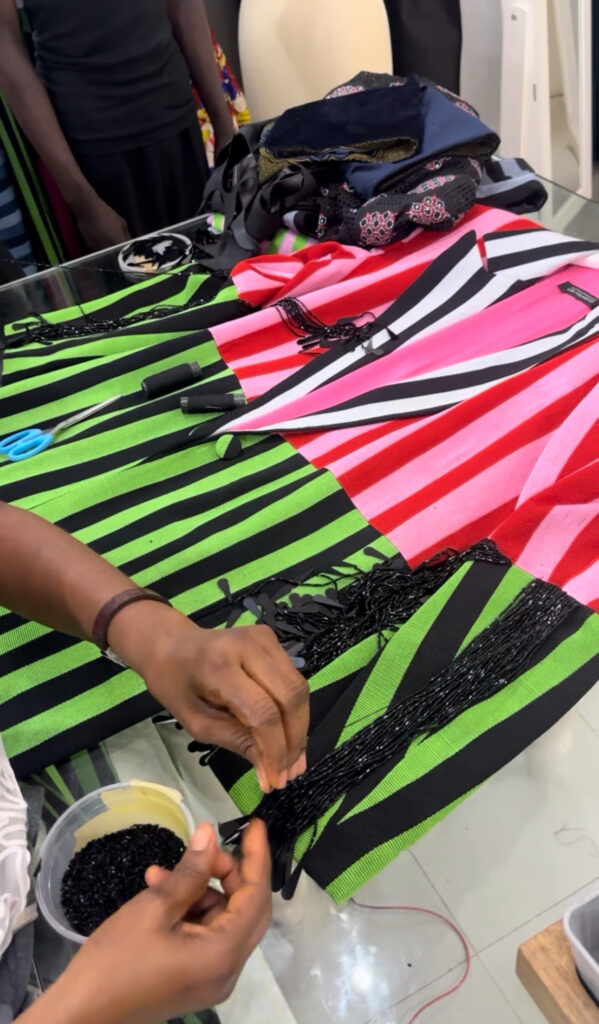
Two women stood side by side at a worktable in Lisa Folawiyo’s Lagos studio, threading beads onto a dress from the upcoming collection. I had come for a model casting — I was writing about the designer’s 20th anniversary show, and the studio carried the particular weight of that occasion: racks being moved, fittings happening in corners, the low hum of concentration that precedes something significant. But I kept coming back to that table.
One row of beading held perhaps 200 to 300 beads. And that was just one line. The full dress would carry closer to 2,500 or 3,000, each one attached by hand, each row measured, aligned, secured. I have since forgotten the name of the piece. I remember its surface.
For anyone who has scrolled past a price tag on an African fashion garment and felt the familiar resistance, the answer was sitting quietly on that table.
The conversation about price in African fashion usually begins online. Under runway photos and campaign images, the same comment appears again and again: “It’s beautiful, but too expensive. Stunning, but not for our wallets, or maybe we are not the target audience.”
It is an uneasy tension to witness. African fashion is having its global moment: designers showing in Paris, stockists in London, collaborations with international retailers blooming, and editorial after editorial positioning African brands as the future of luxury. Yet across the continent, many consumers feel priced out of the very brands that carry their cultural language. The frustration is legitimate. So is the economics dividing both parties, offering little purchasing power to consumers while forcing designers to price their work high enough to stay in business.
What follows is an attempt to trace that divide. Not to defend or indict, but to open the anatomy of cost.
The Anatomy of a Dress
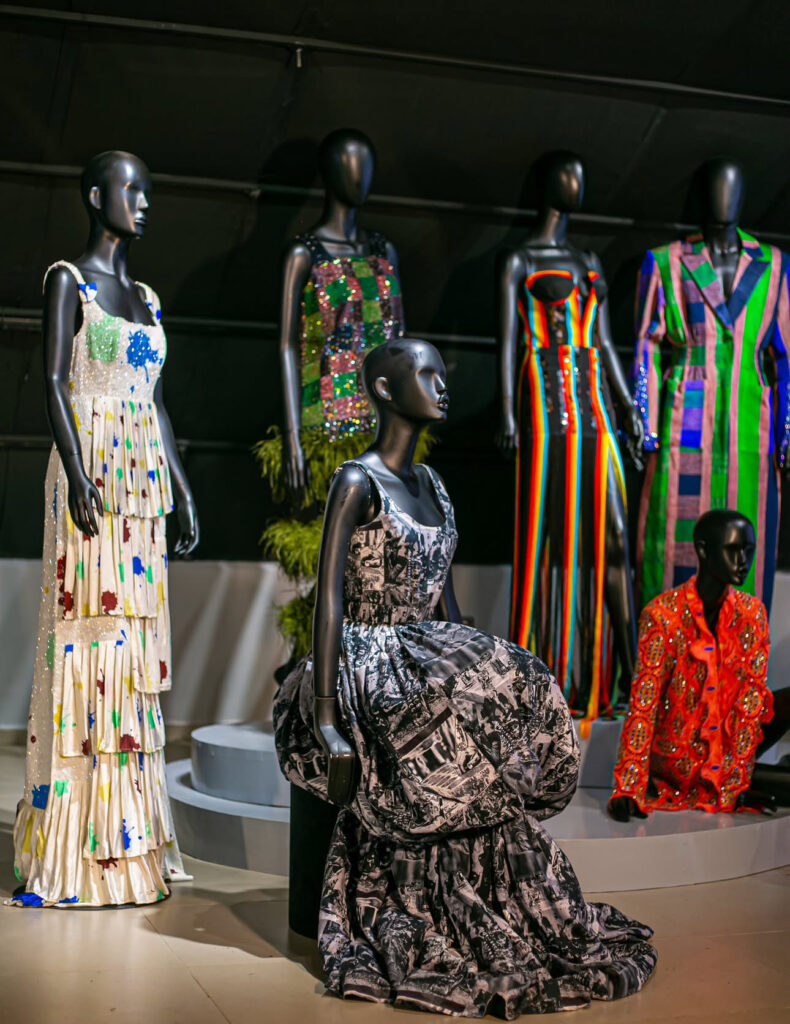
A dress rarely begins with a price tag. It begins with an idea, a sketch, a reference, a memory. Then it moves through fabric sourcing, sampling, fittings, alterations, production. In many African countries, it moves through unstable electricity, imported machinery, inconsistent supply chains. It passes through the hands of pattern cutters, beaders, tailors, finishers — often highly skilled artisans whose labour is neither automated nor outsourced at scale.
Unlike mass-market global brands that produce in the tens of thousands, many African designers operate on small production runs. Fifty pieces can be ambitious. Twenty is common. Without the economies of scale that drive down unit costs in fast fashion, each garment carries a heavier share of overhead: studio rent, generator fuel, staff salaries, logistics, packaging, marketing. In Nigeria, for instance, the cost of powering a studio for a single day can rival what larger international brands spend per unit in entire factory systems elsewhere.
Then there is fabric. While Africa is rich in textile heritage, the infrastructure to produce high volumes of premium fabric locally is limited. Designers often import silks, fringes, organza, taffeta, specialty cottons; duties and shipping fees follow. Even locally produced textiles — handwoven aso oke, kente, raffia, adire — carry labour-intensive processes that resist mechanisation. A single handwoven strip can take days. Intricate beadwork can take weeks.
Brand plays its role too, not simply in the superficial sense of markup, but in the invisible architecture that sustains a label. Fashion shows, lookbooks, campaigns, showroom placements, retailer margins: these are not indulgences but entry points into global markets. When a dress retails at a figure that prompts online debate, it often reflects not only its material reality but the ecosystem required to position it competitively on an international stage.
Back at that worktable, watching two women shape a garment bead by bead, the price of the thing felt less like a number and more like an accounting. The manpower. The patience. The repetition that never shows in the final image. What makes a piece distinct, what makes it beautiful and separates it from mass-produced clothing, is often the very thing that complicates its cost.
Following the Money
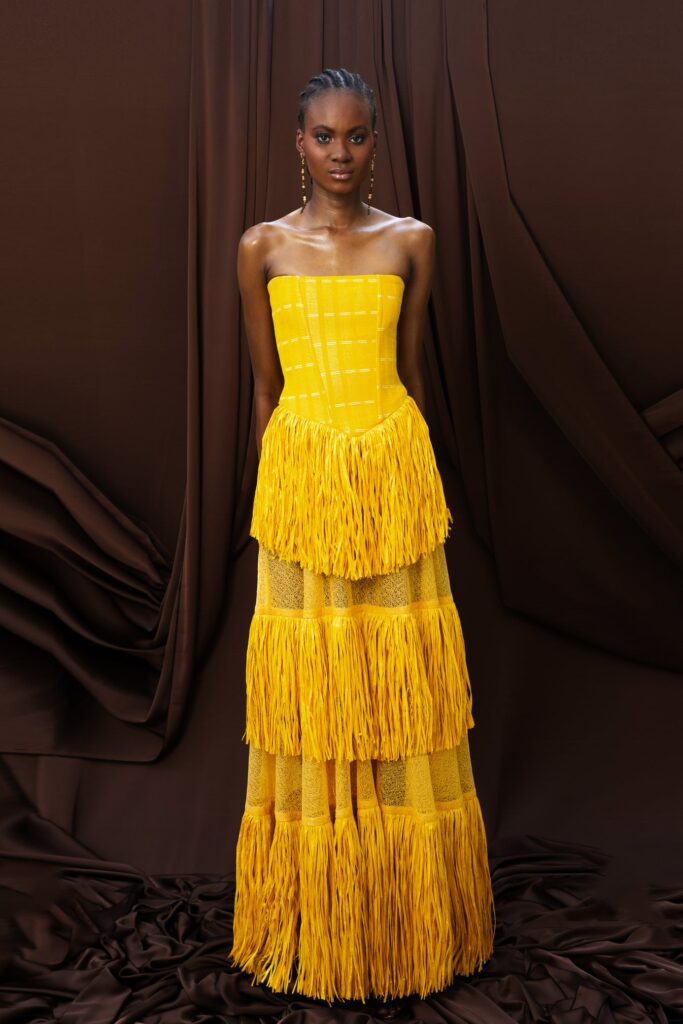
Take the Kilentar Ano Layered Raffia Dress, retailing at approximately $1,200. At first glance, it feels steep. But trace that number backwards.
Raffia begins with a farmer harvesting palm fibres, then a weaver softening and shaping it. That process alone absorbs time and skill: roughly $150–$200 for raw material sourcing and weaving. Then comes construction, the tailor assembling the base, the artisan layering and sculpting the raffia, the finisher refining edges. In a small-batch studio, labour can easily account for $250–$350. Add pattern development, sampling, fittings, studio rent, electricity, staff salaries. If the piece is sold through a retailer taking up to 50%, the brand may only receive about $600 from that $1,200, from which all production and operational costs are covered.
Now compare that to a fast-fashion alternative selling for $60. The fabric is likely synthetic, machine-made at scale. Thousands of units are produced in one run. Labour per garment may cost only a few dollars. Bulk production compresses material, manufacturing, and shipping costs. The brand profits from volume, not intricacy.
Place both dresses side by side and follow the money through every hand that touches them. One garment distributes cost across farmers, weavers, artisans, and a small studio ecosystem. The other reduces cost through scale and speed.
The price difference is not only about design. It is about structure, and what, and who, that structure chooses to sustain.
Because beneath every price tag is a series of decisions: how many artisans are paid, and how fairly; whether fabric is sourced ethically or cheaply; whether production is rushed or meticulous; whether growth is organic or subsidised. These choices shape not only the garment but the industry it contributes to.
The question, then, may not simply be why African fashion is expensive. It may be what it costs to make it otherwise.
If African fashion is to be both globally respected and locally supported, the conversation around price must move past assumptions. It must account for context. And it must ask, honestly, what we believe a dress and the labour behind it is worth.
This is the second piece in The Value Chain, Guzangs’ ongoing series on how African fashion builds and retains economic power. Read the first piece: The Value Chain: From Commodity to Cultural Capital