


The Cloth That Carries the Church
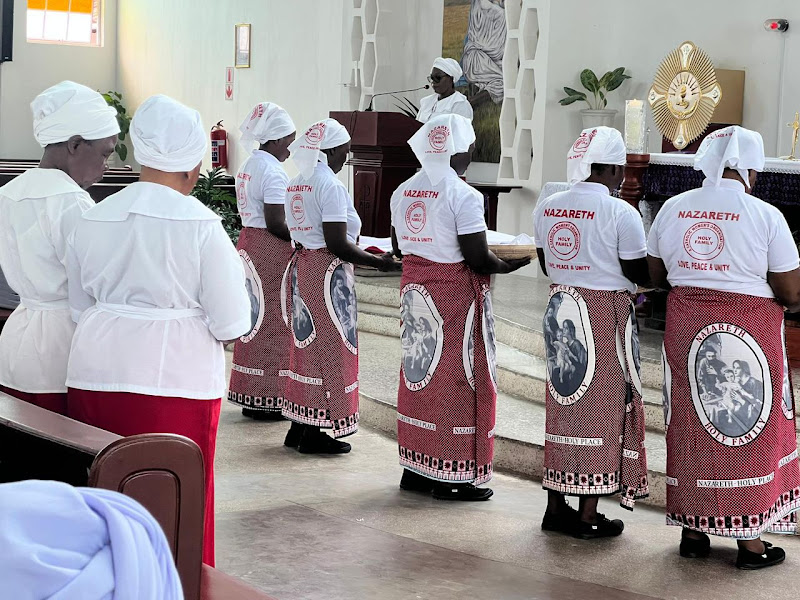
Our spot in the church is not assigned and has never been discussed. It is simply where we go, the way families claim their corner of a parish. Centre to the altar, close enough to the choir that the singing finds you before the service begins. That spot has been ours my whole life, and for most of it nobody in our family was really looking. We were present the way children are present, absorbing without cataloguing.
Then one Sunday something shifted.
It might have been the light coming through the stained glass at a particular angle, catching the fabric all at once. It might have been age, and the way the eyes work differently once questions have started forming. But looking across the women seated around us that morning, something that had always been there refused to stay in the background.
The chitenges. All of them, together, and none of them the same.
Geometric prints in deep indigo and burnt orange beside bolder, lighter hues. Church-issued fabric stamped with the crests of the lay groups, the colours regulated, the motifs deliberate. And folded in among the official cloth, the personal choices. A wrapper with a cross woven into its border. Another scattered with doves surrounding a saint, the birds so small you had to be close to see them. Another printed with Mary and Jesus, worn during Advent and Christmas seasons, because it still meant something.
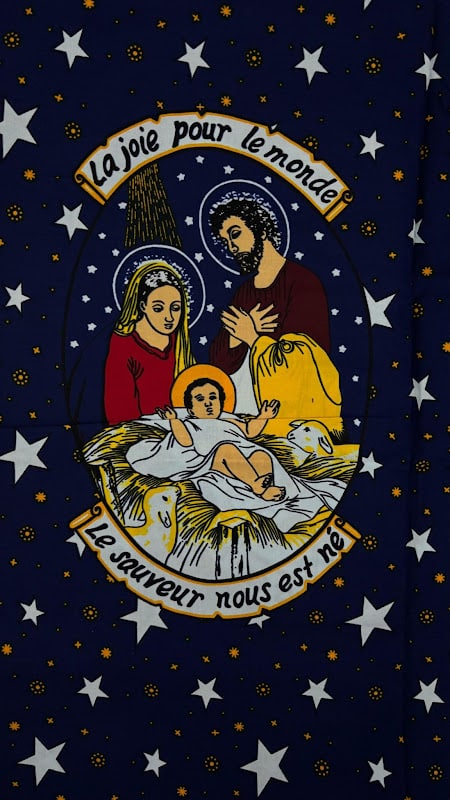
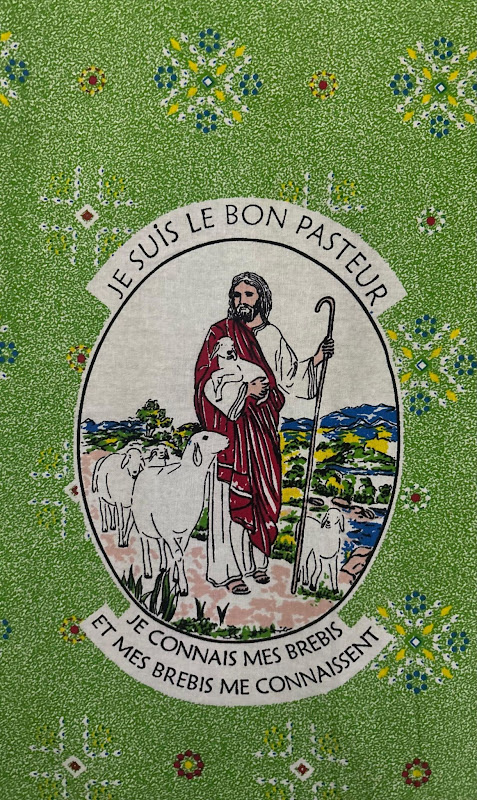
Devotional prints sold for personal wear. Left, a Nativity cloth lettered in French, “La joie pour le monde,” joy for the world. Right, a Good Shepherd print, “Je suis le bon pasteur.” French-language cloth moves into Zambian markets through regional trade routes (Lusaka, 2026)
The chitenge lives most of its life outside the church. It carries babies, covers market tables, works as an apron and towel, and comes out of the wardrobe when a visitor arrives, and someone needs to look proper. The fabric is technically unisex, but in Zambia it belongs most visibly to women. In church, the same cloth is given different work.
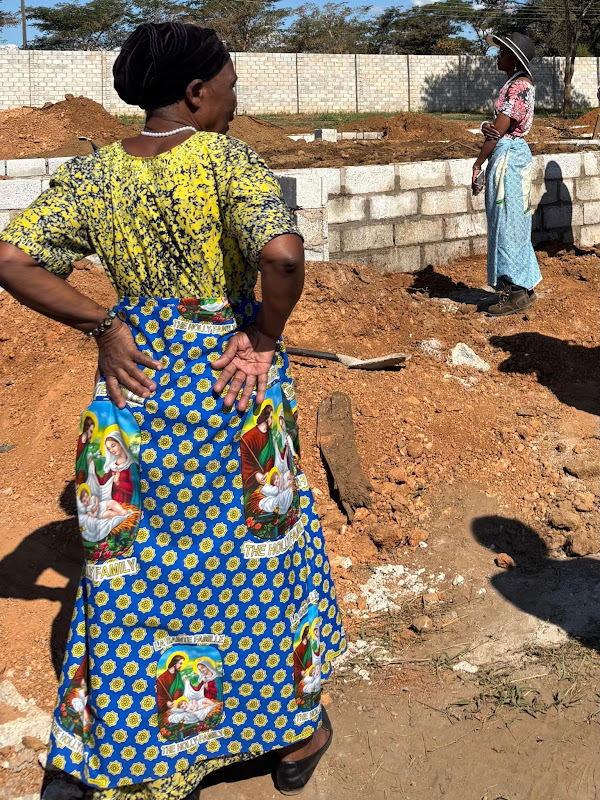
The women in these pews are often referred to as mothers of the church, and the title is earned in labour.
In Zambia, as across much of southern Africa, women fill the congregations, run the guilds, cook for funerals, and raise the money, while the ordained ranks above them stay male. The chitenge sits at the centre of this visible life, and it carries an expectation of modesty, the covering of legs and thighs in public and above all in church. The expectation is older than the state’s interest in it, though it hardened after 1991, when Zambia declared itself a Christian nation. Inside the church, the chitenge approaches the obligatory. A woman who arrives in clothing judged insufficient may find one offered to her by an usher before she reaches her seat.
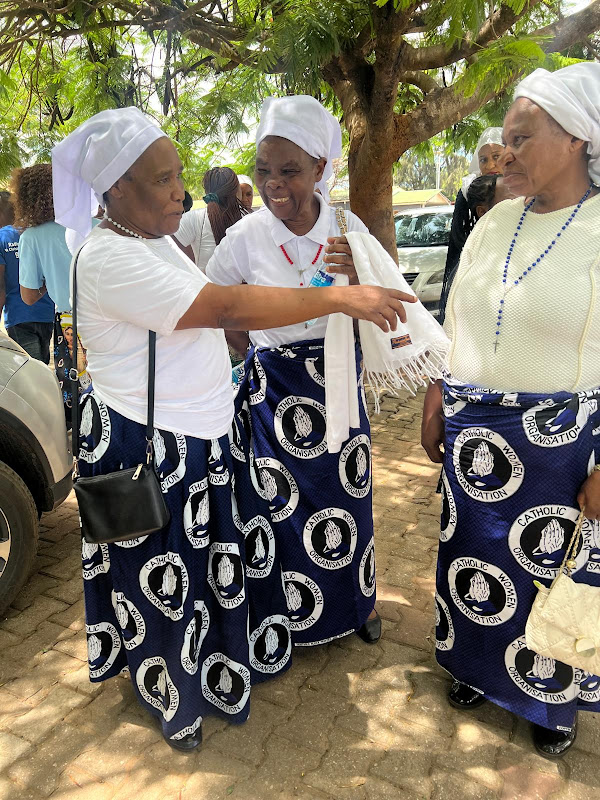
For the Catholic Women’s League (CWL) and its counterparts across Zambia and southern Africa, uniform standards are set at the institutional level, written into constitutions and diocesan guidelines. Enforcement is another matter. The leadership makes the rules; the day-to-day policing belongs to group leaders and to the steady pressure of women among themselves. Most Zambian families would recognise the choreography. A daughter arrives for Sunday Mass in a skirt deemed too short and finds her mother already reaching for a spare chitenge before they leave the car. An aunt produces one from her bag with a look that requires no words. The standard holds because every woman in the congregation already knows it.
Who, exactly, has the authority to declare a woman correctly dressed?
The answer is less official than you might expect. In many lay groups, it is rarely the priest who notices a hem that falls short or a blouse in the wrong shade of white. It is the senior women, the ones who have worn the uniform longest, who laundered it on the morning of their own mothers’ funerals, who know its history in their bodies. They correct with a glance, sometimes with a hand that reaches across to adjust a collar during Mass. There is no handbook. The newcomer learns by being watched.
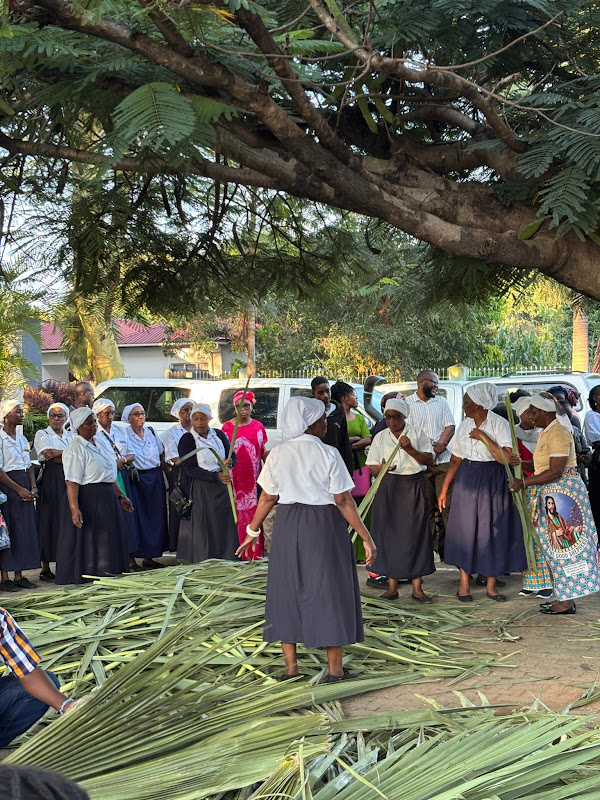
What is striking is that the women themselves rarely describe this regulation as restrictive, even when it presses hardest. The uniform creates the conditions under which a woman who might be overlooked at home, at work, in a society that has not always made room for her, becomes spiritually visible. In uniform, her body is reoriented toward sacred authority. She carries the institution with her into the pew.
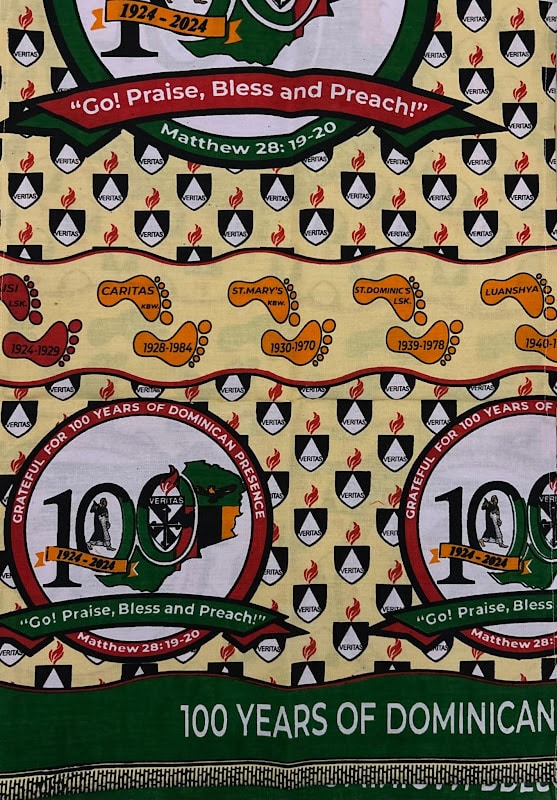
The uniform itself has changed little. Certain prints have come and gone, and that pattern repeats across the region. In southern African church women’s organisations, colour does theological work. White signals purity and readiness for sacred encounter. Blue, in several traditions, attaches to prayer and healing, and in some churches to the laying on of hands. Many of these assignments originated in visions and dreams; committees came later, if they came at all. To alter the colours is to risk disturbing a cosmological order, and everyone involved understands that a dress code is the least of what is at stake.
Ask women what the uniform gives them that ordinary clothes cannot and the answers skip past appearance entirely. The word that recurs is armour. Permission comes close behind. Membership in a church destined, in the League’s own language, for co-responsibility, charity, evangelisation, and the transformation of society. The history underneath that language is severe. Mission churches once regulated the clothing of African women precisely to confine them to modesty and domestic service, to train them, in the vocabulary of the colonial project, into respectable Christian domestics. The CWL’s founding generation knew this history at first hand. Victoria Kasonde, Margaret Chisanga, Anna Chipimo, Dorothy Konoso, and Sister Mary Xavier Walsh organised the League in 1964, in the same political season that Zambia claimed its independence, joined by a sixth founder, the parish records remember only as Mrs Lengalenga. These women had watched African men rise to ministerial positions while women’s standing went unaddressed. The uniform they chose was a rebuttal.
What happens when a woman cannot afford the full uniform? This is the question the groups are least comfortable answering aloud, and the one that most honestly reveals their values. Most Catholic women’s groups admit women in stages, allowing participation while a member saves toward the complete set: fabric, blouse, head covering, sometimes a badge. Group purchasing brings the price of the chitenge down. Still, the incomplete uniform marks its wearer, quietly, as still becoming. Everyone in the pew can see who has the full set, who has the newer fabric, who has borrowed, who has improvised. The cloth tells the truth about money. A woman may wear the same chitenge for years while she saves, and others help where they can, a solidarity the group rarely names and almost always practices.
The cost of entry is lower than outsiders assume. It also adds up quickly once every piece is counted. Two metres of chitenge, the standard cut for a wraparound skirt, sells for around K100 at market rate, which makes the fabric the manageable part. The uniform is rarely just fabric. By the time a woman has sourced the blouse, the head covering, and any required badge or sash, the total stretches well past what a single purchase allows. This is why the staged approach exists, and why the women who have completed the set tend to remember exactly how long it took.
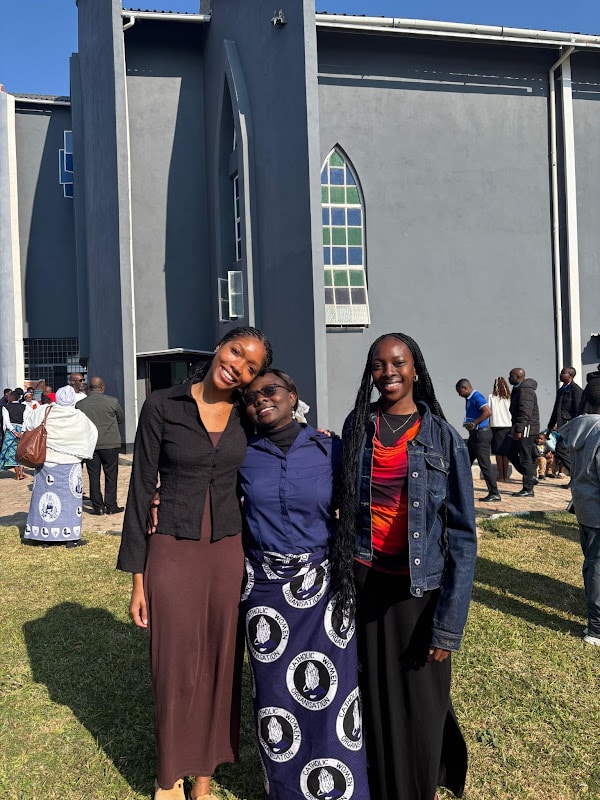
Kamwala, the Lusaka shopping district where most shops are owned by traders of Indian and Arab descent, is the most visited market for chitenge. The fabric comes in pure cotton, wax print, cotton-wax blends, nylon, and polyester, in cuts from the standard two metres up to six for larger garments or shared purchases. My own family tends toward the latter. A full six-metre length bought together and divided evenly among my mother and her sisters, each walking away with enough for her own wrap. The cloth becomes a small act of collective economy before it ever becomes a garment.
Outside Kamwala, a quieter retail ecosystem serves a more particular need. Religious shops specialise in denomination-specific chitenge, stocked with the insignia, colours, and patterns of individual lay groups and Small Christian Communities. The Roman Catholic Church, the United Church of Zambia, and the Seventh-day Adventist Church all have their fabrics in these shops, and where a parish does not stock its own, they are the most reliable way to get the uniform exactly right. Nothing about them is glamorous. The women who rely on them know which stall has the proper print, which seller will call when a new consignment arrives, which fabric fades quickly, which one wrinkles, and which shade is close enough to pass without comment. That knowledge travels the same way the uniform does, from one woman to the next.
On Sunday mornings, when the women rise for the hymn, the fabric moves before the music does, a low rustle through the pews. Cloth gathered at the waist, pressed by hands that know exactly what they are doing. Our spot is where it has always been, centre to the altar, close enough to the choir that the singing finds us first.