


The Ceiling Was Always a Dress
In 1959, conservators at the Alhambra in Granada carefully removed a slightly displaced piece of wood from the ceiling of the Hall of Comares. On its reverse were seven lines in Arabic indicating how parts of the ceiling should be coloured. A craftsman’s practical reminder had survived for centuries out of sight.
Karim Adduchi came across an account of the discovery while researching the palace’s archives. “They left not just an architectural legacy, but a handwritten mark straight from their own hands,” he wrote in answers to Guzangs received in October. He found himself wondering about the people behind the building: “How did they work? What was their day-to-day routine, and who taught them?”
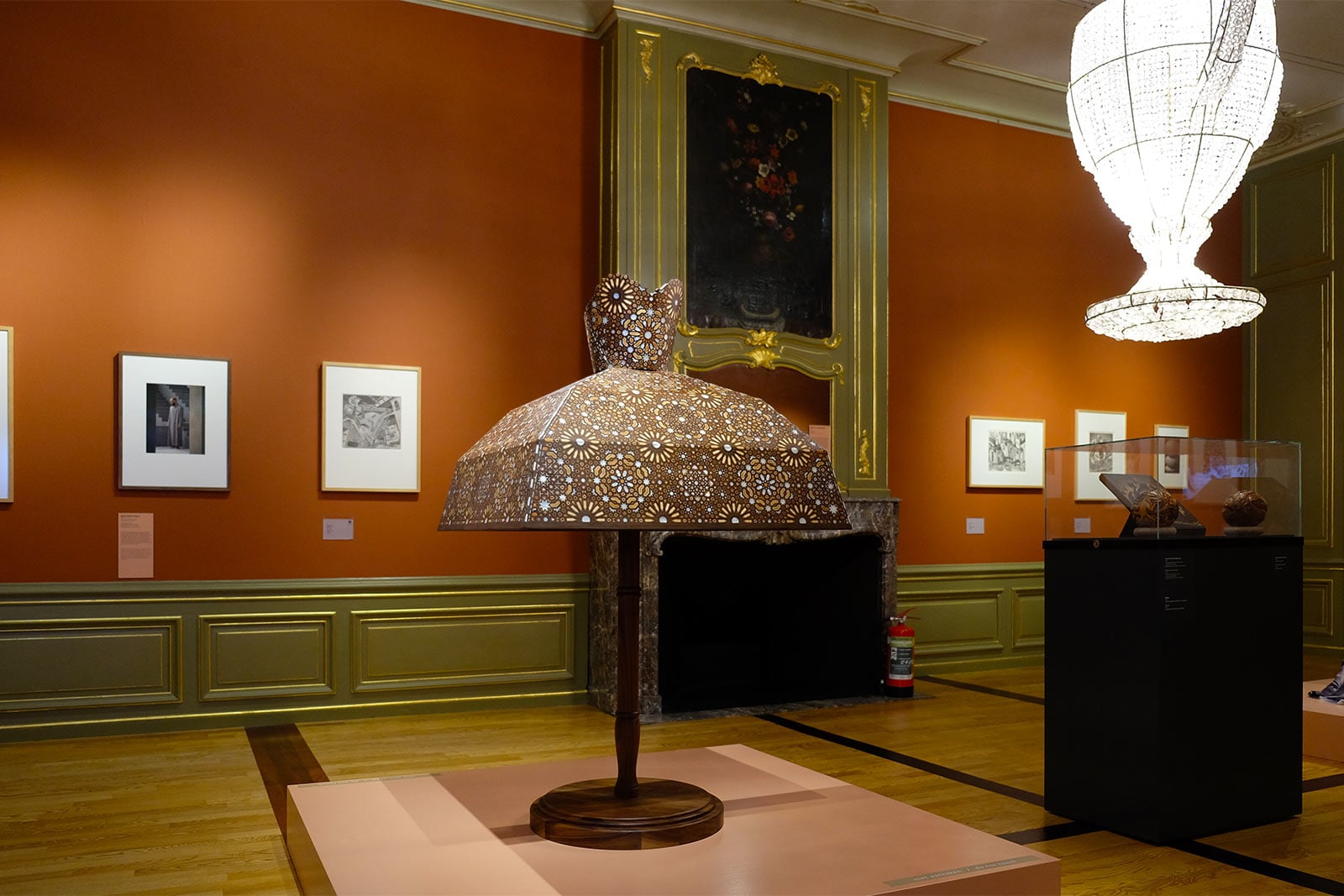
That note helped shape She Is the Seven Skies, a wooden sculpture with a fitted bodice and a broad, domed skirt. Made with artisans working through Turquoise Mountain in Amman, it carries the ceiling’s geometric patterns across a rounded silhouette. Photographs of the installation in The Hague show it raised on a single wooden pole above a low plinth, the skirt faceted and flecked with mother-of-pearl. Adduchi describes it as “floating like fabric frozen in a snapshot of motion”.
Adduchi was born in Imzouren, in Morocco’s Rif, and grew up in Spain before studying fashion at the Gerrit Rietveld Academie in Amsterdam. Moroccan materials have long been part of his practice. A dress in his collection She Has 99 Names was made from an old Amazigh carpet he found in Tangier. He calls the Alhambra “the place where my dual cultures, Spain and Morocco, beautifully converge and reflect one another”.
In his project notes, Adduchi describes four months of research with the palace’s historians, conservators and other specialists. He studied the poetry alongside the construction, and photographed the site on 35mm film. His account extends beyond the archives to the gardeners and security staff, and even the cats living in the grounds.
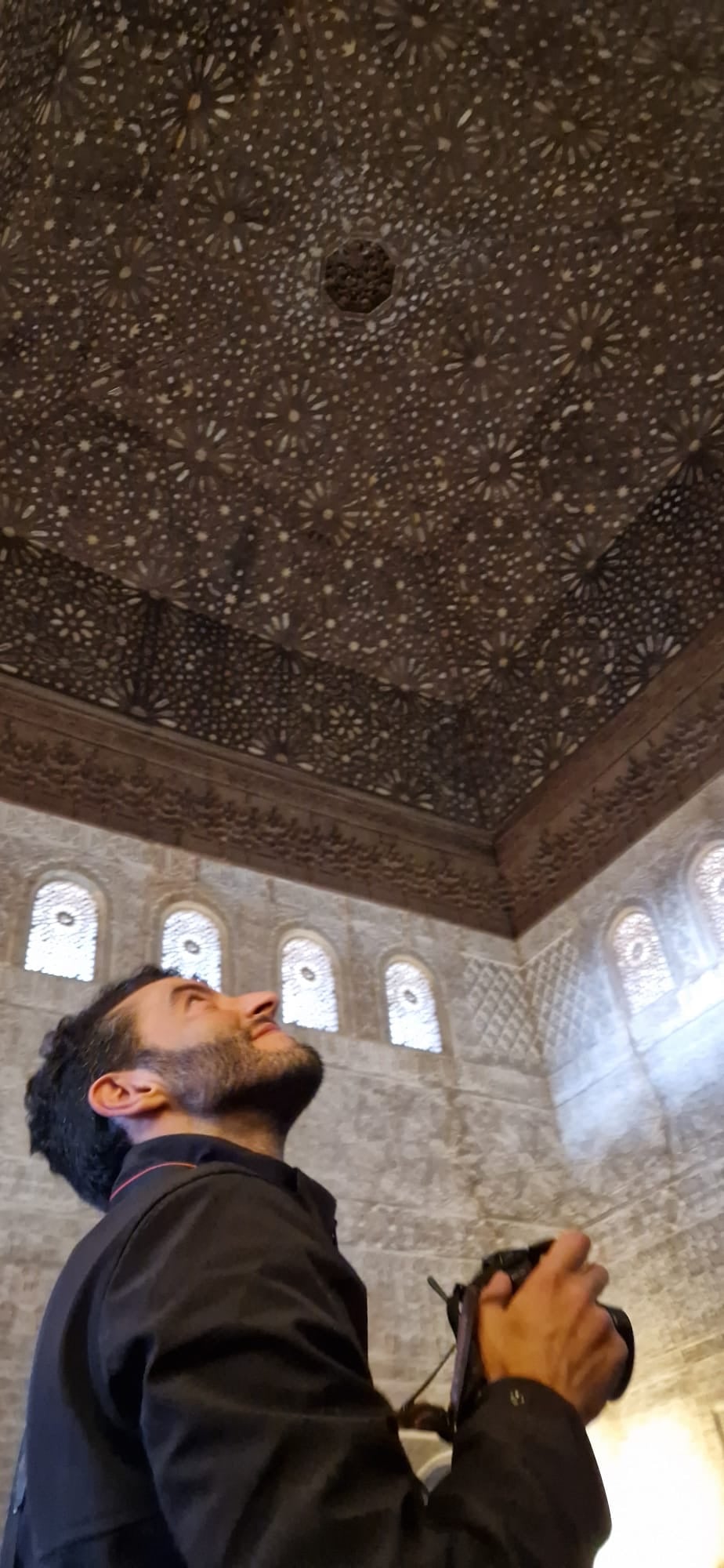
His research came to centre on the Comares ceiling. The fourteenth-century hall was a throne room, where the sultan received visitors beneath a composition of 8,017 wooden pieces. The palace’s custodians describe its decoration as a means of legitimising the ruler. They interpret the ceiling’s successive star patterns as the seven heavens, rising towards paradise at the centre.
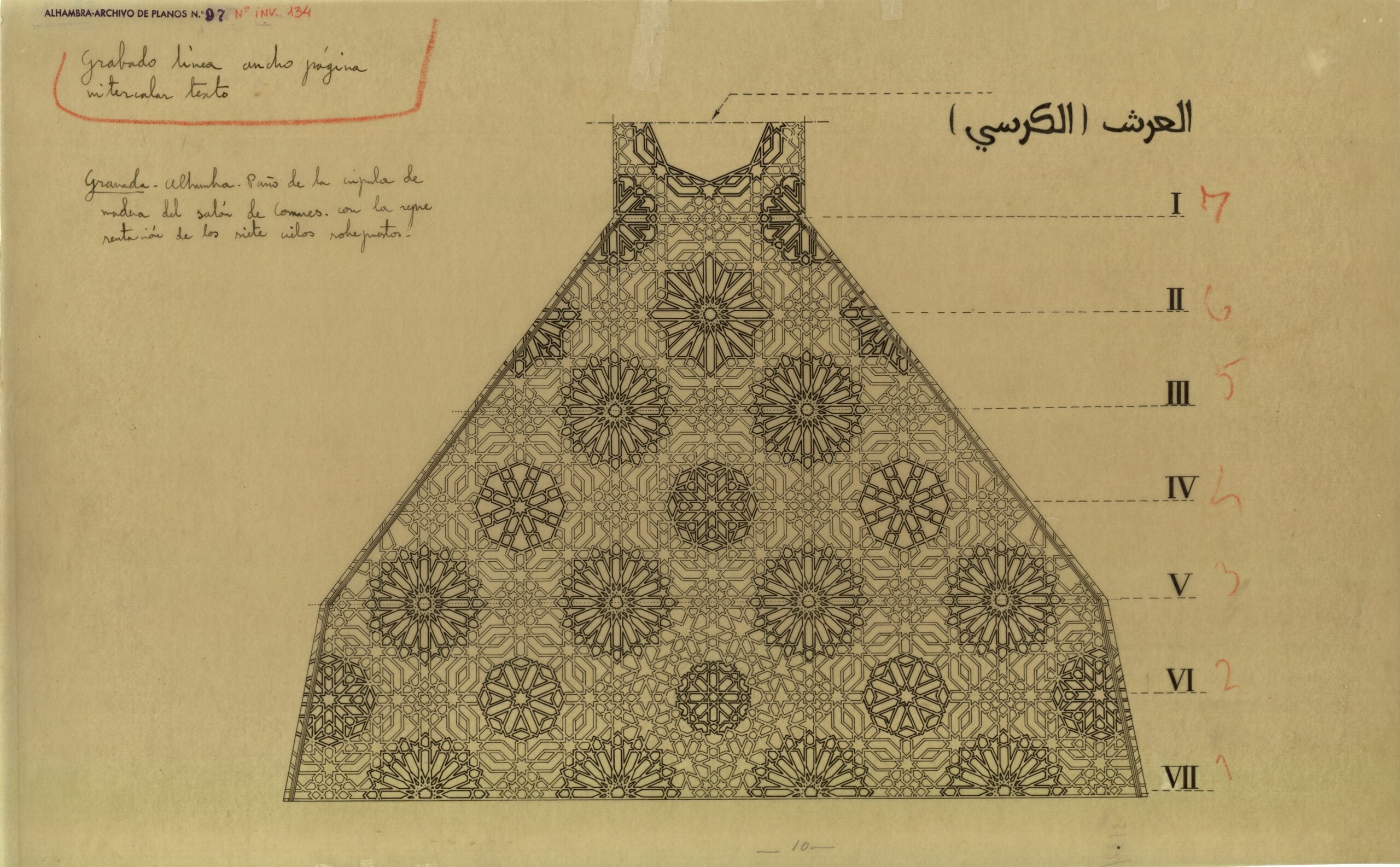
An archive drawing reproduced in Adduchi’s dossier makes the connection to clothing unusually clear. Drawn as one face of the hall’s wooden dome laid flat, its geometric pattern broadens towards the bottom, with seven bands marked in Roman numerals along one side. At the top, where the pattern curves around what reads as a neckline, the drawing is labelled in Arabic al-‘Arsh, the Throne.
The eighth sky
Adduchi carried the seven heavens into the dress, then extended the symbolism. In his interpretation, the eighth sky, the throne of paradise, becomes the woman’s body. That body remains imagined. “It was never designed to be worn, and that was a deeply conscious choice,” Adduchi says. His notes describe the work as a tribute to women and to the historical craftsmen whose names have gone unrecorded.
He laid a second text over the first. The Conference of the Birds, by the Persian Sufi poet Farid ud-Din Attar, follows birds travelling through seven valleys in search of their king, the Simurgh. Only thirty reach their destination, where they recognise themselves in the celestial bird. Adduchi has returned to the poem during uncertain periods in his life; here, he maps its valleys onto the ceiling’s heavens.
For him, both the poem and the palace reward time spent looking. In his answers, he describes the experience of trying to read poetry amid the Alhambra’s ornament, where letters can merge with geometric patterns. Understanding what he was seeing required him to slow down.
It was never designed to be worn, and that was a deeply conscious choice.
Karim Adduchi
Working around the curve
The Comares ceiling is not itself taracea: its ornamental wooden pieces were nailed to boards. Adduchi chose taracea, a form of inlay, to translate its geometry into the dress, which left the problem of keeping the patterns aligned as they travelled around the skirt.
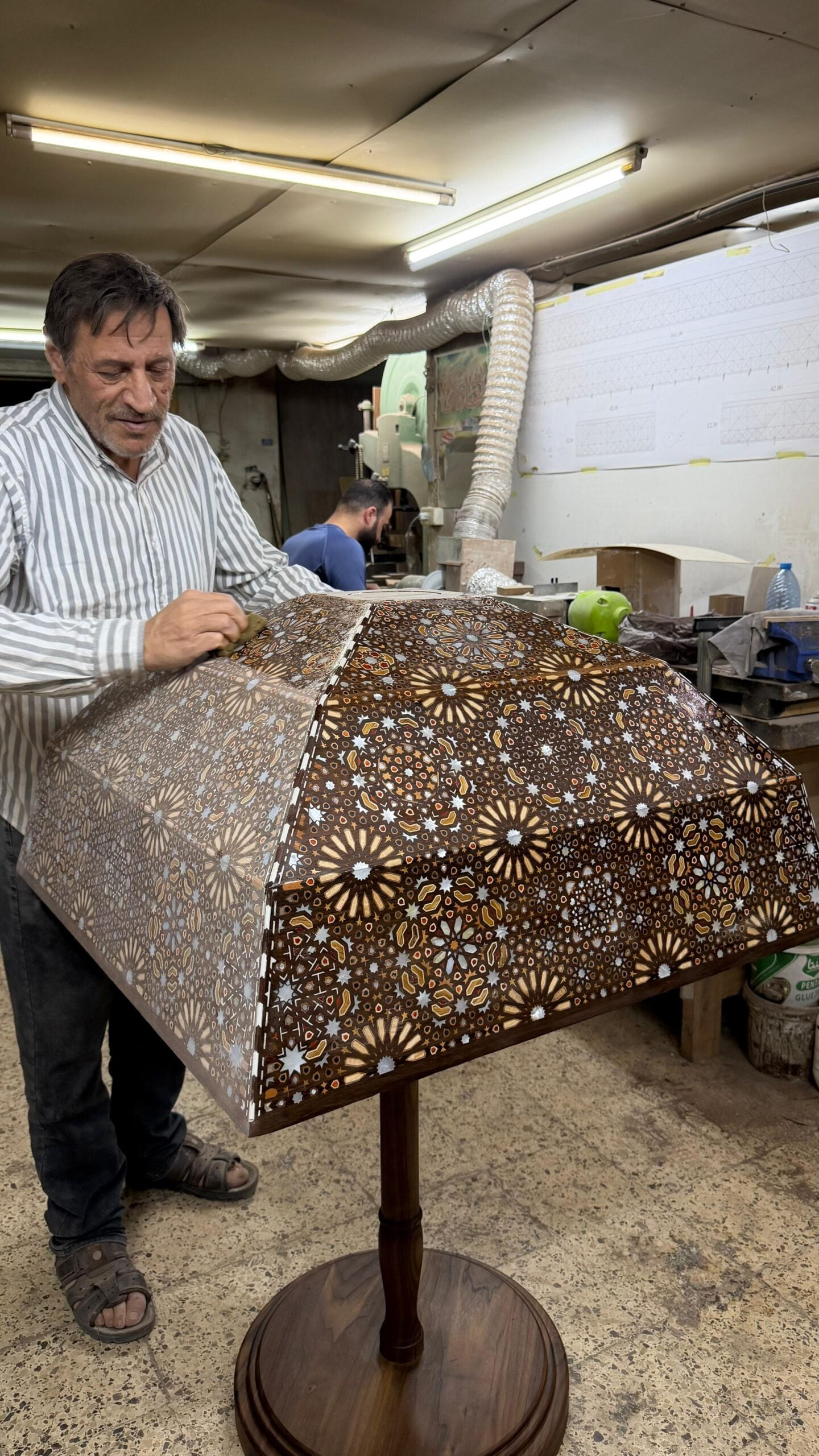
He brought that problem to woodworkers in Amman. Among his collaborators were Maher Darwich, whom Turquoise Mountain identifies as a master carpenter, and Abdelrahman Shaaban, known as Abu Abdo, a master wood-mosaic artisan. His dossier also credits Mehmet Ali and Adel. Adduchi had followed their work for years before approaching them with the project.
Darwich, who is from Damascus, moved to Amman in 2012 and has trained young Jordanian and Syrian apprentices there, according to a profile by Saudi Arabia’s King Abdulaziz Center for World Culture. In his written answers, Adduchi also names Moataz Hammoush, Salma El Qatawneh, Mary Kawar, Fadi Shatara, Zaid Hammoudeh and Ethar Al-Hassan as part of the team at Turquoise Mountain in Amman.
“The main technical challenge was preserving the exact proportion and alignment of the geometric patterns across a rounded structure without distortion,” he says. After design and prototyping sessions, the team redrew the geometric layout from scratch and worked out how to reconcile the pattern with the curve.
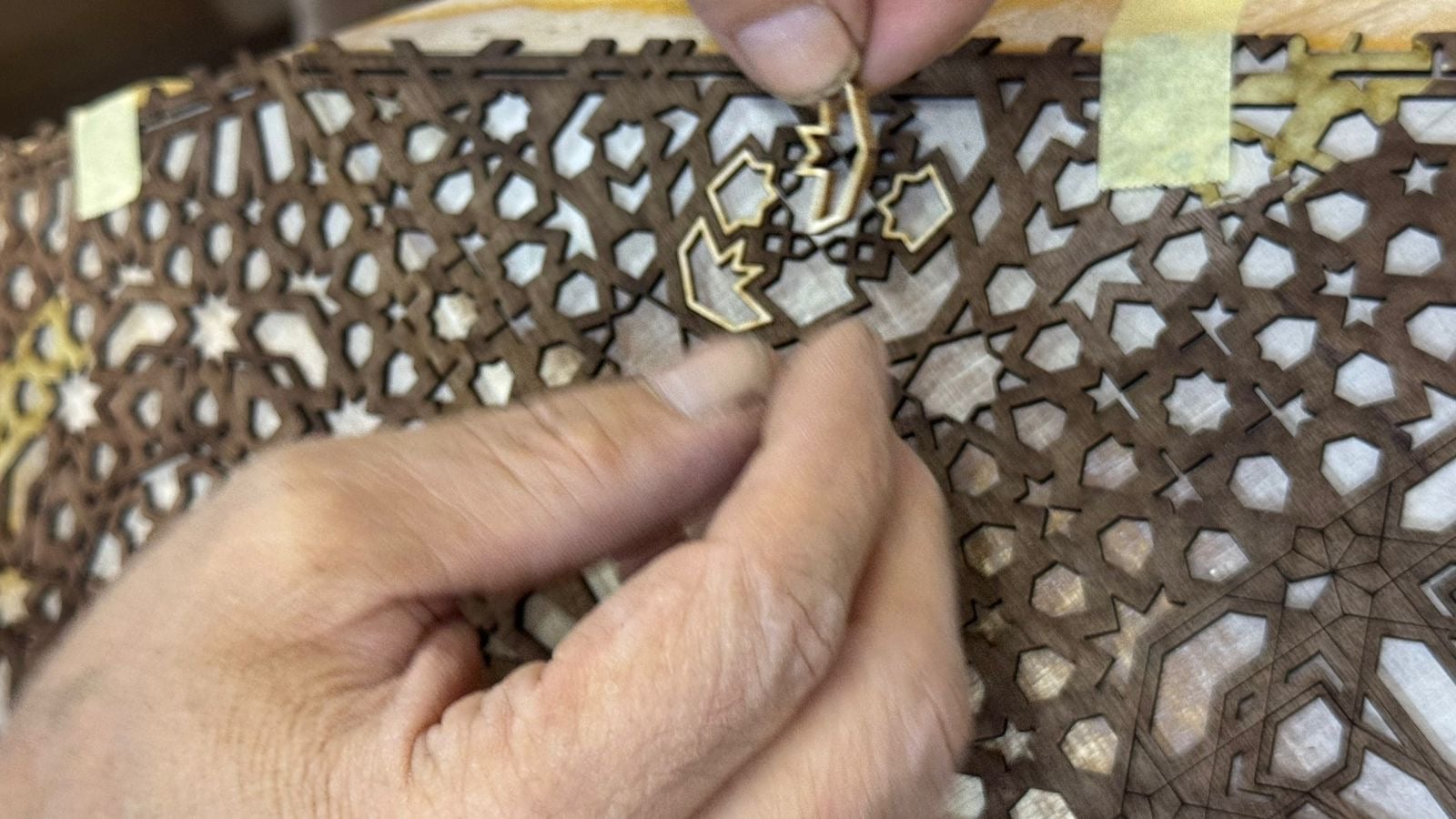
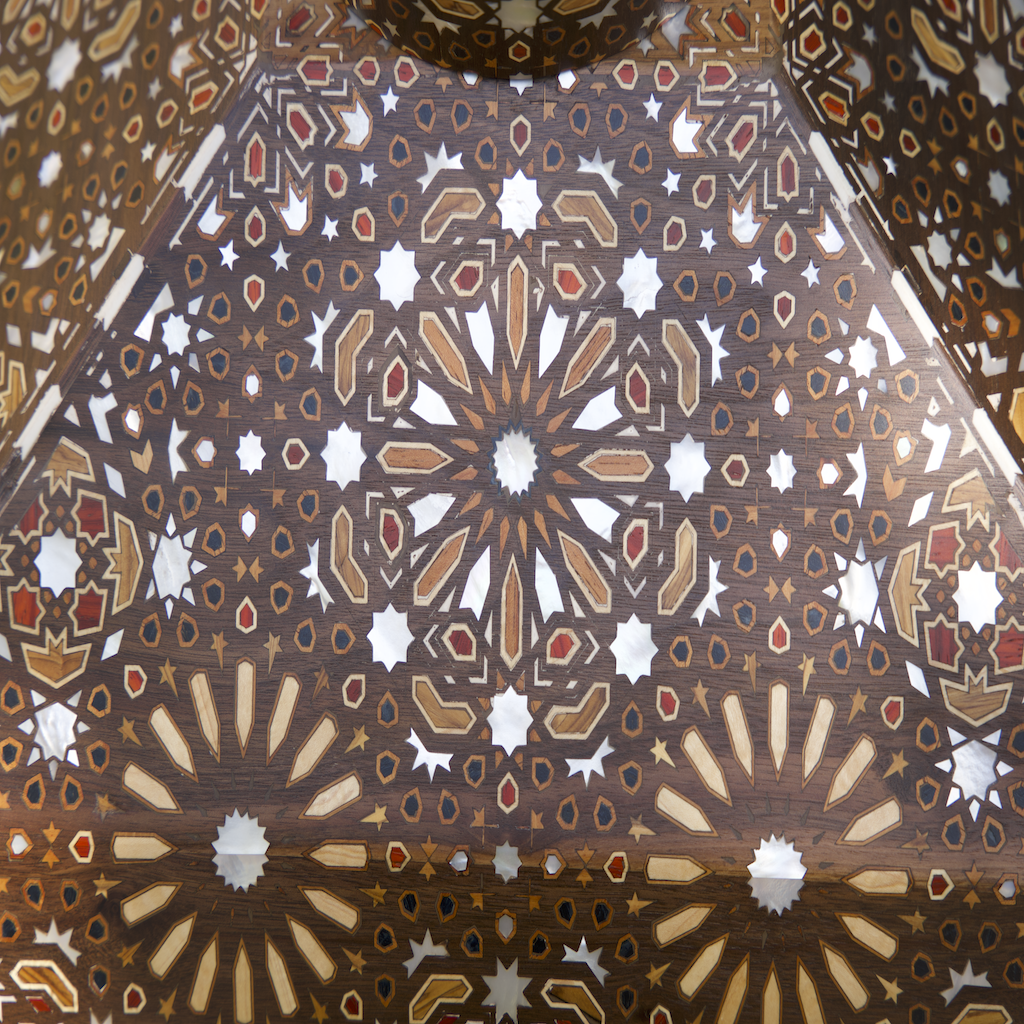
The dress combines walnut and walnut veneer with a mosaic of woods including maple, olive and cherry, as well as mother-of-pearl inlay. Adduchi says the woodworkers’ knowledge meant adapting his design to the nature of the materials, an approach close to the way he usually works. “Forcing a rigid drawing onto a material often ignores its natural tendencies,” he says. He began with an idea and allowed the properties of the wood to help determine the silhouette.
Adduchi describes taracea as endangered, citing conflict, economic pressures and too few young successors. Turquoise Mountain works with wood-mosaic makers from Syria who are now based in Amman. A 2019 profile of its Jordan artisans by the retailer Artisan & Fox described one of them, a Damascene master, who had run his own workshop with around twenty artisans and apprentices before the war; in Amman, it said, he worked by himself.
Adduchi sees a project such as this as a way to employ master artisans while asking them to adapt their skills to a new form. He wrote to Guzangs in August that “a single dress requires more people and craftsmanship than an entire commercial collection”. Turquoise Mountain’s wider work includes woodwork apprenticeships and entry-level courses for refugees and host communities in Jordan, alongside business training and support finding work.
In Granada, where the craft flourished under the Nasrids, taracea has not died out. Andalusia’s historical heritage institute records workshops still working in the city, most of them making boxes, jewellery cases and chessboards for souvenir shops. Adduchi wants the dress to take the technique beyond “a decorative souvenir”.
A single dress requires more people and craftsmanship than an entire commercial collection.
Karim Adduchi
Alongside Escher
The dress was shown in Escher & Islamic Art: 20 Perspectives at Escher in Het Paleis in The Hague, which ran from 10 June to 1 November 2026. The show marked ninety years since M.C. Escher’s second and last visit to the Alhambra, in 1936; the museum identifies that visit as particularly influential in his study of repeating patterns.
Adduchi remembers encountering Escher’s work as a child and says the artist was often in his thoughts during his research. He says the dress draws viewers close enough to bend down and study the geometry.
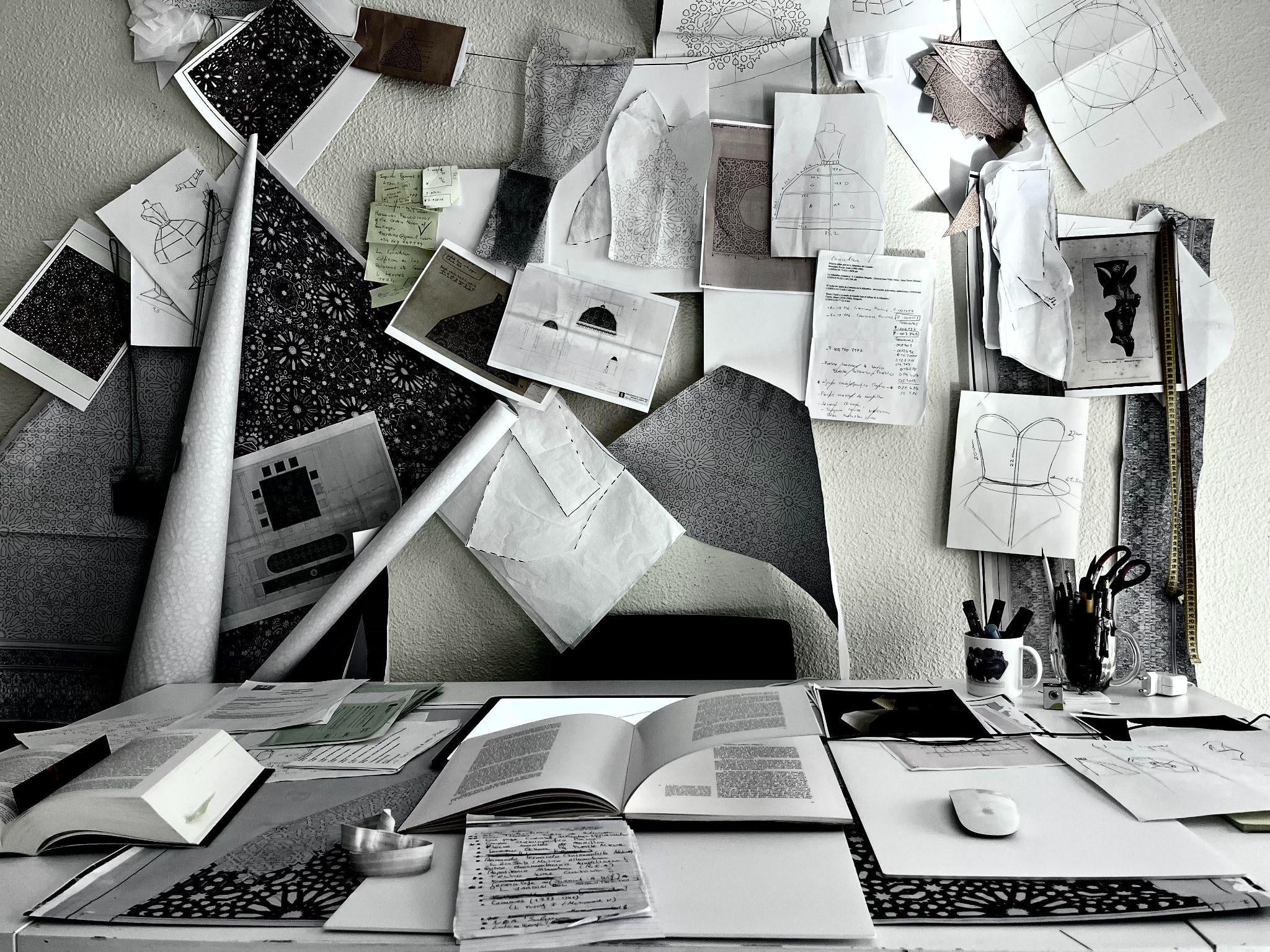
His supplied photographs show how much of the work happened on paper. In a picture of his desk, an open book and handwritten notes sit beneath a wall crowded with geometric studies. Drawings of the skirt and bodice are pinned among the star patterns, with measurements written beside their curves.
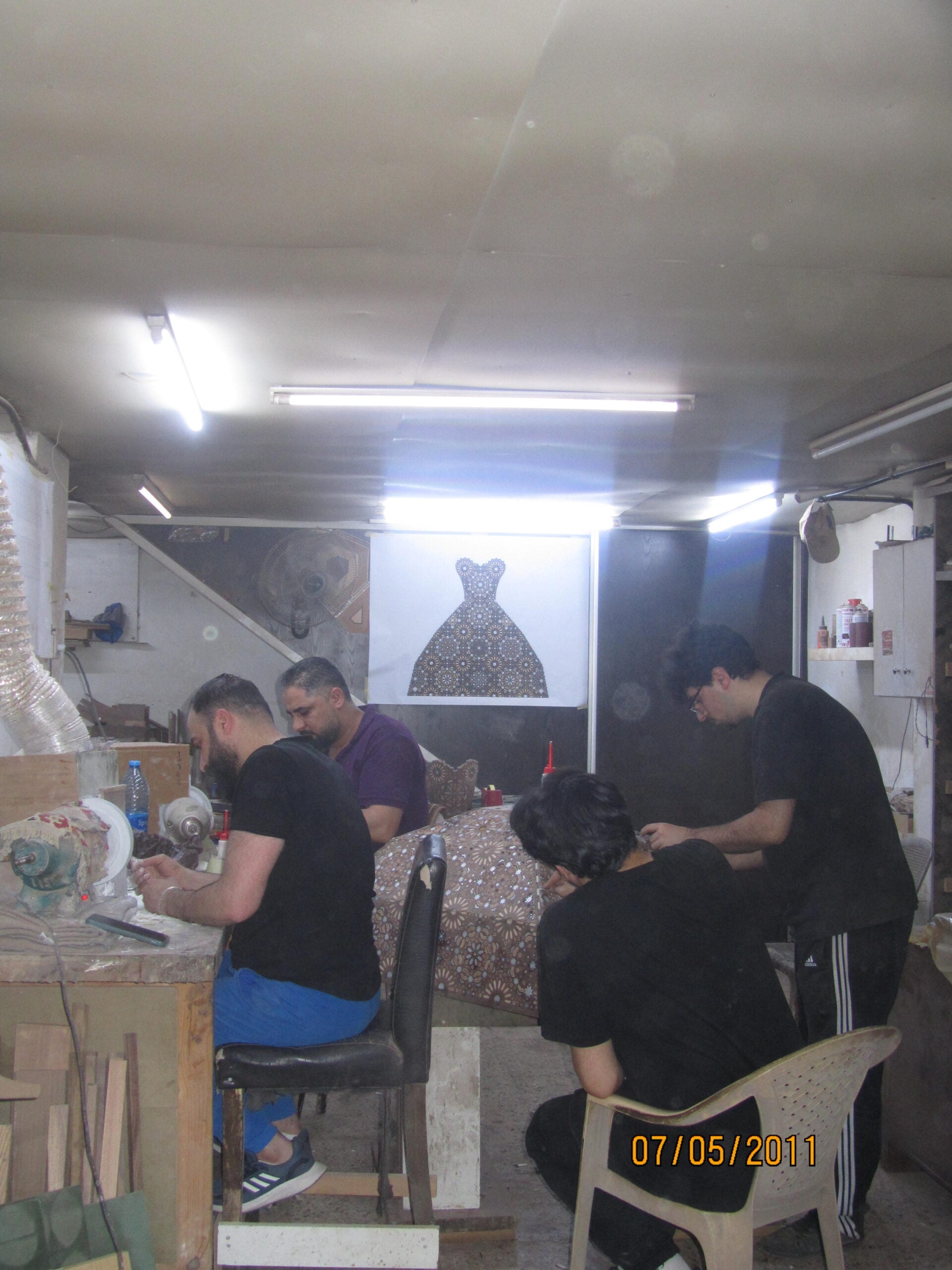
In Amman the geometry went up on the workshop wall. Photographs from there show the dress-shaped drawing printed large and pinned above a bench, where four men work on sections of the inlaid skirt beneath it.