


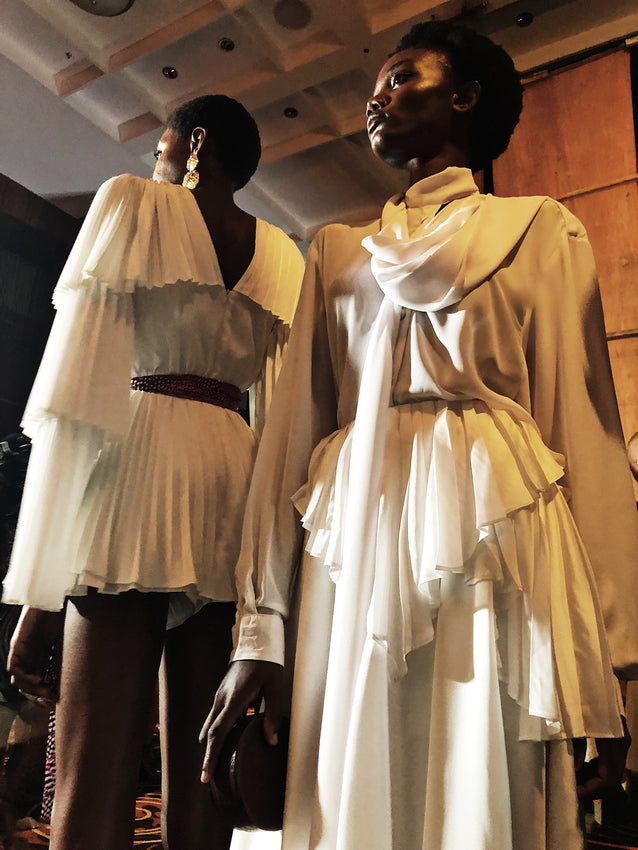
Image courtesy of Andrea Iyamah.
African fashion has been experiencing a delightful renaissance. From Lagos to Abidjan, Dakar to Nairobi, designers are capturing global attention with their creativity, craftsmanship, and cultural storytelling. But beneath the glamour, many African consumers are voicing a growing concern: the escalating cost of homegrown fashion is driving them out of the market.
As inflation and economic instability sweep across the continent, fashion is becoming increasingly inaccessible to the very communities it represents. High production costs, limited infrastructure, imported materials, and the pressure to appeal to international buyers have pushed prices out of reach for most locals. The result? A widening gap between cultural pride and purchasing power.
For many Africans, the issue lies in how easily the label “luxury” is applied both to brands that meet international standards, and to those that don’t. But they also understand that supporting local designers is no longer just about patriotism or personal style. It’s a financial stretch and for many, an impossibility reserved for the privileged few.
In a continent where the majority live on modest incomes, the disconnect is becoming impossible to ignore. The fashion is here. But the people it represents can no longer afford to wear it.
So who or what is to blame? And what choices do designers have when survival is on the line?
From the Local Consumer’s Perspective: No Purchasing Power

Scroll through Instagram or browse the websites of leading African fashion labels, and the message is clear: this is premium fashion. Prices range from $200 to $700 per item — modest by global luxury standards, but unattainable for many Africans when translated into local currency. In countries like Nigeria or Côte d’Ivoire, that could represent someone’s monthly salary or even a year’s rent.
These prices reflect a broader aspiration. Designers are seeking legitimacy in the global fashion system and in that system, high cost often equates to high value. But this ambition has consequences. As prices rise to meet the expectations of international luxury, brands risk alienating the local communities that shaped their stories — people who share their language, customs, and culture, but not their disposable income.
It recalls a moment in 2024, when Nigerian actor and public figure Taymesan took to Instagram to express the same frustration noting that even in show business, many can’t justify the cost of Nigerian fashion, especially for an outfit they’ll only wear once.
The “You’re Not the Target Audience” Crisis
A phrase that’s become increasingly common in recent years: “You’re not the target audience.” It’s usually used to justify high price points, exclusive aesthetics, or marketing tone. And on the surface, it seems reasonable — not every product is made for every consumer.
But in practice, the phrase often serves a more insidious function. It’s used to silence critique, shame local consumers, and defend exclusionary pricing. As PR consultant Elvis Oshiome notes:
“If you go to the comment section of these adire brands that price one boubou at ₦300,000 on TikTok, you’ll see it over and over: ‘You’re not the target audience.’ I understand prestige and brand direction, but you can’t use locally made fabric, call it a traditional name, and then price it so high — while telling the people it comes from that it’s not for them.”
In many ways, some argue that African designers are no longer designing for African consumers but for the diaspora. For second-generation Africans in the U.K., France, Canada, or the U.S., fashion becomes a bridge to heritage. And with greater access to disposable income, the diaspora becomes a profitable, emotionally invested audience.
For designers navigating fragile economies, this market isn’t just desirable — it’s dependable.
From the Designer’s Perspective: The Economy Is to Blame
Still, frustrations over pricing must be weighed against the realities that designers face.
African designers are not designing in a vacuum. They operate within fragile economies, unreliable infrastructure, and a chronic lack of institutional support. The cost of doing business is extraordinarily high often far higher than in Asia or parts of Europe.
Most designers must import their fabrics, trims, and hardware due to a lack of high-quality local options. Shipping fees, customs duties, and fluctuating exchange rates add up quickly. Electricity is unstable especially in cities like Lagos forcing creatives to rely on generators or costly backup systems to power their studios.
Labor, though sometimes romanticized as affordable, is often unskilled or inconsistent, requiring designers to take on the added burden of training and oversight. Simply producing a collection can be an exhausting financial feat.
Meanwhile, local economies across the continent face inflation, currency devaluation, and high unemployment. This means the average African consumer cannot afford the real cost of local fashion. Designers are caught in a bind: do they price for their local market and risk running at a loss or price for the diaspora and risk being labeled elitist?
For many, pricing for the diaspora isn’t a branding move. It’s survival.
A Foresight Resolve
Both perspectives hold truth. And therein lies the complexity.
Fashion is a business. In Africa, it’s a business operating under intense pressure often without the safety nets or systems that support creative industries elsewhere. Designers are doing what they can to survive, grow, and eventually give back.
To reduce this to accusations of “selling out” or “ignoring the continent” is to miss the larger point.
The more urgent question is: What systems need to be in place for African fashion to thrive and remain accessible? What kinds of investment, infrastructure, and policy support are required so that designers no longer have to choose between local love and global viability?
Until those answers come, we must extend grace and push for solutions that uplift the entire fashion ecosystem, not just the few who can afford it.