


Who Needs More Clothes When Moses Aina Has Other Ideas
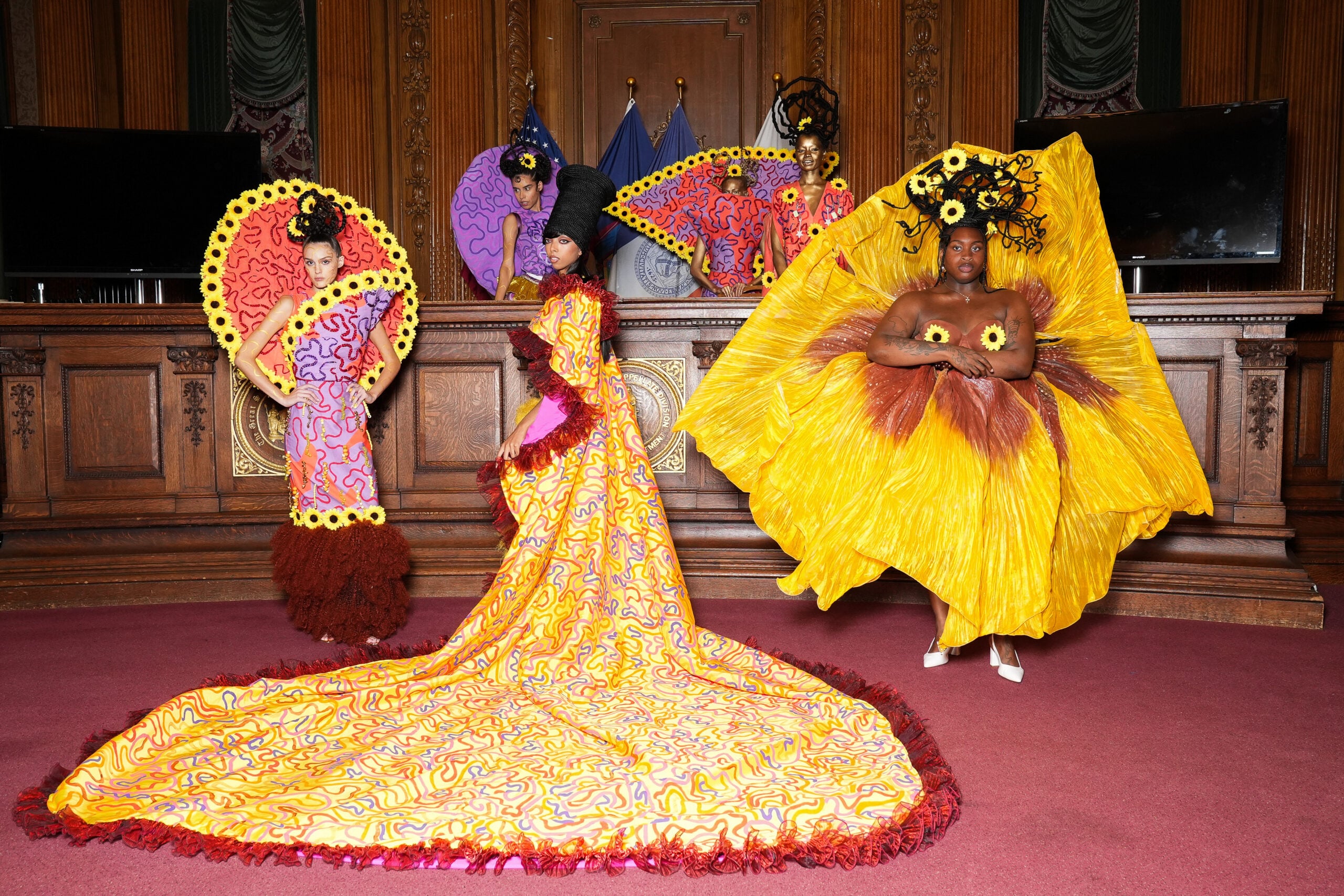
“We don’t need more clothes,” Moses Aina says, and it’s an amusing declaration from a designer whose creations include an eight-foot train, a ballgown embellished with Barbie dolls, and sculptural garments that turn braided hair into wearable art. But Aina isn’t interested in producing clothes simply for the sake of it. She wants them to mean something. “What we need are pieces that shift the needle, pieces that are creating conversation, pieces that are actually doing things to help and uplift other people,” she explains.
At IGBO-SISUN, the New York City-based fashion house she founded, subtlety is hardly the point. Taffeta erupts into extravagant silhouettes, Afro Marley hair becomes intricate embroidery, and sunflowers, cowrie shells and gold embellishments transform garments into declarations of self-worth. The pieces are theatrical, occasionally impractical, and unapologetically conspicuous. They are also quite personal.
For Aina, a Black trans woman of Nigerian heritage, fashion offers a way to explore identity, cultural inheritance, and the freedom to exist on one’s own terms. Her designs celebrate the body without concealment, which allows the wearers to occupy space without apologising for their presence. “You can’t really hide in the shadows whenever you’re wearing IGBO-SISUN,” she emphasises.
She was born and raised in Dallas, Texas, in a family whose history stretches across Nigeria, Togo and the United States. Her parents’ influence went well beyond professional achievement. Both worked in medicine, and Aina remembers growing up in a household where ambition came with an expectation of generosity. “I had a really good home environment with parents who pushed me to not only do well for myself, but to also do well for other people,” she recalls.
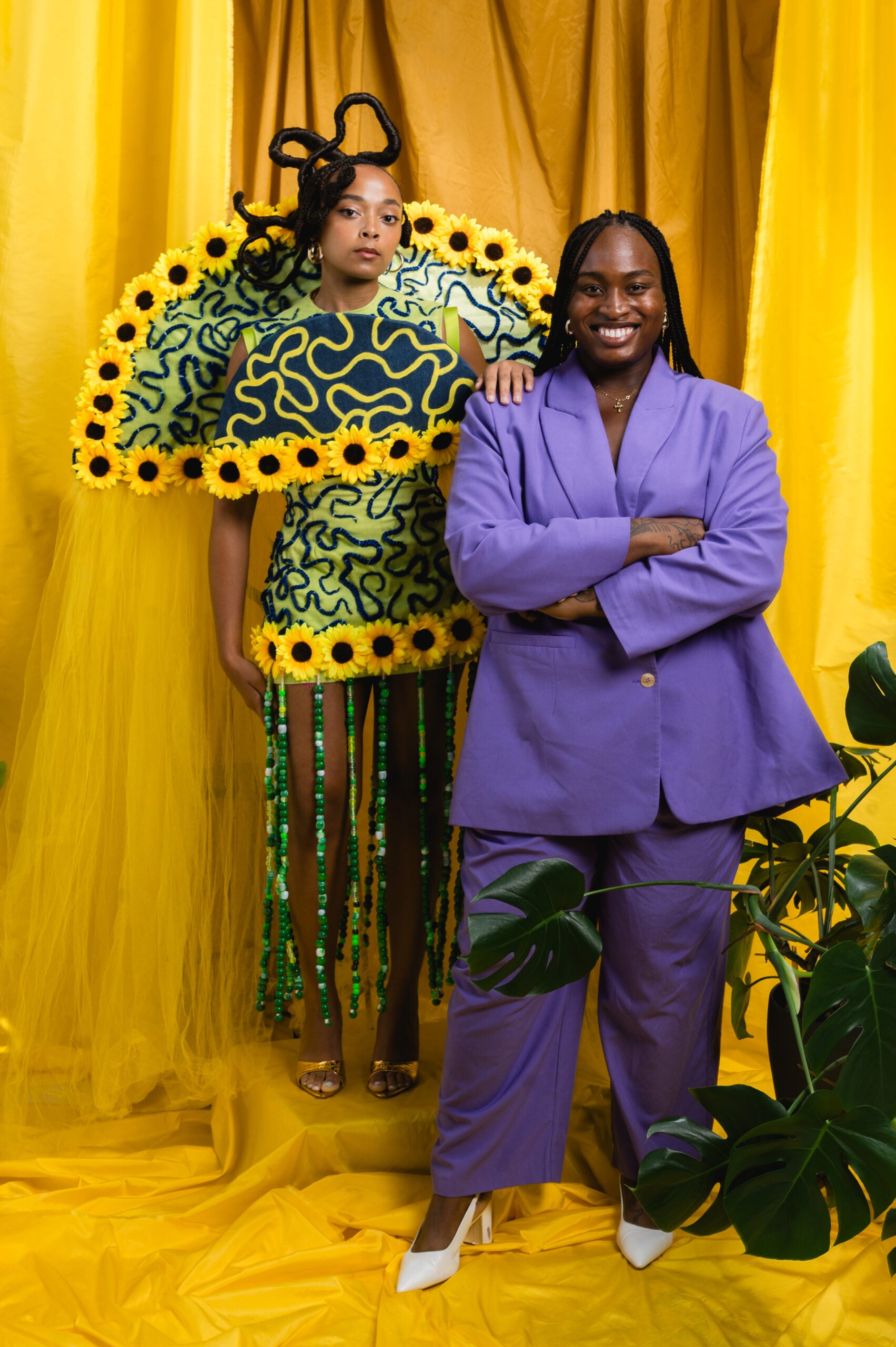
Her family’s political history is another source of inspiration. Sylvanus Olympio, Togo’s first president, was her great-grandfather. Olympio, who led the country following its independence from France in 1960, was assassinated in 1963. Aina sees his pursuit of political and economic independence as an example of the courage required to challenge existing power structures.
Fashion, however, wasn’t always the plan. She arrived at New York University intending to pursue theatre, a fitting choice for someone whose clothes now seem perpetually ready for their close-up. She soon realised the stage wasn’t where she wanted to spend her career. Instead, she began making clothes for herself, cutting and combining fabrics before persuading photographer friends to shoot her creations around New York. “I would make things or cut things out and piece them together,” she recalls. The process was informal, spontaneous, and driven by curiosity, with no grand business plan.
London would give that budding interest an entirely different dimension. Feeling ready for a change, Aina moved to the city for a year and began experimenting with an alter ego. She adopted the name IGBO-SISUN, wore enormous red hair, and gravitated toward colours that were impossible to ignore. The experiment was liberating. Away from the familiarity of New York, she discovered the pleasure of presenting herself without seeking approval.
“There was boldness, there was authenticity, there was also a form of self-love that I had for myself whenever I took that name on,” she says.
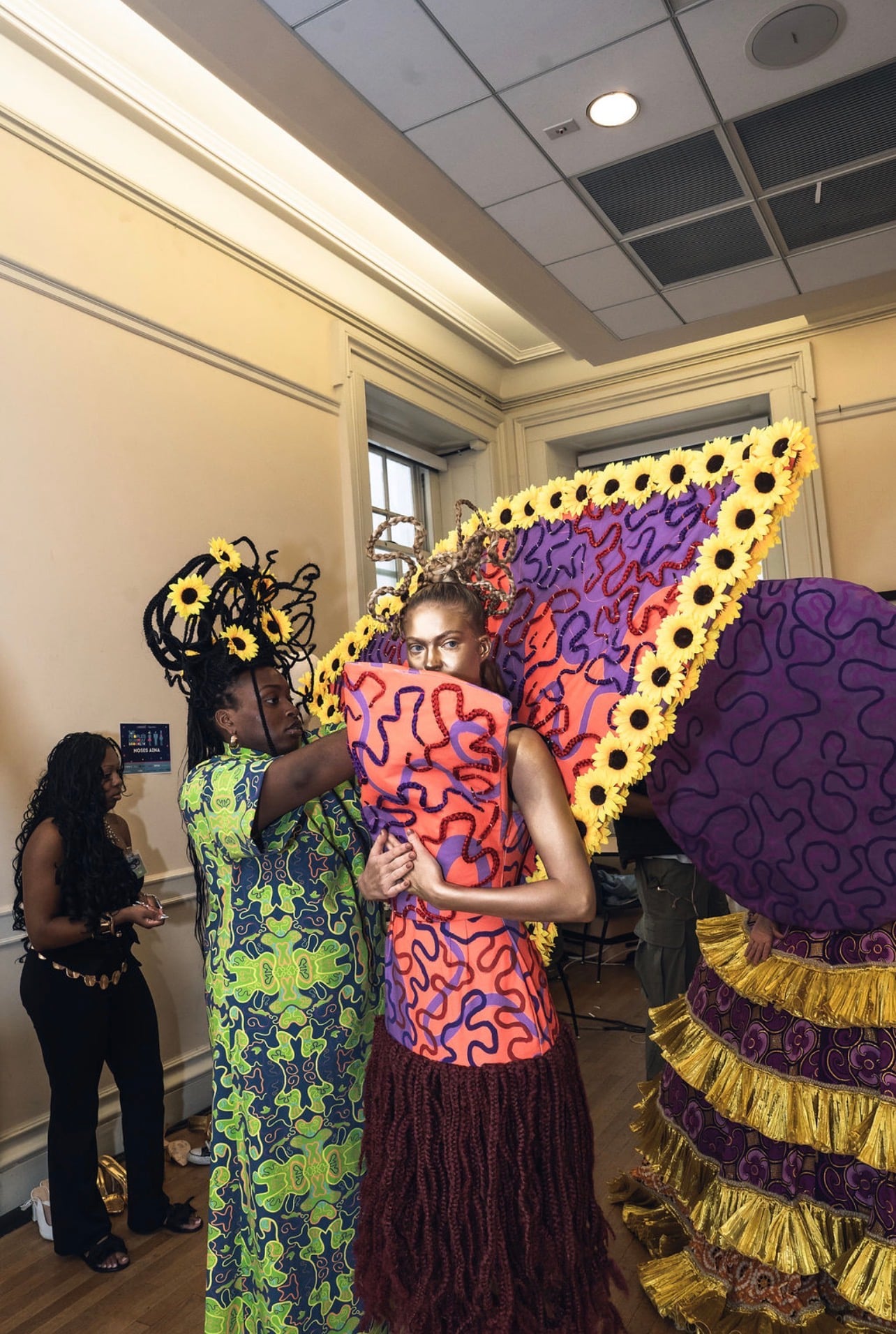
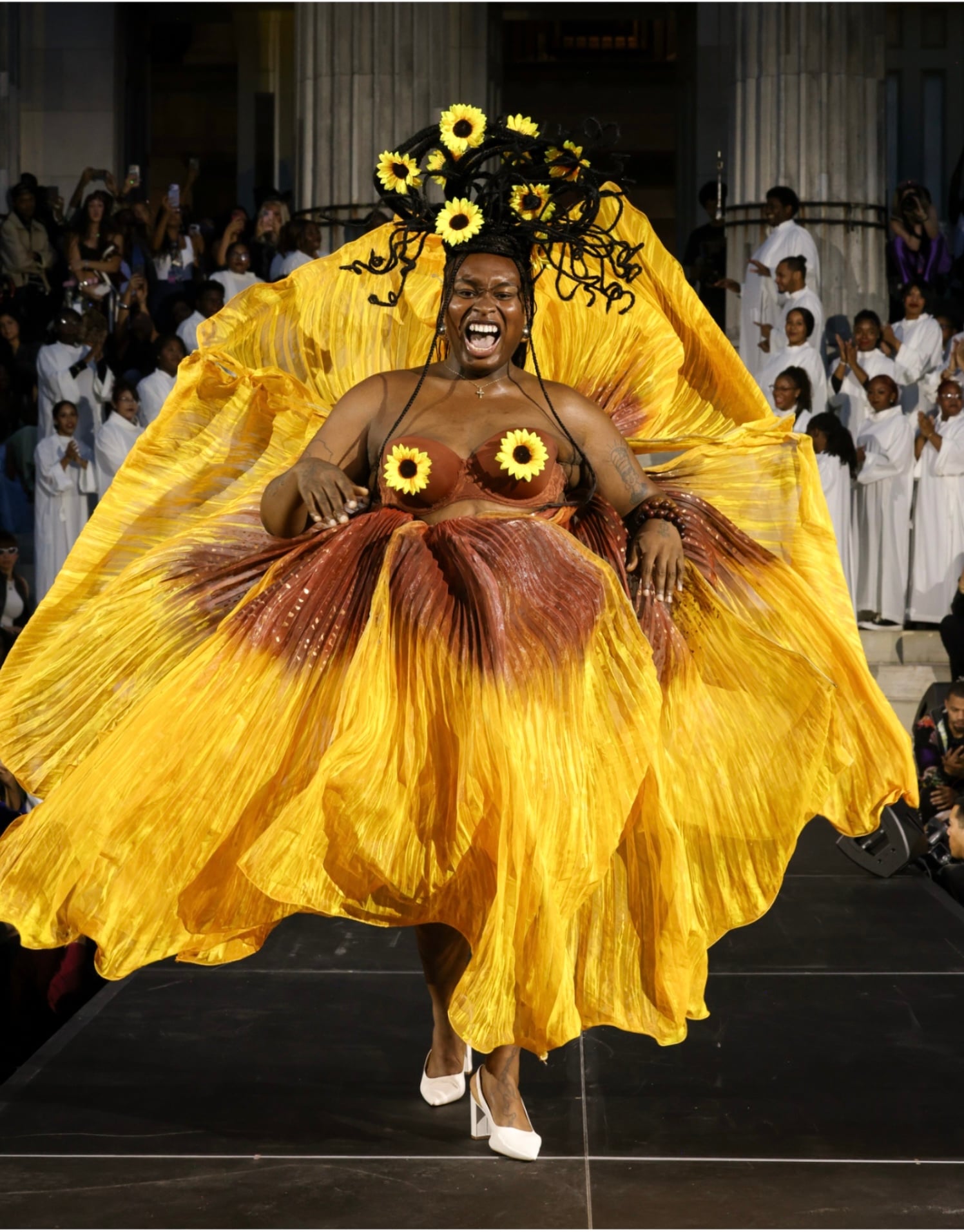
When she returned to New York City, she resumed using her birth name but kept the spirit of her London alter ego. The confidence, the bright colours, the refusal to shrink herself: those qualities would become the foundation of IGBO-SISUN.
For Aina, the point isn’t merely to attract attention. It’s to make visibility feel pleasurable.
That thinking finds one of its clearest expressions in “Reclaiming My Body“, a taffeta ballgown and crown that was commissioned by the Museum of Modern Art. The gown is covered with more than 300 Barbie dolls, blue Afro wigs, gathered tulle, and chiffon sleeves that fall to the floor. It’s a curious combination of childhood nostalgia and exaggerated femininity, with enough volume to make an entrance before its wearer has said a word.
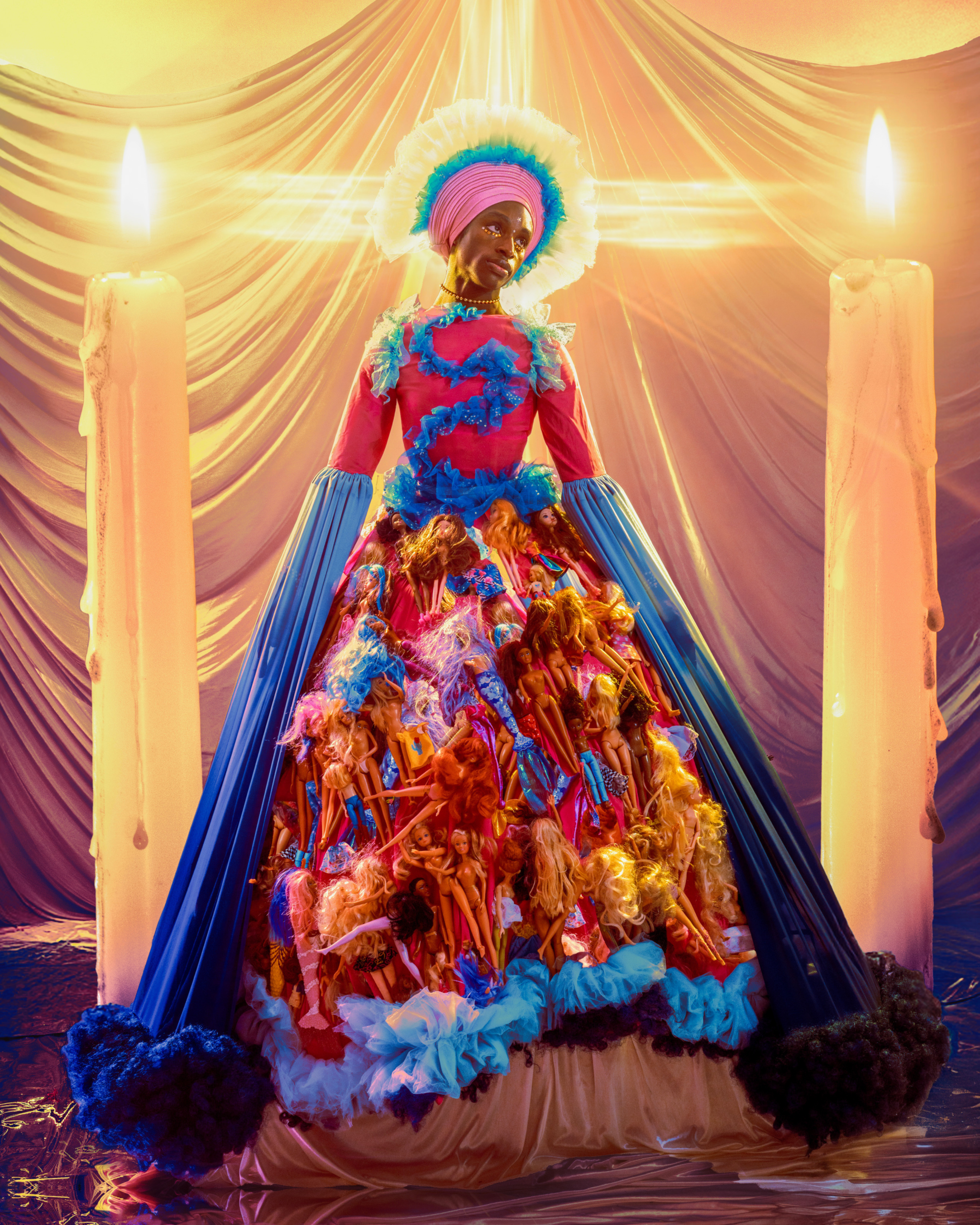
But the story behind it is less playful. Aina conceived the piece following Donald Trump’s re-election in 2024, amid growing anxiety about political decisions affecting bodily autonomy. She remembers the frustration and sadness of that period and wanted to create something that could offer a different emotional response. “Reclaiming my body is a love letter to Black femininity,” she says, describing the work as an attempt to restore power through beauty, joy, and self-expression.
The language of royalty appears throughout IGBO-SISUN, not simply as a metaphor for luxury but as a way of asserting dignity. Aina wants people to feel deserving of beautiful things, of attention, and of the space they inhabit. That philosophy shapes her relationship with the body. She designs for different silhouettes and encourages customers to approach her garments without rigid expectations about gender.
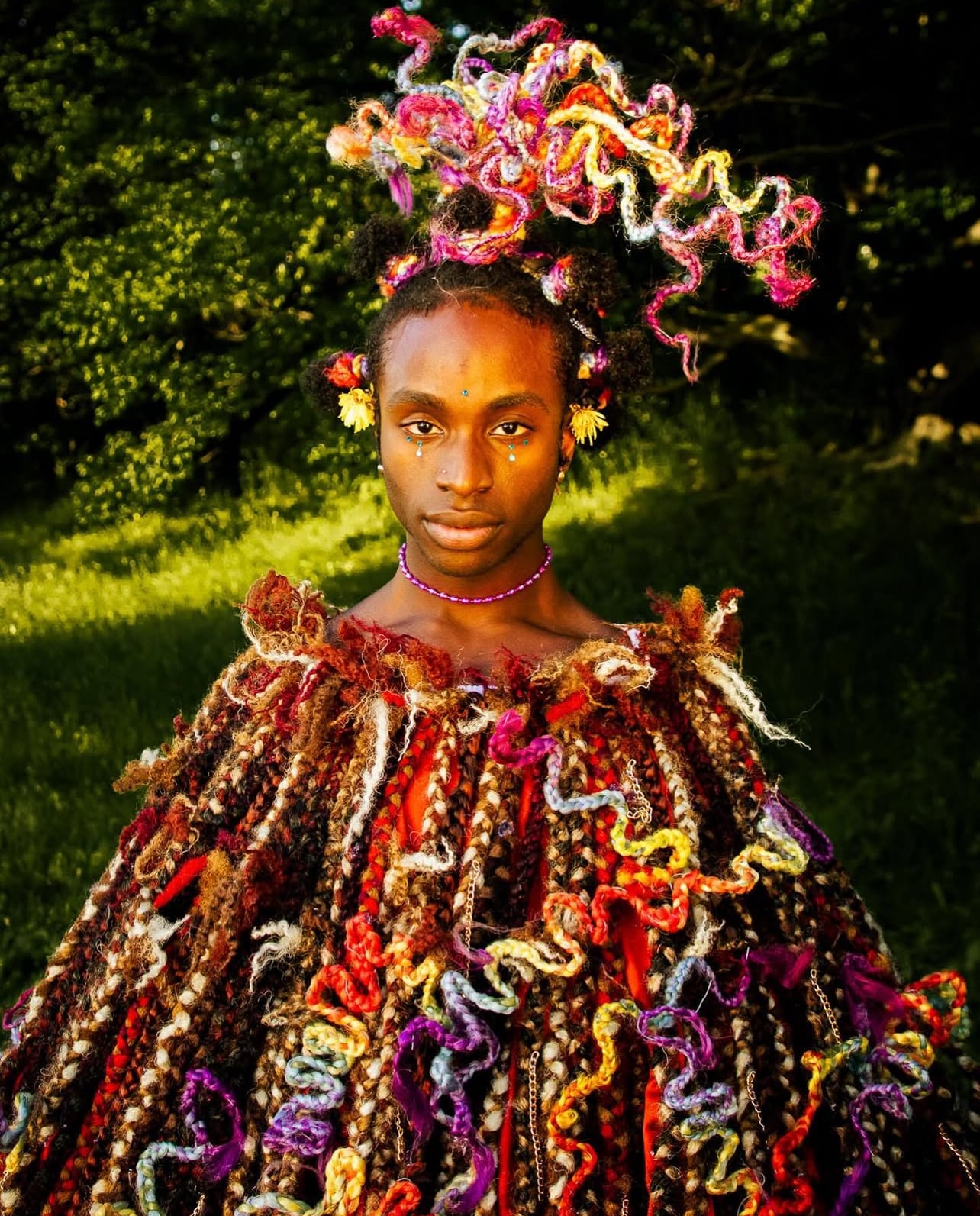
In her world, hair is also inseparable from ancestry. “Hair is connected to our roots, which is connected to our ancestors,” she says. “It’s where we come from. It is a big part of our legacy.” She is drawn to the head as a place where personal presentation and cultural identity meet. Braids, coral beads, shells and crowns allow her to transform familiar forms of adornment into dramatic fashion statements. Aina connects these materials to Yoruba cultural traditions and to the visual language of status, beauty, and ceremonial dress.
There’s a certain irony in Aina’s vision: her designs are anything but ordinary, yet she wants people to actually live in them. “This is not just about vanity. It’s not just about the money. It’s not just about the clout or the status or whatever,” she insists.
Asked what she hopes her archive will communicate 50 years from now, her answer is simple: “I would hope that they understand that there was a lot of passion that went into this.”
For someone who declares the world doesn’t need more clothes, Aina has certainly found a reason to keep making them.