


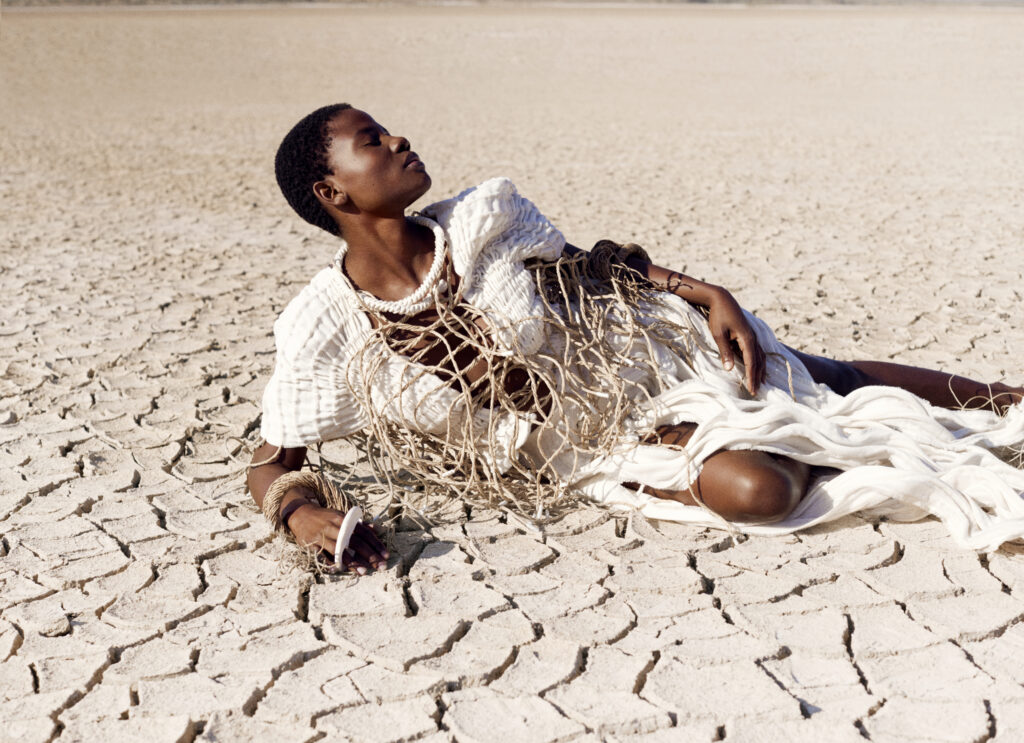
Ilkhe du Toit’s collection Salt begins with a contradiction. The designer grew up on a sheep farm in South Africa where her family exported wool to European mills, surrounded by raw fiber that would eventually become garments. Yet the connection between the two felt invisible. “I didn’t understand how wool became clothing,” she admits.
That childhood disconnect became the foundation of her practice. Salt, shot in the stark landscape of a South African salt pan and created entirely from 100% wool sourced from Italy—specifically from Marzotto, the factory her family once supplied—traces that journey in reverse. Material to garment. Origin to design.
The approach is deliberate. “I allowed the wool to lead,” she explains. “It dictated the shapes, silhouettes, and textures. I didn’t look at trends or advertisements. Instead, I started with the fabric, letting it speak first.”
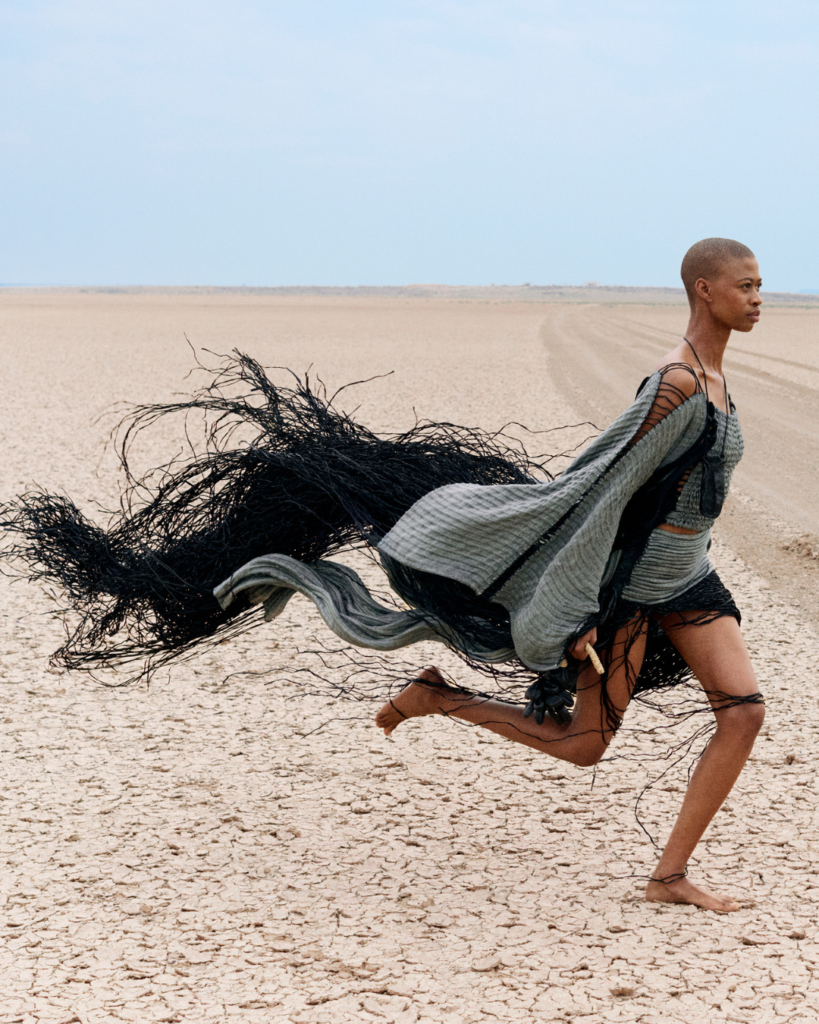
The salt pan location connects to process as much as aesthetic. Salt is a key ingredient in wool dyeing, and the landscape itself holds meaning for du Toit. “The pan is a place of both desolation and abundance,” she says. “It’s overused and infertile, yet it has its own beauty and value—a metaphor for what sustainability in design can achieve.”
After spending over a year off-grid, du Toit returned to South Africa to shoot the collection. The distance from modern consumerism clarified her priorities. “It wasn’t just about fashion,” she reflects. “It was about responsibility—understanding the impact of what we make.”
That responsibility extends to how the collection was produced. Du Toit worked with local women unfamiliar with fashion or textiles, teaching them the craft as they completed the pieces together. “We have an inherent connection to textiles,” she says, “especially as women. It’s something ancient, something we’re simply remembering.”
The collaboration with Marzotto—the same factory that once processed her family’s wool—represents another kind of full circle. “There’s a sense of harmony in that,” she says. “It feels like coming full circle.”
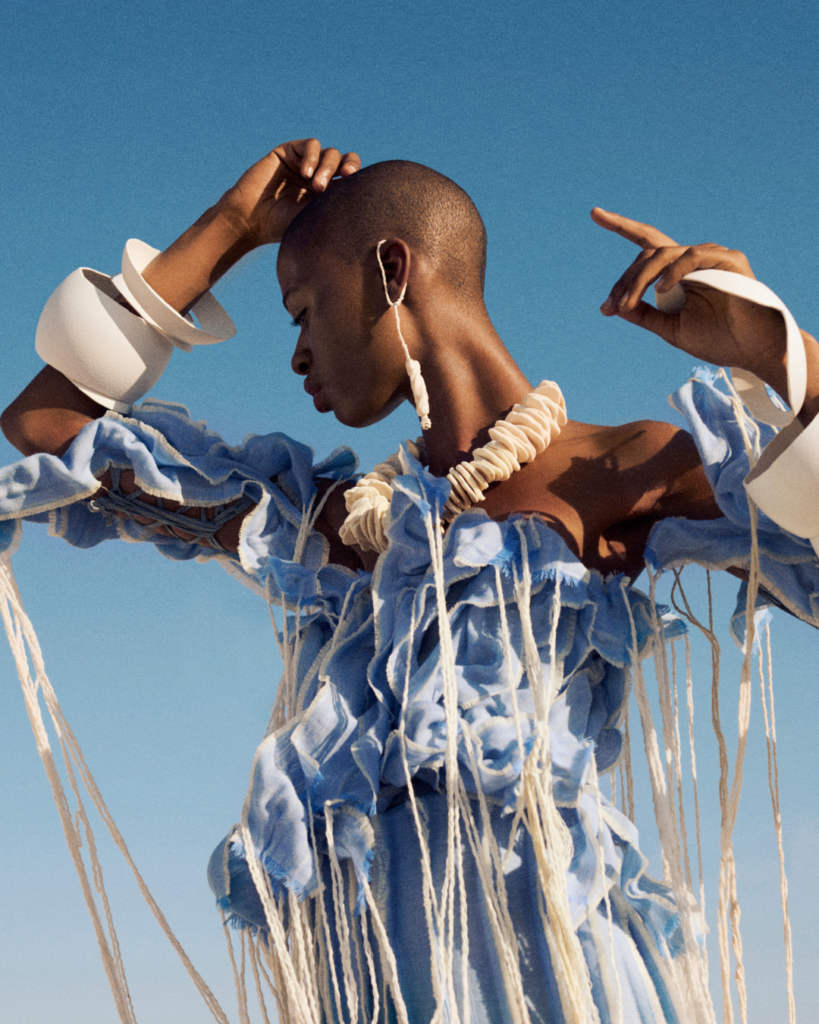
Du Toit advocates for what she calls textile-led fashion, where designers and manufacturers work together from the beginning to develop materials that serve both creative vision and structural integrity. “Too often, we design first and then try to make the fabric fit. But that compromises both the textile and the garment,” she explains. “It should be a partnership, where each brings out the best in the other.”
Her aspirations extend beyond her own work. She envisions creating spaces for young designers, particularly in Africa, to reconnect with source materials. “Africa exports so many raw textiles,” she notes, “but we’re losing the connection to the craft. If we nurture that link, the possibilities are endless.”
Du Toit, who interned with Iris van Herpen, has drawn comparisons between Salt’s sweeping silhouettes and costume design, particularly the work in Dune. She’s open to the possibility. “Being surrounded by people who inspire me in this creative world only strengthens my resolve,” she says.
Salt demonstrates du Toit’s core belief: design should begin with listening to the material, not imposing on it. The story starts with the textile.
CREDITS:
SALT by Ilkhe du Toit
In Collaboration with: Cape Wools, Marzotto Wool Manufacturers, Aalto University
Textile composition: 100% Merino Wool (RWS)
Fashion and textile design by Ilkhe du Toit
Photo by Liezl Zwarts
Salt Fashion Film directed by Will Venter
Styled by Bernadine Venter
Jewelry by Helaina du Toit
Models: Lethabo Sara Khunou, Ludina Ngwenya, and Katlego Gontse Masike
Makeup by Nombuso Ngcobo
Retouching by Flecks Studio
Photography production by Elisma Uys-Hankekom
Antoinette Njombua-Fombad is a creative writer and author of Everything Is WITHIN. She explores the language of artistic expression and believes that style is an extension of the soul.
Want more stories like this? Subscribe to Guzangs newsletters, delivered straight to your inbox.