


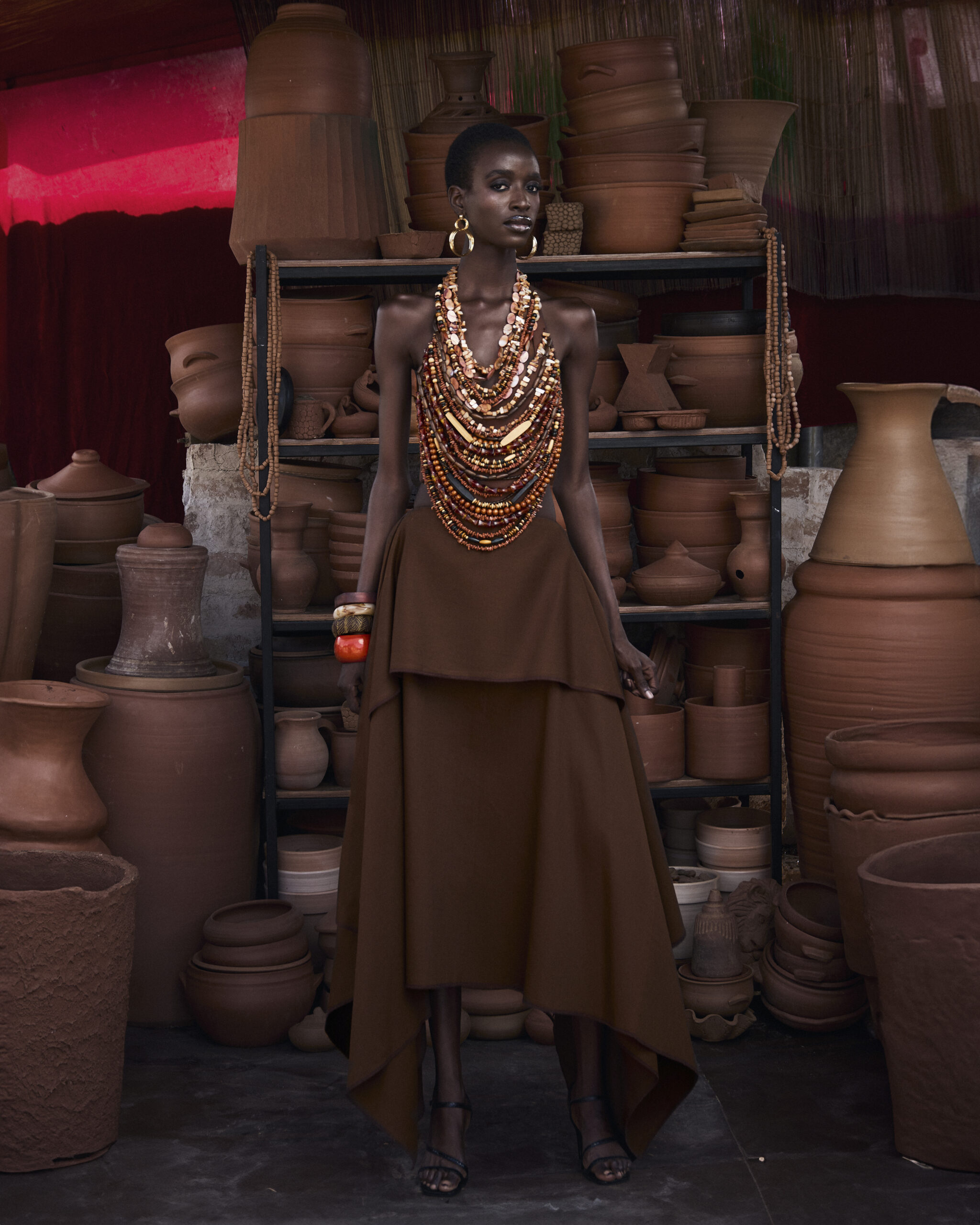
Florentina Agu did not start the research for her new collection by sketching. She went on residencies. She hosted a painter in her home for several weeks. She visited wood carving workshops she hadn’t returned to since childhood. The collection that emerged from that process, titled “Akaoru” — Igbo for “handwork” — is less a seasonal offering than a studied argument about what Nigerian craftsmanship is worth, and what it will take to keep it alive.
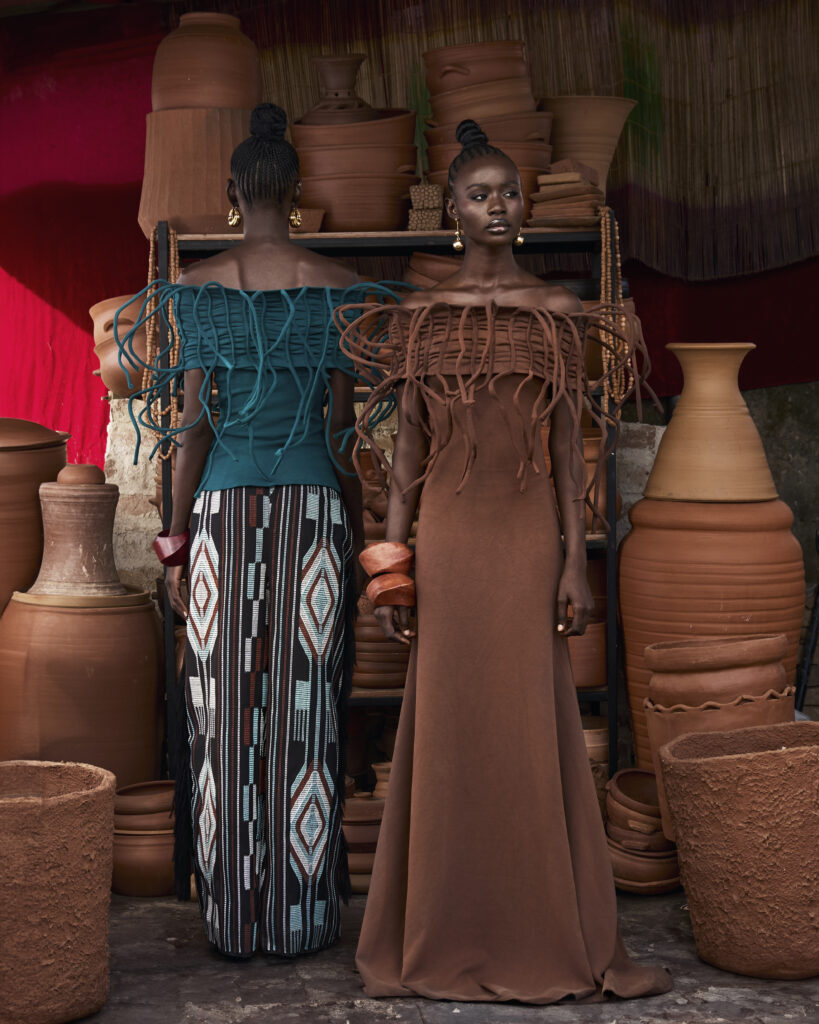
The 23-look collection, which launches today, works across three distinct mediums: weaving, woodwork, and pottery. Each one required Hertunba to step outside the boundaries of fashion production and into adjacent creative disciplines where the conditions are, in many cases, more precarious.
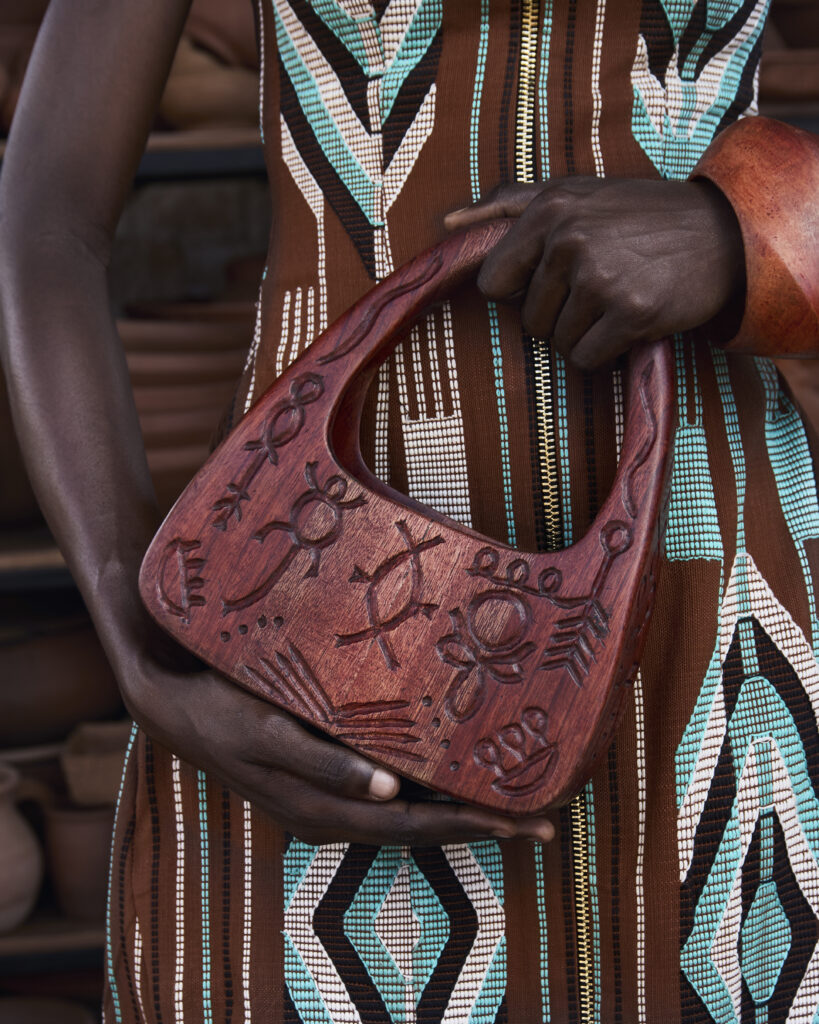
The woodwork story is personal. Agu’s father ran a wood carving studio that produced parquet flooring and carved objects for both domestic sale and export. When she returned to that world recently, many of the artisans her family had worked with had died. Those still living were in difficult circumstances. Rather than treat this as background atmosphere, Agu made it operational: she commissioned the surviving carvers to produce handcrafted bags from aged and reclaimed mahogany and ebony. “Whatever they would earn making a bed, I would pay them more to create something for the collection,” she says. Some of the materials came from unfinished works left behind by artisans who had passed away, acquired directly from their families. The result is a series of carved wooden bags and one-of-a-kind bangles that sit within the collection not as novelty accessories but as functional objects with traceable provenance.
The weaving component addresses a well-documented structural problem. Nigeria’s textile infrastructure has eroded significantly over the past two decades, with domestic cotton production declining and synthetic fibres filling the gap. Agu spent time studying hand-weaving techniques and incorporated them into garments that range from graphic, boldly striped strapless column dresses to beaded and hand-painted pieces that reference the visual language of aso-oke without reproducing it literally. The striped dresses, shot three abreast against the pottery studio backdrop, are among the collection’s strongest images: clean geometry, hand-produced texture, no embellishment competing with the fabric itself.
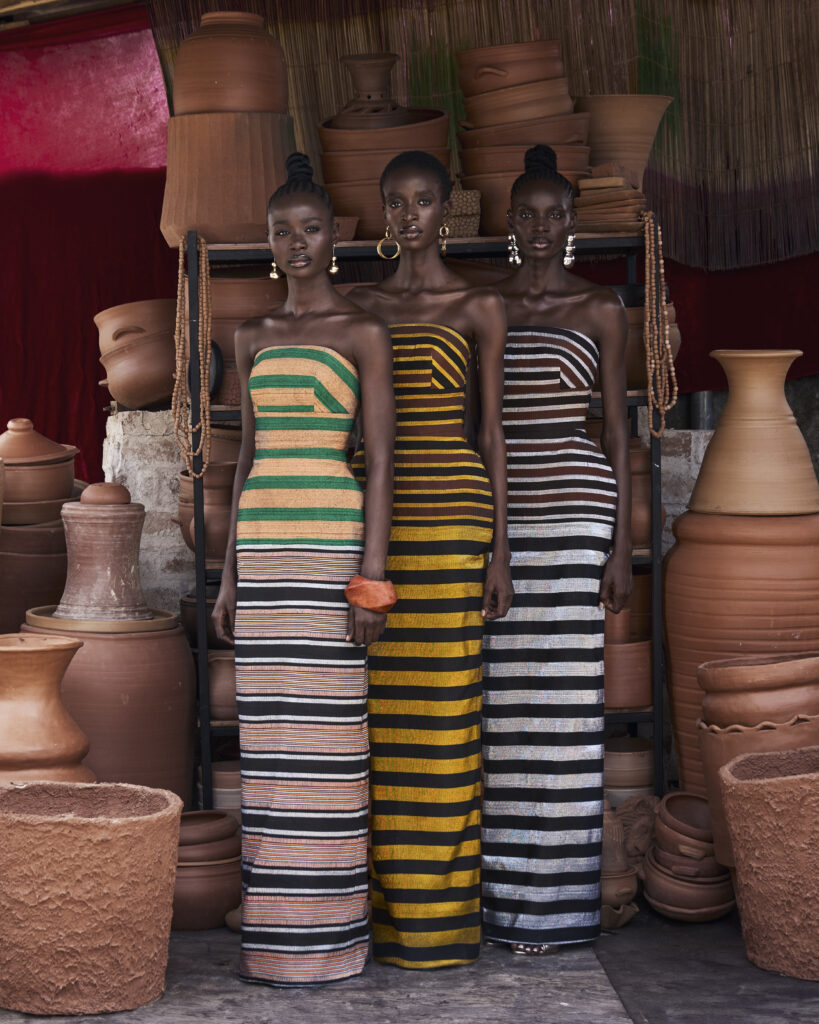
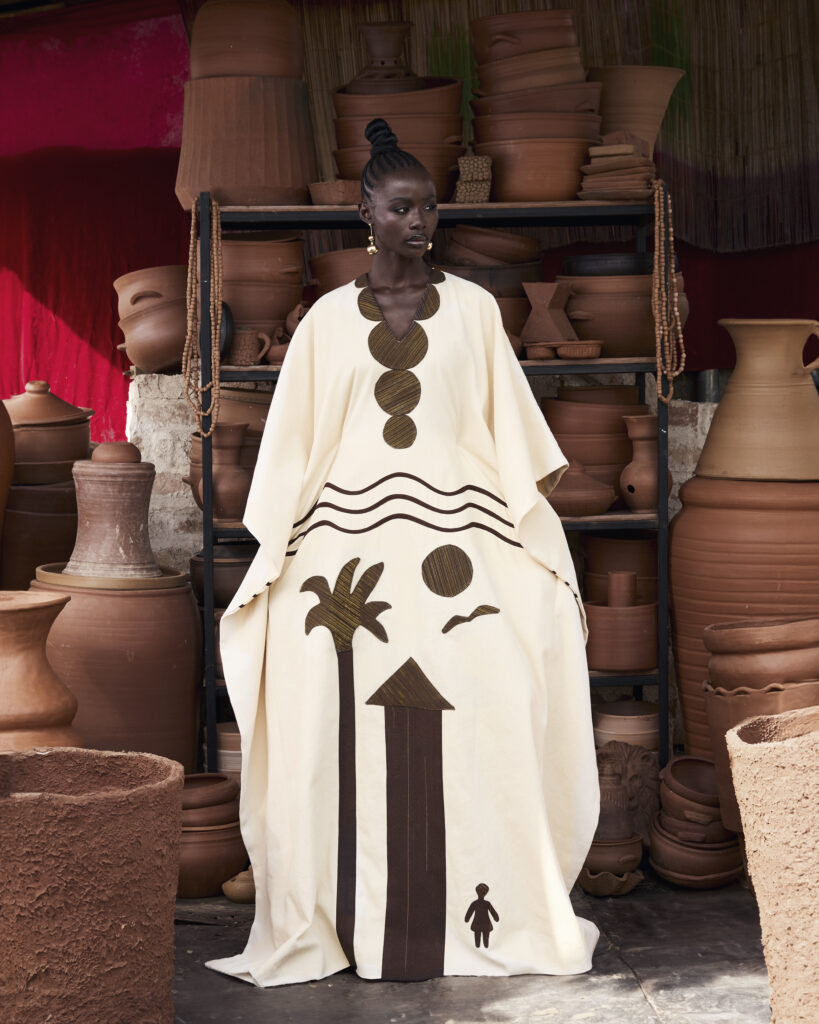
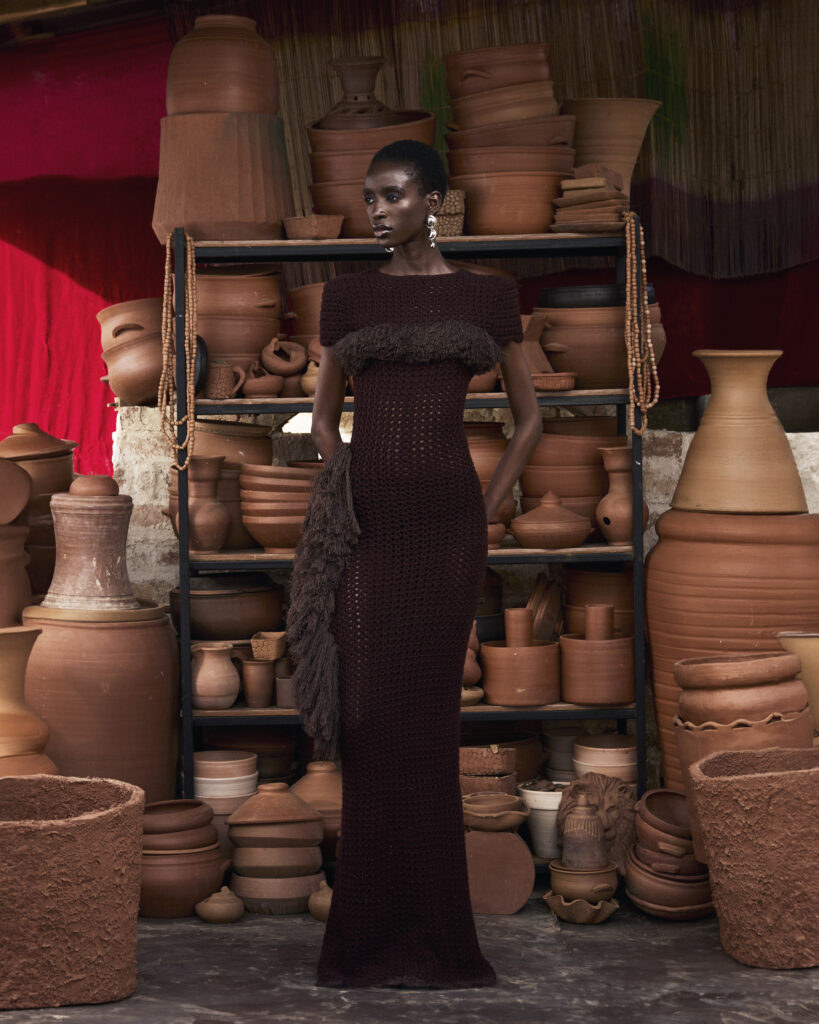
The third medium, pottery, is both subject and setting. Agu worked with a Lagos-based potter who produced clay beads for several pieces in the collection. “We even had a potter on our currency at some point,” she says, “which shows how valued the craft once was.” Today, that recognition has faded. The campaign imagery, shot entirely inside a working pottery studio surrounded by shelves of unfired vessels, makes the connection between garment and craft environment literal. The clothes do not sit in front of the pottery for visual contrast. They sit within it, as part of the same material world.
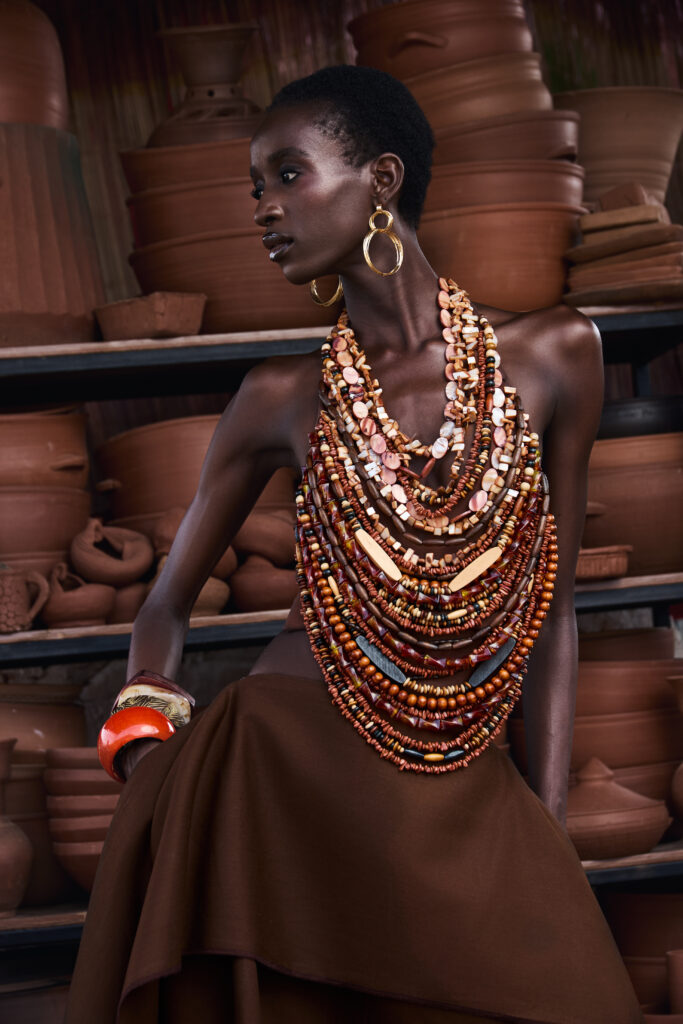
A series of garments developed from the painting residency carry hand-applied landscape compositions across their surfaces, with repeated motifs of palm trees, dwellings, and solitary figures rendered in appliqué and embroidery. These appear across several silhouettes, from fitted column dresses to voluminous caftans, and read less like prints than like paintings that happen to be wearable. Other pieces push further toward sculpture, with hand-constructed cord work radiating from the shoulders of fitted tops, and abstracted face compositions built from woven bustiers and appliquéd lips that turn the garment itself into a portrait.
What holds the collection together is not a single aesthetic through-line but a methodology. Hand dyeing, hand painting, hand beading, hand weaving, hand crochet, handcrafted woodwork: the techniques vary, but the commitment to manual process is consistent. It is also expensive. “Sampling is expensive and often where most of the cost lies,” Agu says. “You produce materials, realise they are not right, and start again. That is something people do not always see.”
This is a tension that runs through Nigerian fashion more broadly, and Agu is not the first designer to name it. “In Nigeria, handmade work is often undervalued, almost treated as ordinary,” she says. “Yet elsewhere, that same label increases worth.” But she is doing something specific with Akaoru that deserves attention: she is routing money directly to artisans working in disciplines that fashion typically borrows from aesthetically without supporting economically. The wooden bags are not “inspired by” carving. They are carved, by carvers, who were paid to carve them. The clay beads are not referencing pottery. They are pottery.
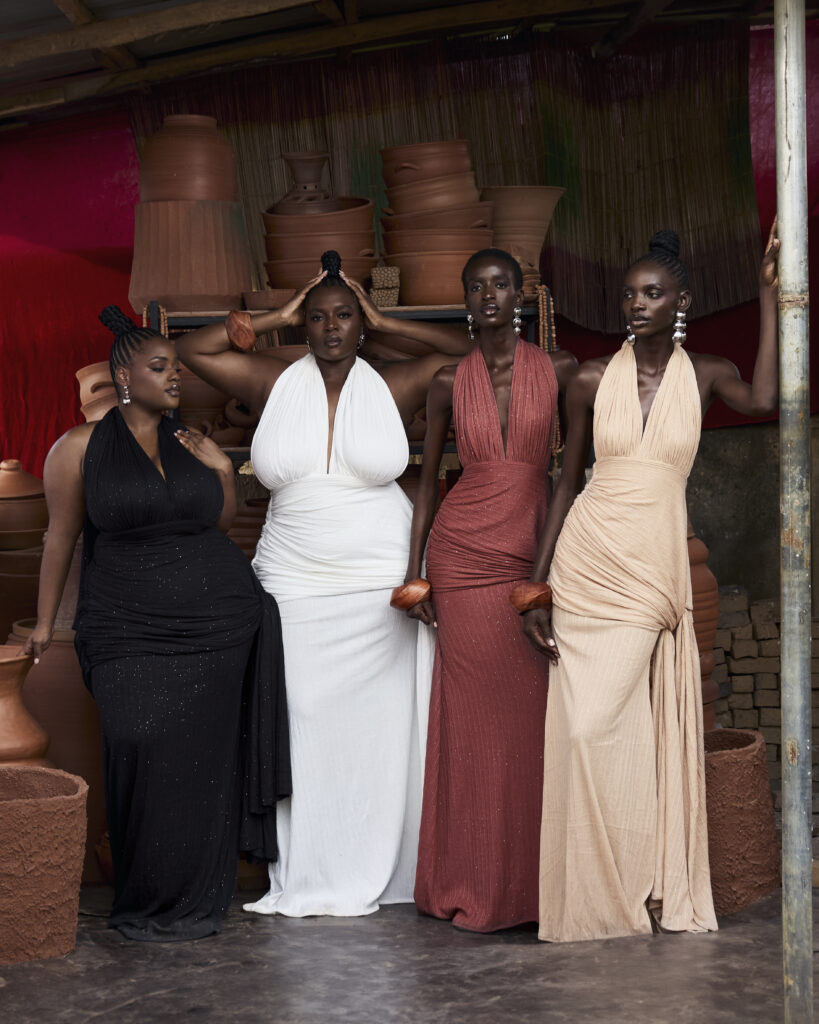
The collection also marks a deliberate expansion of Hertunba’s casting, with plus-size models featured throughout the campaign rather than in a separate edit. They wear the same face-motif bustiers, the same halter gowns, the same carved wooden bags. In one of the campaign’s strongest images, four models in deep-plunging halter gowns stand shoulder to shoulder across a range of body types and skin tones, and the clothes fit all of them as if they were always meant to. It is not flagged or footnoted. It is simply part of the collection.
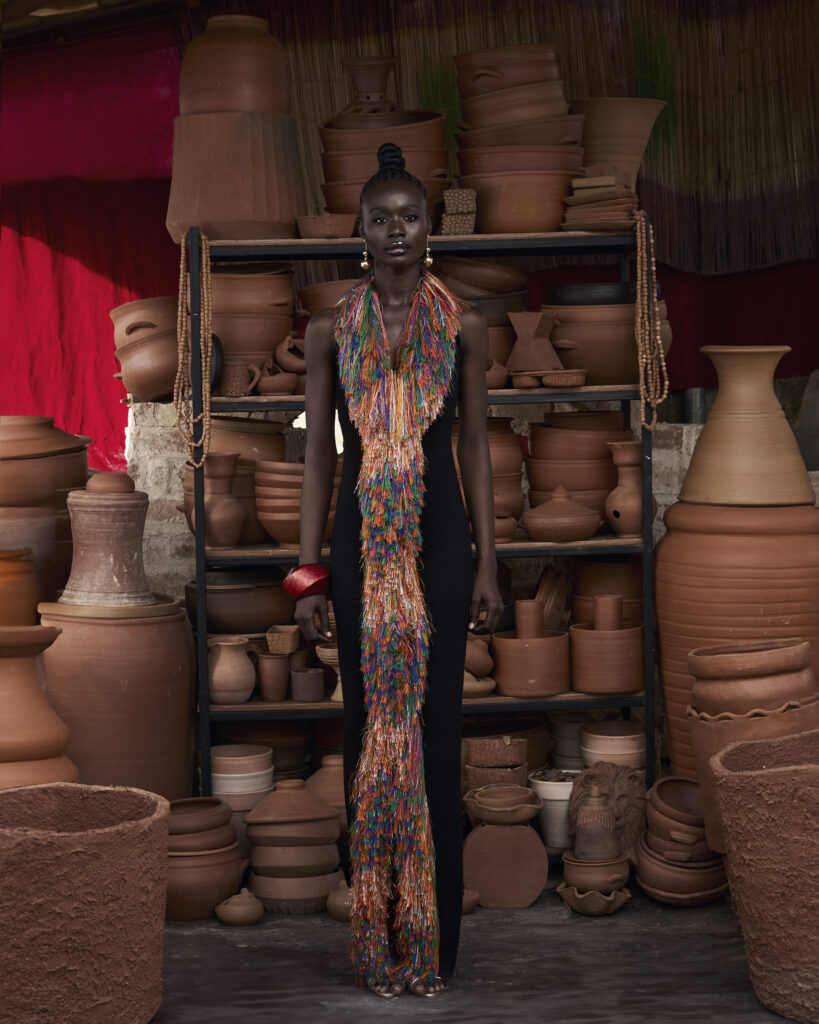
Akaoru is the kind of work that rewards patience from its audience in the same way it demanded patience from its maker. Hertunba is releasing the story in parts across its social channels, a decision that reflects both the depth of the collection and a recognition that the full weight of the process cannot be communicated in a single post. That instinct is correct. There is enough here for people to sit with.
Hertunba’s Akaoru collection is available online beginning April 12, 2026.