


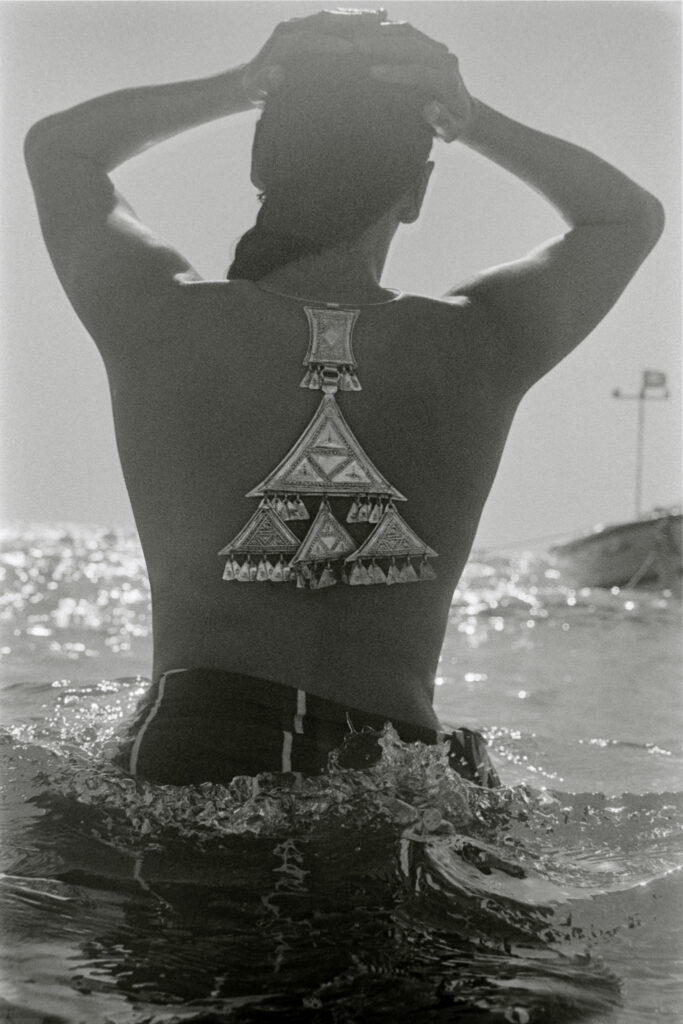
A Letter From Tounes is part of NOT A FAD, a long-term initiative from Fashion. Art. Development. (FAD) — a platform founded in 2020 to honor heritage not as something fixed or nostalgic, but as a living practice. Through design, artisan partnerships, and storytelling, FAD connects ancestral craft with contemporary aesthetics to reclaim narratives across the Sahel and its diasporas.
This editorial, shot in Hammamet, Tunisia or Tounes, as it’s called in Arabic brings that mission to life. Featuring Fatou Alhya Diagne and Amar Ghaly, and photographed by Dior Sow, the story unfolds at the threshold between land and sea, where cloth, metal, and memory become language.
Craft as Culture: The Melhfa and the Safaah
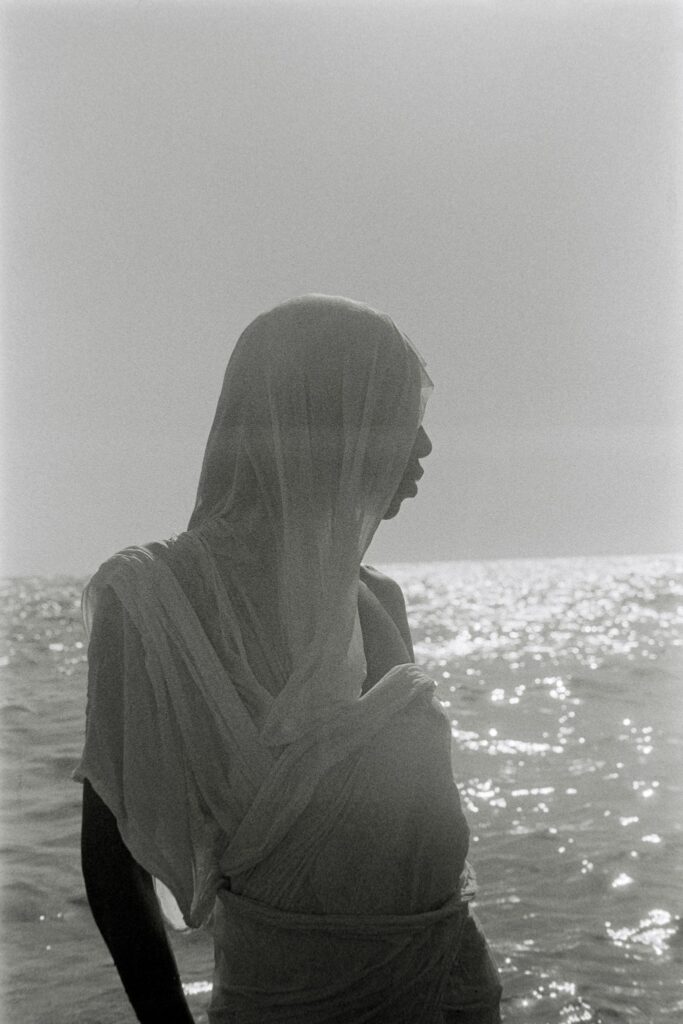
Fatou appears draped in a melhfa — a wide, flowing garment worn by women across the Sahel for generations. In white, it evokes salt, stone, and silence. But more than visual poetry, the melhfa is practical: a shield against heat and dust, and a garment shaped by both modesty and movement. It’s a foundational piece—adaptable, enduring, and deeply tied to those who wear it.
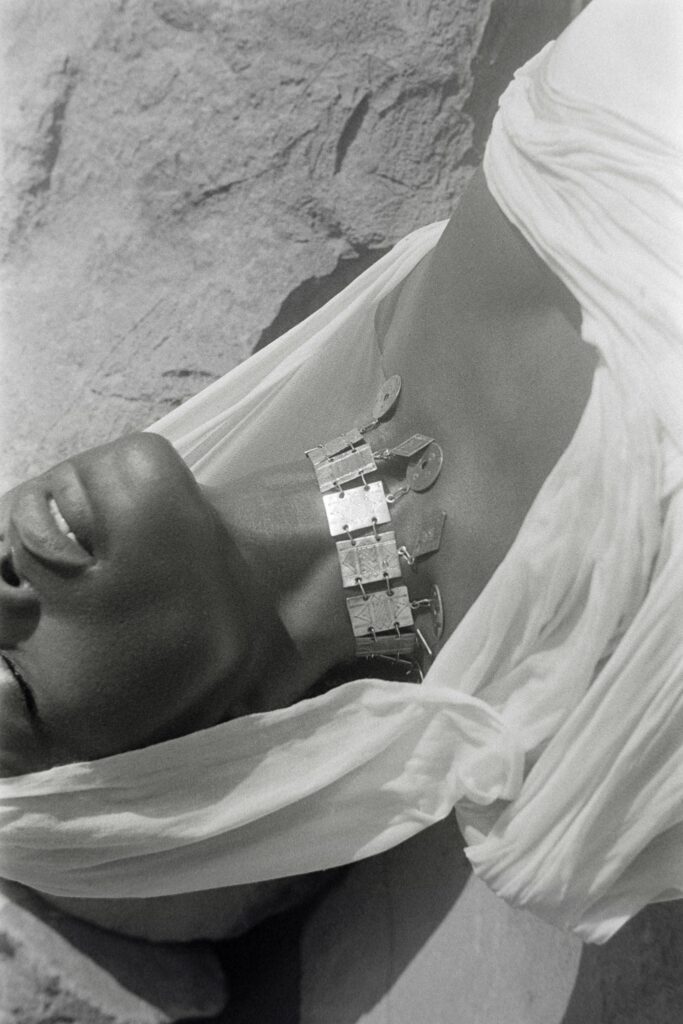
Around her neck rests the Safaah choker, a silver piece designed by FAD in collaboration with INDIGENIUS, and rendered through digital modeling inspired by Tuareg design codes. The choker carries both traditional symbolism and futuristic edge. It gleams with protective energy, referencing Nigerien and Sahelian amulets believed to guard against the evil eye. In this context, it’s more than jewelry — it becomes an invocation, a design of resistance and remembrance.
The Washak Pendant: Tracing Memory Across the Spine
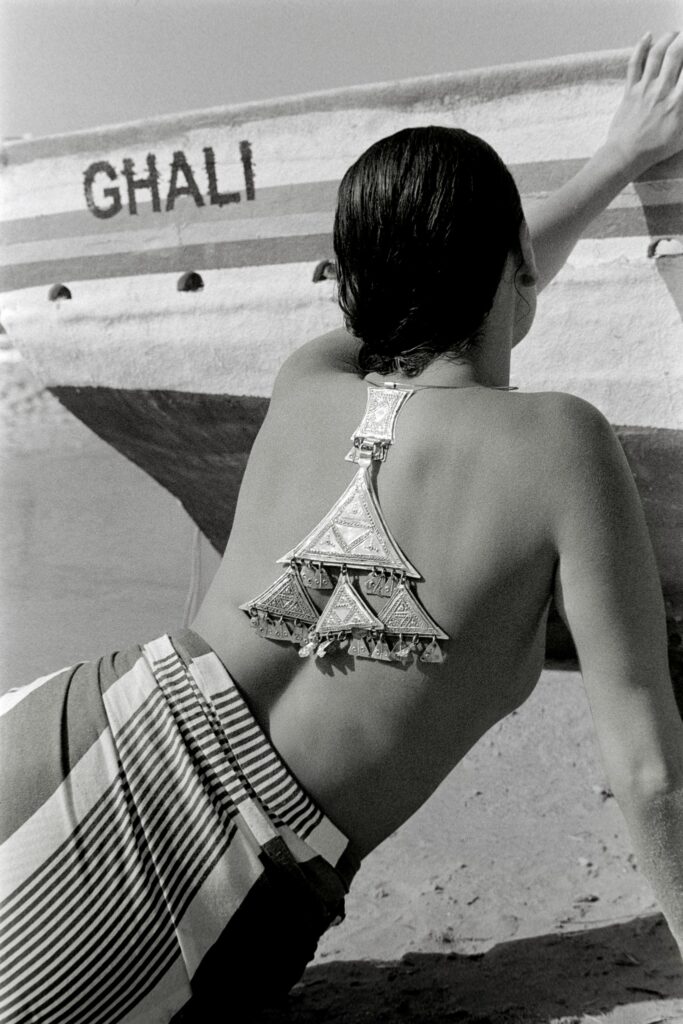
In a contrasting scene, Amar enters the sea. Across her back lies the Washak pendant, also known as Tcherot or Khoumeissa — a sacred emblem passed through generations in Niger and across Tuareg communities. Its presence is tactile and deliberate.
Historically worn close to the body, the pendant is both protection and inheritance. Here, its placement along the spine feels intentional — like history worn along the body’s centerline, anchoring movement in meaning. “It doesn’t merely sit on the skin,” the writer notes. “It presses into it like a memory carried forward.”
The Sahara as Bridge
The Sahel and North Africa are often described as separate regions, but history tells another story. The Sahara — often imagined as a barrier — has long functioned as a bridge, connecting communities through trade, symbolism, and craft. The motifs woven into A Letter From Tounes reflect this continuity: from the flowing fabrics to the architectural silverwork, from the desert in Niger to the shoreline in Tunisia.
Each item — the melhfa, the Safaah, the Washak — becomes a vessel of shared cultural codes, carried across borders and time. They remind us that craft moves. That clothing is also communication.
Editorial as Epistle
A Letter From Tounes is more than a lookbook. It’s a visual letter — an offering shaped by the hands of artisans, the force of memory, and the creativity of a new generation. It reflects on feminine expression, African artisanship, and the role of design in preserving what cannot be forgotten.
Heritage is not static. It lives, it adapts and most importantly, it speaks.
Editorial Details
• Title: A Letter From Tounes
• Location: Hammamet, Tunisia
• Creative Direction: FAD
• Photography: Dior Sow
• Talent: Amar Ghaly & Fatou Alhya Diagne
• Garment & Jewelry: Traditional melhfa and Washak pendant, sourced in Niger by FAD; Safaah choker designed by FAD x INDIGENIUS
• Initiative: #NOTAFAD