When Swedish/German photojournalist Nora Lorek first set foot in Bidibidi, northern Uganda—one of the world’s largest refugee settlement, home to over 250,000 South Sudanese—she did not expect to discover a textile tradition that would transform her work. It was 2017, and she had come to document Uganda’s refugee response, curious to understand how a functioning community could emerge amid such displacement.
It was there, working with a young translator named Asha Catherine Ngonga, that Nora first heard the word milaya.
“Bedsheet,” Asha explained.
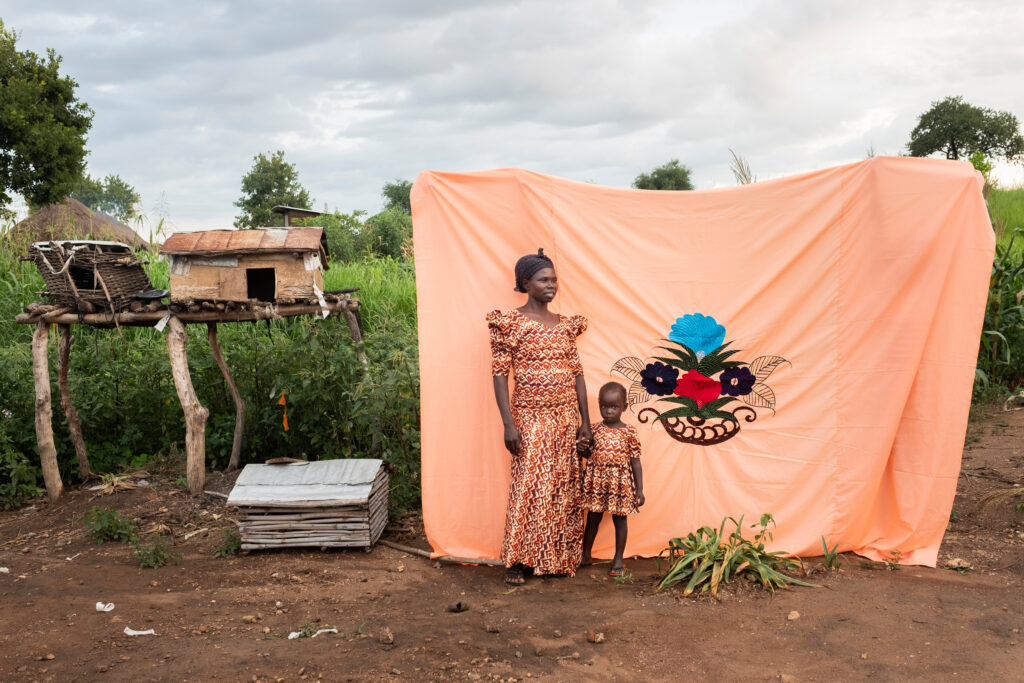
At first, Nora was puzzled—why would families fleeing war carry something so ordinary? But Asha revealed its deeper meaning: in South Sudan, women pile their belongings into a sheet, tie it into a bundle, and carry it as they flee. The milaya is practical, yes, but it also carries profound symbolism—home, memory, and survival.
The next morning, Nora asked to see these sheets. She expected plain, worn fabrics. Instead, women unfolded stunning hand-embroidered pieces—some decades old, others newly made—each dense with stitches, patterns, and patience. These were heirlooms: dowries, wedding gifts, funeral shrouds, sacred coverings. They were as much works of art as they were vessels of life.
“I was completely struck,” Nora remembers. “The artistry, the pride—these women had carried so little from home, but they had carried this.”
She began photographing families with their milayas—portraits that captured not only displacement, but also dignity. When the story was published, readers reached out with the same question: How can we support these women? How can we buy this art?
At the time, the answer was nearly impossible: fly to Uganda, drive twelve hours north, and hope to find the right community.
Together with journalist colleague Nina Strochlic, Nora decided to build a bridge. They had met while reporting for National Geographic in 2017. Two years later, they co-founded The Milaya Project, a nonprofit organization in Bidibidi that works with South Sudanese women to transform their embroidery into a source of livelihood and cultural preservation.
The Milaya Project was born not just as a marketplace—but as a lifeline for tradition, livelihood, and pride.
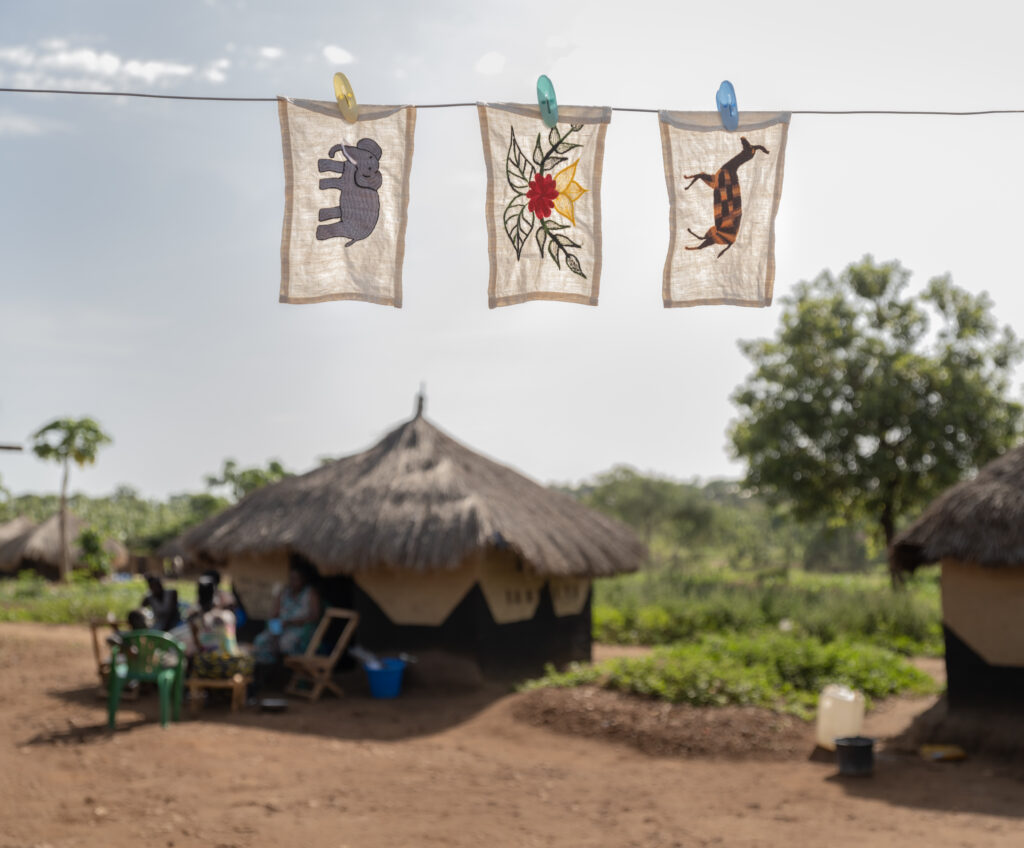
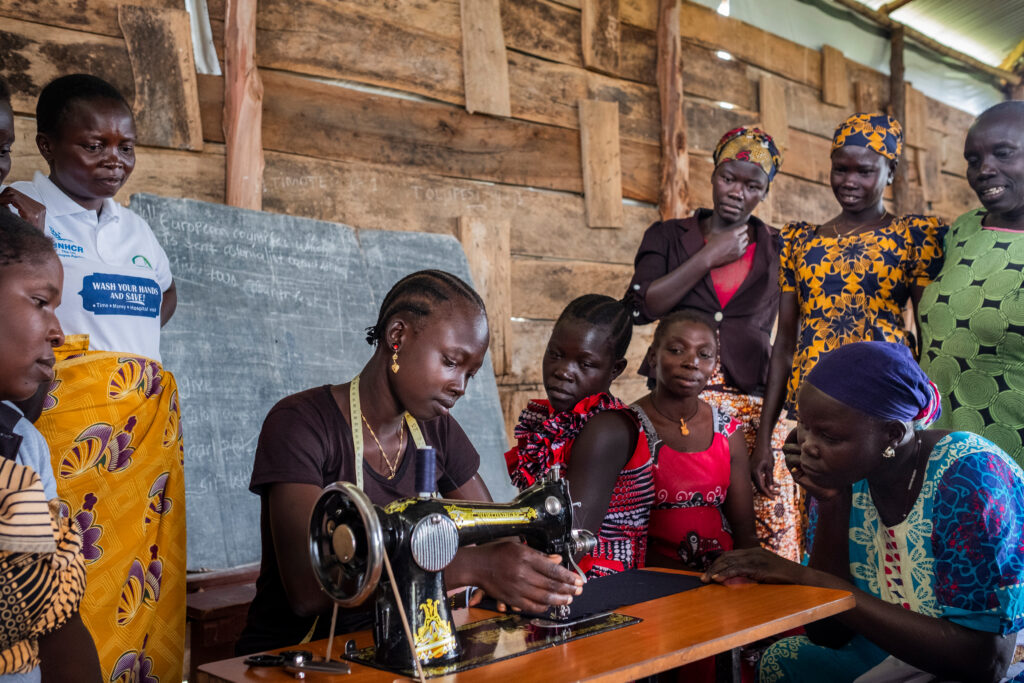
A milaya is no ordinary sheet. Large and thin, it is covered in embroidery so dense that the fabric grows heavy in the hand. Each one can take a week or more to complete, often stitched in fragments between cooking, farming, and childcare.
Traditionally, men drew the patterns while women embroidered—but in the settlement, the women don’t yet draw themselves. They are currently learning design, directing what should be drawn while others trace the outlines.
In South Sudanese homes, milayas mark life’s milestones. They drape beds to welcome guests, wrap newborns, cover coffins, and hang in churches during weddings and funerals. Smaller ones shield televisions or tables from dust. From birth to death, the milaya is present.
Nora, who grew up sewing, was stunned that such artistry was considered everyday.
“Why has no one outside seen this?” she wondered. “Why isn’t this recognized as art?”
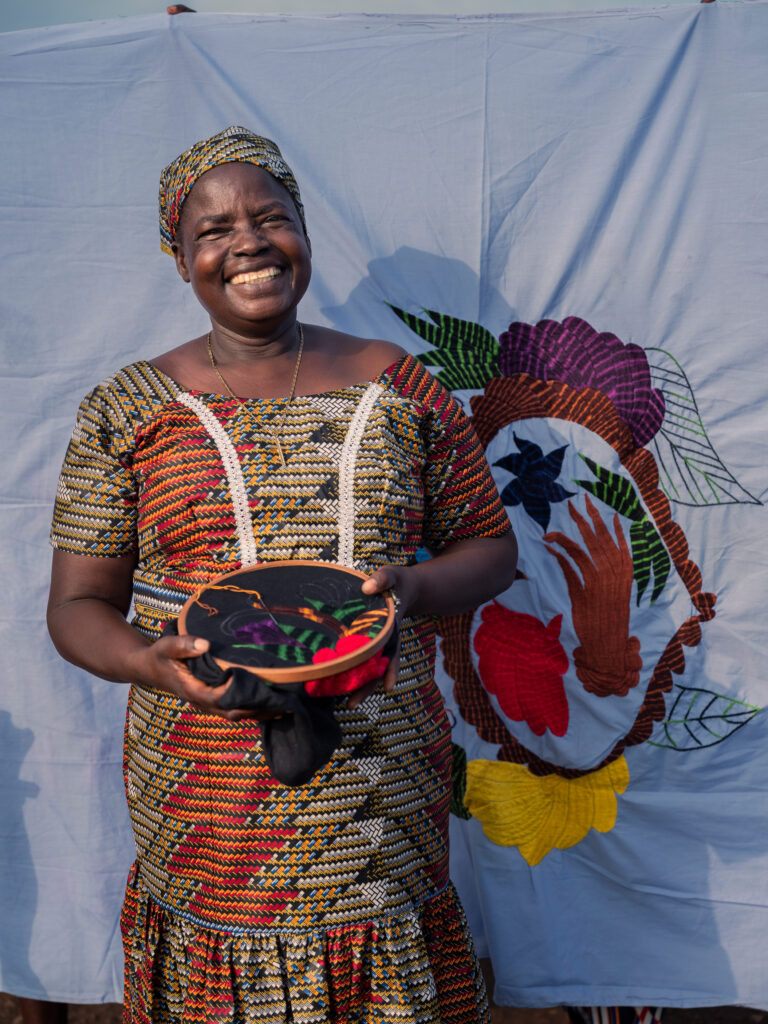
When Nora first arrived, new milayas were rare. Money in Bidibidi went to food or school fees, not fabric or thread. Most women only had the sheets they had carried from South Sudan.
“I remember one woman working on a milaya she had started back home,” Nora recalls. “That was the exception.”
The Milaya Project changed that. By supplying materials and fair pay, women could embroider again—not only for income, but for themselves. Grace Diko, one of the artisans, recreated a peacock design she had once stitched for export, this time to keep in her own home.
“It was moving to realize that, after working for the project, they still wanted these pieces for themselves,” Nora says. “It showed me the designs weren’t just for a market—they held deep personal meaning.”
Asha’s journey captures the spirit of the project. She began as Nora’s translator, traveling with her little boy, Elvis, and carrying the only milaya she owned. Later, she became the project’s first Field Coordinator—managing logistics, assigning designs, and bridging communication between the team and the women’s groups.
Today, Asha lives back in South Sudan, but her role paved the way for others. Brenda Vivian and Betty Yangi now share the position of Field Coordinators, continuing her legacy. Nora often works alongside sisters Charity Gaba and Unia Ataya Alfred, who frequently collaborate on a single milaya—a quiet symbol of sisterhood and shared creativity.
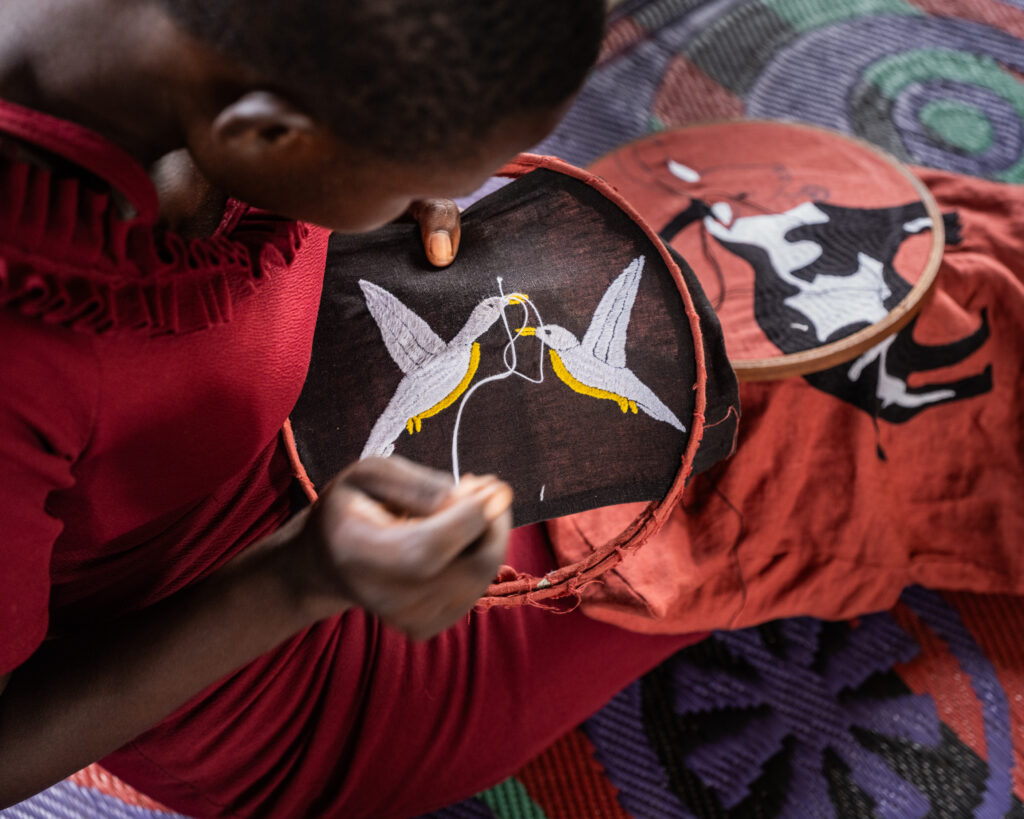
The project’s impact is visible in the smallest, most human details.
“You can often tell who is part of the Milaya Project,” Nora says. “The food they eat, the clothes they wear, the fact their children are still in school.”
When food rations in Bidibidi fell from twelve kilos per person per month to just three, embroidery income filled the gap. It became survival—but also structure, purpose, and dignity.
“I’m a freelancer,” Nora explains. “If I go a week without work, I feel purposeless. Imagine years in a refugee settlement, with no certainty of the future. The Milaya Project gives women meetings to attend, work to complete, even just a reason to charge their phone and connect. That structure is as important as the money.”
In Bidibidi, these “small” things—food, clothes, health, and the ability to keep children in school—are the big things. Education beyond the settlement’s basic level often requires moving to nearby towns, something now possible for families involved in the project.
And then there is the craft itself: the joy of making, the pride in stitches passed from mother to daughter, neighbor to neighbor.
“The resilience,” Nora reflects, “is in the persistence. Even in the hardest times, the women keep embroidering. For them, it’s essential.”
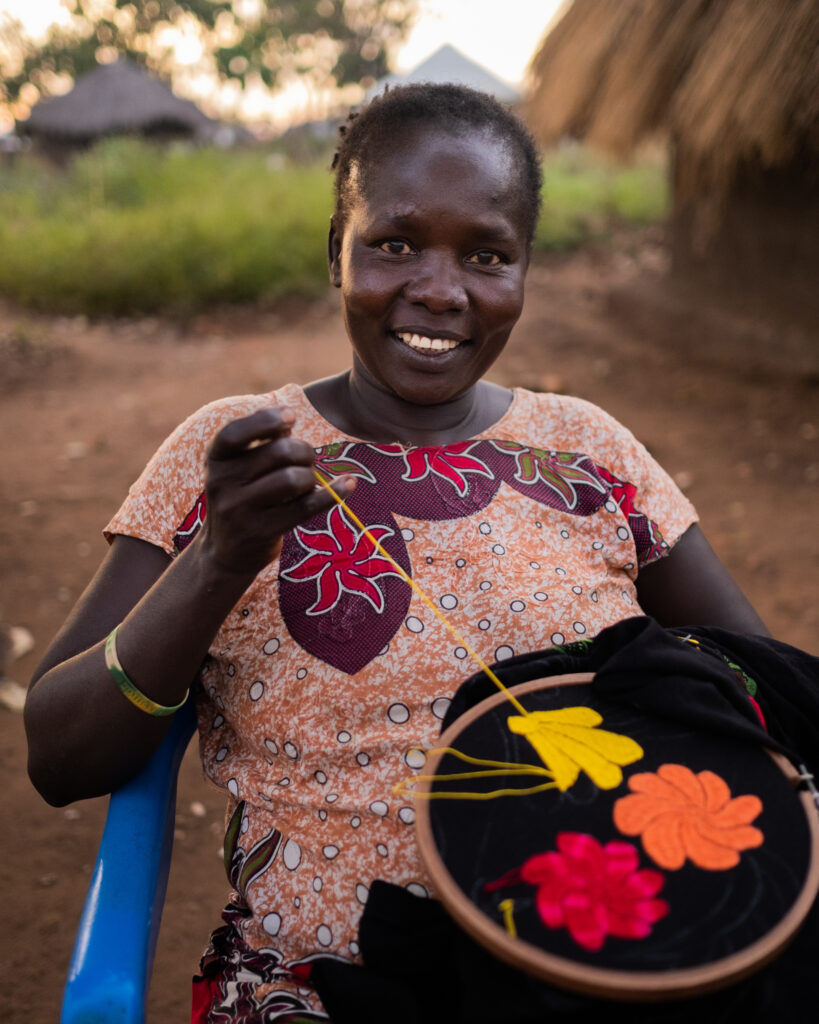
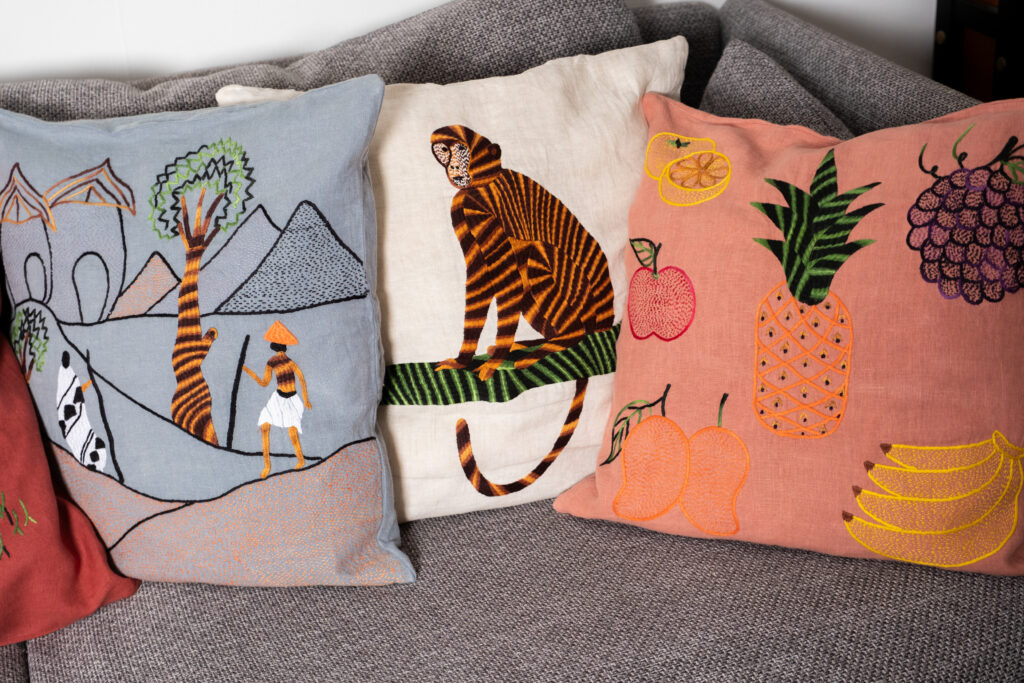
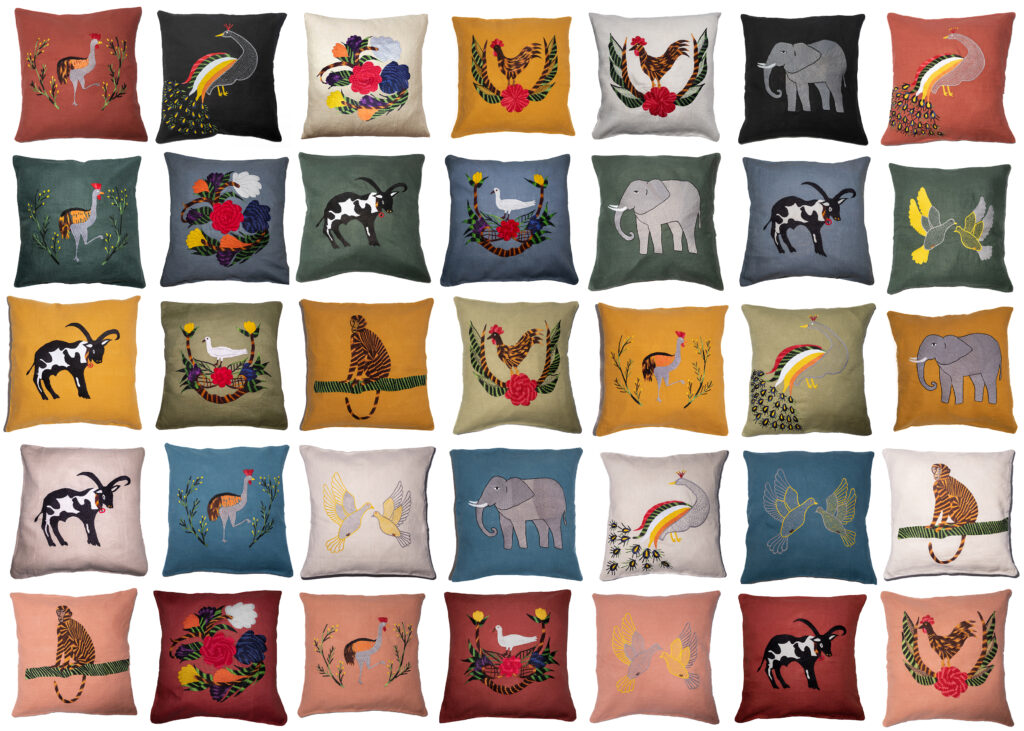
Adapting the milaya for an international audience required both creativity and care. The project now produces pillows, wall hangings, and collaborative pieces—preserving the intricate artistry while making the work more accessible.
Patterns often emerge from collaboration: coordinators suggest ideas, or women draw inspiration from daily life. Those who don’t draw themselves give detailed direction to those who do. One elephant motif, for instance, took over a week of refinements before the artisans finally said, laughing, “Now it looks like an elephant.”
The Milaya Project has also bridged worlds through exhibitions and artistic collaborations. In Gothenburg, Sweden, portraits from the women’s homes were printed on fabric and brought back to the settlement, where they embroidered over them. These collaborative works were later exhibited at the Hasselblad Center, transforming photography into living textile art.
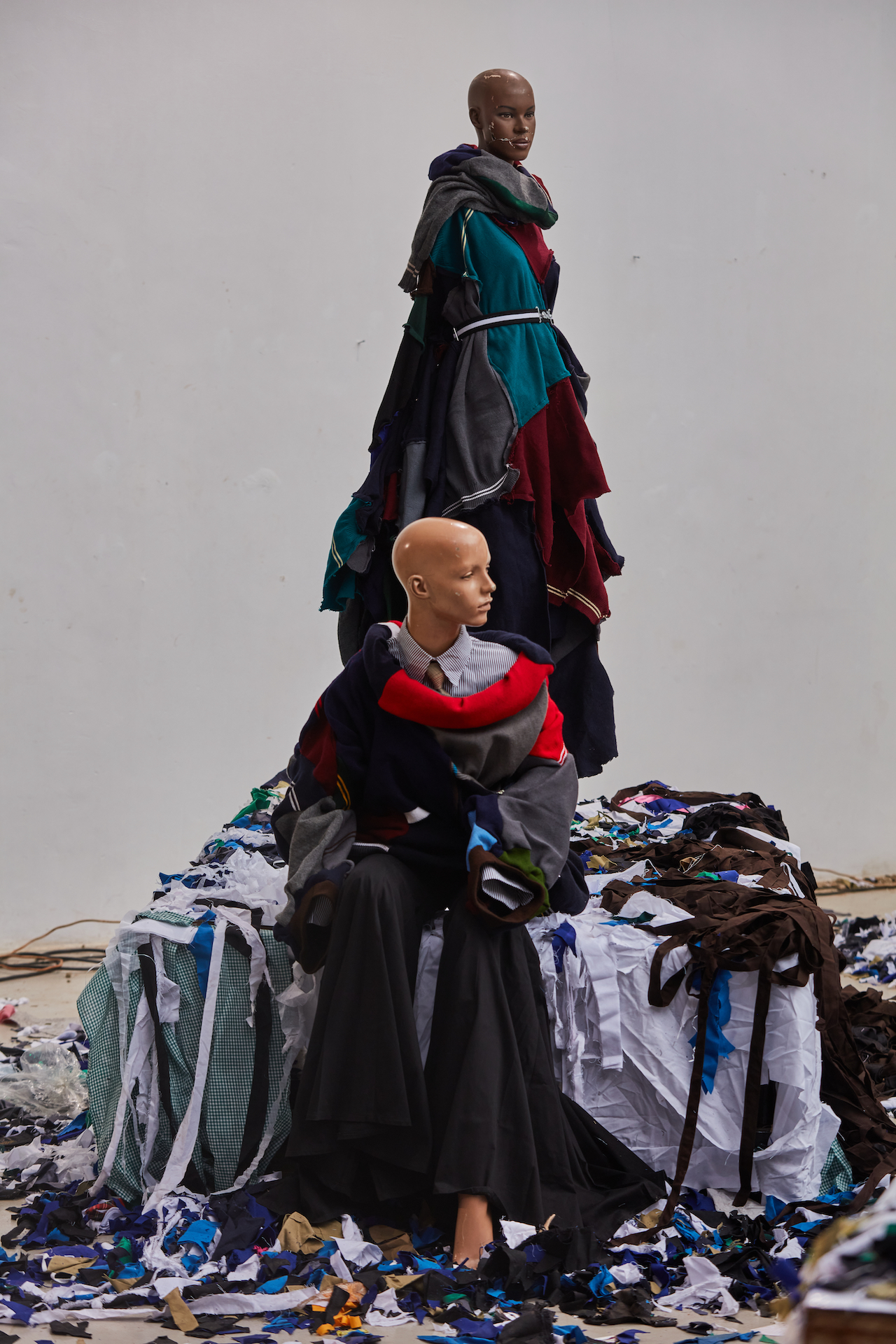
In Uganda, the project partnered with Buzigahill, the Kampala-based fashion brand founded by Bobby Kolade, known for repurposing secondhand clothing in his Return to Sender collections. Through this collaboration, Milaya artisans embroidered reclaimed fabrics—blending traditional South Sudanese craftsmanship with contemporary design.
Today, their embroidered works reach audiences from Kampala to Japan, carried through exhibitions and ethical fashion collaborations that prove the milaya’s artistry can transcend borders.
Visitors approach these pieces with reverence: some admire the craftsmanship alone; others, learning the stories behind the stitches, are visibly moved.
“That reaction—’Why haven’t I seen this before?’—was the same one I had,” Nora recalls.
For the women, this recognition is deeply personal. Photos of their work displayed abroad are sent back to Bidibidi, offering tangible proof that their artistry resonates far beyond the settlement.
“Knowing their embroidery has reached the world gives them joy and motivation,” Nora says. “It’s a reminder that their stories are being carried forward.”
At its heart, the Milaya Project is about more than craft. It is about women rebuilding meaning amid uncertainty—and a tradition that continues to stitch resilience across generations.
Every milaya tells a story: of displacement and survival, of chickens and fruit, of peacocks and elephants, of laughter around the embroidery circle. They are not just bedsheets.
They are archives of life itself.
And as long as women keep embroidering, the threads will not break.
Nora Lorek is a documentary photographer based in Gothenburg, Sweden. Her work focuses on forced migration, culture, and human rights. In her long-term projects, she builds stories collaboratively with those she photographs—using visual storytelling as a tool for advocacy and change.
Nina Strochlic is a journalist and writer who has covered conflict, migration, human rights, and culture in 23 countries. A former staff writer for National Geographic, Newsweek, and The Daily Beast, her work has appeared in The Washington Post, Foreign Policy, Atlas Obscura, and VICE. She holds a degree in journalism from the University of Oregon.
Together, they co-founded The Milaya Project in 2019—uniting storytelling and craftsmanship to honor South Sudanese women’s embroidery traditions, ensuring that even in exile, the threads of home endure.
To learn more about The Milaya Project and view available embroidered pieces, visit milayaproject.org. All proceeds support South Sudanese women artisans in Bidibidi. Follow their journey at instagram.com/milayaproject.