Some artists paint what they see. Modou Gueye paints what stays with him.
Born in 1990 in Pikine, Senegal, and now living between Dakar and Barcelona, Gueye creates from a place where memory meets ritual, and where the ordinary is reborn as sacred. His work doesn’t seek to explain, it seeks to remember. Not with nostalgia, but with intent, tenderness and defiance.
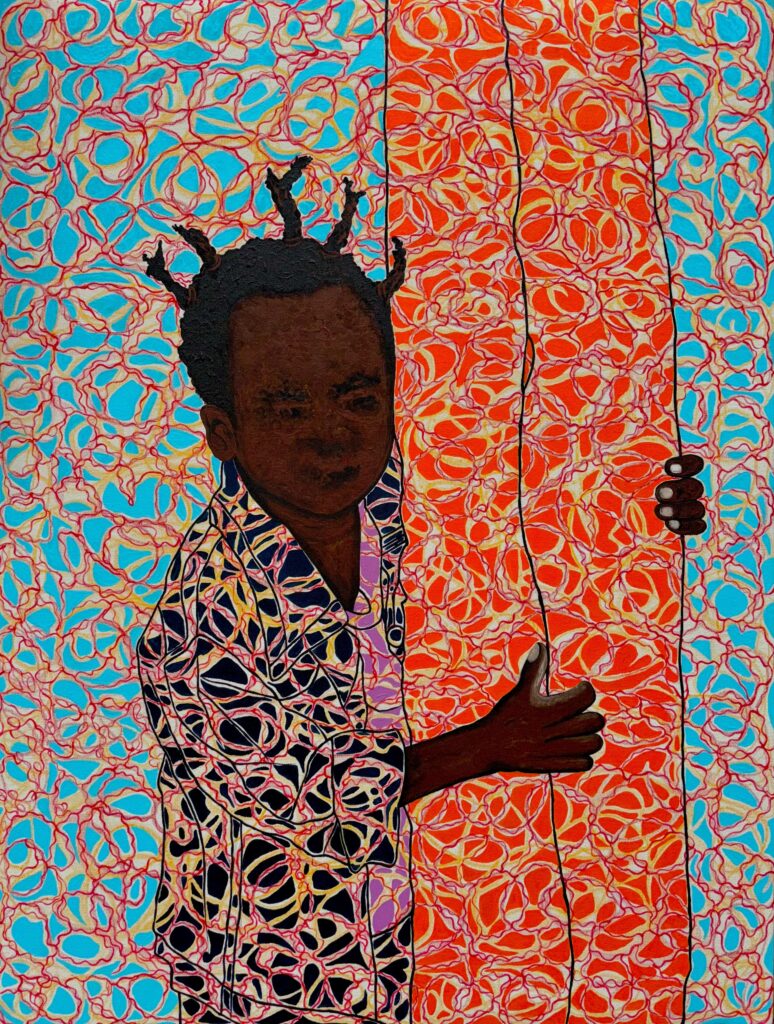
In his acclaimed series, Les Nattes de Mon Enfance (The Mats of My Childhood), Gueye turns to two deeply symbolic elements from his upbringing: the ubiquitous woven floor mats of West African homes and the intricate braids sculpted by women’s hands. Together, they form a visual language of care, intimacy, and continuity. Together, they resist disappearance.
“Those mats weren’t just furniture. They were the architecture of our lives,” Gueye explains. “We ate, we laughed, we prayed, we braided our hair on them. They were our ground. Our foundation.”

The French word nattes carries this beautiful double meaning: floor mats and hair braids. Both are woven. Both are cultural. Both require patience, rhythm, and presence. Gueye weaves them into his paintings like a griot of texture and pigment, inviting the viewer to enter his world not as outsider, but as kin.
The series began with a single moment. Gueye discovered an old mat—frayed, discolored, tucked away in the corner of his home. But it carried more than dust.
“When I touched it, it was as if it breathed. It had absorbed stories. I could hear the voices of my childhood again.”
That moment became a portal. On canvas, Gueye began to braid memory back into form. Working with acrylics, scraps of fabric, fingerprints, and texture, he constructs tactile surfaces that echo the feel of woven mats and the softness of freshly braided hair. His palette is intuitive—dusty reds, deep blues, ochres kissed by light.
“Each color holds emotion. It’s never random,” he says.

The repetition of mats and braids across his paintings acts like a mantra. An ancestral echo. Each line, each weave, each gesture becomes an offering not only to his own past but to the diasporic present.
“Diaspora is not just distance. It’s fragmentation. Displacement. But through art, I’m able to reconnect the pieces—to myself, to my people, to a visual tradition that is ours.”
For Gueye, these paintings are not simply about memory—they are about power. In a world that often demands performance and spectacle from African artists, he instead turns inward. He reclaims tenderness as an act of resistance.

The women in his life are central to that tenderness.
“My mother, my grandmother, my aunts—they were the first artists I ever knew. They braided hair with the precision of sculptors. They laid mats with the care of architects. Their work was never seen as ‘art,’ but it was the most sacred form of creation.”
Through his paintings, Gueye honors those everyday gestures. He elevates them from background to center stage.
“A braid is not just a hairstyle,” he says. “It’s knowledge. It’s inheritance. It’s history passed hand to hand.”
The act of mat-laying and hair-braiding becomes metaphor for cultural endurance. In the diaspora, where roots are often severed or sanitized, Gueye’s work insists that we remember what shaped us—not through museum labels or archives, but through scent, skin, and silence.
“I’m not painting nostalgia,” he says. “I’m painting presence. What’s still with me. What still breathes.”

In today’s global art world, African creators are too often asked to fit into prefabricated narratives. But Modou Gueye rewrites the frame. He paints not to be understood, but to be felt. His work does not translate Africa—it transmits it, in its own rhythm, its own temperature, its own truth.
After one exhibition, an older woman approached him, tears streaming. She said his work had taken her back to her childhood mat—the scent of coconut oil, the sound of braiding, the feel of her grandmother’s hands.
“She told me she hadn’t cried in years,” Gueye remembers. “But the work opened something inside her. That’s when I knew—it’s not just my memory I’m painting. It’s ours.”
Now based between Dakar and Barcelona, Gueye is preparing for a solo exhibition in Spain and working on an interdisciplinary residency that brings African and European artists together around the theme of shared memory. He’s also exploring new mediums: textiles, installation, soundscapes—immersive worlds where people don’t just see the work, but step into it.
“I want to build spaces that feel like memory. Spaces that carry warmth, rhythm, breath. Spaces where you can find yourself—maybe even parts of yourself you forgot.”
And when asked what he hopes The Mats of My Childhood leaves behind, he doesn’t hesitate:
“That we never forget that beauty is born from care. That our culture lives in the repetition of the smallest acts. That diaspora isn’t rupture it’s reinvention. And that a mat, a braid, a memory they are not small. They are everything.”
All images courtesy of Modou Gueye.