
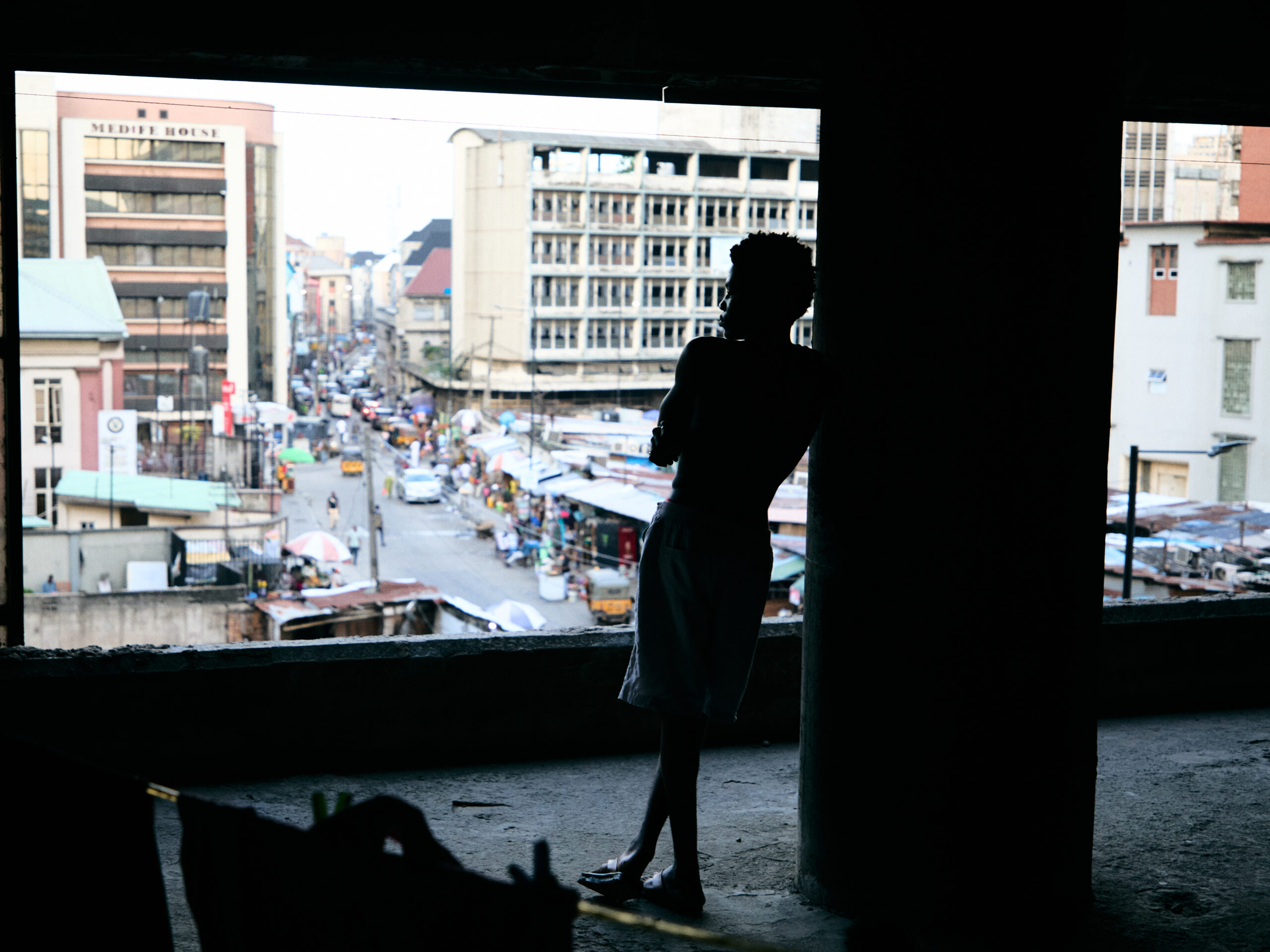
Berlin-based, Polish-Nigerian director Justyna Obasi has spent the last decade making images that feel like memories you didn’t know you had. Her commercials for Adidas, Google, and Meta shimmer with colour and intimacy; her music videos for Oumou Sangaré and Kaleo pulse with lived-in texture. But it is in the quieter corners of her work that the real conversations happen. Her new short film, Ritual, is perhaps the quietest—and most radical—thing she has ever made.
There is no title card yet, no spoken dialogue, no conventional three-act spine. There is only concrete, sky, and a group of boys on the edge of Lagos rehearsing what it means to become men.
The film’s origin story begins years before any camera roll. On a trip to Owerri, Imo State, Obasi found herself watching a group of street children who had turned an unfinished building opposite her hotel into a home. From her window she observed their daily choreography: bathing with buckets, sharing plates of rice, playing, fighting, sleeping in rows on bare floors. “They were living on the edge of society,” she remembers. “Free in one sense, trapped in another. And the space felt so distinctly masculine—the way they moved around each other, the unspoken rules, the small moments of correction. It wasn’t aggression exactly; it was ritual. Masculinity looked like something built through repetition, moment by moment, rather than something they simply were.”
That image never left her. When the opportunity came to make a new short—shot in Lagos, with a micro-crew, in the liminal weeks between commercial jobs—she returned to it. “I wanted to capture masculinity not as a finished product but as something still under construction, still wet, still able to take a different shape.”
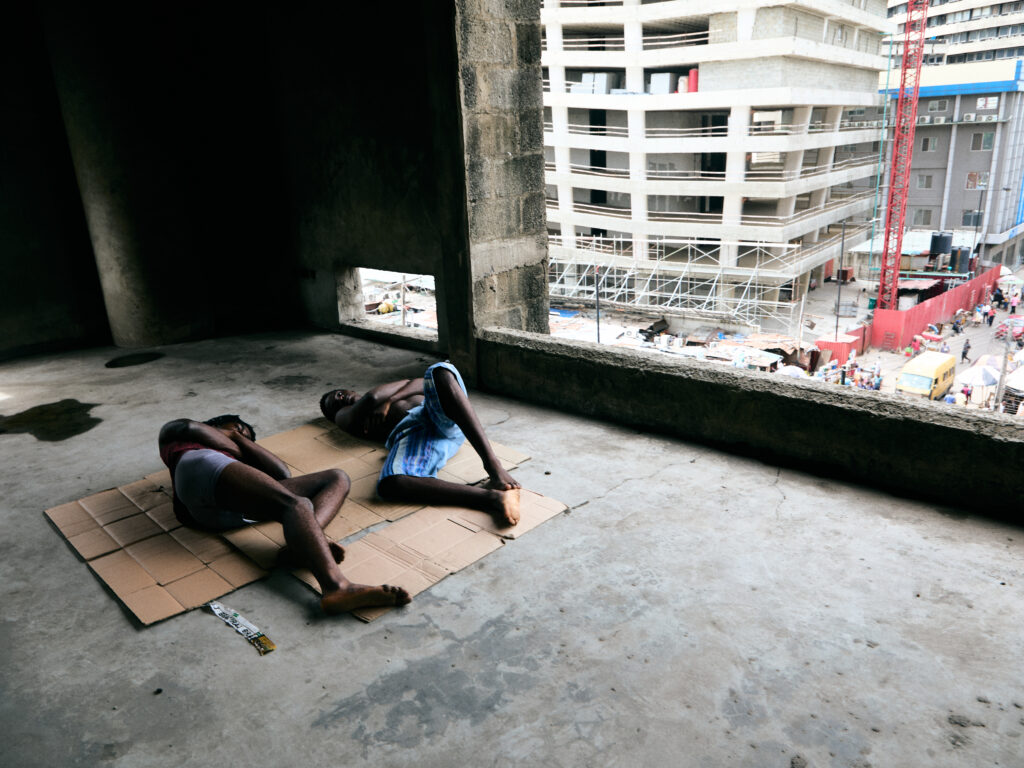
The unfinished building in Lagos is therefore not just a location; it is the film’s central metaphor. “We need those kinds of spaces,” Obasi says, “outside the mainstream, outside the father’s house with its painted walls and fixed expectations. An unfinished building has no final blueprint. You can still decide what goes where, what kind of man you want the structure to hold.”
Inside this concrete shell, a fragile community of boys has formed. They are not homeless in the sentimental sense; they are simply elsewhere, in a pocket where society’s usual scripts have not yet hardened. The camera watches them the way Obasi once watched from her hotel window—respectfully, at a slight remove. There is tenderness in the distance.
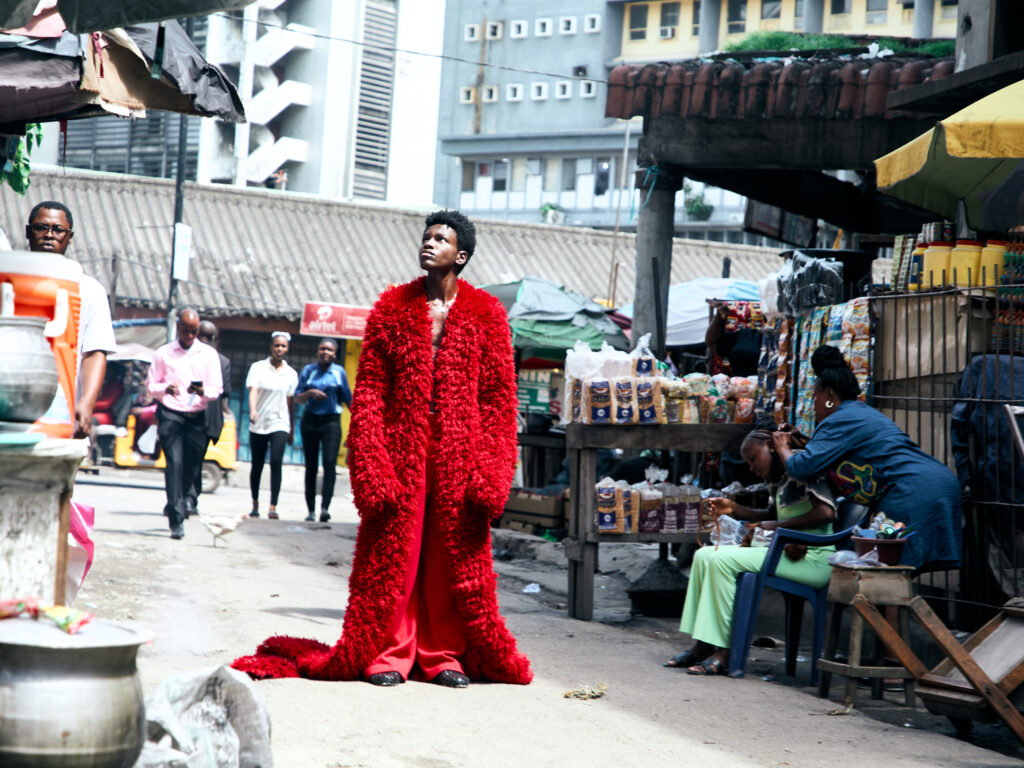
At the heart of the film is one boy and one garment: an oversized coat from Lagos label Oshobor. The coat is too big for him, too soft, too flamboyant for the environment it enters. His father—present only in memory and in the weight of expectation—would never approve. Yet the boy wears it anyway. He wears it like contraband. He wears it like a possibility.
Over the course of the film we watch him care for it with monastic devotion: carrying water in a red plastic kettle, soaking the heavy fabric in a bucket, wringing it out with both hands, spreading it across broken concrete to dry in the sun. These sequences are shot in extreme close-up—the water dripping, the weave of the cloth, the steam rising in the heat. There is no music at first, only the amplified sound of labour and breath.
“Those actions—soaking, wringing, drying—are about attention and responsibility,” Obasi explains. “In Igbo culture, and in many African cultures, you care for the things that represent you. The way you keep your clothes says something about the way you keep yourself. I wanted those small, repetitive acts to feel sacred, because they are. Tending to a piece of clothing becomes tending to an identity that is still forming.”
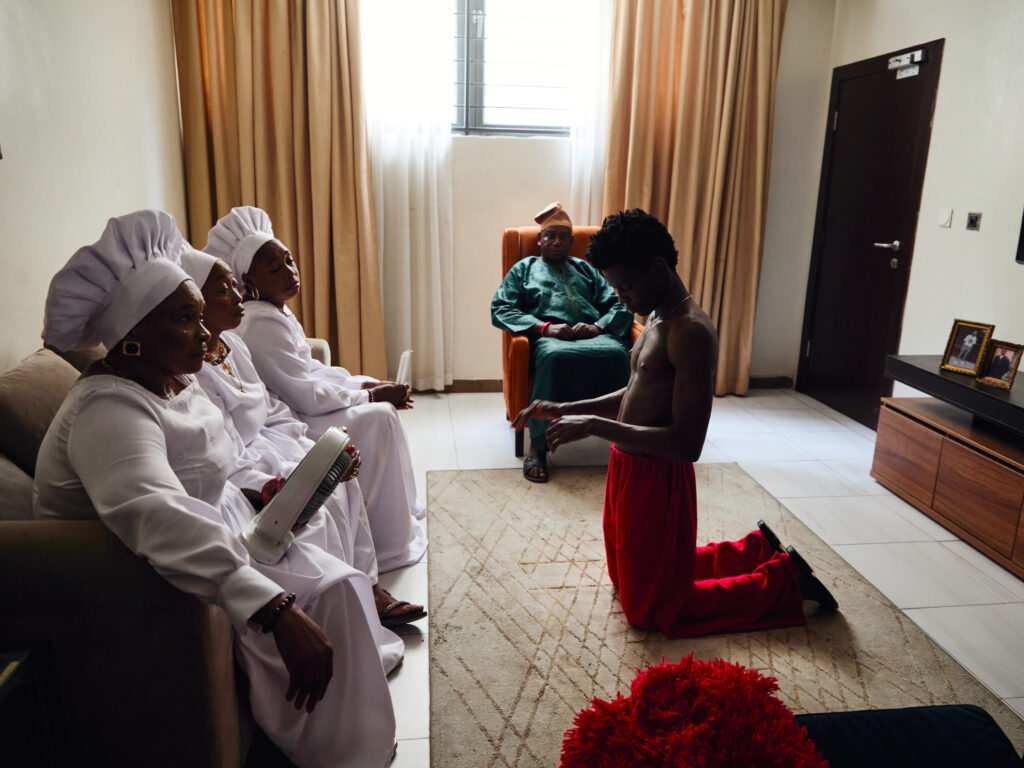
The collaboration with stylist Jahn Affah and with Oshobor was never superficial. The label’s eponymous founder built the brand around conversations—often difficult ones—between Nigerian fathers and sons. The clothes are oversized, textured, sometimes almost armour-like, yet they leave room for vulnerability. “The rawness of the fabric, the way it hangs heavy when wet and then light when dry, became a perfect externalisation of inner conflict,” Obasi says. “Tradition on one side, self-invention on the other. The coat carries legacy and rebellion at the same time.”
Affah added tiny, culturally precise details: a tree-bark pendant on a leather cord symbolising growth, the proud acrylics and gold jewellery of a passing Celestial Church woman grounding the film in a specific Lagos spirituality. Nothing feels like set dressing; everything feels like character.
Sound is its own protagonist. Lagos is one of the loudest cities on earth—generators, okadas, preaching, music—but Obasi rations its chaos. The roar of the city is allowed inside the unfinished building only at moments of pressure, when the outside world threatens to collapse the fragile interiority the boys have built. Otherwise, a gentle, almost childlike score (composed by a yet-to-be-announced collaborator) keeps the frame soft, hopeful, inward. “I wanted the audience to practise the same discipline the protagonist is learning,” Obasi says. “To stop listening to what Lagos expects of you and start listening to what is trying to grow inside.”
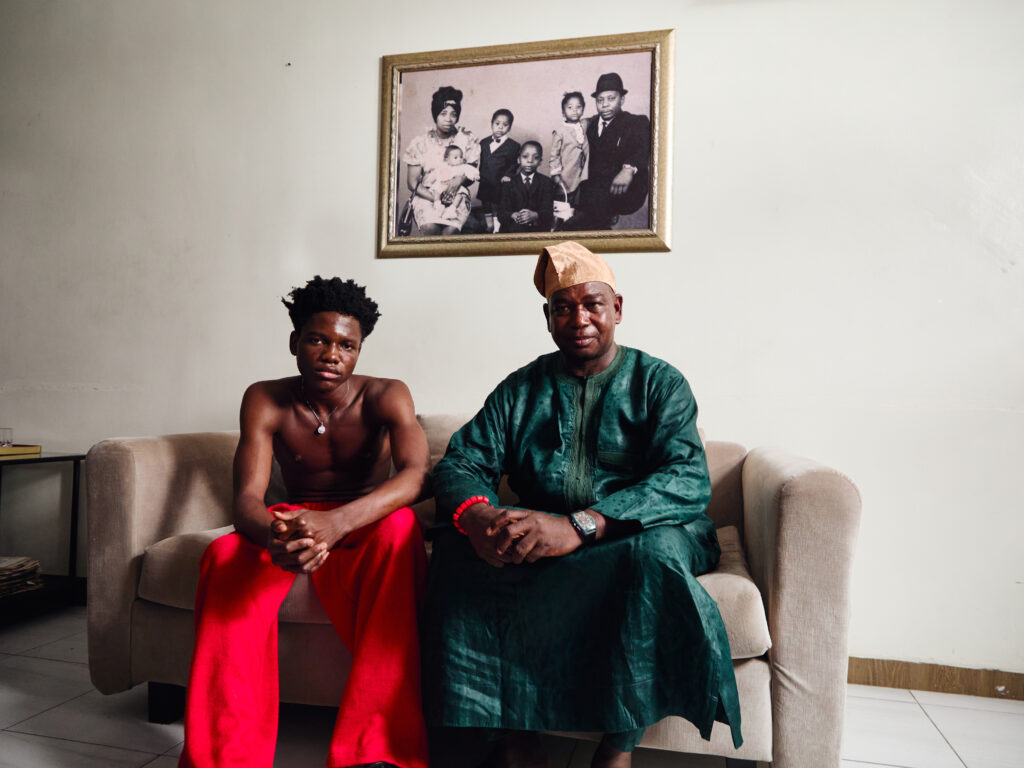
There is a father in the film, though we never see his face clearly. His presence is felt in posture, in silence, in the memory of disapproval. The coat is rebellion against him, yes—but it is also inheritance. The oversized shoulders echo the father’s own traditional agbada; the softness subverts it. The garment becomes a site where generations negotiate.
“I didn’t want a loud confrontation,” Obasi says. “In real life, these shifts rarely happen with shouting. They happen when a boy decides to wear something his father hates and then cares for it anyway. They happen in the quiet decision to keep the coat clean even when everyone laughs. Small, intentional acts, repeated daily—that’s where culture actually changes.”
When I ask what she hopes audiences carry away, Obasi pauses longer than she has in the entire conversation.
“I want people to notice the tiny rituals they already have for themselves every morning. How they fold their clothes, how they greet their reflection, how gently or harshly they speak to the parts of themselves that don’t yet fit. I want the film to say: those moments are not trivial. They are the places where we decide what kind of men we are going to be. Vulnerability is not the opposite of strength. It is the daily work that makes strength possible.”
Ritual is currently on the festival circuit, still seeking its first public screening. When it lands, it will likely feel less like a short film and more like a meditation you can inhabit. In under fifteen minutes, Justyna Obasi has built a sanctuary out of broken concrete and one carefully tended coat—a space where a softer, braver, self-invented African masculinity can, at last, begin to dry in the sun.
Guzangs is proud to present this exclusive first look at a work that refuses to finish its boys too early, that understands growing up is less about completion than about learning, every single day, how to carry yourself gently.
Production Credits
Photography: Arinzechukwu Patrick
1st AD: Ikuyajolu Segun
Casting Director: Shola Samaiye
Production Designer: Yussuf Ayomide Ekerin
Make-Up Artist: Kehinde Are
Cast: Greatness Peter, Ololade Emmanuel, Olodejo Williams, Odey Ikpa