
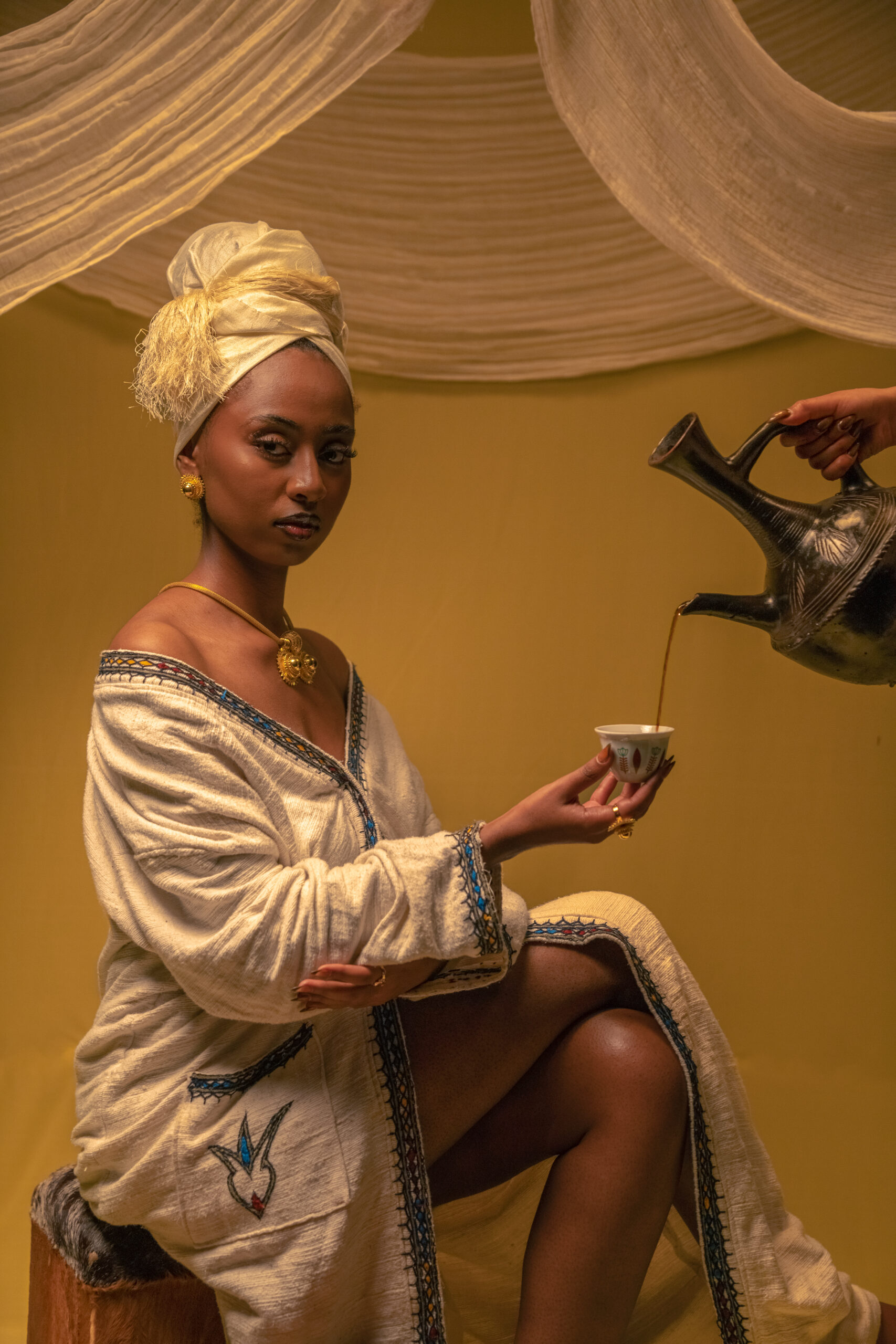
Long before coffee became a global commodity, legend placed its origin in the Ethiopian highlands. Kaldi, a goat herder, noticed his animals leaping with unusual energy after eating bright red berries from a wild shrub. When monks roasted and brewed those berries, coffee revealed itself not simply as a stimulant but as a practice of presence. In Ethiopia, coffee was never merely discovered—it was recognized.
That recognition continues to shape Ethiopian life today. In Coffee Ceremony, a visual series by Rekik Abiy, the ritual becomes both subject and method—part of a larger, three-part project exploring identity, authorship, and cultural participation within Addis Ababa’s rapidly evolving creative landscape.
“The project asks very simple but urgent questions,” Rekik says. “Who are we in this moment? Whose stories do we carry? And how do we consciously contribute to the culture we inherit?”
The work enters a dialogue first articulated in The Addis Reporter’s 1969 essay, “The Hyphenated Ethiopian.” More than fifty years later, the negotiation between global modernity and cultural responsibility remains unresolved. Rather than framing hybridity as loss, Rekik claims it as agency.
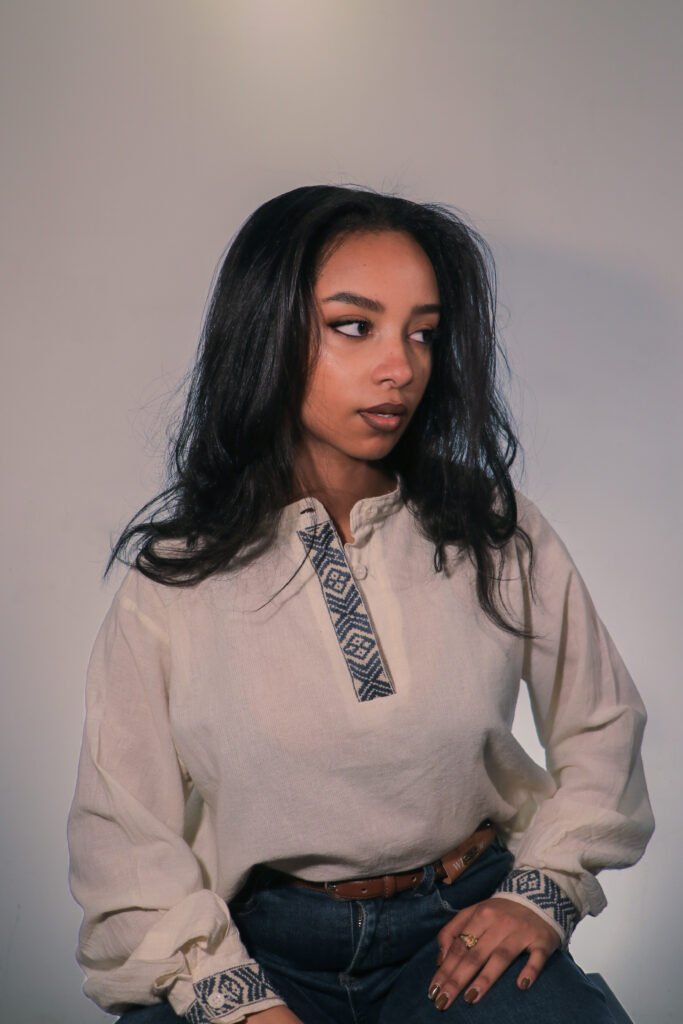
“Hybridity is often treated as dilution,” she explains. “But it is precisely in that in-between space that new Ethiopian expressions can emerge.”
Within this framework, the coffee ceremony feels inevitable. Present in nearly every Ethiopian home and embedded in earliest memory, it is both ordinary and sacred, domestic yet performative.
“The coffee ceremony is not something I discovered,” Rekik reflects. “It’s something I returned to, because it has always shaped how I understand myself.”
In Ethiopia, coffee is never merely a beverage. It is ceremony, community, and a distinctly feminine art form. The woman who prepares it is not simply a host; she is the bearer of quiet authority.
“Through her hands, care becomes agency,” Rekik says. “The ceremony teaches presence, patience, and balance.”
For Rekik, the ritual is inseparable from her most formative memories—her grandmother’s home, where family gathered for holidays and moments of togetherness. Sharing coffee extended the intimacy of sharing a meal. Time slowed. Stories unfolded. Belonging was reaffirmed.
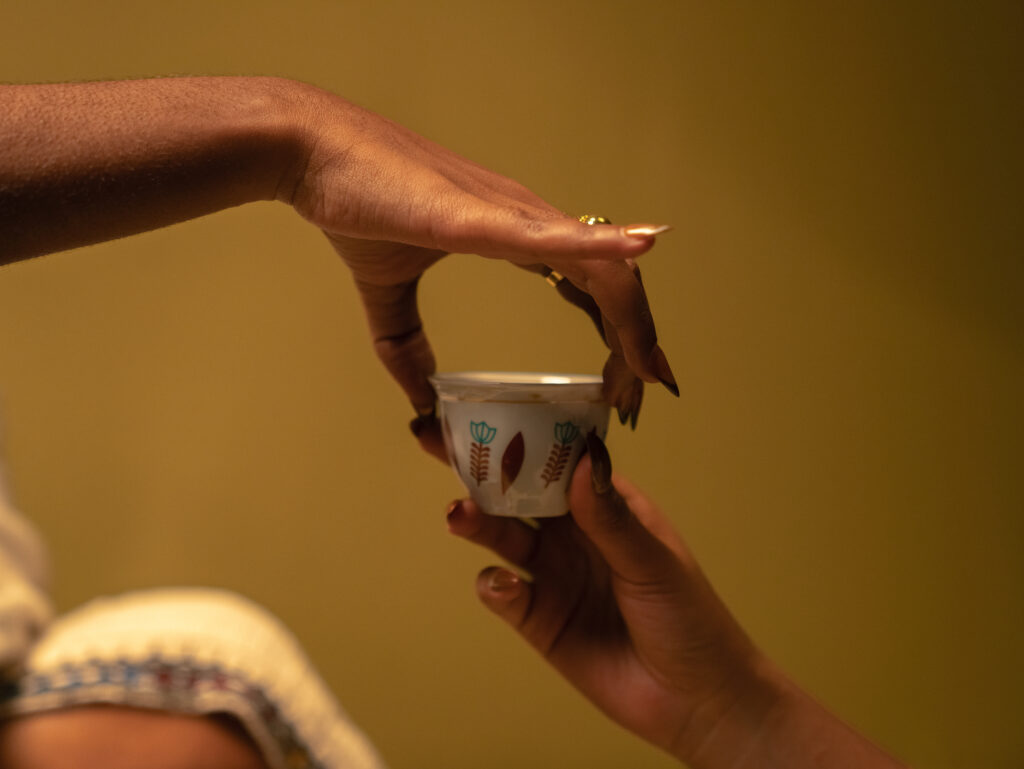 The ceremony’s sensory richness—the aroma of roasting beans, the curl of incense smoke, the deliberate choreography of pouring—invites attentiveness. Tradition is not abstract here; it is felt, practiced, and remembered.
The creative process behind the series mirrors the ritual itself. Objects drawn from the artists’ own homes shape the visual language, grounding the work in what is intimate and familiar.
“Coffee slows time,” Rekik notes. “It teaches balance—between giving and receiving, movement and stillness.”
The Ethiopian woman depicted in the series embodies this equilibrium. She nurtures, but she also indulges. She is both custodian of tradition and participant in modernity.
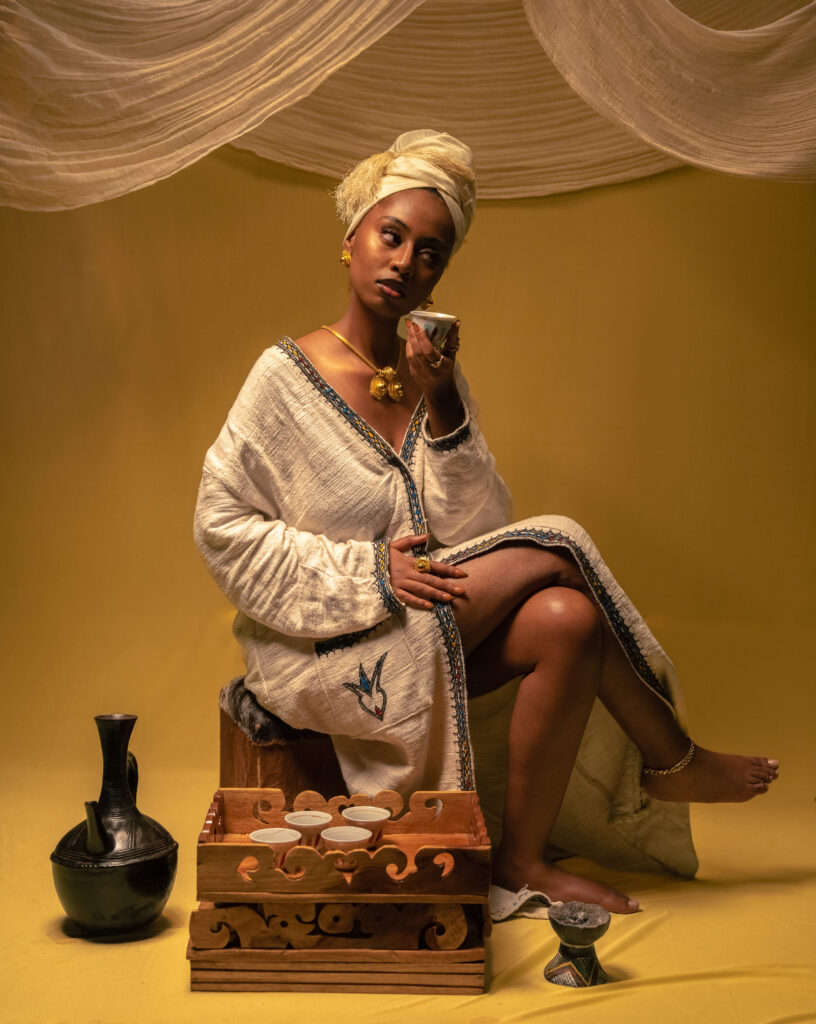 Created by an all-women team, the decision to center femininity was deliberate—not to reframe the ceremony, but to recognize the authority that has always existed within it.
“We didn’t seek to elevate the ceremony,” Rekik adds. “The elevation was always there.”
Visually, the series is rooted in Ethiopian identity. Green, yellow, and red—the colors of the flag—guide the emotional language of the images. Yellow, central to the coffee ceremony, evokes calm, nurture, and quiet warmth. Familiar gestures from Ethiopian art reappear not as nostalgia but as reverence.
At its core, Coffee Ceremony affirms that originality does not come from rejecting the past but from engaging with it.
“There is no exhaustion in this ritual,” Rekik says. “Only new ways of seeing.”
From Kaldi’s goats to the hands of Ethiopian women today, coffee remains what it has always been: a living language of memory, care, and presence—carried forward through ritual, imagination, and continuity.
Credits
Photography & Editing: Rekik Abiy (@negussieaa) Set Design / Styling: Bamlak Kibret (@bambamcreates) Set Design / Writing: Maraki Abiy (@maki__an) Model / Makeup: Sara Ibrahim (@.afro_head)
Best of Culture 2025
Oury Sene