
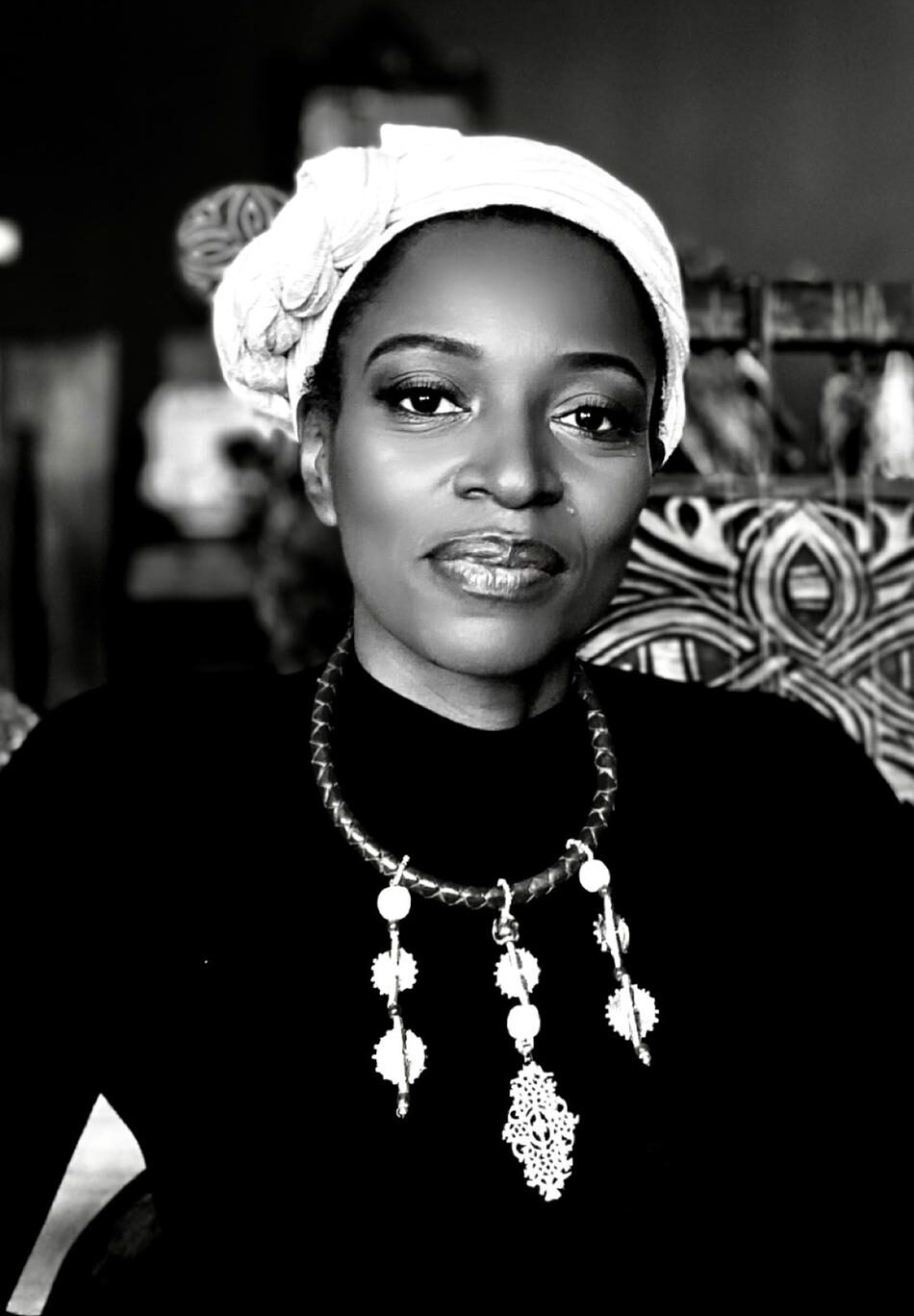
Hortense Mbea moves through the world as if every gesture were a prayer. Every fold of fabric, every hand-stitched seam, every bead threaded with care carries a story—a word, a sentence, a chapter in Africa’s vast and unending book.
Born and raised abroad, the Cameroonian designer returned to the continent in 2002 after university, drawn to Addis Ababa by memory and instinct—by the echo of her father’s diplomatic years and the pull of a city where the past hums softly beneath the present. “I came to Addis because I wanted to start my career here as an interpreter,” she recalls. “My father was posted in Ethiopia, so I used to come on vacation and do internships at the OAU back then.”
Her early career was built in the quiet discipline of words—first as a freelance interpreter, then at the African Development Bank (AfDB). But somewhere between policy documents and conference rooms, something inside her began to shift. “During my time at the AfDB, they launched Fashionomics Africa, and I was very involved,” she says. “I often traveled with the program’s head, Geraldine Fraser-Moleketi, meeting artisans across the continent and seeing firsthand the incredible craftsmanship of Africa. It inspired me deeply.”
Those journeys would become the blueprint for a new chapter—one where she would no longer translate other people’s stories, but tell her own.
In 2017, Hortense took a leap of faith and began creating jewelry. What started as a small garden showcase at her home in Addis Ababa bloomed into something extraordinary. The pieces caught the eye of collectors and curators; soon she was traveling to exhibit them. “I wanted to be a connector,” she says—“to bring the artistry and creativity I’d witnessed across Africa into one space.”
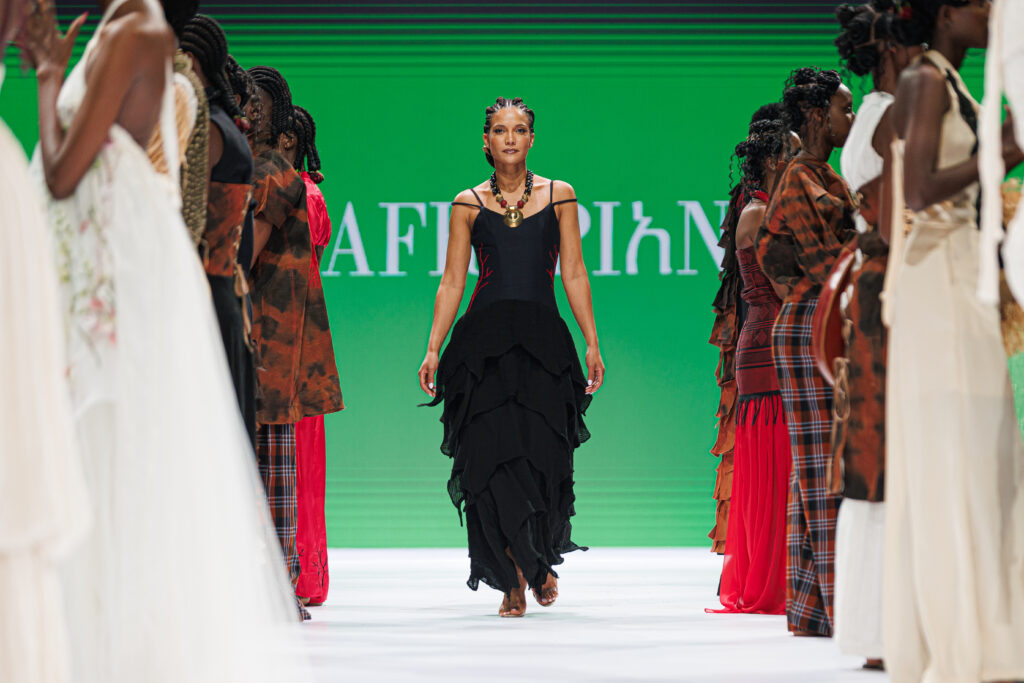
That impulse to connect became her design language. By 2019, she was invited to show her first clothing line at Hub of Africa Fashion Week, pairing her jewelry with garments that told stories of womanhood, love, and belonging. Her debut, I’m Every Woman, was a love letter to strength and joy—its models danced to Beyoncé’s “Brown Skin Girl,” their movements radiant, defiant, free.
Then came Intore, a collection born of Rwanda’s elegance and its dance traditions—a meeting between rhythm and remembrance. Premiered at FIMO (Festival International de la Mode) in Lomé and later shown in Dakar and Kinshasa, it drew audiences to tears.
By 2024, Hortense had turned toward home, toward ancestry. Her collection Bamun: A Royal Wedding was an ode to her half-sister, a Bamoun princess from Cameroon, and to the kingdom’s extraordinary heritage. “Cameroon is a democracy, but we still have kings,” she explains. “One of the most fascinating kingdoms is Bamoun. Their 19th-century Sultan, Njoya, was a true genius—he invented his own alphabet, Shumom, still taught in schools today. He created a calendar for agriculture, wrote books, music, even comics. Their artistry and heritage are extraordinary.”
The runway in Addis became a stage for ceremony. Models moved like characters in an epic—the bride, the groom, the priestess, the guards, the flower children (her own children among them). Traditional Bamoun drumming reverberated through the space as if summoning ancestors. “It was like telling a story without words,” she says softly.
From Addis, Bamun traveled to Costa Rica Fashion Week, where Hortense insisted on diverse casting in a space still dominated by whiteness. The result was electric. “People came up to me saying, ‘My great-grandfather was from Senegal.’ It touched people beyond race—it resonated on a human level.”
Then came Shanghai Fashion Week, where Bamun met the world again—this time through the lenses of global media and the curiosity of a new audience. “I discovered many similarities between African and Chinese textile traditions,” Hortense reflects. “Indigo dyeing, hand-stitching, the use of symbols—it was as if our stories had been traveling toward each other all along.”
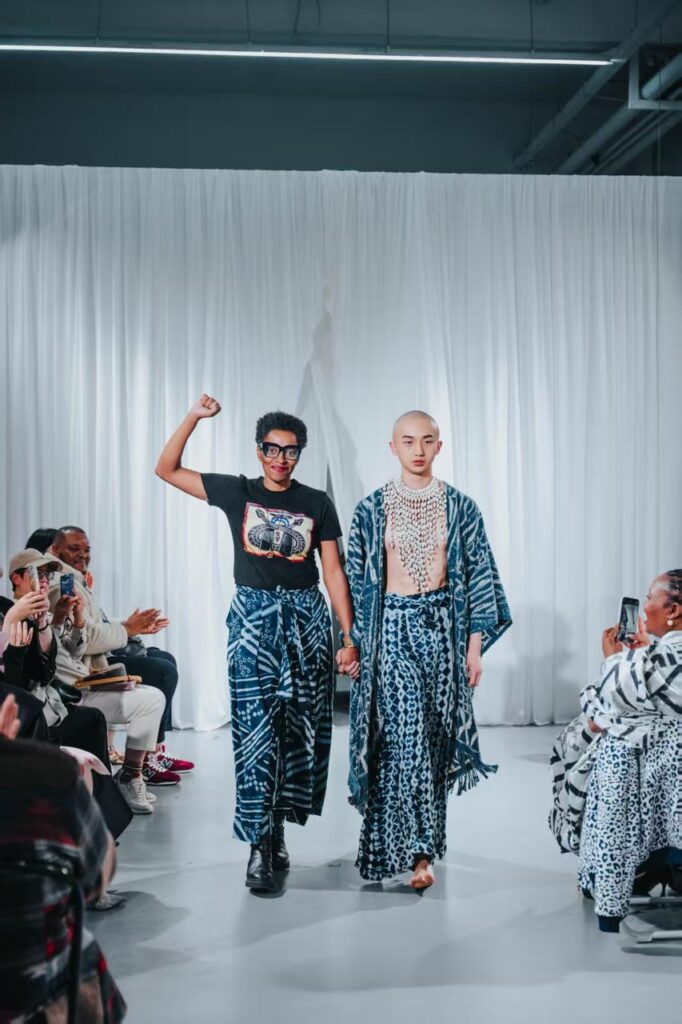
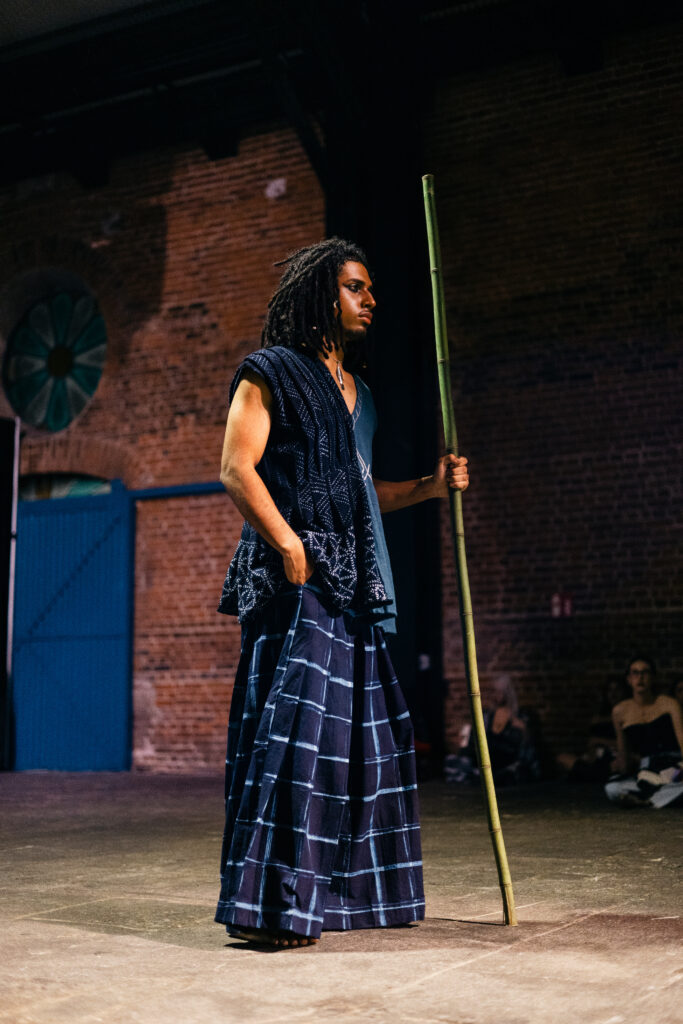
At the heart of Bamun lies Ndop, the sacred royal textile of the Bamoun people—indigo-dyed, handwoven, steeped in meaning. “When you’re born into nobility, they make a personal piece of Ndop for you—you’re wrapped in it at birth, and again when you’re buried. Because of that sacredness, I never sell Ndop pieces; I only use them to tell stories.”
Alongside Ndop, Hortense works with Shemma from Ethiopia, Bogolan from Mali, Baule from Côte d’Ivoire, Mandjak from Senegal—a vocabulary of fabrics that speak in pattern, pigment, and memory.
Her network of artisans spans fifteen African countries—batik makers in Ghana, bogolan dyers in Mali, weavers in Kenya, embroiderers in Ethiopia. “They’ve been with me since 2017—they’re family,” she says. Many are women who once carried firewood or sold crafts by the roadside; now they weave for fashion houses and walk proudly in their own artistry. She works, too, with young people—giving them responsibility, trust, and visibility in an industry too often ruled by gatekeepers.
At her core, Hortense calls herself a keeper of memory. “My collections are chapters in a book,” she says. “Each one tells a story about who we were and who we still are. My mission is to remind us that Africa existed before colonization—that we’ve always had beauty, structure, creativity, and depth.”
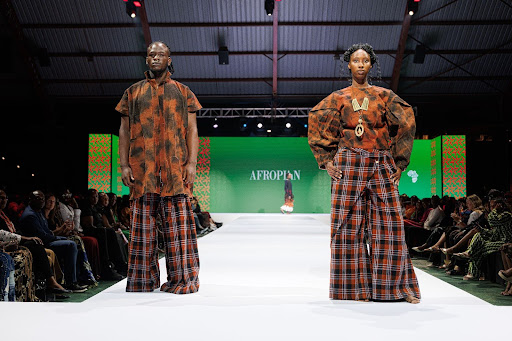
Her most recent collection, Neema, continues this rhythm—inspired by the spirit of the forest, crafted from barkcloth, and debuted at Giants of Africa. It is both an homage to nature and a whisper of renewal.
Her concept store in Addis Ababa is not a boutique but a sanctuary—a creative portal where art, literature, and music converge. Friends drop by to read poetry, to talk, to dream. “There’s even a swing inside,” she smiles. “A reminder to stay playful and connected to your inner child.”
Looking ahead, Hortense envisions new horizons—more fashion films, more exhibitions, and perhaps a book gathering her stories and sketches. If Bamun had a soundtrack, she says, it would begin with the heartbeat of Africa—the drums. For Neema, she collaborates with Ethiopian-French artist Iri Ji, whose voice she describes as “mystical, soulful—she sounds like Mother Africa herself.”
Hortense Mbea designs not for trends, but for memory. Her work is a bridge—between generations, between continents, between what was and what can still be. Every piece she creates beats with the same quiet conviction: that Africa’s past and future are stitched from the same cloth.
She is, in every sense, a fashion griot—telling the continent’s story one garment, one rhythm, one heartbeat at a time.